Utah: Pedestrians Practice Test
Yielding to pedestrians at crosswalks, blind pedestrians, children and school zones, and pedestrian signals.
Independent educational site · not affiliated with any government agency or DMV
Ready? Test yourself
- Instant feedback with an explanation
- Every answer cites its source in the manual
- Your best score is saved on this device
- Keyboard: press 1 to 4 to answer and Enter for the next question
Questions are original and based on the official manual "Utah Driver Handbook" (2026 edition (new 2026 laws effective May 6, 2026)), Utah Department of Public Safety, Driver License Division.
All 27 questions in this practice test
Take the test above first, then use this list to study. Tap “Show answer” to see the correct answer and explanation.
Show the questions and answersHide the questions
-
If your view is blocked at a crosswalk, what do the safe driving tips say to do?
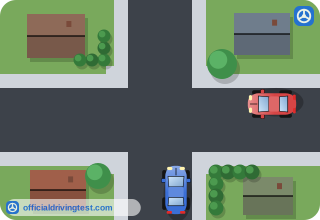
- Move forward carefully and look both ways before entering the intersection
- Wait until the view clears itself, even if it takes several minutes
- Sound your horn, then continue through the intersection
- Speed up so you clear the intersection quickly
Show answer
Correct answer: Move forward carefully and look both ways before entering the intersection
When the view at a crosswalk is blocked, move forward carefully and look both ways before entering the intersection.
Source: Utah Driver Handbook (2026 edition (new 2026 laws effective May 6, 2026)), page 26 · Open this page in the manual (Manual page 26)
-
Where must you stop at a stop sign or signal that has a stop line or crosswalk?
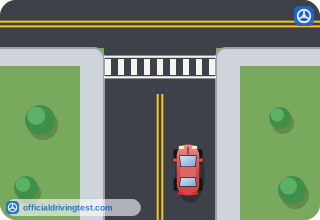
- Behind the stop line or crosswalk
- In the crosswalk, with your front bumper at the line
- Past the crosswalk, at the edge of the intersection
- Beside the stop line, in the next lane
Show answer
Correct answer: Behind the stop line or crosswalk
At a stop sign or signal you must stop behind the stop line or crosswalk.
Source: Utah Driver Handbook (2026 edition (new 2026 laws effective May 6, 2026)), page 44 · Open this page in the manual (Manual page 44)
-
If crosswalks are not marked, where must you stop at a stop sign?
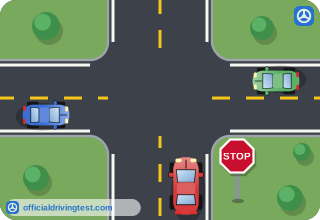
- In the middle of the intersection
- Just beyond the stop sign
- Before the intersection or stop sign
- Beside the sidewalk
Show answer
Correct answer: Before the intersection or stop sign
Without marked crosswalks you must stop before the intersection or stop sign.
Source: Utah Driver Handbook (2026 edition (new 2026 laws effective May 6, 2026)), page 44 · Open this page in the manual (Manual page 44)
-
Must you yield to a pedestrian entering or in a crosswalk that is not marked?
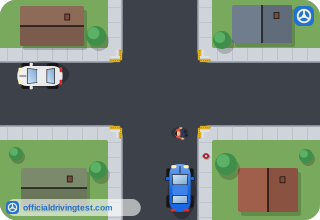
- No, only at marked crosswalks
- Yes, even if it is not marked
- No, only at crosswalks with signals
- Yes, but only on residential streets
Show answer
Correct answer: Yes, even if it is not marked
You must yield to pedestrians entering or in a crosswalk, marked or not.
Source: Utah Driver Handbook (2026 edition (new 2026 laws effective May 6, 2026)), page 44 · Open this page in the manual (Manual page 44)
-
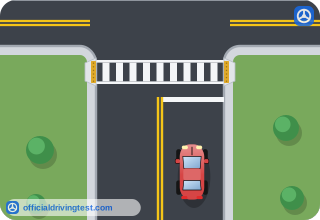
What do crosswalks show?
- Where vehicles may turn around
- Where parking is prohibited
- Where the speed limit changes
- Where pedestrians may cross the road
Show answer
Correct answer: Where pedestrians may cross the road
Crosswalks show where pedestrians may cross the road.
Source: Utah Driver Handbook (2026 edition (new 2026 laws effective May 6, 2026)), page 44 · Open this page in the manual (Manual page 44)
-
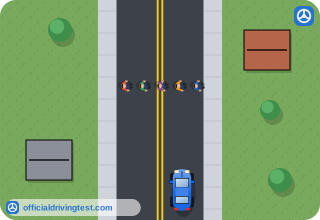
At a minimum, how long must vehicles remain stopped for a pedestrian crossing the road, even if they are not in a crosswalk?
- Until the pedestrian has stepped off the curb into the street
- Until the pedestrian has reached a marked crosswalk
- Until you can no longer see the pedestrian in your mirror
- Until the pedestrian has crossed at least the driver's half of the road
Show answer
Correct answer: Until the pedestrian has crossed at least the driver's half of the road
Vehicles stay stopped until the pedestrian has crossed at least the driver's half of the road, in a marked or unmarked crosswalk or not.
Source: Utah Driver Handbook (2026 edition (new 2026 laws effective May 6, 2026)), page 82 · Open this page in the manual (Manual page 82)
-
What does the handbook say about mid-block crosswalks?
- They are always marked with warning signs and painted lines
- They may not be marked by warning signs and road markings
- They are marked only at traffic lights
- They are always painted with a white bar
Show answer
Correct answer: They may not be marked by warning signs and road markings
Pedestrians can cross at mid-block crosswalks that have no warning signs or road markings, so drivers must stay aware.
Source: Utah Driver Handbook (2026 edition (new 2026 laws effective May 6, 2026)), page 82 · Open this page in the manual (Manual page 82)
-
What must you do when a pedestrian is crossing a street with a guide dog or carrying a white cane?
- Slow down and sound your horn
- Pass behind the pedestrian
- Come to a complete stop
- Proceed if the pedestrian is far from your path
Show answer
Correct answer: Come to a complete stop
A pedestrian with a guide dog or white cane is visually impaired, and the driver must come to a complete stop.
Source: Utah Driver Handbook (2026 edition (new 2026 laws effective May 6, 2026)), page 82 · Open this page in the manual (Manual page 82)
-
The traffic light is green and pedestrians are crossing in your path. What must you do?
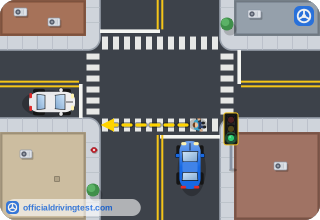
- Yield to the pedestrians
- Proceed because you have the green light
- Sound your horn and continue slowly
- Speed up to clear the crossing
Show answer
Correct answer: Yield to the pedestrians
A green light does not remove the duty to yield: you must yield to pedestrians.
Source: Utah Driver Handbook (2026 edition (new 2026 laws effective May 6, 2026)), page 82 · Open this page in the manual (Manual page 82)
-
When should you watch carefully for pedestrians because they may step out unseen?
- Only when driving on roads that have sidewalks
- When driving next to parked or stopped vehicles
- Only when driving above 45 mph
- Only at stop signs
Show answer
Correct answer: When driving next to parked or stopped vehicles
Parked or stopped vehicles can hide pedestrians, so the handbook says to watch for them when driving beside such vehicles.
Source: Utah Driver Handbook (2026 edition (new 2026 laws effective May 6, 2026)), page 82 · Open this page in the manual (Manual page 82)
-
Where should you slow down because children may be present?
- On freeways
- On rural roads with no houses or schools
- Only when you see a school bus
- Near playgrounds and in residential areas
Show answer
Correct answer: Near playgrounds and in residential areas
Drivers should slow down near playgrounds and in residential areas.
Source: Utah Driver Handbook (2026 edition (new 2026 laws effective May 6, 2026)), page 82 · Open this page in the manual (Manual page 82)
-
Why should you be ready to stop quickly in residential areas?
- Children can run out from between parked vehicles
- Pedestrians always cross at the nearest corner
- Parked cars often pull out suddenly
- Sidewalks are not allowed there
Show answer
Correct answer: Children can run out from between parked vehicles
Children can run out between parked vehicles with little warning.
Source: Utah Driver Handbook (2026 edition (new 2026 laws effective May 6, 2026)), page 82 · Open this page in the manual (Manual page 82)
-
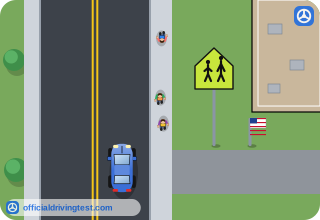
What must you do when the lights are flashing in a school zone?
- Stop until the lights stop flashing
- Drive the normal speed limit
- Obey a slower speed limit
- Pass slow vehicles
Show answer
Correct answer: Obey a slower speed limit
Children are present when school-zone lights flash, and a slower speed limit applies.
Source: Utah Driver Handbook (2026 edition (new 2026 laws effective May 6, 2026)), page 82 · Open this page in the manual (Manual page 82)
-
What must you do at school crossings where there is a traffic patrol?
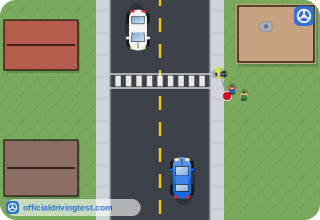
- Slow down and sound your horn
- Pass if no children are in the street
- Stop and yield as signaled
- Follow the car ahead through the crossing
Show answer
Correct answer: Stop and yield as signaled
At school crossings with a traffic patrol you must stop and yield as signaled.
Source: Utah Driver Handbook (2026 edition (new 2026 laws effective May 6, 2026)), page 82 · Open this page in the manual (Manual page 82)
-
What must pedestrians do if there are sidewalks?
- Use them
- Walk beside them in the road
- Use them only at night
- Use them only when carrying a light
Show answer
Correct answer: Use them
The handbook says pedestrians must use sidewalks where they exist.
Source: Utah Driver Handbook (2026 edition (new 2026 laws effective May 6, 2026)), page 82 · Open this page in the manual (Manual page 82)
-
Where should a pedestrian walk or jog if there is no sidewalk but there is a shoulder?
- On the right shoulder, as close to the roadway as possible
- In the right lane
- On the center line
- On the left shoulder, as far from the edge of the roadway as possible
Show answer
Correct answer: On the left shoulder, as far from the edge of the roadway as possible
With no sidewalk, a pedestrian uses the left shoulder, as far from the roadway edge as possible.
Source: Utah Driver Handbook (2026 edition (new 2026 laws effective May 6, 2026)), page 82 · Open this page in the manual (Manual page 82)
-
Where should a pedestrian walk when neither a sidewalk nor a shoulder is available?
- In the center of the lane
- As near as possible to the outside edge of the roadway
- Beside the center line
- On the right side with traffic coming from behind
Show answer
Correct answer: As near as possible to the outside edge of the roadway
If there is neither sidewalk nor shoulder, the pedestrian walks as near as possible to the outside edge of the roadway.
Source: Utah Driver Handbook (2026 edition (new 2026 laws effective May 6, 2026)), page 82 · Open this page in the manual (Manual page 82)
-
Which way should pedestrians walk or jog on a roadway or shoulder?
- Facing traffic on the left side
- With traffic on the right side
- With traffic on the left side
- Facing traffic on the right side
Show answer
Correct answer: Facing traffic on the left side
Pedestrians should always walk or jog facing traffic on the left side of the shoulder or roadway.
Source: Utah Driver Handbook (2026 edition (new 2026 laws effective May 6, 2026)), page 82 · Open this page in the manual (Manual page 82)
-
What do higher speeds lead to for pedestrians and bicyclists?
- Better visibility
- More time to react
- Greater injuries
- Fewer crashes
Show answer
Correct answer: Greater injuries
The handbook says higher speeds lead to greater injuries to pedestrians and bicyclists, so slow down.
Source: Utah Driver Handbook (2026 edition (new 2026 laws effective May 6, 2026)), page 83 · Open this page in the manual (Manual page 83)
-
What should you do when turning or otherwise entering a crosswalk?
- Keep your speed and watch for signals
- Slow down and be prepared to stop
- Sound your horn
- Speed up to clear it
Show answer
Correct answer: Slow down and be prepared to stop
Many pedestrian crashes happen while vehicles are turning, so slow down and be ready to stop at crosswalks.
Source: Utah Driver Handbook (2026 edition (new 2026 laws effective May 6, 2026)), page 83 · Open this page in the manual (Manual page 83)
-
What should you do for pedestrians when making a turn?
- Look once and turn quickly
- Watch only for other vehicles
- Flash your lights
- Take extra care and look twice
Show answer
Correct answer: Take extra care and look twice
Many pedestrian-motor vehicle crashes happen when vehicles are turning, so look twice for pedestrians.
Source: Utah Driver Handbook (2026 edition (new 2026 laws effective May 6, 2026)), page 83 · Open this page in the manual (Manual page 83)
-
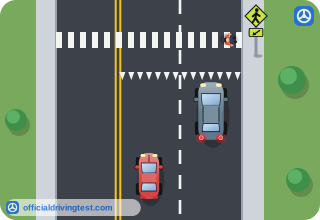
Why should you stop before the crosswalk when yielding to pedestrians?
- So the pedestrians can see your turn signals clearly
- So you can turn without stopping again
- So you avoid blocking the sidewalk
- So other vehicles can see the pedestrians and stop too
Show answer
Correct answer: So other vehicles can see the pedestrians and stop too
Stopping before the crosswalk lets other drivers see the crossing pedestrians so they stop as well.
Source: Utah Driver Handbook (2026 edition (new 2026 laws effective May 6, 2026)), page 83 · Open this page in the manual (Manual page 83)
-
Why should you never pass vehicles stopped at a crosswalk?
- The vehicles may be about to turn
- There may be people crossing that you cannot see
- The crosswalk may be icy
- The road surface is often narrower at crosswalks
Show answer
Correct answer: There may be people crossing that you cannot see
A stopped vehicle may hide people who are crossing, so never pass it at a crosswalk.
Source: Utah Driver Handbook (2026 edition (new 2026 laws effective May 6, 2026)), page 83 · Open this page in the manual (Manual page 83)
-
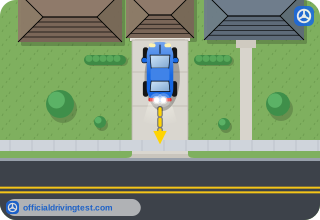
Why should you be extra cautious when backing up?
- Mirrors do not work in reverse
- Other drivers will not yield
- Pedestrians can move into your path
- Your lights do not show behind you
Show answer
Correct answer: Pedestrians can move into your path
Pedestrians can move into your path while you back up, so be extra cautious.
Source: Utah Driver Handbook (2026 edition (new 2026 laws effective May 6, 2026)), page 83 · Open this page in the manual (Manual page 83)
-
What should you never assume around pedestrians?
- The right of way
- That they may move into your path
- That they may be hard to see at night
- That they are children
Show answer
Correct answer: The right of way
The handbook says never to assume the right of way when driving near pedestrians.
Source: Utah Driver Handbook (2026 edition (new 2026 laws effective May 6, 2026)), page 83 · Open this page in the manual (Manual page 83)
-
Where should you cross railroad tracks on foot?
- Only at designated pedestrian or roadway crossings
- Anywhere the track looks unused
- Anywhere there is a clear view in both directions
- At any point where there are no weeds
Show answer
Correct answer: Only at designated pedestrian or roadway crossings
Tracks should be crossed only at designated pedestrian or roadway crossings, obeying all warning signs and signals.
Source: Utah Driver Handbook (2026 edition (new 2026 laws effective May 6, 2026)), page 88 · Open this page in the manual (Manual page 88)
-
How does the handbook describe walking down a train track?
- Legal if no train is in sight
- Legal during the daytime only
- Illegal and dangerous
- Legal on tracks that look unused
Show answer
Correct answer: Illegal and dangerous
Walking down a train track is both illegal and dangerous.
Source: Utah Driver Handbook (2026 edition (new 2026 laws effective May 6, 2026)), page 88 · Open this page in the manual (Manual page 88)