Texas: Traffic signals Practice Test
Red, yellow, and green lights and arrows, and how to use a roundabout.
Independent educational site · not affiliated with any government agency or DMV
Ready? Test yourself
Answer to start, or tap Start below:
When may a driver disregard the instructions of a traffic signal?
- Instant feedback with an explanation
- Every answer cites its source in the manual
- Your best score is saved on this device
- Keyboard: press 1 to 4 to answer and Enter for the next question
Questions are original and based on the official manual "Texas Driver Handbook" (Revised January 2026), Texas Department of Public Safety (DPS).
All 26 questions in this practice test
Take the test above first, then use this list to study. Tap “Show answer” to see the correct answer and explanation.
Show the questions and answersHide the questions
-
What must you do when you approach a steady (solid) red traffic light?
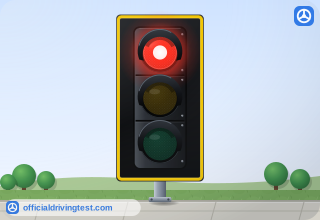
- Stop before entering the crosswalk or intersection
- Slow down and proceed if no cross traffic is visible
- Sound your horn and proceed carefully
- Stop only if pedestrians are present
Show answer
Correct answer: Stop before entering the crosswalk or intersection
A steady red light means you must stop before entering the crosswalk or intersection, and yield to all pedestrians and other traffic lawfully using the intersection.
Source: Texas Driver Handbook (Revised January 2026), page 25
-
After stopping at a steady red light, when is a right turn permitted?
- Right turns are never allowed on a red light
- You may turn right unless prohibited by law
- Only if a police officer waves you through
- Only between 10 p.m. and 6 a.m.
Show answer
Correct answer: You may turn right unless prohibited by law
At a steady red light, you may turn right after stopping unless prohibited by law.
Source: Texas Driver Handbook (Revised January 2026), page 25
-
At a steady red light, when is a left turn allowed?
- A left turn on red is never allowed in Texas
- Anytime there is no oncoming traffic in sight
- Only for buses and emergency vehicles
- If both streets are one-way, unless prohibited by law
Show answer
Correct answer: If both streets are one-way, unless prohibited by law
You may also turn left on a steady red light if both streets are one-way, unless prohibited by law.
Source: Texas Driver Handbook (Revised January 2026), page 25
-
Besides stopping, what else must a driver do at a steady red light before proceeding on a permitted turn?
- Honk to alert nearby pedestrians
- Wait exactly five seconds before moving
- Yield to all pedestrians and other traffic
- Flash the headlights at oncoming traffic
Show answer
Correct answer: Yield to all pedestrians and other traffic
You must yield to all pedestrians and other traffic lawfully using the intersection before proceeding.
Source: Texas Driver Handbook (Revised January 2026), page 25
-
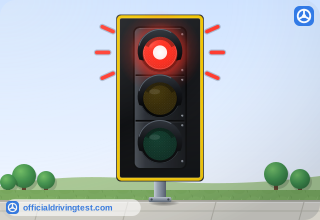
What should a driver do at a flashing red light?
- Slow down, but there is no need to stop
- Stop only if another vehicle is already at the intersection
- Treat it the same as a flashing yellow light
- Stop completely, then proceed when it is safe to do so
Show answer
Correct answer: Stop completely, then proceed when it is safe to do so
A flashing red light means stop completely before entering the crosswalk or intersection, then proceed when you can do so safely.
Source: Texas Driver Handbook (Revised January 2026), page 25
-
At an intersection where you face a flashing red light, why should you still watch carefully before proceeding?
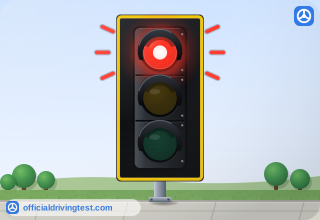
- Vehicles on the intersecting road may not have to stop
- All directions always face a flashing red light at the same time
- Cross traffic must always yield to you
- A flashing red light means the signal is broken and can be ignored
Show answer
Correct answer: Vehicles on the intersecting road may not have to stop
Vehicles on the intersecting road may not have to stop, so you must proceed carefully even after stopping.
Source: Texas Driver Handbook (Revised January 2026), page 25
-
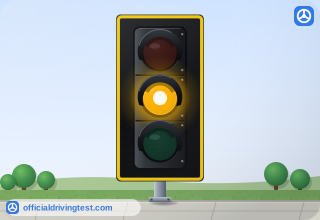
What does a steady yellow light warn drivers to do?
- Speed up to clear the intersection immediately
- Use caution, as the light is about to change to red
- It has no special meaning and can be ignored
- Pedestrians may cross freely
Show answer
Correct answer: Use caution, as the light is about to change to red
A steady yellow light warns drivers to use caution because the light is about to turn red, and to stop before the nearest crosswalk if it can be done safely.
Source: Texas Driver Handbook (Revised January 2026), page 25
-
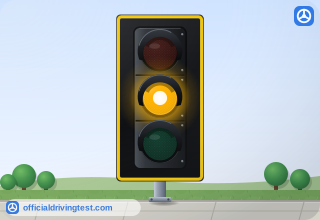
If a light turns yellow and you cannot stop safely, what should you do?
- Pull over immediately
- Go cautiously through the intersection before it turns red
- Slam on the brakes regardless of following traffic
- Reverse back into the previous lane
Show answer
Correct answer: Go cautiously through the intersection before it turns red
If a stop cannot be made safely, you may proceed cautiously through the intersection before the light changes to red.
Source: Texas Driver Handbook (Revised January 2026), page 25
-
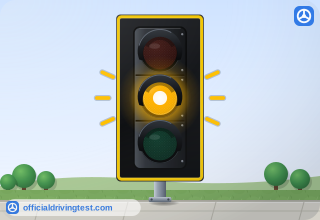
What does a flashing yellow light mean?
- Come to a complete stop as you would at a stop sign
- It has the same meaning as a steady red light
- Slow down and proceed with caution
- Yield only to pedestrians and ignore vehicles
Show answer
Correct answer: Slow down and proceed with caution
A flashing yellow light warns drivers to slow down and proceed with caution.
Source: Texas Driver Handbook (Revised January 2026), page 25
-
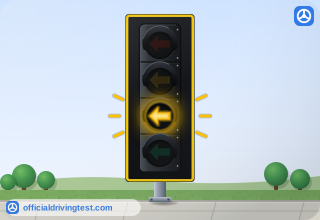
What does a flashing yellow arrow for left turns allow a driver to do?
- Turn left with no need to yield to oncoming traffic
- Turn left, but yield the right-of-way to oncoming traffic
- Turn left only if no other vehicles are on the road
- Left turns are prohibited
Show answer
Correct answer: Turn left, but yield the right-of-way to oncoming traffic
A flashing yellow arrow allows a driver to turn left, but the driver must yield the right-of-way to oncoming traffic.
Source: Texas Driver Handbook (Revised January 2026), page 25
-
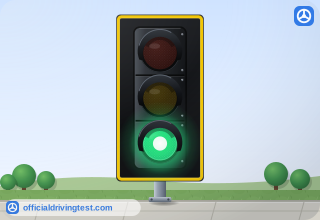
What does a steady green light allow a driver to do?
- Proceed without needing to watch for pedestrians or other traffic
- Stop and wait for a manual signal from an officer
- Speed through the intersection as quickly as possible
- Go straight or turn if safe, unless another sign or signal prohibits it
Show answer
Correct answer: Go straight or turn if safe, unless another sign or signal prohibits it
A steady green light means the driver can proceed straight ahead or turn if it is safe and not prohibited by another sign or signal, while watching for cars and pedestrians.
Source: Texas Driver Handbook (Revised January 2026), page 25
-
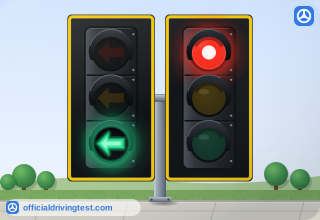
What does a green arrow displayed at the same time as a red light mean?
- The red light overrides the arrow, so you must stop
- It means traffic in all directions has a green light
- Only pedestrians may proceed, so all vehicles must wait
- Go carefully in the arrow's direction after yielding to others
Show answer
Correct answer: Go carefully in the arrow's direction after yielding to others
A green arrow with a red light means the driver can proceed carefully in the direction of the arrow after yielding the right-of-way to other vehicles and pedestrians.
Source: Texas Driver Handbook (Revised January 2026), page 25
-
When turning left on a steady green light, what must a driver do first?
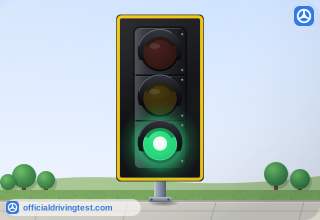
- Proceed immediately since the light is green
- Only yield to pedestrians, not to vehicles
- Yield the right-of-way to all oncoming traffic
- Sound the horn before turning
Show answer
Correct answer: Yield the right-of-way to all oncoming traffic
You can turn left on a green light, but you must yield the right-of-way to all traffic approaching from the opposite direction before turning.
Source: Texas Driver Handbook (Revised January 2026), page 25
-
When may a driver disregard the instructions of a traffic signal?
- Whenever traffic is light
- During any emergency the driver personally declares
- When a law enforcement officer is directing traffic
- Traffic signals must always be obeyed and can never be overridden
Show answer
Correct answer: When a law enforcement officer is directing traffic
Drivers must obey traffic signals except when a law enforcement officer is directing traffic; you must obey the officer at all times, even if told to do something ordinarily against the law.
Source: Texas Driver Handbook (Revised January 2026), page 25
-
A modern roundabout is best described as:
- A one-way, circular intersection where traffic flows counterclockwise
- A two-way intersection controlled entirely by traffic signals
- A straight four-way stop with no circular movement
- A one-way, circular intersection where traffic flows clockwise
Show answer
Correct answer: A one-way, circular intersection where traffic flows counterclockwise
A modern roundabout is a one-way, circular intersection where traffic flows counterclockwise around a center island.
Source: Texas Driver Handbook (Revised January 2026), page 49
-
Modern roundabouts control entering traffic using:
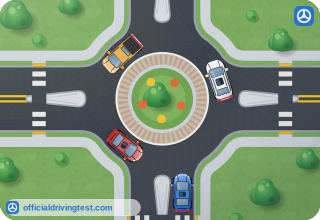
- Yield signs rather than traffic lights
- Traffic lights only
- Stop signs at every entry point
- A police officer directing traffic at all times
Show answer
Correct answer: Yield signs rather than traffic lights
Modern roundabouts use yield signs rather than traffic lights to control vehicles entering the intersection.
Source: Texas Driver Handbook (Revised January 2026), page 49
-
Compared to a traditional four-way signalized intersection with 32 potential conflict points, a modern roundabout has:
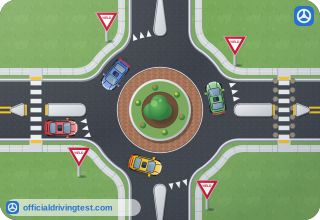
- Sixty-four potential conflict points
- The exact same 32 conflict points
- No conflict points at all
- Only eight potential conflict points
Show answer
Correct answer: Only eight potential conflict points
A modern roundabout has only eight potential conflict points, compared to 32 in a traditional four-way signalized intersection.
Source: Texas Driver Handbook (Revised January 2026), page 49
-
The correct steps for driving through a modern roundabout are to:
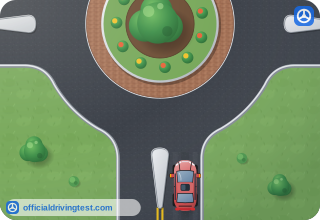
- Slow down, yield to traffic in the circle, go counterclockwise, turn right to exit
- Speed up, merge ahead of circulating traffic, and exit with a left turn
- Stop completely at the entry regardless of gaps in traffic
- Enter without yielding, travel clockwise around the island, then exit
Show answer
Correct answer: Slow down, yield to traffic in the circle, go counterclockwise, turn right to exit
To drive in a modern roundabout: slow down as you approach, yield to traffic already in the circle, enter and follow the loop counterclockwise, then make a right turn to exit.
Source: Texas Driver Handbook (Revised January 2026), page 50
-
When exiting a roundabout, you should:
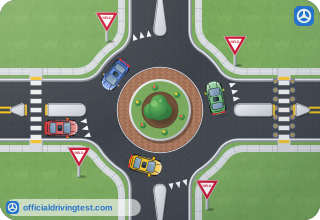
- Make a right turn, using your turn signal
- Come to a complete stop in the circle first
- Speed up sharply as you leave the circle
- Signal a left turn
Show answer
Correct answer: Make a right turn, using your turn signal
Make a right turn by using your turn signal when exiting the circle.
Source: Texas Driver Handbook (Revised January 2026), page 50
-
When approaching a multi-lane roundabout, you should choose the correct entry lane by observing the:
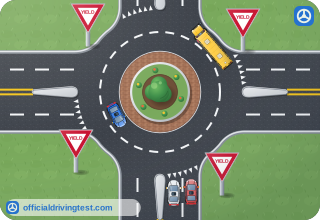
- Color of the center island
- Speed of the vehicle ahead of you
- Position of nearby pedestrians
- Advance lane movement sign
Show answer
Correct answer: Advance lane movement sign
When approaching a multi-lane roundabout, observe the advance lane movement sign for choosing the correct entry lane, and do not change lanes while driving in the circle.
Source: Texas Driver Handbook (Revised January 2026), page 50
-
While driving inside the circle of a multi-lane roundabout, you should:
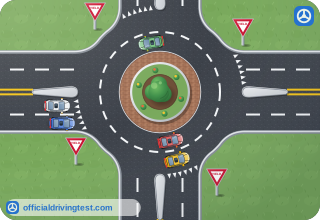
- Straddle both lanes for better visibility
- Stop in the circle to let pedestrians cross
- Not change lanes
- Change lanes freely to pass slower vehicles
Show answer
Correct answer: Not change lanes
Do not change lanes while driving in the circle of a multi-lane roundabout.
Source: Texas Driver Handbook (Revised January 2026), page 50
-
If an emergency vehicle approaches while you are already driving inside a roundabout circle, you should:
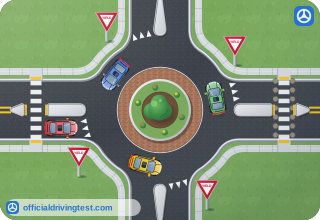
- Clear the circle first, then pull over
- Stop immediately inside the circle
- Reverse out of the circle
- Speed up to exit before the emergency vehicle enters
Show answer
Correct answer: Clear the circle first, then pull over
Pull over for emergency vehicles on the roundabout approaches and exits, but do not stop for emergency vehicles in the roundabout circle; clear the circle first and then pull over.
Source: Texas Driver Handbook (Revised January 2026), page 50
-
When navigating any roundabout and a semitrailer, bus, or fire truck needs more than one lane to get around the circle, you should:
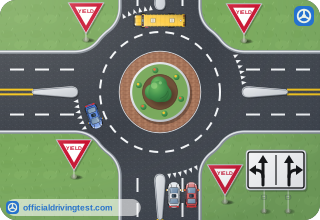
- Give it space
- Pass it quickly on the inside
- Honk to make it move faster
- Stop directly behind it inside the circle
Show answer
Correct answer: Give it space
When navigating all roundabouts, give space for large vehicles, such as semitrailers, buses, and fire trucks, that need more than one lane when driving around the circle.
Source: Texas Driver Handbook (Revised January 2026), page 50
-
How should you react when a traffic officer directs you to do something that would ordinarily be against traffic law?
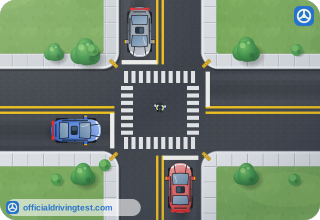
- Obey the officer, whose directions override traffic signals
- Ignore the officer and follow the posted signs
- Stop your car and refuse to move
- Only follow the officer if you agree with the instruction
Show answer
Correct answer: Obey the officer, whose directions override traffic signals
Drivers must obey traffic signals except when a law enforcement officer is directing traffic. You must obey the officer at all times, even if told to do something that is ordinarily against the law.
Source: Texas Driver Handbook (Revised January 2026), page 25
-
What does a green arrow showing along with a red light mean?
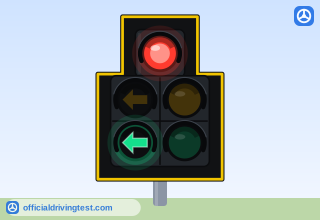
- You must come to a complete stop and wait, because the red light overrides the arrow
- You may drive straight through or turn in any direction without yielding to anyone
- The intersection is closed for construction and you must take another route
- You may proceed carefully in the arrow's direction after yielding to other vehicles and pedestrians
Show answer
Correct answer: You may proceed carefully in the arrow's direction after yielding to other vehicles and pedestrians
A green arrow shown with a red light means you may proceed carefully in the direction of the arrow after yielding the right-of-way to other vehicles and pedestrians.
Source: Texas Driver Handbook (Revised January 2026), page 25
-
How should you react to a flashing red light?
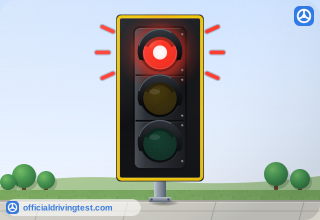
- Come to a complete stop, then proceed when safe
- Treat it like a yield sign and slow down without stopping
- Ignore it since it is malfunctioning
- Speed up to clear the intersection quickly
Show answer
Correct answer: Come to a complete stop, then proceed when safe
At a flashing red light, stop completely before entering the crosswalk or intersection, then proceed when you can do so safely.
Source: Texas Driver Handbook (Revised January 2026), page 25