Texas: Right-of-way & turning Practice Test
Who goes first at intersections, and the rules for turning safely.
Independent educational site · not affiliated with any government agency or DMV
Ready? Test yourself
Answer to start, or tap Start below:
If a driver fails to yield the right-of-way and that failure causes bodily injury to another person, what fine can Texas impose?
- Instant feedback with an explanation
- Every answer cites its source in the manual
- Your best score is saved on this device
- Keyboard: press 1 to 4 to answer and Enter for the next question
Questions are original and based on the official manual "Texas Driver Handbook" (Revised January 2026), Texas Department of Public Safety (DPS).
All 31 questions in this practice test
Take the test above first, then use this list to study. Tap “Show answer” to see the correct answer and explanation.
Show the questions and answersHide the questions
-
If a driver fails to yield the right-of-way and that failure causes bodily injury to another person, what fine can Texas impose?
- A fine of $1,000 to $4,000
- No fine, only a written warning
- A fine of $500 to $2,000
- A fine of $50 to $200
Show answer
Correct answer: A fine of $500 to $2,000
A driver who commits a traffic offense involving failure to yield and causes bodily injury faces a fine of $500 to $2,000; causing serious bodily injury raises the fine to $1,000-$4,000.
Source: Texas Driver Handbook (Revised January 2026), page 20
-
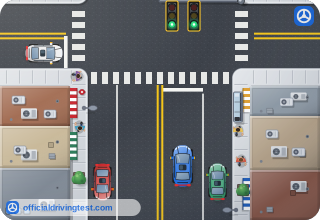
At an intersection controlled by signs and signals, what must you do?
- Ignore them if no other traffic is present
- Yield only to vehicles on your right
- Proceed based on which vehicle arrived first, regardless of signals
- Obey the signs and signals
Show answer
Correct answer: Obey the signs and signals
When signs and signals control traffic at an intersection, you must obey them. Know the meaning of each sign and signal.
Source: Texas Driver Handbook (Revised January 2026), page 20
-
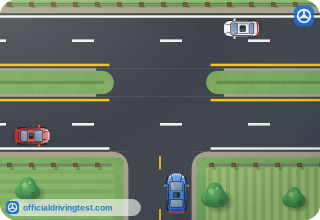
You are driving on a single-lane road that intersects with a divided road that has three or more lanes. Who has the right-of-way?
- You, because you are already moving
- Whichever vehicle is larger
- Whoever sounds the horn first
- Vehicles on the divided road
Show answer
Correct answer: Vehicles on the divided road
If you drive on a single or two-lane road that intersects a divided road or one with three or more lanes, you must yield to vehicles on that larger road.
Source: Texas Driver Handbook (Revised January 2026), page 20
-
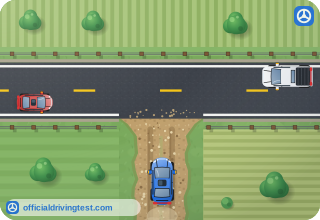
An unpaved road intersects a paved road. Who must yield the right-of-way?
- Neither driver needs to yield
- Whoever is driving a larger vehicle
- The driver on the unpaved road
- The driver on the paved road
Show answer
Correct answer: The driver on the unpaved road
If you are driving on an unpaved road that intersects a paved road, you must yield the right-of-way to vehicles traveling on the paved road.
Source: Texas Driver Handbook (Revised January 2026), page 20
-
At an intersection with no signs, signals, multiple lanes, or paving differences, when should you yield?
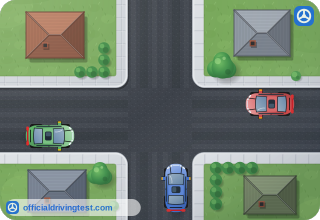
- To any vehicle already in or approaching from your right
- To any vehicle approaching from your left only
- To no one, since it is an uncontrolled intersection
- Only to pedestrians, never to vehicles
Show answer
Correct answer: To any vehicle already in or approaching from your right
At this type of intersection, yield to any vehicle that has entered or is approaching on your right. You may proceed if the road to your right is clear, but still watch for vehicles from the left and confirm other drivers actually yield.
Source: Texas Driver Handbook (Revised January 2026), page 20
-
When turning left at an intersection, you must always yield the right-of-way to:
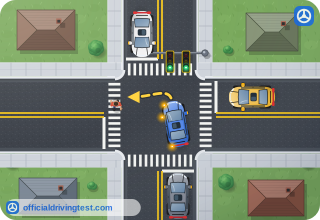
- No one, because left turns always have the right-of-way
- Only vehicles behind you
- Any vehicle coming straight through from the opposite direction
- Vehicles turning right from the same direction as you
Show answer
Correct answer: Any vehicle coming straight through from the opposite direction
When turning left, always yield the right-of-way to any vehicle coming straight through the intersection from the other direction.
Source: Texas Driver Handbook (Revised January 2026), page 20
-
Before entering a street from a private driveway, alley, or building, you must:
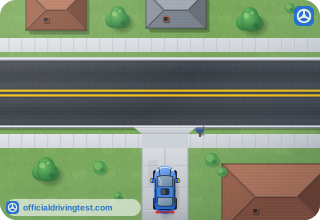
- Stop before the sidewalk and yield to vehicles and pedestrians
- Sound your horn and proceed immediately
- Yield only if a pedestrian is already in the roadway
- Proceed at normal speed, since you have the right-of-way
Show answer
Correct answer: Stop before the sidewalk and yield to vehicles and pedestrians
When entering or crossing a road from a private road, alley, building, or driveway, you must stop prior to the sidewalk and yield the right-of-way to all approaching vehicles and pedestrians.
Source: Texas Driver Handbook (Revised January 2026), page 20
-
You are on a street that ends at a T-intersection with a through street. What must you do?
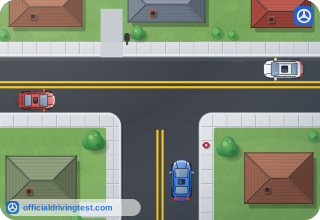
- Stop and yield to vehicles on the through street
- Proceed without stopping since your street ends there
- Only yield if a stop sign is posted
- Sound your horn and merge into traffic
Show answer
Correct answer: Stop and yield to vehicles on the through street
When approaching a T-intersection from a street that ends there, you must stop and yield the right-of-way to vehicles on the through street.
Source: Texas Driver Handbook (Revised January 2026), page 20
-
You are driving on a frontage road of a controlled-access highway. Who must you yield to?
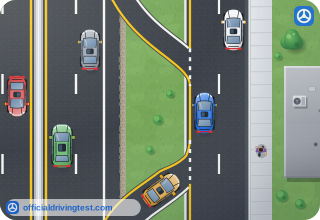
- Vehicles entering or leaving the frontage road to or from the highway
- Only vehicles already on the frontage road ahead of you
- No one, since frontage road drivers always have the right-of-way
- Only pedestrians crossing the frontage road
Show answer
Correct answer: Vehicles entering or leaving the frontage road to or from the highway
A driver on a frontage road of a controlled-access highway must yield to a vehicle entering or about to enter the frontage road from the highway, and to one leaving or about to leave the frontage road to enter the highway.
Source: Texas Driver Handbook (Revised January 2026), page 21
-
On a road divided into three or more lanes moving the same direction, a vehicle entering a lane from the right must yield to:
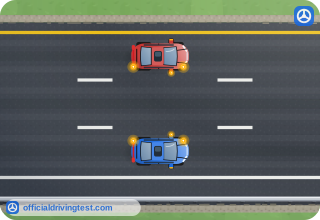
- Only vehicles with their turn signal off
- A vehicle entering the same lane of traffic from the left
- A vehicle already two lanes away
- No one, since the right lane always has priority
Show answer
Correct answer: A vehicle entering the same lane of traffic from the left
On a road with three or more lanes moving the same direction, a vehicle entering a lane from the right must yield to a vehicle entering that same lane from the left.
Source: Texas Driver Handbook (Revised January 2026), page 21
-
According to the seven steps for making a safe turn, when should you decide to make the turn?
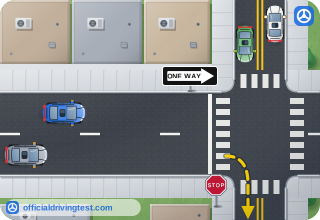
- As late as possible to keep your options open
- Before you get to the turning point
- Exactly when you arrive at the intersection
- Only after another driver signals you to turn
Show answer
Correct answer: Before you get to the turning point
The first of the seven steps is to decide before you get to the turning point; a last-minute turn is dangerous.
Source: Texas Driver Handbook (Revised January 2026), page 39
-
Before changing lanes to prepare for a turn, what should you do first?
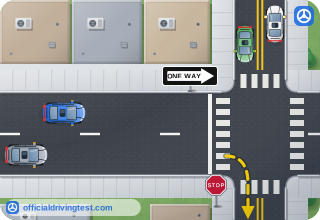
- Speed up to clear the intersection faster
- Close your eyes briefly to focus
- Look behind and to both sides for other vehicles
- Immediately turn on your hazard lights
Show answer
Correct answer: Look behind and to both sides for other vehicles
Look behind and to both sides to see where other vehicles are before you change lanes.
Source: Texas Driver Handbook (Revised January 2026), page 39
-
If you cannot get into the proper lane within one-half block before turning, what should you do?
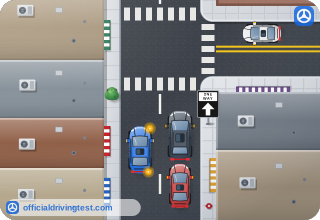
- Cut across the other lanes quickly
- Do not turn, and continue straight ahead
- Turn anyway from whatever lane you are in
- Stop in the intersection and wait
Show answer
Correct answer: Do not turn, and continue straight ahead
Move into the proper lane as soon as possible; if you cannot get into the proper lane within one-half block before turning, do not turn and continue straight ahead.
Source: Texas Driver Handbook (Revised January 2026), page 39
-
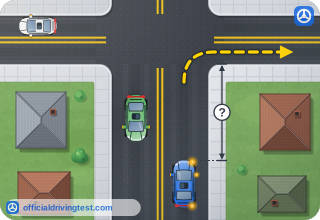
How far before you turn should you give the proper turn signal, and if using a hand signal, when should you stop holding it?
- At least 10 feet before the turn, and you may keep your hand out during the whole turn
- At least a mile before the turn, with no need to stop signaling
- There is no set distance, signal whenever convenient
- At least 100 feet before the turn, and stop holding it before turning, since you need both hands
Show answer
Correct answer: At least 100 feet before the turn, and stop holding it before turning, since you need both hands
Give the proper turn signal at least 100 feet before you turn. If using a hand signal, hold it until close to the intersection, but do not hold it while making the turn since you need both hands on the wheel.
Source: Texas Driver Handbook (Revised January 2026), page 40
-
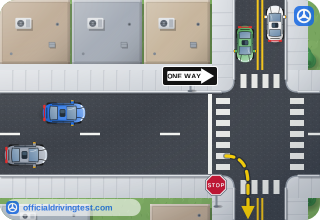
According to the seven steps for making a safe turn, what should you avoid using while turning, and where should you stay and finish the turn?
- Avoid looking at the road, and finish in any lane
- Avoid slowing down, and speed through the turn
- Avoid using the brake or clutch, and stay in and finish in the proper lane
- Avoid using your turn signal, and drift into whichever lane is open
Show answer
Correct answer: Avoid using the brake or clutch, and stay in and finish in the proper lane
Slow down to a reasonable turning speed and don't use the brake or clutch while turning; stay in the proper turn lane at all times and finish the turn in the proper lane.
Source: Texas Driver Handbook (Revised January 2026), page 40
-
When making a right turn, where should you position your vehicle well ahead of the turning point?
- Move your vehicle to the far right lane
- Move your vehicle to the center lane
- Move your vehicle to the far left lane
- Stay in whatever lane you happen to be in
Show answer
Correct answer: Move your vehicle to the far right lane
To make a right turn, signal for a lane change well ahead of the turning point and, when safe, move your vehicle to the far right lane.
Source: Texas Driver Handbook (Revised January 2026), page 40
-
When making a right turn, how far from the corner should you use your turn signal and slow down?
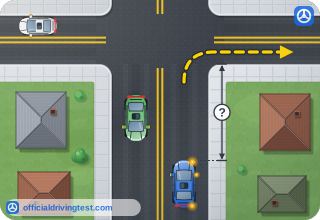
- At least 100 feet from the corner
- At least 10 feet from the corner
- At least half a mile from the corner
- Only after you have already begun turning
Show answer
Correct answer: At least 100 feet from the corner
Use your right turn signal and slow down at least 100 feet from the corner.
Source: Texas Driver Handbook (Revised January 2026), page 40
-
Before starting a right turn, what should you do, and where should you keep your vehicle while turning?
- Look both ways, and keep as close as possible to the right edge
- Look only to the right, and drift toward the center line
- Look only in the rearview mirror, and stay in the leftmost lane
- There is no need to look; just follow the car ahead
Show answer
Correct answer: Look both ways, and keep as close as possible to the right edge
Look both ways before starting to turn, and keep as close as possible to the right edge of the road.
Source: Texas Driver Handbook (Revised January 2026), page 40
-
When making a left turn, where should you move well ahead of the turning point?
- Onto the paved shoulder
- Into a bicycle lane
- Into the center lane
- Into the far right lane
Show answer
Correct answer: Into the center lane
Well ahead of the turning point, signal for a lane change and, when safe, move into the center lane.
Source: Texas Driver Handbook (Revised January 2026), page 40
-
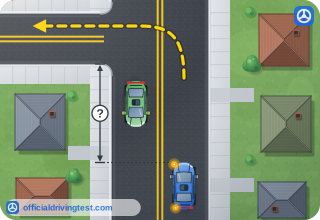
When making a left turn, how far from the corner should you use your turn signal and slow down?
- At least 20 feet from the corner
- At least 300 feet from the corner
- Only right as you enter the intersection
- At least 100 feet from the corner
Show answer
Correct answer: At least 100 feet from the corner
Use the left turn signal and slow down at least 100 feet from the corner.
Source: Texas Driver Handbook (Revised January 2026), page 40
-
As you enter the intersection to make a left turn, where should you stay relative to the center line, and to whom must you yield?
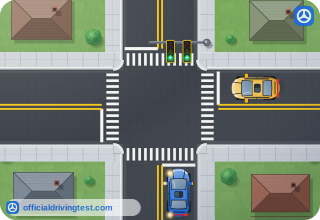
- Stay to the right of the center line, and yield to any vehicle coming from the opposite direction
- Stay to the left of the center line, and yield to no one since you have already signaled
- Straddle the center line, and yield only to pedestrians
- Position does not matter, and no one has to yield during a left turn
Show answer
Correct answer: Stay to the right of the center line, and yield to any vehicle coming from the opposite direction
Stay to the right of the center line as you enter the intersection, and yield the right-of-way to any vehicle approaching from the opposite direction.
Source: Texas Driver Handbook (Revised January 2026), page 40
-
To complete a left turn correctly, you should turn into the road you are entering how?
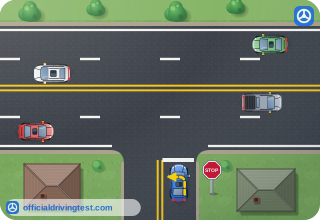
- To the right of its center line, in the lane where you least interfere with traffic
- To the left of its center line, entering whichever lane is closest to you
- Into the farthest lane available, regardless of other traffic
- Onto the shoulder of the new road
Show answer
Correct answer: To the right of its center line, in the lane where you least interfere with traffic
To complete a left turn you should turn to the right of the center line of the road into which you are turning, entering the lane in which you will interfere the least with other traffic.
Source: Texas Driver Handbook (Revised January 2026), page 40
-
Once you have completed your left turn, when may you change lanes?
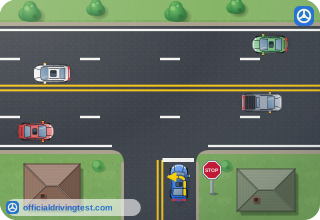
- You may signal and change lanes if necessary
- You may never change lanes right after a left turn
- Only if another driver waves you over
- Immediately, without signaling or checking mirrors
Show answer
Correct answer: You may signal and change lanes if necessary
Once you have completed your left turn, you may signal and change lanes if necessary.
Source: Texas Driver Handbook (Revised January 2026), page 40
-
If you are turning left from a one-way street onto a two-way street, from which lane should you turn, and into which lane should you enter?
- Turn from the right lane into the left lane, moving in the same direction
- It does not matter which lanes you use
- You must always enter the center turn lane
- Turn from the left lane into the right lane, moving in the same direction
Show answer
Correct answer: Turn from the left lane into the right lane, moving in the same direction
If you are turning left from a one-way street onto a two-way street, you should turn from the left lane into the right lane, moving in the same direction.
Source: Texas Driver Handbook (Revised January 2026), page 40
-
If you are turning left from a two-way street onto a one-way street, which lane should you enter?
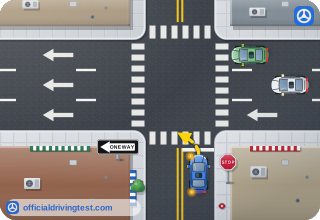
- Whichever lane is closest to your original lane
- The lane where you interfere least with other traffic
- Always the leftmost lane, regardless of traffic
- Always the rightmost lane, regardless of traffic
Show answer
Correct answer: The lane where you interfere least with other traffic
If you are turning left onto a one-way street, enter the street in the lane in which you will interfere the least with other traffic.
Source: Texas Driver Handbook (Revised January 2026), page 41
-
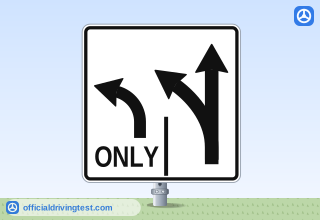
Besides signs, what else should you watch for that may permit turning right or left from two or more traffic lanes?
- Only the time of day
- Nothing else needs to be observed
- Pavement markings
- Only the color of nearby vehicles
Show answer
Correct answer: Pavement markings
Watch for pavement markings and signs that permit turning right or left from or into two or more traffic lanes, or that give other special turning or lane information.
Source: Texas Driver Handbook (Revised January 2026), page 41
-
What does "Yield Right-of-Way" mean?
- Allowing other traffic or pedestrians to go first
- Driving as fast as possible to clear the intersection
- Always having the right to go first
- Turning off your headlights
Show answer
Correct answer: Allowing other traffic or pedestrians to go first
To yield the right-of-way means giving up your turn to proceed and letting other vehicles or pedestrians go first when required.
Source: Texas Driver Handbook (Revised January 2026), page 76
-
If you discover you are in the wrong lane to make a turn as you enter an intersection, what should you do?
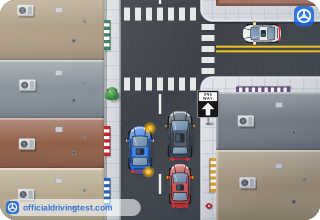
- Do not turn; continue straight ahead
- Swerve quickly across the other lanes to get into position
- Stop in the middle of the intersection until traffic clears
- Reverse back out of the intersection
Show answer
Correct answer: Do not turn; continue straight ahead
The handbook says that if you cannot get into the proper lane within one-half block before turning, do not turn, and continue straight ahead.
Source: Texas Driver Handbook (Revised January 2026), page 39
-
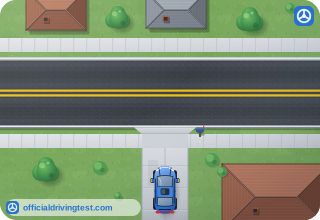
What should you do when coming onto a street from a private alley or driveway?
- Proceed without stopping since you have the right-of-way
- Honk your horn and proceed immediately
- Only slow down; stopping is optional
- Stop and yield to all approaching vehicles and pedestrians
Show answer
Correct answer: Stop and yield to all approaching vehicles and pedestrians
A driver entering a roadway from a private alley or driveway must stop and yield to pedestrians and vehicles already on the road.
Source: Texas Driver Handbook (Revised January 2026), page 20
-
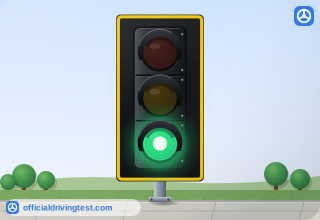
When a driver is waiting to make a left turn at a light without a protected arrow, what should he do when the light turns green?
- Turn immediately regardless of oncoming traffic
- Wait for the light to turn red again before turning
- Honk and proceed without checking traffic
- Yield to oncoming traffic and pedestrians, then turn
Show answer
Correct answer: Yield to oncoming traffic and pedestrians, then turn
On a green light without a protected turn arrow, a left-turning driver must yield to oncoming traffic and pedestrians before completing the turn.
Source: Texas Driver Handbook (Revised January 2026), page 25
-
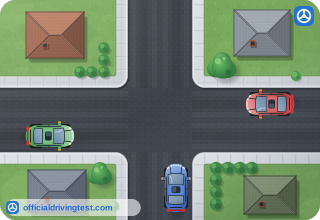
What precautions should a driver take at uncontrolled intersections (no signs or signals)?
- Honk continuously while crossing
- Close your eyes and proceed quickly
- Yield to vehicles on your right and check for traffic from the left
- Maintain full speed since you always have the right-of-way
Show answer
Correct answer: Yield to vehicles on your right and check for traffic from the left
At an intersection not controlled by signs or signals, yield the right-of-way to any vehicle that has entered or is approaching the intersection on your right, and make sure there are no approaching vehicles from the left.
Source: Texas Driver Handbook (Revised January 2026), page 20