Texas: Railroad & light rail crossings Practice Test
Safety rules for crossing train tracks and sharing the road with light rail.
Independent educational site · not affiliated with any government agency or DMV
Ready? Test yourself
Answer to start, or tap Start below:
Which situation requires you to stop at a railroad grade crossing?
- Instant feedback with an explanation
- Every answer cites its source in the manual
- Your best score is saved on this device
- Keyboard: press 1 to 4 to answer and Enter for the next question
Questions are original and based on the official manual "Texas Driver Handbook" (Revised January 2026), Texas Department of Public Safety (DPS).
All 27 questions in this practice test
Take the test above first, then use this list to study. Tap “Show answer” to see the correct answer and explanation.
Show the questions and answersHide the questions
-
When required to stop at a railroad grade crossing, how far from the nearest rail should you stop?
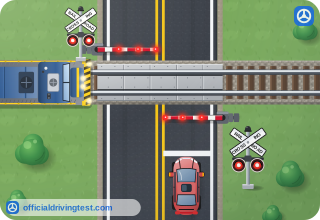
- Between 5 and 10 feet from the nearest rail
- Between 15 and 50 feet from the nearest rail
- Right at the rail, as close as possible
- At least 200 feet from the nearest rail
Show answer
Correct answer: Between 15 and 50 feet from the nearest rail
When approaching a railroad grade crossing under conditions requiring a stop, you must stop between 15 and 50 feet from the nearest rail.
Source: Texas Driver Handbook (Revised January 2026), page 21
-
Which situation requires you to stop at a railroad grade crossing?
- A crossing gate is lowered or a flag person warns of a train
- The crossing has no markings of any kind
- You are more than a mile from the crossing
- There is a stop sign at a nearby unrelated intersection
Show answer
Correct answer: A crossing gate is lowered or a flag person warns of a train
You must stop at a railroad crossing if a crossing gate is lowered or a flag person warns of an approaching train, among other listed conditions.
Source: Texas Driver Handbook (Revised January 2026), page 21
-
An approaching train is within about 1,500 feet of a crossing and produces an audible signal. What must you do?
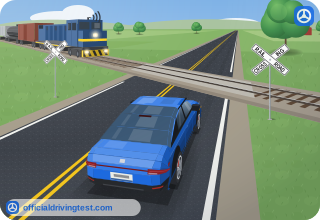
- Stop between 15 and 50 feet from the nearest rail
- Speed up to cross before the train arrives
- Honk your horn and proceed
- Only slow down slightly, since 1,500 feet is far away
Show answer
Correct answer: Stop between 15 and 50 feet from the nearest rail
If an approaching train is within about 1,500 feet of the crossing and sounding an audible signal identifying the immediate hazard, you must stop between 15 and 50 feet from the nearest rail.
Source: Texas Driver Handbook (Revised January 2026), page 21
-
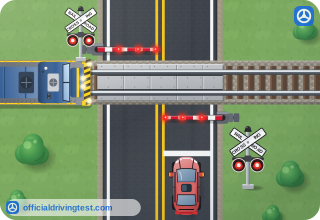
Once you have stopped at a railroad grade crossing, how long must you remain stopped?
- You may proceed immediately after stopping once
- Until allowed to proceed or it is safe to proceed
- For exactly 10 seconds, then proceed regardless
- Until another vehicle behind you honks
Show answer
Correct answer: Until allowed to proceed or it is safe to proceed
You are required to stop at a railroad grade crossing and remain stopped until allowed to proceed or it is safe to proceed.
Source: Texas Driver Handbook (Revised January 2026), page 22
-
What is the fine for failing to obey the law regarding railroad grade crossings?
- A fine of $50 to $200
- A fine of $1,000 to $4,000
- License revocation with no fine
- There is no penalty specified
Show answer
Correct answer: A fine of $50 to $200
A person who fails to obey the law regarding railroad grade crossings is subject to a fine of $50 to $200.
Source: Texas Driver Handbook (Revised January 2026), page 22
-
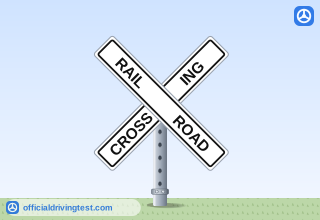
A railroad crossing is marked only with a cross-buck sign or a reduce-speed sign. What should you do?
- Only look left, since trains only approach from the left
- Look both ways and listen for a whistle; stop if a train is approaching
- Cross immediately without slowing down
- Wait a full five minutes before crossing regardless of trains
Show answer
Correct answer: Look both ways and listen for a whistle; stop if a train is approaching
If a crossing is marked only with a cross-buck or reduce-speed sign, look both ways and listen for a whistle. Stop if a train is approaching; if not, proceed with caution.
Source: Texas Driver Handbook (Revised January 2026), page 22
-
Red lights are flashing at a railroad crossing. What must you do?
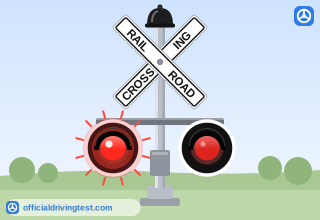
- Stop, and if a train is approaching, remain stopped until it passes and the lights stop flashing
- Slow down and proceed carefully, since flashing lights are only a suggestion to drivers
- Flash your headlights back and proceed
- Stop only if you can actually see a train; otherwise proceed through without stopping
Show answer
Correct answer: Stop, and if a train is approaching, remain stopped until it passes and the lights stop flashing
If red lights are flashing at a railroad crossing, stop. If a train is approaching, remain stopped until the train passes and the lights stop flashing.
Source: Texas Driver Handbook (Revised January 2026), page 22
-
The gates at a railroad crossing have been lowered. What should you do?
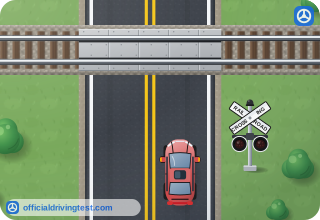
- Stop and wait until the train passes and the gates are raised
- Drive around the gate if no train is visible
- Honk and wait for the gate operator to wave you through
- Back up and use an alternate crossing immediately
Show answer
Correct answer: Stop and wait until the train passes and the gates are raised
If the railroad crossing gates have been lowered, stop, remain stopped, and wait until the train passes and the gates are raised before crossing.
Source: Texas Driver Handbook (Revised January 2026), page 22
-
Before crossing railroad tracks, why should you make sure all tracks are clear, even after one train passes?
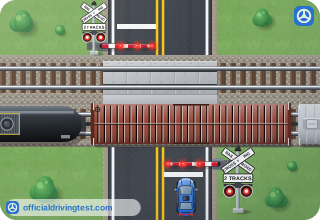
- There may be other tracks, and one train could block the view of another
- Trains always travel in pairs at the exact same speed
- The second train is legally required to stop for you
- It is not necessary; one train passing means the crossing is clear
Show answer
Correct answer: There may be other tracks, and one train could block the view of another
Be sure the tracks are clear before you proceed to cross, since there may be two or more sets of tracks and one train could be blocking the view of another.
Source: Texas Driver Handbook (Revised January 2026), page 22
-
Your car stalls on the tracks and a train is approaching. What should you do?
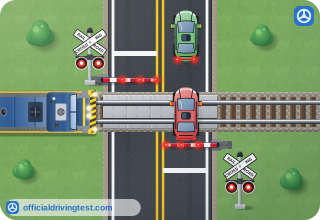
- Get out and run toward the train, to the side of the tracks
- Stay in the car with your seatbelt on
- Try repeatedly to restart the engine until the train arrives
- Run in the same direction the train is traveling
Show answer
Correct answer: Get out and run toward the train, to the side of the tracks
If your car stalls on the tracks and a train is approaching, get out quickly and move away from the tracks. Run toward the approaching train to the side of the tracks and avoid flying debris.
Source: Texas Driver Handbook (Revised January 2026), page 22
-
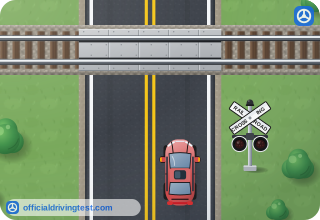
Who always has the right-of-way at a railroad crossing?
- The first vehicle to reach the crossing
- Emergency vehicles only
- Whichever vehicle is largest
- The train, which cannot stop at crossings
Show answer
Correct answer: The train, which cannot stop at crossings
Trains do not and cannot stop at crossings. Trains always have the right-of-way.
Source: Texas Driver Handbook (Revised January 2026), page 22
-
If you encounter a problem with a railroad crossing signal, what should you do?
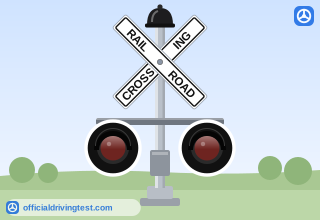
- Call DPS, local police, or the county sheriff, and give the signal's number
- Ignore it and drive through, since signals are rarely accurate
- Post about it on social media so the railroad will see it
- Wait at the crossing until a Texas DPS trooper happens to drive by
Show answer
Correct answer: Call DPS, local police, or the county sheriff, and give the signal's number
If you encounter a railroad grade crossing signal problem, call the Texas DPS Communications Center at (800) 772-7677 or your local police or sheriff's office, and be ready to give the crossing's identifying number.
Source: Texas Driver Handbook (Revised January 2026), page 22
-
What is the Emergency Notification System (ENS) sign at a railroad crossing?
- A speed limit sign for vehicles crossing the tracks
- A lighted sign that only appears at night
- A yield sign for pedestrians crossing the tracks
- A blue and white sign with the railroad's emergency number
Show answer
Correct answer: A blue and white sign with the railroad's emergency number
The ENS sign is a blue and white sign at the grade crossing that lists the railroad's emergency contact number to call to report emergencies or safety concerns at that crossing.
Source: Texas Driver Handbook (Revised January 2026), page 22
-
When calling the railroad's emergency contact number from an ENS sign, what should you communicate?
- The crossing's identification number and the nature of the emergency
- Only your name, phone number, and driver license number
- Only the make, model, and color of your vehicle
- Nothing; the ENS sign automatically alerts the railroad dispatcher
Show answer
Correct answer: The crossing's identification number and the nature of the emergency
Communicate your location by providing the identification number on the ENS sign and state the nature of the emergency to the dispatcher.
Source: Texas Driver Handbook (Revised January 2026), page 22
-
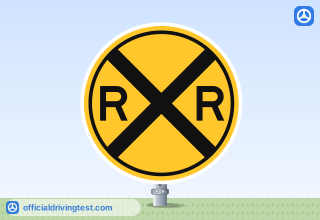
A round yellow Railroad Crossing warning sign means you are within a few hundred feet of a railroad crossing. What should you do?
- Change lanes to pass slower vehicles near the crossing
- Slow down and be prepared to stop; never try to beat a train
- Speed up to cross the tracks before a train arrives
- Sound your horn continuously until you cross
Show answer
Correct answer: Slow down and be prepared to stop; never try to beat a train
This sign means you are within a few hundred feet of a railroad crossing. Slow down and be prepared to stop. If you see a train coming, stop. Never try to beat a train.
Source: Texas Driver Handbook (Revised January 2026), page 32
-
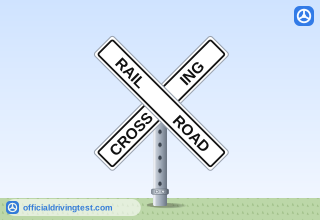
What does a railroad crossbuck sign indicate?
- That a train is currently approaching
- The speed limit for trains on that stretch of track
- Where the tracks are, and how many if more than one
- That the crossing is permanently closed
Show answer
Correct answer: Where the tracks are, and how many if more than one
Railroad crossbuck signs are posted at every railroad grade crossing and show the location of the train tracks. If more than one track is to be crossed, the sign will show the number of tracks. Always slow down, look, listen, and be prepared to yield to an approaching train.
Source: Texas Driver Handbook (Revised January 2026), page 32
-
What is the purpose of an Emergency Notification System sign at a railroad crossing?
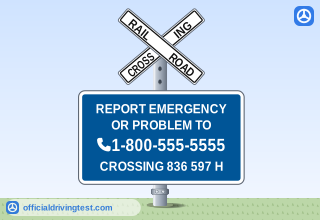
- It displays the daily train schedule for that crossing
- It warns that the crossing has no warning lights installed
- It indicates the maximum vehicle weight allowed to cross
- It lets the public report unsafe situations at the crossing
Show answer
Correct answer: It lets the public report unsafe situations at the crossing
Emergency Notification System signs are posted so the public may report unsafe situations. Posted on each sign are an emergency contact number and a USDOT National Crossing Inventory Number that identifies the exact location of the crossing.
Source: Texas Driver Handbook (Revised January 2026), page 32
-
At a railroad crossing with a gate and flashing lights, when should you stop, and how long should you remain stopped?
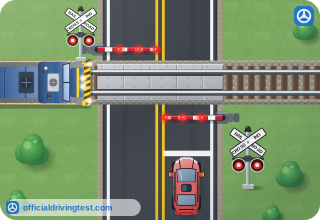
- Stop for five seconds, then proceed regardless of the gate
- You do not need to stop if no train is visible
- Stop when lights flash; stay until gates rise and flashing stops
- Stop only after the gate has fully lowered across the road
Show answer
Correct answer: Stop when lights flash; stay until gates rise and flashing stops
Stop when the lights begin to flash before the gate lowers across your side of the road. Remain stopped until the gates are raised and the lights stop flashing.
Source: Texas Driver Handbook (Revised January 2026), page 33
-
At a railroad crossing, where must you stop, and under what conditions?
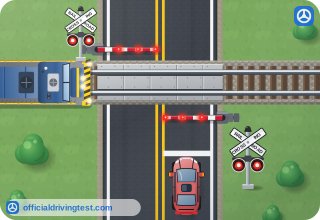
- 15 to 50 feet from the nearest rail, when a flag person or warning device signals
- Exactly at the nearest rail, and only when you can see a train coming
- At least 100 feet from the crossing at all times
- You are never required to stop unless a gate is present
Show answer
Correct answer: 15 to 50 feet from the nearest rail, when a flag person or warning device signals
At railroad crossings, stop within 15 feet to 50 feet of the nearest rail when directed by a flag person, when there are flashing red lights or warning bells sounding, or when any warning device tells you a train is coming.
Source: Texas Driver Handbook (Revised January 2026), page 33
-
Is it legal to drive, stop, or park your vehicle on light rail tracks?
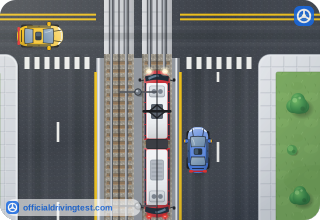
- Yes, as long as no train is visible
- Yes, but only for less than one minute
- Yes, if hazard lights are on
- No, it is dangerous and illegal
Show answer
Correct answer: No, it is dangerous and illegal
Do not drive, stop, or park your vehicle on light rail tracks. It's dangerous and illegal. Trains can't start or stop quickly regardless of traffic flow.
Source: Texas Driver Handbook (Revised January 2026), page 53
-
Where should you cross light rail tracks?
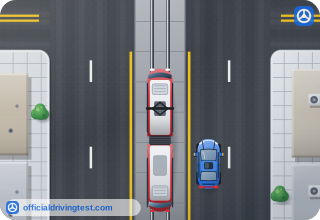
- Anywhere, since light rail always yields to vehicles
- Only at designated crossings, and only when it is safe
- Anywhere along the tracks, as long as no train is in sight
- Only where there is a stop sign
Show answer
Correct answer: Only at designated crossings, and only when it is safe
Cross the tracks only at designated crossings and only when it is safe. Obey all warning signs, flashing lights, signals, and crossing gates.
Source: Texas Driver Handbook (Revised January 2026), page 53
-
Why should you look both ways before crossing light rail tracks?
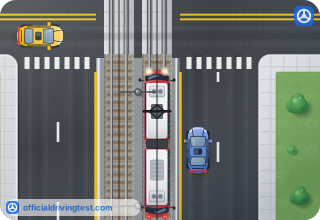
- Light rail trains only run once a day
- It is only necessary at night
- Trains always sound a horn well before the crossing
- Trains travel in both directions
Show answer
Correct answer: Trains travel in both directions
Look both ways before crossing the tracks. Trains travel in both directions.
Source: Texas Driver Handbook (Revised January 2026), page 53
-
Why is it important to stay especially alert near light rail lines?
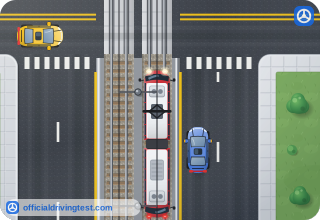
- Light rail trains are louder than any other vehicle
- Light rail only operates during rush hour
- Light rail trains cannot stop under any circumstances
- Light rail is quieter than most cars, so you may not hear it
Show answer
Correct answer: Light rail is quieter than most cars, so you may not hear it
Stay alert. Light rail is quieter than a bus or most cars. You may not hear a light rail coming, so listen for train horns and signal bells.
Source: Texas Driver Handbook (Revised January 2026), page 53
-
What should you never do at a light rail crossing gate?
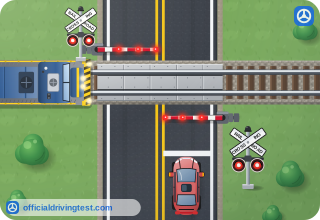
- Never use your turn signal near a gate
- Never wait more than five seconds at a gate
- Never drive around a crossing gate arm
- Never stop before the gate lowers
Show answer
Correct answer: Never drive around a crossing gate arm
Never drive around crossing gate arms. Never race a train, run in front of a train, or put anything on or near the tracks.
Source: Texas Driver Handbook (Revised January 2026), page 53
-
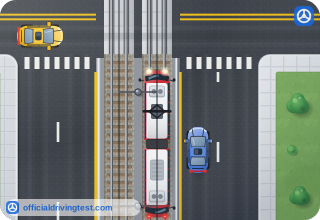
What is true about trying to beat a light rail train to a crossing?
- It is safe if your vehicle is faster than the train
- It is only dangerous for pedestrians, not vehicles
- Light rail trains always stop for vehicles at crossings
- You should never try; even in a tie, you lose
Show answer
Correct answer: You should never try; even in a tie, you lose
Never try to beat the train to a crossing. Even in a tie, you lose.
Source: Texas Driver Handbook (Revised January 2026), page 53
-
Who issues tickets to people who violate light rail warning signs, flashing lights, signals, and crossing gates?
- The light rail conductor only
- The city's traffic engineer
- No one; there are no penalties
- A law enforcement officer
Show answer
Correct answer: A law enforcement officer
Obey all warning signs, flashing lights, signals, and crossing gates. A law enforcement officer will issue tickets to violators, and you should always follow instructions from a law enforcement officer.
Source: Texas Driver Handbook (Revised January 2026), page 53
-
Which sign tells you to watch out for a train?
- A blue rectangular sign
- A green circular sign
- A red octagon
- A round yellow "RXR" sign
Show answer
Correct answer: A round yellow "RXR" sign
Round signs are railroad advance warning signs: you are within a few hundred feet of a railroad crossing, so slow down and be prepared to stop.
Source: Texas Driver Handbook (Revised January 2026), page 26