Texas: Parking rules — Part 2 Practice Test
Questions in this part include: “May you lend your disabled parking windshield identification card to someone else?” · “Within how many feet of a crosswalk at an intersection is it illegal to park?”
Independent educational site · not affiliated with any government agency or DMV
Ready? Test yourself
Answer to start, or tap Start below:
You may use a disabled parking windshield identification card only when:
- Instant feedback with an explanation
- Every answer cites its source in the manual
- Your best score is saved on this device
- Keyboard: press 1 to 4 to answer and Enter for the next question
Questions are original and based on the official manual "Texas Driver Handbook" (Revised January 2026), Texas Department of Public Safety (DPS).
All 22 questions in this practice test
Take the test above first, then use this list to study. Tap “Show answer” to see the correct answer and explanation.
Show the questions and answersHide the questions
-
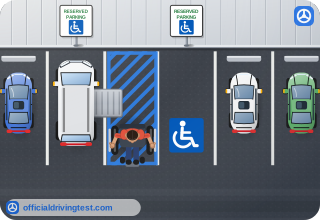
To legally park in a space designated as disabled parking, a vehicle must have:
- A note signed by a doctor kept in the glove box
- Any handicap symbol sticker purchased online
- Written permission from the property owner only
- A disabled plate or a state-issued windshield ID card
Show answer
Correct answer: A disabled plate or a state-issued windshield ID card
You may not park in a disabled parking space unless the vehicle has a disabled license plate or state-issued removable windshield identification card.
Source: Texas Driver Handbook (Revised January 2026), page 43
-
You may use a disabled parking windshield identification card only when:
- You are transporting the person it was issued to
- Any family member is riding in the vehicle
- You are running an errand for the cardholder
- The vehicle is parked for less than 15 minutes
Show answer
Correct answer: You are transporting the person it was issued to
You may not use a disabled parking windshield identification card unless transporting the disabled person to whom it was issued.
Source: Texas Driver Handbook (Revised January 2026), page 43
-
May you lend your disabled parking windshield identification card to someone else?
- Yes, if they ask permission first
- Yes, for a maximum of one day
- No, it is illegal to lend it to someone else
- Yes, as long as they are a close relative
Show answer
Correct answer: No, it is illegal to lend it to someone else
Texas law specifically states you may not lend your windshield identification card to someone else.
Source: Texas Driver Handbook (Revised January 2026), page 43
-
Even with a valid disabled parking plate or card, you may not:
- Block an access ramp or curb ramp
- Park for more than one hour
- Park facing the wrong direction
- Park without a front license plate
Show answer
Correct answer: Block an access ramp or curb ramp
Texas law states you may not block an access or curb ramp, even when legally parking in a disabled space.
Source: Texas Driver Handbook (Revised January 2026), page 43
-
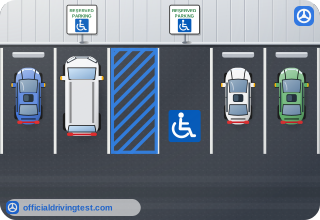
Striped areas adjacent to disabled parking spaces are reserved for:
- Wheelchair lifts
- Extra vehicle parking during busy hours
- Motorcycle parking
- Delivery truck loading
Show answer
Correct answer: Wheelchair lifts
Do not park in striped areas adjacent to disabled parking spaces; striped areas are for wheelchair lifts.
Source: Texas Driver Handbook (Revised January 2026), page 43
-
Before leaving your vehicle unattended, Texas law requires you to:
- Leave the engine running so it stays warm
- Only roll up the windows
- Leave the key in the ignition in case you need to return quickly
- Turn off the engine, lock the ignition, remove the key, and set the brake
Show answer
Correct answer: Turn off the engine, lock the ignition, remove the key, and set the brake
It is illegal to permit a car to stand idling unattended without turning off the engine, locking the ignition, removing the key, and setting the parking brake.
Source: Texas Driver Handbook (Revised January 2026), page 43
-
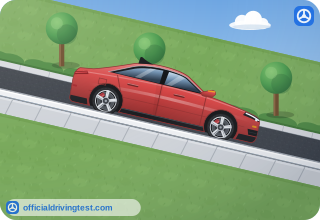
If you leave your vehicle unattended while standing on a grade (hill), you must also:
- Open the windows fully
- Point the front wheels straight ahead only
- Turn the front wheels to the curb or roadside
- Leave the transmission in neutral
Show answer
Correct answer: Turn the front wheels to the curb or roadside
When standing on any grade, Texas law requires turning the front wheels to the curb or side of the road, in addition to the other unattended vehicle requirements.
Source: Texas Driver Handbook (Revised January 2026), page 43
-
The requirement to remove the key from the ignition before leaving a vehicle unattended does NOT apply when:
- The driver will return within five minutes
- The engine was started using a remote starter
- The vehicle is parked on private property
- The vehicle has an alarm system installed
Show answer
Correct answer: The engine was started using a remote starter
The requirements about turning off the engine, locking the ignition, and removing the key do not apply to a driver who starts the engine using a remote starter that remotely starts the engine without the key in the ignition.
Source: Texas Driver Handbook (Revised January 2026), page 43
-
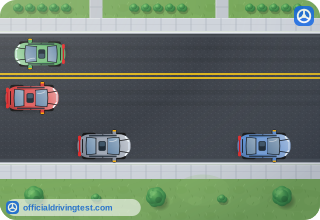
When preparing to parallel park, you should signal, then stop even with the front of the car ahead, about how far out from the empty space?
- About two feet
- About one foot
- About four feet
- About six feet
Show answer
Correct answer: About two feet
Choose a space large enough for your car, signal, then stop even with the front of the car about two feet out from the space.
Source: Texas Driver Handbook (Revised January 2026), page 43
-
After stopping beside the car ahead of the empty space, which way should you first turn your front wheels before backing in to parallel park?
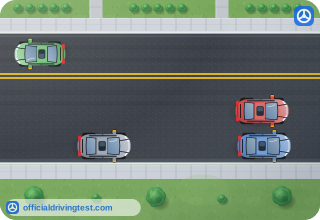
- All the way to the right
- All the way to the left
- Keep them pointed straight ahead
- It does not matter which way
Show answer
Correct answer: All the way to the right
Make sure you will not interfere with oncoming traffic, then turn your front wheels all the way to the right and back slowly toward the curb.
Source: Texas Driver Handbook (Revised January 2026), page 43
-
On a roadway that allows two-way traffic, Texas law requires a driver to park with the vehicle's right-hand wheels within how many inches of the right-hand curb or edge of the roadway?
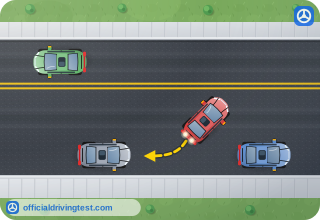
- 12 inches
- 24 inches
- 18 inches
- 6 inches
Show answer
Correct answer: 18 inches
On a roadway that allows two-way traffic, the driver must park with the vehicle's right-hand wheels within 18 inches of the right-hand curb or edge of the roadway.
Source: Texas Driver Handbook (Revised January 2026), page 43
-
When your front seat is opposite the rear bumper of the car ahead while parallel parking, what should you do?
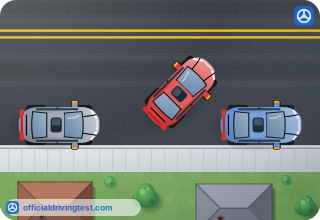
- Straighten the wheels and pull forward out of the space
- Stop and put the vehicle in park immediately
- Turn the wheel all the way to the left and back slowly toward the car behind
- Turn your steering wheel all the way to the right and accelerate
Show answer
Correct answer: Turn the wheel all the way to the left and back slowly toward the car behind
When your front seat is opposite the rear bumper of the car ahead, turn your steering wheel all the way to the left and back slowly toward the car behind you without touching it.
Source: Texas Driver Handbook (Revised January 2026), page 44
-
When you finish parallel parking, about how far should your vehicle be from the curb, and what is the maximum allowed?
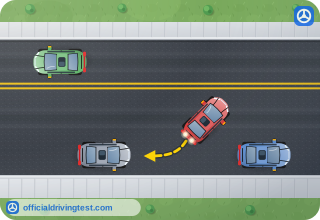
- About two feet from the curb; never more than four feet
- Touching the curb; never more than six inches
- About six inches from the curb; never more than 18 inches
- About 12 inches from the curb; never more than 24 inches
Show answer
Correct answer: About six inches from the curb; never more than 18 inches
You should be about six inches from the curb, and you should never park more than 18 inches from the curb or edge of the road.
Source: Texas Driver Handbook (Revised January 2026), page 44
-
When parking downhill next to a curb, which way should you turn your front wheels?
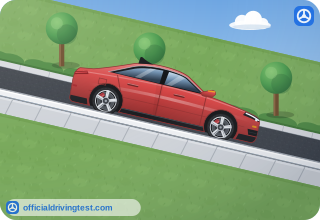
- Away from the curb
- Straight ahead only
- Toward oncoming traffic
- Toward the curb
Show answer
Correct answer: Toward the curb
The handbook's Parking on Hills diagram labels the downhill car "Turn wheels to curb."
Source: Texas Driver Handbook (Revised January 2026), page 44
-
When parking uphill next to a curb, which way should you turn your front wheels?
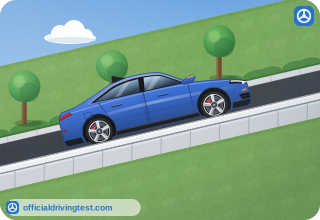
- It does not matter on an uphill grade
- Turn the back of the wheels to the curb
- Keep them straight and rely on the parking brake alone
- Straight ahead only
Show answer
Correct answer: Turn the back of the wheels to the curb
The handbook's Parking on Hills diagram labels the uphill car "Turn back of wheels to curb."
Source: Texas Driver Handbook (Revised January 2026), page 44
-
When parking on a hill where there is no curb, which way should you turn your front wheels?
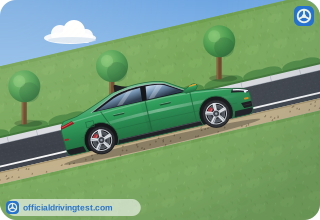
- Turn them to the right, toward the side of the road
- Turn them to the left, toward the center of the road
- It does not matter which way when there is no curb
- Keep the wheels perfectly straight
Show answer
Correct answer: Turn them to the right, toward the side of the road
The handbook's Parking on Hills diagram says "Turn wheels to right, no curb." Texas law requires turning the front wheels to the curb or side of the road when standing on any grade.
Source: Texas Driver Handbook (Revised January 2026), page 44
-
Before leaving a parking space, you should:
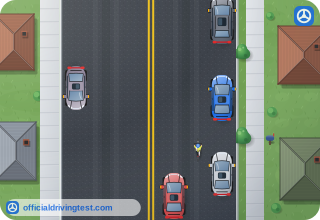
- Only check your rearview mirror
- Wait for another driver to wave you out
- Check all your mirrors, then signal before pulling out
- Honk your horn twice and pull out immediately
Show answer
Correct answer: Check all your mirrors, then signal before pulling out
Use caution when leaving a parking space, check all your mirrors to make sure nothing is obstructing your path (especially children, who often play between parked cars), and signal before leaving.
Source: Texas Driver Handbook (Revised January 2026), page 44
-
According to the Texas Driver Handbook, coasting downgrade with the gears or transmission in neutral is:
- Illegal only at night
- Illegal only in school zones
- Illegal
- Legal but discouraged
Show answer
Correct answer: Illegal
It is illegal to coast on a downgrade with the gears or transmission in neutral.
Source: Texas Driver Handbook (Revised January 2026), page 44
-
When parking uphill on a street with no curb, which direction should you turn your front wheels?
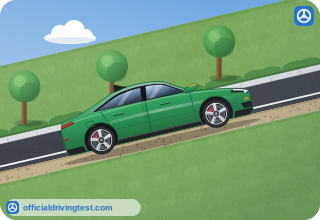
- To the left, toward the center of the road
- To the right, toward the edge of the road
- Keep them straight
- It does not matter
Show answer
Correct answer: To the right, toward the edge of the road
Uphill with no curb, turn your wheels to the right so that if the vehicle rolls, it moves away from traffic and off the road.
Source: Texas Driver Handbook (Revised January 2026), page 44
-
Within how many feet of a crosswalk at an intersection is it illegal to park?
- 5 feet
- 10 feet
- 20 feet
- 50 feet
Show answer
Correct answer: 20 feet
Texas law prohibits parking within 20 feet of a crosswalk at an intersection so that visibility and pedestrian safety are not blocked.
Source: Texas Driver Handbook (Revised January 2026), page 42
-
When parking parallel to a curb, your curb-side wheels must be no more than how many inches from the curb?
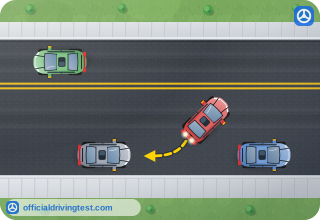
- 6 inches
- 18 inches
- 36 inches
- 48 inches
Show answer
Correct answer: 18 inches
When parallel parking, your wheels must be within 18 inches of the curb to keep the vehicle safely out of the traffic lane.
Source: Texas Driver Handbook (Revised January 2026), page 44
-
How close to a fire hydrant may a vehicle lawfully park?
- No closer than 3 feet
- Right next to it is fine
- No closer than 50 feet
- No closer than 15 feet
Show answer
Correct answer: No closer than 15 feet
Texas law prohibits parking within 15 feet of a fire hydrant so firefighters have unobstructed access in an emergency.
Source: Texas Driver Handbook (Revised January 2026), page 42