Texas: Financial responsibility & insurance — Part 1 Practice Test
Questions in this part include: “After a crash resulting in injury or death, if you did not stop at the scene, what must you do?” · “What is the penalty for a first offense of failing to stop and comply after a crash resulting in serious bodily injury?”
Independent educational site · not affiliated with any government agency or DMV
Ready? Test yourself
Answer to start, or tap Start below:
When recording another driver's insurance information after a crash, how should you write the insurance company name and policy number?
- Instant feedback with an explanation
- Every answer cites its source in the manual
- Your best score is saved on this device
- Keyboard: press 1 to 4 to answer and Enter for the next question
Questions are original and based on the official manual "Texas Driver Handbook" (Revised January 2026), Texas Department of Public Safety (DPS).
All 17 questions in this practice test
Take the test above first, then use this list to study. Tap “Show answer” to see the correct answer and explanation.
Show the questions and answersHide the questions
-
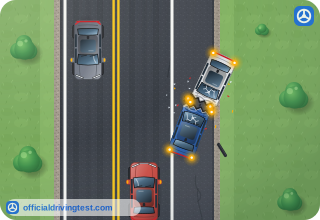
After a crash, if requested and available, what information should you exchange with the other drivers involved?
- Names, contact details, plate numbers, license and insurance info
- Only your name and phone number, nothing else
- Only your insurance company and policy number
- Nothing, unless a police officer is present at the scene
Show answer
Correct answer: Names, contact details, plate numbers, license and insurance info
If requested and available, drivers should exchange names, addresses, phone numbers, vehicle identification numbers, license plate numbers, driver license information, and insurance information.
Source: Texas Driver Handbook (Revised January 2026), page 59
-
When recording another driver's insurance information after a crash, how should you write the insurance company name and policy number?
- Exactly as shown on the driver's proof-of-insurance card
- In abbreviated form only
- From memory, without checking the card
- You are not required to record this information
Show answer
Correct answer: Exactly as shown on the driver's proof-of-insurance card
Write the insurance company name and policy number exactly as shown on the driver's proof-of-insurance card.
Source: Texas Driver Handbook (Revised January 2026), page 59
-
If you know the name of the other driver's insurance company after a crash but the address and phone number are not listed on the insurance card, what should you do?
- Skip recording that information entirely
- Call 911 for the insurer's contact details
- Contact the vehicle registration office instead
- Call the Texas Department of Insurance for the details
Show answer
Correct answer: Call the Texas Department of Insurance for the details
If you know the driver's insurance company but the information isn't on the card, call the Texas Department of Insurance at (800) 252-3439 to get the company's address and phone number.
Source: Texas Driver Handbook (Revised January 2026), page 59
-
You should always notify law enforcement as soon as possible after a crash in each of these situations EXCEPT:
- There is an injury or fatality
- A driver leaves the scene of the crash
- You suspect a driver is intoxicated
- The vehicles can be moved off the roadway
Show answer
Correct answer: The vehicles can be moved off the roadway
You should notify law enforcement when there is an injury or fatality, when vehicles cannot be moved off the roadway, when a driver leaves the scene, or when you suspect intoxication. Being able to easily move vehicles is not itself a reason to call law enforcement.
Source: Texas Driver Handbook (Revised January 2026), page 59
-
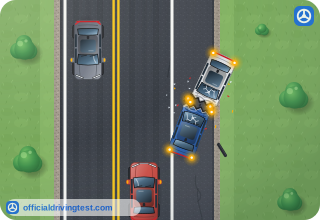
If you are driving a vehicle involved in a crash that injures or kills a person, what must you do immediately?
- Drive to another city before contacting police
- Wait for a tow truck before taking any other action
- Stop at, or as close as possible to, the scene
- Leave the scene immediately and report the crash later
Show answer
Correct answer: Stop at, or as close as possible to, the scene
You must immediately stop your vehicle at the scene of the crash, or as close as possible, without obstructing traffic more than necessary.
Source: Texas Driver Handbook (Revised January 2026), page 59
-
After a crash resulting in injury or death, if you did not stop at the scene, what must you do?
- Keep driving but text a photo of the scene to police
- Return to the scene only if there were witnesses present
- Immediately return and remain at the scene until you have complied
- File a report only if the other party asks you to
Show answer
Correct answer: Immediately return and remain at the scene until you have complied
If you did not stop at the scene, you must immediately return and remain at the scene until you have complied with the legal requirements (providing information, showing your license, and providing assistance).
Source: Texas Driver Handbook (Revised January 2026), page 59
-
In a crash causing injury, what information must you provide to an injured person or to the operator, occupant, or attendant of a vehicle involved?
- Your name, address, registration number, and insurer
- Only your phone number and email address
- Your Social Security number and bank account
- Your employer's name, address, and phone number
Show answer
Correct answer: Your name, address, registration number, and insurer
You must provide your name and address, the registration number of the vehicle you were driving, and the name of your motor vehicle liability insurer.
Source: Texas Driver Handbook (Revised January 2026), page 59
-
In a crash causing injury, what else must you do, if requested and available, besides providing your name, address, and insurer's name?
- Show your driver license
- Provide your medical records
- Write a formal apology letter
- Give the other driver a full copy of your insurance policy
Show answer
Correct answer: Show your driver license
If requested and available, you must show your driver license to any person injured, or to the operator, occupant, or person attending a vehicle involved in the collision.
Source: Texas Driver Handbook (Revised January 2026), page 59
-
What "reasonable assistance" must you provide to a person injured in a crash you were involved in?
- Transporting or arranging transport to a physician or hospital if needed
- Administering medications to the injured person
- Personally paying the injured person's medical bills at the scene
- Only calling the injured person's family members
Show answer
Correct answer: Transporting or arranging transport to a physician or hospital if needed
You must provide reasonable assistance, including transporting or arranging transportation of the injured person to a physician or hospital if treatment is apparently necessary or requested.
Source: Texas Driver Handbook (Revised January 2026), page 59
-
What is the penalty for a first offense of failing to stop and comply after a crash resulting in the death of a person?
- Only an automatic license suspension, with no fine or jail time
- A second degree felony with a fine up to $10,000 and 2 to 20 years in TDCJ
- A Class C misdemeanor with a fine up to $500
- A third degree felony with 2 to 10 years in TDCJ
Show answer
Correct answer: A second degree felony with a fine up to $10,000 and 2 to 20 years in TDCJ
A first offense crash resulting in death is a second degree felony punishable by a fine not to exceed $10,000 and imprisonment in TDCJ for 2 to 20 years.
Source: Texas Driver Handbook (Revised January 2026), page 59
-
What is the penalty for a first offense of failing to stop and comply after a crash resulting in serious bodily injury?
- A third degree felony with 2 to 10 years in TDCJ
- A second degree felony with 2 to 20 years in TDCJ
- A Class B misdemeanor with up to 180 days in jail
- No criminal penalty, only a civil fine
Show answer
Correct answer: A third degree felony with 2 to 10 years in TDCJ
A first offense crash resulting in serious bodily injury is a third degree felony punishable by a fine not to exceed $10,000 and imprisonment in TDCJ for 2 to 10 years.
Source: Texas Driver Handbook (Revised January 2026), page 59
-
What is the penalty for a first offense of failing to stop and comply after a crash resulting in injury (not serious bodily injury or death)?
- Up to 5 years in TDCJ, a fine up to $5,000, or both
- Life imprisonment
- A fine only, with no possibility of jail time
- A Class C misdemeanor with a $500 fine
Show answer
Correct answer: Up to 5 years in TDCJ, a fine up to $5,000, or both
A first offense crash resulting in injury is punishable by up to 5 years in TDCJ, or up to 1 year in county jail, a fine not to exceed $5,000, or both a fine and imprisonment.
Source: Texas Driver Handbook (Revised January 2026), page 59
-
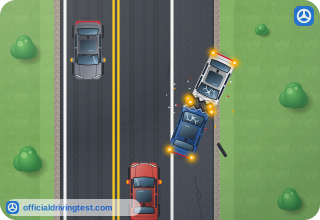
If a crash results ONLY in damage to a vehicle that is driven or attended by a person, what must you do?
- Only stop if the damage clearly exceeds $5,000
- Continue driving and call the police once you get home
- Stop only if the other driver specifically asks you to
- Immediately stop at, or as close as possible to, the scene
Show answer
Correct answer: Immediately stop at, or as close as possible to, the scene
You must immediately stop your vehicle at, or as close as possible to, the scene without obstructing traffic more than necessary, even when the crash only damages a driven or attended vehicle.
Source: Texas Driver Handbook (Revised January 2026), page 59
-
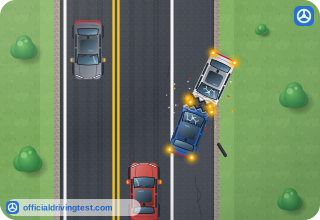
If a vehicle-damage-only crash occurs on a main lane, ramp, shoulder, or median and each vehicle can be normally and safely driven, what should drivers do?
- Push the vehicles into a nearby ditch
- Wait for a tow truck before moving anything
- Move their vehicles as soon as possible to a frontage road or other suitable location
- Leave the vehicles exactly where they stopped no matter what, until police arrive
Show answer
Correct answer: Move their vehicles as soon as possible to a frontage road or other suitable location
When each vehicle can be normally and safely driven, drivers must move their vehicle as soon as possible to a designated crash investigation site, frontage road, nearest suitable cross street, or other suitable location.
Source: Texas Driver Handbook (Revised January 2026), page 59
-
After a vehicle-damage-only crash, if you did not stop, what must you provide upon returning to the scene?
- Your name, address, registration number, and insurer's name
- Only your insurance card
- A written statement given to the media
- Nothing, since the other driver already left the scene
Show answer
Correct answer: Your name, address, registration number, and insurer's name
You must provide your name and address, the registration number of the vehicle you were driving, and the name of your insurer, and show your driver license if requested and available.
Source: Texas Driver Handbook (Revised January 2026), page 59
-
What is the penalty for a first-offense failure to stop after a vehicle-damage-only crash with LESS than $200 in damages?
- No penalty, since the damage is minor
- A Class C misdemeanor punishable by a fine not to exceed $500
- A Class B misdemeanor punishable by a fine up to $2,000 and jail
- A third degree felony
Show answer
Correct answer: A Class C misdemeanor punishable by a fine not to exceed $500
A first offense with less than $200 in damages is a Class C misdemeanor punishable by a fine not to exceed $500.
Source: Texas Driver Handbook (Revised January 2026), page 60
-
What is the penalty for a first-offense failure to stop after a vehicle-damage crash with $200 OR MORE in damages?
- A Class C misdemeanor with a $500 fine
- A second degree felony
- Only an automatic 1-year license revocation
- A Class B misdemeanor with a fine up to $2,000
Show answer
Correct answer: A Class B misdemeanor with a fine up to $2,000
A first offense with $200 or more in damages is a Class B misdemeanor punishable by a fine not to exceed $2,000, confinement in jail for up to 180 days, or both.
Source: Texas Driver Handbook (Revised January 2026), page 60