Texas: Financial responsibility & insurance
Insurance minimums, vehicle registration, and what to do after a crash. Split into 3 shorter tests so you're not stuck in one long quiz.
Independent educational site · not affiliated with any government agency or DMV
Choose a part
Financial responsibility & insurance — Part 1
Questions in this part include: “After a crash resulting in injury or death, if you did not stop at the scene, what must you do?”
Financial responsibility & insurance — Part 2
Questions in this part include: “If you collide with and damage an UNATTENDED vehicle, what must you immediately do?”
Financial responsibility & insurance — Part 3
Questions in this part include: “Every owner or operator of a motor vehicle in Texas is required to furnish evidence of financial responsibility to whom?”
Questions are original and based on the official manual "Texas Driver Handbook" (Revised January 2026), Texas Department of Public Safety (DPS).
All 51 Financial responsibility & insurance questions with answers
Choose a part above to take a practice test, or study every question and answer here.
Show the questions and answersHide the questions
1Part 117 questions
-
After a crash, if requested and available, what information should you exchange with the other drivers involved?
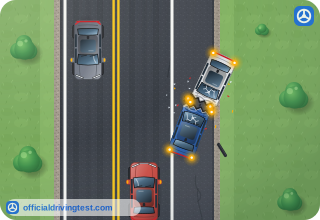
- Names, contact details, plate numbers, license and insurance info
- Only your name and phone number, nothing else
- Only your insurance company and policy number
- Nothing, unless a police officer is present at the scene
Show answer
Correct answer: Names, contact details, plate numbers, license and insurance info
If requested and available, drivers should exchange names, addresses, phone numbers, vehicle identification numbers, license plate numbers, driver license information, and insurance information.
Source: Texas Driver Handbook (Revised January 2026), page 59
-
When recording another driver's insurance information after a crash, how should you write the insurance company name and policy number?
- Exactly as shown on the driver's proof-of-insurance card
- In abbreviated form only
- From memory, without checking the card
- You are not required to record this information
Show answer
Correct answer: Exactly as shown on the driver's proof-of-insurance card
Write the insurance company name and policy number exactly as shown on the driver's proof-of-insurance card.
Source: Texas Driver Handbook (Revised January 2026), page 59
-
If you know the name of the other driver's insurance company after a crash but the address and phone number are not listed on the insurance card, what should you do?
- Skip recording that information entirely
- Call 911 for the insurer's contact details
- Contact the vehicle registration office instead
- Call the Texas Department of Insurance for the details
Show answer
Correct answer: Call the Texas Department of Insurance for the details
If you know the driver's insurance company but the information isn't on the card, call the Texas Department of Insurance at (800) 252-3439 to get the company's address and phone number.
Source: Texas Driver Handbook (Revised January 2026), page 59
-
You should always notify law enforcement as soon as possible after a crash in each of these situations EXCEPT:
- There is an injury or fatality
- A driver leaves the scene of the crash
- You suspect a driver is intoxicated
- The vehicles can be moved off the roadway
Show answer
Correct answer: The vehicles can be moved off the roadway
You should notify law enforcement when there is an injury or fatality, when vehicles cannot be moved off the roadway, when a driver leaves the scene, or when you suspect intoxication. Being able to easily move vehicles is not itself a reason to call law enforcement.
Source: Texas Driver Handbook (Revised January 2026), page 59
-
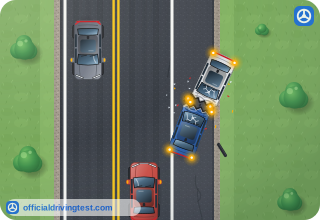
If you are driving a vehicle involved in a crash that injures or kills a person, what must you do immediately?
- Drive to another city before contacting police
- Wait for a tow truck before taking any other action
- Stop at, or as close as possible to, the scene
- Leave the scene immediately and report the crash later
Show answer
Correct answer: Stop at, or as close as possible to, the scene
You must immediately stop your vehicle at the scene of the crash, or as close as possible, without obstructing traffic more than necessary.
Source: Texas Driver Handbook (Revised January 2026), page 59
-
After a crash resulting in injury or death, if you did not stop at the scene, what must you do?
- Keep driving but text a photo of the scene to police
- Return to the scene only if there were witnesses present
- Immediately return and remain at the scene until you have complied
- File a report only if the other party asks you to
Show answer
Correct answer: Immediately return and remain at the scene until you have complied
If you did not stop at the scene, you must immediately return and remain at the scene until you have complied with the legal requirements (providing information, showing your license, and providing assistance).
Source: Texas Driver Handbook (Revised January 2026), page 59
-
In a crash causing injury, what information must you provide to an injured person or to the operator, occupant, or attendant of a vehicle involved?
- Your name, address, registration number, and insurer
- Only your phone number and email address
- Your Social Security number and bank account
- Your employer's name, address, and phone number
Show answer
Correct answer: Your name, address, registration number, and insurer
You must provide your name and address, the registration number of the vehicle you were driving, and the name of your motor vehicle liability insurer.
Source: Texas Driver Handbook (Revised January 2026), page 59
-
In a crash causing injury, what else must you do, if requested and available, besides providing your name, address, and insurer's name?
- Show your driver license
- Provide your medical records
- Write a formal apology letter
- Give the other driver a full copy of your insurance policy
Show answer
Correct answer: Show your driver license
If requested and available, you must show your driver license to any person injured, or to the operator, occupant, or person attending a vehicle involved in the collision.
Source: Texas Driver Handbook (Revised January 2026), page 59
-
What "reasonable assistance" must you provide to a person injured in a crash you were involved in?
- Transporting or arranging transport to a physician or hospital if needed
- Administering medications to the injured person
- Personally paying the injured person's medical bills at the scene
- Only calling the injured person's family members
Show answer
Correct answer: Transporting or arranging transport to a physician or hospital if needed
You must provide reasonable assistance, including transporting or arranging transportation of the injured person to a physician or hospital if treatment is apparently necessary or requested.
Source: Texas Driver Handbook (Revised January 2026), page 59
-
What is the penalty for a first offense of failing to stop and comply after a crash resulting in the death of a person?
- Only an automatic license suspension, with no fine or jail time
- A second degree felony with a fine up to $10,000 and 2 to 20 years in TDCJ
- A Class C misdemeanor with a fine up to $500
- A third degree felony with 2 to 10 years in TDCJ
Show answer
Correct answer: A second degree felony with a fine up to $10,000 and 2 to 20 years in TDCJ
A first offense crash resulting in death is a second degree felony punishable by a fine not to exceed $10,000 and imprisonment in TDCJ for 2 to 20 years.
Source: Texas Driver Handbook (Revised January 2026), page 59
-
What is the penalty for a first offense of failing to stop and comply after a crash resulting in serious bodily injury?
- A third degree felony with 2 to 10 years in TDCJ
- A second degree felony with 2 to 20 years in TDCJ
- A Class B misdemeanor with up to 180 days in jail
- No criminal penalty, only a civil fine
Show answer
Correct answer: A third degree felony with 2 to 10 years in TDCJ
A first offense crash resulting in serious bodily injury is a third degree felony punishable by a fine not to exceed $10,000 and imprisonment in TDCJ for 2 to 10 years.
Source: Texas Driver Handbook (Revised January 2026), page 59
-
What is the penalty for a first offense of failing to stop and comply after a crash resulting in injury (not serious bodily injury or death)?
- Up to 5 years in TDCJ, a fine up to $5,000, or both
- Life imprisonment
- A fine only, with no possibility of jail time
- A Class C misdemeanor with a $500 fine
Show answer
Correct answer: Up to 5 years in TDCJ, a fine up to $5,000, or both
A first offense crash resulting in injury is punishable by up to 5 years in TDCJ, or up to 1 year in county jail, a fine not to exceed $5,000, or both a fine and imprisonment.
Source: Texas Driver Handbook (Revised January 2026), page 59
-
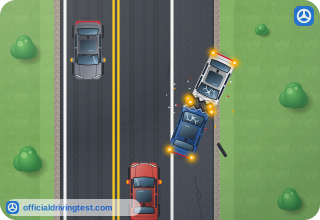
If a crash results ONLY in damage to a vehicle that is driven or attended by a person, what must you do?
- Only stop if the damage clearly exceeds $5,000
- Continue driving and call the police once you get home
- Stop only if the other driver specifically asks you to
- Immediately stop at, or as close as possible to, the scene
Show answer
Correct answer: Immediately stop at, or as close as possible to, the scene
You must immediately stop your vehicle at, or as close as possible to, the scene without obstructing traffic more than necessary, even when the crash only damages a driven or attended vehicle.
Source: Texas Driver Handbook (Revised January 2026), page 59
-
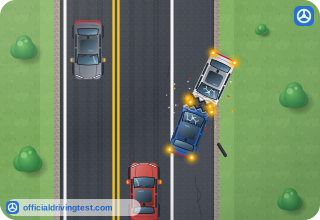
If a vehicle-damage-only crash occurs on a main lane, ramp, shoulder, or median and each vehicle can be normally and safely driven, what should drivers do?
- Push the vehicles into a nearby ditch
- Wait for a tow truck before moving anything
- Move their vehicles as soon as possible to a frontage road or other suitable location
- Leave the vehicles exactly where they stopped no matter what, until police arrive
Show answer
Correct answer: Move their vehicles as soon as possible to a frontage road or other suitable location
When each vehicle can be normally and safely driven, drivers must move their vehicle as soon as possible to a designated crash investigation site, frontage road, nearest suitable cross street, or other suitable location.
Source: Texas Driver Handbook (Revised January 2026), page 59
-
After a vehicle-damage-only crash, if you did not stop, what must you provide upon returning to the scene?
- Your name, address, registration number, and insurer's name
- Only your insurance card
- A written statement given to the media
- Nothing, since the other driver already left the scene
Show answer
Correct answer: Your name, address, registration number, and insurer's name
You must provide your name and address, the registration number of the vehicle you were driving, and the name of your insurer, and show your driver license if requested and available.
Source: Texas Driver Handbook (Revised January 2026), page 59
-
What is the penalty for a first-offense failure to stop after a vehicle-damage-only crash with LESS than $200 in damages?
- No penalty, since the damage is minor
- A Class C misdemeanor punishable by a fine not to exceed $500
- A Class B misdemeanor punishable by a fine up to $2,000 and jail
- A third degree felony
Show answer
Correct answer: A Class C misdemeanor punishable by a fine not to exceed $500
A first offense with less than $200 in damages is a Class C misdemeanor punishable by a fine not to exceed $500.
Source: Texas Driver Handbook (Revised January 2026), page 60
-
What is the penalty for a first-offense failure to stop after a vehicle-damage crash with $200 OR MORE in damages?
- A Class C misdemeanor with a $500 fine
- A second degree felony
- Only an automatic 1-year license revocation
- A Class B misdemeanor with a fine up to $2,000
Show answer
Correct answer: A Class B misdemeanor with a fine up to $2,000
A first offense with $200 or more in damages is a Class B misdemeanor punishable by a fine not to exceed $2,000, confinement in jail for up to 180 days, or both.
Source: Texas Driver Handbook (Revised January 2026), page 60
2Part 217 questions
-
If you collide with and damage an UNATTENDED vehicle, what must you immediately do?
- Drive away and report the incident within 30 days
- Leave a note only if the damage exceeds $1,000
- Call your own insurance company and take no other action
- Stop and find the owner, or attach a written notice to the vehicle
Show answer
Correct answer: Stop and find the owner, or attach a written notice to the vehicle
You must immediately stop and either locate the operator or owner and give your name and address, or securely attach a written notice to the vehicle with your name, address, and a statement of the circumstances of the collision.
Source: Texas Driver Handbook (Revised January 2026), page 60
-
If a crash results ONLY in damage to a fixture, landscaping, or structure legally on or adjacent to a highway, what must you do?
- No action is required for property damage of this kind
- Try to locate and notify the owner, and give your name and address
- Notify TxDOT within 24 hours regardless of the damage amount
- Only pay for repairs if you are later caught
Show answer
Correct answer: Try to locate and notify the owner, and give your name and address
You must take reasonable steps to locate the owner or person in charge of the property and notify them of the crash, and provide your name, address, and vehicle registration number.
Source: Texas Driver Handbook (Revised January 2026), page 60
-
What is the penalty for a first-offense failure to comply after a crash causing $200 or more in damage to a fixture, landscaping, or structure?
- A felony charge with mandatory prison time
- A civil lawsuit only, with no criminal charge
- A Class B misdemeanor with up to 180 days in jail
- A Class C misdemeanor with a $2,000 fine
Show answer
Correct answer: A Class B misdemeanor with up to 180 days in jail
For $200 or more in damages, the penalty is a Class B misdemeanor punishable by a fine not to exceed $2,000, confinement in jail for up to 180 days, or both.
Source: Texas Driver Handbook (Revised January 2026), page 60
-
If you are involved in a hit-and-run crash as the victim, what should you do?
- Handle it privately with the other driver once found
- Wait to see if the other driver comes back on their own
- File a claim only with your own insurer and skip contacting police
- Report the crash to law enforcement for investigation
Show answer
Correct answer: Report the crash to law enforcement for investigation
If you are involved in a hit-and-run crash, you should report it to law enforcement for investigation.
Source: Texas Driver Handbook (Revised January 2026), page 60
-
According to the Texas Department of Insurance, what will pay for damages in a hit-and-run crash that is reported to law enforcement?
- Uninsured motorist coverage
- The at-fault driver's health insurance
- A special TxDOT compensation fund
- No coverage is available in hit-and-run cases
Show answer
Correct answer: Uninsured motorist coverage
The Texas Department of Insurance advises that uninsured motorist coverage will pay for damages in hit-and-run crashes that are reported to a law enforcement agency.
Source: Texas Driver Handbook (Revised January 2026), page 60
-
In which county must a vehicle be registered?
- The owner's county of residency
- Any county in Texas the owner chooses
- The county where the vehicle was purchased
- The county where the vehicle was manufactured
Show answer
Correct answer: The owner's county of residency
All vehicles must be registered in the owner's county of residency.
Source: Texas Driver Handbook (Revised January 2026), page 16
-
Within how many days of purchase must an owner register a newly purchased vehicle in Texas?
- 30 days
- 10 days
- 60 days
- 90 days
Show answer
Correct answer: 30 days
An owner must register a newly purchased vehicle within 30 days of purchase.
Source: Texas Driver Handbook (Revised January 2026), page 16
-
For how many days are a buyer's temporary tags recognized in Texas?
- 60 days
- 30 days
- 15 days
- 90 days
Show answer
Correct answer: 60 days
Buyers' temporary tags are recognized for 60 days.
Source: Texas Driver Handbook (Revised January 2026), page 16
-
A farm-registered vehicle may be used for which of the following, in addition to farm and ranch purposes?
- Operating a taxi service
- Taking family to church, school, or the doctor
- Gainful employment, such as a delivery job
- Commercial hauling for profit
Show answer
Correct answer: Taking family to church, school, or the doctor
Farm-registered vehicles may be used as a means of passenger transportation for family members to attend church or school, to visit doctors, or for other necessities of the home or family, but may not be used for gainful employment.
Source: Texas Driver Handbook (Revised January 2026), page 16
-
Which of the following is NOT required to be registered, inspected, or display a license plate when temporarily operated on Texas highways?
- A commercial truck
- A motorcycle
- A farm tractor
- A passenger car
Show answer
Correct answer: A farm tractor
Farm tractors, along with certain farm trailers, implements of agriculture, power sweepers, certain golf carts, electric bicycles, and personal assistive mobility devices, are not required to be registered, inspected, or display a license plate when temporarily operated on highways.
Source: Texas Driver Handbook (Revised January 2026), page 17
-
A new Texas resident must do what before applying for a Texas driver license?
- Register every vehicle he or she owns
- Complete a defensive driving course
- Pass the driving skills test first
- Purchase Texas vehicle insurance only
Show answer
Correct answer: Register every vehicle he or she owns
A new Texas resident must register every vehicle he or she owns before applying for a Texas driver license.
Source: Texas Driver Handbook (Revised January 2026), page 17
-
When a nonresident establishes residency in Texas or enters gainful employment, for how many days may they operate their vehicle before it must be registered in Texas?
- 60 days
- 10 days
- 90 days
- 30 days
Show answer
Correct answer: 30 days
When a nonresident establishes residency in Texas or enters into gainful employment, the vehicle may be operated for 30 days; after that it must be registered in Texas.
Source: Texas Driver Handbook (Revised January 2026), page 17
-
Before registering their vehicle, a new Texas resident must obtain a vehicle inspection report and VIN verification, and present what else, or the vehicle cannot be registered?
- A notarized bill of sale only
- A copy of their previous state's title only
- Evidence of financial responsibility for the vehicle
- A smog certificate from their previous state
Show answer
Correct answer: Evidence of financial responsibility for the vehicle
New residents registering a vehicle must obtain a Texas vehicle inspection report and VIN verification, and evidence of financial responsibility must be presented at the time of registration; if it is not presented, the vehicle cannot be registered.
Source: Texas Driver Handbook (Revised January 2026), page 17
-
What is the primary purpose of the Texas Motor Vehicle Safety Responsibility Act?
- To make drivers financially responsible for death, injury, or damage
- To require all drivers to pass a written test every five years
- To standardize vehicle registration fees across counties
- To create a state-run auto insurance company
Show answer
Correct answer: To make drivers financially responsible for death, injury, or damage
The Texas Motor Vehicle Safety Responsibility Act was enacted to ensure all drivers are financially responsible for death, injury, or property damage they may cause while operating a motor vehicle.
Source: Texas Driver Handbook (Revised January 2026), page 18
-
What is the minimum amount of liability insurance required in Texas against the injury or death of one person?
- $25,000
- $30,000
- $60,000
- $55,000
Show answer
Correct answer: $30,000
As of January 1, 2011, the minimum liability insurance in Texas is $30,000 against injury or death of one person.
Source: Texas Driver Handbook (Revised January 2026), page 18
-
What is the minimum amount of liability insurance required in Texas against injury or death of two or more individuals in a single crash?
- $30,000
- $55,000
- $60,000
- $100,000
Show answer
Correct answer: $60,000
The minimum liability insurance in Texas is $60,000 against injury or death of two or more individuals.
Source: Texas Driver Handbook (Revised January 2026), page 18
-
What is the minimum amount of liability insurance required in Texas against property damage?
- $10,000
- $15,000
- $30,000
- $25,000
Show answer
Correct answer: $25,000
The minimum liability insurance in Texas is $25,000 against property damage.
Source: Texas Driver Handbook (Revised January 2026), page 18
3Part 317 questions
-
When must a person present evidence of financial responsibility according to the Texas Motor Vehicle Safety Responsibility Act?
- Only when enrolling in a driver education course
- When getting a license, registration, or inspection
- Only when purchasing fuel at a gas station
- Only when renewing a hunting or fishing license
Show answer
Correct answer: When getting a license, registration, or inspection
Evidence of financial responsibility must be presented at the time a person applies for a driver license, registers a motor vehicle, or obtains a motor vehicle inspection report.
Source: Texas Driver Handbook (Revised January 2026), page 18
-
Every owner or operator of a motor vehicle in Texas is required to furnish evidence of financial responsibility to whom?
- Only the Texas Department of Motor Vehicles by mail once a year
- A car dealership at the time of any test drive
- Only an insurance adjuster if one happens to ask
- A law enforcement officer or another person involved in a crash
Show answer
Correct answer: A law enforcement officer or another person involved in a crash
Every owner or operator of a motor vehicle in Texas is required to furnish evidence of financial responsibility to a law enforcement officer upon request or to another person involved in a crash.
Source: Texas Driver Handbook (Revised January 2026), page 18
-
What must a standard proof of liability insurance form prescribed by the Texas Department of Insurance include?
- Only the driver's Social Security number
- The insurer's name, policy number, and period
- Only the vehicle's odometer reading
- The driver's employment history
Show answer
Correct answer: The insurer's name, policy number, and period
The standard proof of liability insurance form must include the name of the insurer, policy number, and policy period; name and address of each insured; policy limits or a statement of compliance with minimum coverage; and the make and model of each covered vehicle.
Source: Texas Driver Handbook (Revised January 2026), page 18
-
Which of the following is accepted as evidence of financial responsibility in Texas?
- A verbal statement from the driver claiming to have insurance
- An insurance binder indicating the owner and/or operator is in compliance
- A copy of the vehicle's registration sticker only
- A letter from a friend vouching for the driver
Show answer
Correct answer: An insurance binder indicating the owner and/or operator is in compliance
An insurance binder indicating the owner and/or operator is in compliance is accepted as evidence of financial responsibility.
Source: Texas Driver Handbook (Revised January 2026), page 18
-
A certificate issued by the state comptroller as evidence of financial responsibility must show the vehicle owner has money or securities on deposit of at least how much?
- $25,000
- $30,000
- $55,000
- $60,000
Show answer
Correct answer: $55,000
A certificate issued by the state comptroller must show the owner has on deposit with the comptroller money or securities for at least $55,000.
Source: Texas Driver Handbook (Revised January 2026), page 18
-
Which document, issued by DPS, can serve as evidence of financial responsibility by showing a bond is on file for the vehicle?
- A traffic citation receipt
- A learner's permit
- A surety bond issued by DPS
- A vehicle inspection sticker
Show answer
Correct answer: A surety bond issued by DPS
A surety bond issued by DPS showing the vehicle has a bond on file with DPS is accepted as evidence of financial responsibility.
Source: Texas Driver Handbook (Revised January 2026), page 18
-
A certificate issued by a county judge as evidence of financial responsibility must show the vehicle owner has cash or a cashier's check on deposit of at least how much?
- $30,000
- $55,000
- $60,000
- $100,000
Show answer
Correct answer: $55,000
A certificate issued by the county judge of a county in which the vehicle is registered must show the owner has on deposit cash or a cashier's check for at least $55,000.
Source: Texas Driver Handbook (Revised January 2026), page 18
-
A certificate of self-insurance issued by DPS is available to a person who has more than how many vehicles registered in his or her name?
- 10 vehicles
- 15 vehicles
- 25 vehicles
- 50 vehicles
Show answer
Correct answer: 25 vehicles
A certificate of self-insurance issued by DPS shows the person has more than 25 vehicles registered in his/her name.
Source: Texas Driver Handbook (Revised January 2026), page 18
-
Which of the following is an acceptable form of evidence of financial responsibility in Texas?
- A printed photo of the driver's car
- An image of the insurance information on a phone
- A verbal confirmation given over the phone
- A copy of the driver's birth certificate
Show answer
Correct answer: An image of the insurance information on a phone
An image displayed on a wireless communication device that includes the information required in a standard insurance form is accepted as evidence of financial responsibility.
Source: Texas Driver Handbook (Revised January 2026), page 18
-
If a driver receives a citation for failing to provide evidence of financial responsibility, on what basis may the court dismiss the charge?
- If the driver pays the fine immediately
- If the driver proves they were insured when cited
- If the driver attends a defensive driving course
- If the driver sells the vehicle within 10 days
Show answer
Correct answer: If the driver proves they were insured when cited
The court may dismiss the charge if the individual provides evidence that a liability insurance policy was in effect when the citation was issued.
Source: Texas Driver Handbook (Revised January 2026), page 18
-
What is the fine range for a 1st conviction of driving without sufficient evidence of financial responsibility in Texas?
- $100 to $200
- $175 to $350
- $350 to $1,000
- $500 to $1,000
Show answer
Correct answer: $175 to $350
Table 13 of the handbook shows a 1st conviction results in a fine of $175 to $350.
Source: Texas Driver Handbook (Revised January 2026), page 18
-
For a 2nd or subsequent conviction of driving without evidence of financial responsibility, for how many days may the court order the driver's vehicle impounded?
- 30 days
- 90 days
- 180 days
- 365 days
Show answer
Correct answer: 180 days
For a 2nd or subsequent conviction, penalties include license suspension, a fine of $350 to $1,000, and court-ordered impoundment of the vehicle for 180 days.
Source: Texas Driver Handbook (Revised January 2026), page 18
-
A driver's vehicle registration or driving privilege may be suspended if a judgment resulting from a crash has not been satisfied within how many days of the judgment?
- 30 days
- 60 days
- 90 days
- 120 days
Show answer
Correct answer: 60 days
Registration, license, or driving privilege will be suspended if a judgment resulting from a crash has not been satisfied within 60 days of the judgment.
Source: Texas Driver Handbook (Revised January 2026), page 19
-
After a conviction requiring maintenance of evidence of financial responsibility, for how long from the most recent conviction date must a driver maintain it?
- 1 year
- 2 years
- 3 years
- 5 years
Show answer
Correct answer: 2 years
A driver's registration, license, or driving privilege may be suspended when required to maintain evidence of financial responsibility for two years from the most recent conviction date.
Source: Texas Driver Handbook (Revised January 2026), page 19
-
If you are required to maintain proof of financial responsibility for the future, for how many years must that proof be kept up?
- 1 year
- 2 years
- 5 years
- 10 years
Show answer
Correct answer: 2 years
When required, proof of financial responsibility must generally be maintained for 2 years.
Source: Texas Driver Handbook (Revised January 2026), page 19
-
When are you required to show proof of financial responsibility (insurance)?
- Only once, when first licensed
- It is never required in Texas
- When police ask, or after a crash
- Only when purchasing a new car
Show answer
Correct answer: When police ask, or after a crash
You must show evidence of financial responsibility to a law enforcement officer on request, to another person involved in a crash, and when you apply for a driver license, register a vehicle, or get a vehicle inspection report.
Source: Texas Driver Handbook (Revised January 2026), page 18
-
How may a driver show proof of financial responsibility when needed?
- By verbal statement only
- It cannot be proven
- Only with a bank loan document
- With a liability insurance policy
Show answer
Correct answer: With a liability insurance policy
Accepted evidence includes a liability insurance policy in at least the minimum amounts, a standard proof of liability insurance form, an insurance binder, a surety bond on file with DPS, a deposit of at least $55,000 with the state comptroller or county judge, a DPS certificate of self-insurance, or an image on a wireless device showing the standard insurance form information.
Source: Texas Driver Handbook (Revised January 2026), page 18