Tennessee: Pavement markings — Part 1 Practice Test
Questions in this part include: “Because states continue to update signage to meet federal requirements, what may drivers encounter?” · “What color are the lines that separate traffic moving in opposite directions?”
Independent educational site · not affiliated with any government agency or DMV
Ready? Test yourself
- Instant feedback with an explanation
- Every answer cites its source in the manual
- Your best score is saved on this device
- Keyboard: press 1 to 4 to answer and Enter for the next question
Questions are original and based on the official manual "Tennessee Comprehensive Driver License Manual" (March 2025 printing), Tennessee Department of Safety and Homeland Security.
All 17 questions in this practice test
Take the test above first, then use this list to study. Tap “Show answer” to see the correct answer and explanation.
Show the questions and answersHide the questions
-
The manual’s information on pavement markings is based on which publication, which all states’ highway agencies must use in marking and signing roadways?
- The State Highway Patrol Field Handbook
- The Manual on Uniform Traffic Control Devices
- The National Driver Register Guide
- The Standard Highway Signing Directory
Show answer
Correct answer: The Manual on Uniform Traffic Control Devices
The chapter follows the Federal Highway Administration’s Manual on Uniform Traffic Control Devices.
Source: Tennessee Comprehensive Driver License Manual (March 2025 printing), page 42 · Open this page in the manual (Manual page 42)
-
Because states continue to update signage to meet federal requirements, what may drivers encounter?
- Only new markings and signs
- Markings that differ in every county
- Signs with no federal standard
- Both old and new markings and signs
Show answer
Correct answer: Both old and new markings and signs
Drivers may meet both old and new markings and signs while states update them, so they should stay alert and follow directions.
Source: Tennessee Comprehensive Driver License Manual (March 2025 printing), page 42 · Open this page in the manual (Manual page 42)
-
What do line colors tell you about the road you are on?
- How many lanes it has ahead
- Whether it is a one-way or two-way roadway
- Whether it is a state or a county road
- How steep the road ahead is
Show answer
Correct answer: Whether it is a one-way or two-way roadway
Line colors show whether you are on a one-way or two-way roadway.
Source: Tennessee Comprehensive Driver License Manual (March 2025 printing), page 42 · Open this page in the manual (Manual page 42)
-
A solid white line along the side of the road indicates what?
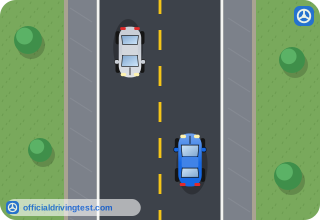
- The left edge of the lanes going in your direction
- A boundary between opposing traffic
- A place where passing is permitted
- The right edge of the traffic lane
Show answer
Correct answer: The right edge of the traffic lane
A solid white line marks the right edge of the traffic lane.
Source: Tennessee Comprehensive Driver License Manual (March 2025 printing), page 42 · Open this page in the manual (Manual page 42)
-
A solid or broken yellow line along the side of a road indicates what?
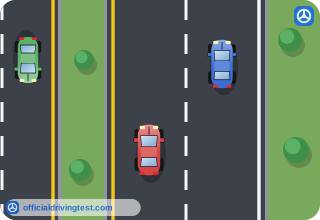
- The left edge of the traffic lanes going in your direction
- The right edge of the traffic lane that you are in
- The edge of a pedestrian walkway next to the road
- The start of a railroad crossing ahead of you
Show answer
Correct answer: The left edge of the traffic lanes going in your direction
A solid or broken yellow line marks the left edge of the lanes going your way.
Source: Tennessee Comprehensive Driver License Manual (March 2025 printing), page 42 · Open this page in the manual (Manual page 42)
-
You find yourself with a yellow line to your right and a white line to your left. What does this mean?
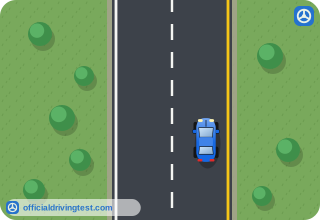
- You are in a passing zone
- You are in an HOV lane
- You are going the wrong way
- You are approaching a railroad crossing
Show answer
Correct answer: You are going the wrong way
Yellow on your right and white on your left means you are driving the wrong way.
Source: Tennessee Comprehensive Driver License Manual (March 2025 printing), page 42 · Open this page in the manual (Manual page 42)
-
On a divided highway, what color line is always on the side of the roadway to the left of the driver, nearest the median?
- A white line
- A broken white line
- No line at all
- A yellow line
Show answer
Correct answer: A yellow line
On a divided highway the line nearest the median, to the driver’s left, is always yellow.
Source: Tennessee Comprehensive Driver License Manual (March 2025 printing), page 42 · Open this page in the manual (Manual page 42)
-
What color are the lines that separate traffic moving in opposite directions?
- Yellow
- White
- Red
- Blue
Show answer
Correct answer: Yellow
Lines separating traffic moving in opposite directions are yellow.
Source: Tennessee Comprehensive Driver License Manual (March 2025 printing), page 42 · Open this page in the manual (Manual page 42)
-
Besides separating traffic moving in opposite directions, what else are yellow lines used for?
- Marking where pedestrians may cross the roadway
- Showing the right edge of the road
- Marking a boundary at a hazard such as bridge supports
- Separating lanes of traffic moving in the same direction
Show answer
Correct answer: Marking a boundary at a hazard such as bridge supports
Yellow lines also mark a boundary or barrier at a particular hazard, such as bridge supports.
Source: Tennessee Comprehensive Driver License Manual (March 2025 printing), page 42 · Open this page in the manual (Manual page 42)
-
What do broken yellow lines between lanes of traffic mean?
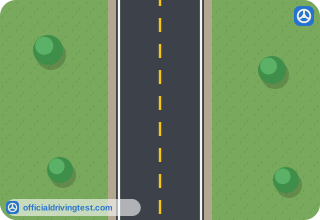
- You may never cross the line, even to pass another car
- You may cross to pass if it is safe and no traffic is oncoming
- You may cross the line only to turn left into a driveway
- You must slow down before crossing the line to pass
Show answer
Correct answer: You may cross to pass if it is safe and no traffic is oncoming
Broken yellow lines allow you to cross to pass when there is no oncoming traffic and it is safe.
Source: Tennessee Comprehensive Driver License Manual (March 2025 printing), page 42 · Open this page in the manual (Manual page 42)
-
What do two solid yellow lines between lanes of traffic mean?
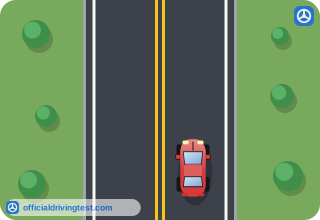
- You may not cross them to pass from either direction
- You may cross them to pass if no oncoming traffic is in view
- Only the driver in the lane next to the line may cross them
- You may cross them only during daylight hours
Show answer
Correct answer: You may not cross them to pass from either direction
Two solid yellow lines may not be crossed from either direction, even with no oncoming traffic in sight.
Source: Tennessee Comprehensive Driver License Manual (March 2025 printing), page 42 · Open this page in the manual (Manual page 42)
-
When may you cross a solid yellow line?
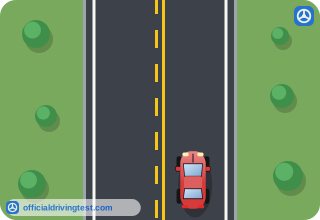
- To pass a slower vehicle when no oncoming traffic is in view
- To change lanes when traffic is heavy
- To turn into a driveway or side road if it is safe
- To pass any vehicle that is below the speed limit
Show answer
Correct answer: To turn into a driveway or side road if it is safe
You may cross a solid yellow line to turn into a driveway or side road when it is safe to do so.
Source: Tennessee Comprehensive Driver License Manual (March 2025 printing), page 42 · Open this page in the manual (Manual page 42)
-
Between opposing lanes there is a solid yellow line and a broken yellow line. The solid line is on your side. What does that mean?
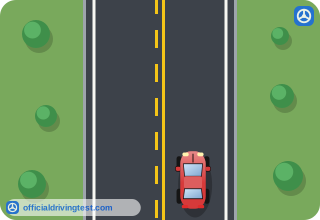
- You are in a passing zone
- You may not pass
- You may pass if no oncoming traffic is in view
- You may pass only during daylight hours
Show answer
Correct answer: You may not pass
With the solid yellow line on your side you may not pass.
Source: Tennessee Comprehensive Driver License Manual (March 2025 printing), page 43 · Open this page in the manual (Manual page 43)
-
Between opposing lanes there is a solid yellow line and a broken yellow line. The broken line is on your side. What does that mean?
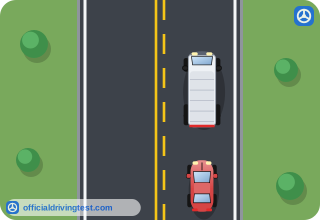
- You may not pass until the solid line ends
- You must slow down and stay in your lane
- You may pass only if the vehicle ahead signals
- You are in the passing zone and may pass if it is safe
Show answer
Correct answer: You are in the passing zone and may pass if it is safe
The broken line on your side means a passing zone, where you may pass when it is safe.
Source: Tennessee Comprehensive Driver License Manual (March 2025 printing), page 43 · Open this page in the manual (Manual page 43)
-
When you pass in a passing zone, by when must you safely return to your side of the roadway?
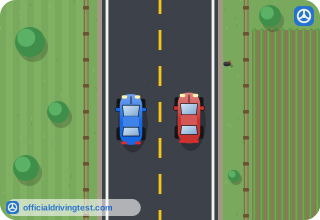
- Before you reach the next side road
- Before the passing zone ends
- Within a few seconds of starting to pass
- After the vehicle you passed signals
Show answer
Correct answer: Before the passing zone ends
You must return safely to your side before the passing zone ends.
Source: Tennessee Comprehensive Driver License Manual (March 2025 printing), page 43 · Open this page in the manual (Manual page 43)
-
What color lane markings separate multiple lanes of traffic that flow in the same direction?
- Yellow
- Red
- Blue
- White
Show answer
Correct answer: White
Multiple lanes flowing in the same direction are separated by white lane markings.
Source: Tennessee Comprehensive Driver License Manual (March 2025 printing), page 43 · Open this page in the manual (Manual page 43)
-
What do broken white lines between lanes of traffic mean?
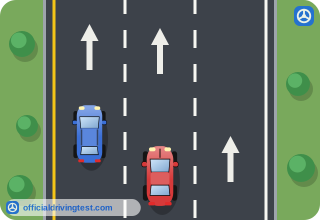
- You may cross the lines to pass or change lanes if it is safe
- You may never cross the lines
- You may cross the lines only to turn into a driveway
- You may cross the lines only on a freeway
Show answer
Correct answer: You may cross the lines to pass or change lanes if it is safe
Broken white lines allow you to cross to pass or change lanes when it is safe.
Source: Tennessee Comprehensive Driver License Manual (March 2025 printing), page 43 · Open this page in the manual (Manual page 43)