South Dakota: Pedestrians Practice Test
Yielding to pedestrians at crosswalks and mid-block crossings, children and people who may be confused.
Independent educational site · not affiliated with any government agency or DMV
Ready? Test yourself
- Instant feedback with an explanation
- Every answer cites its source in the manual
- Your best score is saved on this device
- Keyboard: press 1 to 4 to answer and Enter for the next question
Questions are original and based on the official manual "South Dakota Driver License Manual" (Revised 11/2024), South Dakota Department of Public Safety.
All 20 questions in this practice test
Take the test above first, then use this list to study. Tap “Show answer” to see the correct answer and explanation.
Show the questions and answersHide the questions
-
What must you do for pedestrians at a crosswalk?
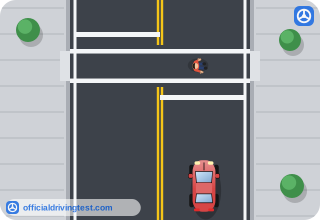
- Yield to pedestrians entering or in the crosswalk
- Yield only if they have already started to cross
- Sound your horn and continue forward slowly
- Stop only at crosswalks that are marked
Show answer
Correct answer: Yield to pedestrians entering or in the crosswalk
You must yield to pedestrians who are entering or already in a crosswalk.
Source: South Dakota Driver License Manual (Revised 11/2024), page 37
-
You must stop at an intersection and no crosswalk is apparent. Where must you stop?
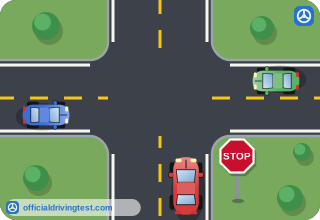
- In the middle of the intersection
- Just past the intersection
- Before entering the intersection
- At the far side of the intersection
Show answer
Correct answer: Before entering the intersection
Not all crosswalks are marked, so if none is apparent you must stop before you enter the intersection.
Source: South Dakota Driver License Manual (Revised 11/2024), page 37
-
There is a stop line before the crosswalk. Which must you obey first?
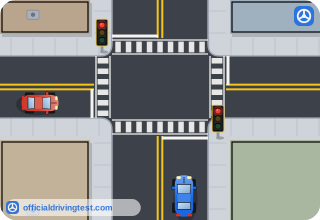
- The stop line
- The crosswalk
- Whichever one has a pedestrian near it
- Neither, if no pedestrian is walking
Show answer
Correct answer: The stop line
When a stop line comes before the crosswalk, the stop line must be obeyed first.
Source: South Dakota Driver License Manual (Revised 11/2024), page 37
-
What does the manual say you should never do as a pedestrian at a roundabout?
- Use the crosswalk on each approach
- Walk along the sidewalk around the roundabout
- Cross the circulating lanes to the center island
- Wait at the curb for vehicles to yield
Show answer
Correct answer: Cross the circulating lanes to the center island
The manual warns pedestrians never to cross the circulating lanes of a roundabout to the center island.
Source: South Dakota Driver License Manual (Revised 11/2024), page 39
-
Whom must you yield to when approaching and when exiting a roundabout?
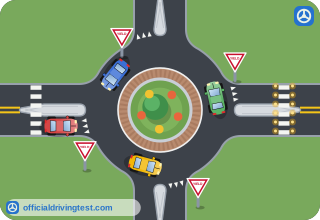
- Only other motor vehicles
- Pedestrians and bicyclists
- No one, because you have the right-of-way
- Only vehicles in the roundabout
Show answer
Correct answer: Pedestrians and bicyclists
The steps say to yield to pedestrians and bicyclists on the approach, and again when exiting.
Source: South Dakota Driver License Manual (Revised 11/2024), page 40
-
Where do pedestrians cross at a diverging diamond interchange (DDI)?
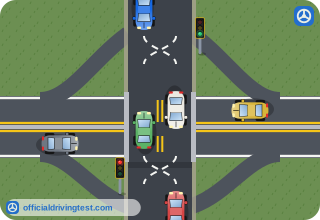
- Anywhere along the ramps
- Anywhere between the two sets of signals
- Only at the crosswalks
- Across the median
Show answer
Correct answer: Only at the crosswalks
Pedestrians use designated walkways and cross only at the crosswalks.
Source: South Dakota Driver License Manual (Revised 11/2024), page 42
-
Where should you always watch for children crossing the street, running, or riding into the street without looking?
- Interstate highways and freeway ramps
- Narrow bridges, tunnels, and rural roads
- Schools, playgrounds, and residential streets
- Acceleration lanes and merge ramps
Show answer
Correct answer: Schools, playgrounds, and residential streets
Schools, playgrounds, and residential streets often have children present.
Source: South Dakota Driver License Manual (Revised 11/2024), page 46
-
Before beginning a right turn, what must you check?
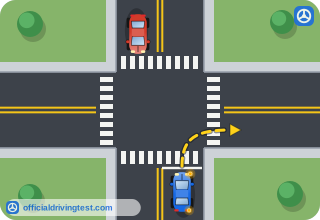
- Whether the vehicle behind you is a truck
- Whether the curb has a parking space
- Pedestrians crossing where you will be turning
- Whether the crosswalk has a painted border
Show answer
Correct answer: Pedestrians crossing where you will be turning
Do not begin a turn without checking for pedestrians crossing where you will turn.
Source: South Dakota Driver License Manual (Revised 11/2024), page 48
-
What should you do when you are near bicyclists and pedestrians, especially children?
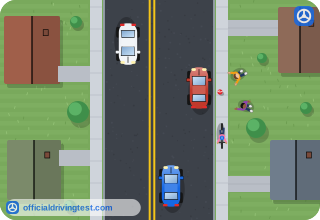
- Pass close to them to clear the lane quickly
- Sound the horn as you drive alongside
- Give extra space and do not drive alongside them
- Drive alongside them at a slow speed
Show answer
Correct answer: Give extra space and do not drive alongside them
They can move into your path quickly and without warning, so wait until it is safe to pass in the adjoining lane.
Source: South Dakota Driver License Manual (Revised 11/2024), page 52
-
A pedestrian is crossing at an intersection and has the right-of-way. What should you do?
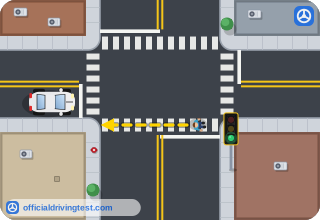
- Tap the horn so the pedestrian hurries
- Sound a sharp blast
- Not use the horn, and yield the right-of-way
- Drive around the pedestrian
Show answer
Correct answer: Not use the horn, and yield the right-of-way
Pedestrians and bicyclists crossing at an intersection have the right-of-way.
Source: South Dakota Driver License Manual (Revised 11/2024), page 55
-
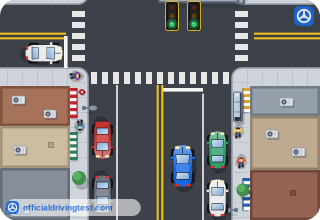
Which pedestrians should you always be prepared to yield to?
- Only pedestrians in a marked crosswalk
- Only pedestrians who have a walk signal
- Only pedestrians at intersections with traffic signals
- Pedestrians, even if they are not in a crosswalk
Show answer
Correct answer: Pedestrians, even if they are not in a crosswalk
The manual says to always be ready to yield to pedestrians even when they are not in a crosswalk.
Source: South Dakota Driver License Manual (Revised 11/2024), page 61
-
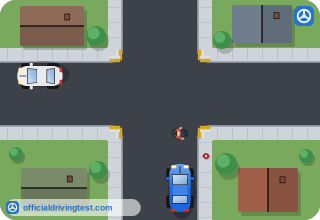
A pedestrian is crossing at an intersection where no crosswalk is marked. What should you do?
- Go ahead because there is no crosswalk
- Yield to the pedestrian
- Sound your horn so the pedestrian hurries
- Go ahead if the pedestrian is on the far side of the road
Show answer
Correct answer: Yield to the pedestrian
The manual says to yield to pedestrians crossing at intersections even when a crosswalk is not marked.
Source: South Dakota Driver License Manual (Revised 11/2024), page 61
-
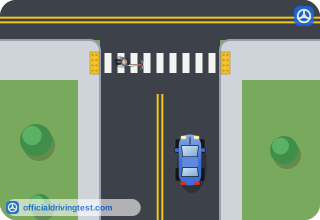
A pedestrian is crossing the street guided by a dog or carrying a white cane. What must you do?
- Slow down and sound your horn
- Slow down and pass behind the pedestrian
- Come to a complete stop and yield the right-of-way
- Flash your headlights so the pedestrian can hurry
Show answer
Correct answer: Come to a complete stop and yield the right-of-way
You must always yield to persons who are visually impaired, and a guide dog or white cane means a complete stop.
Source: South Dakota Driver License Manual (Revised 11/2024), page 61
-
Your traffic light is green but pedestrians are still in the intersection. What should you do?
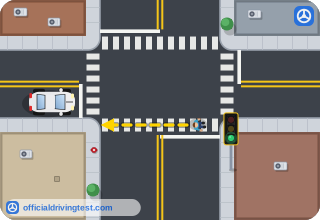
- Yield the right-of-way to them
- Go ahead because you have the green light
- Honk to ask them to hurry
- Go ahead if there is traffic behind you
Show answer
Correct answer: Yield the right-of-way to them
Pedestrians in the intersection have the right-of-way even if the traffic light is green.
Source: South Dakota Driver License Manual (Revised 11/2024), page 61
-
What should you be prepared to do for pedestrians when you make a right or left turn on red?
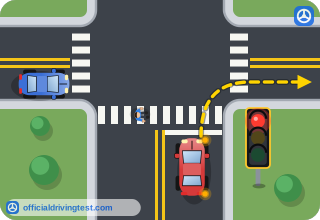
- Yield the right-of-way to them
- Sound your horn so they know you are turning
- Turn first because you were stopped first
- Stop only if they are in a marked crosswalk
Show answer
Correct answer: Yield the right-of-way to them
When turning on red, be prepared to yield the right-of-way to pedestrians.
Source: South Dakota Driver License Manual (Revised 11/2024), page 61
-
Why should you slow down when driving next to parked or stopped vehicles?
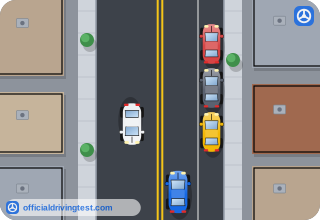
- Their drivers are required to yield to you
- The speed limit is lower beside parked vehicles
- Pedestrians can walk out between the vehicles
- Their tires may throw gravel at your vehicle
Show answer
Correct answer: Pedestrians can walk out between the vehicles
Pedestrians may step out from between parked or stopped vehicles, so you slow down and do not pass until you are sure none are crossing.
Source: South Dakota Driver License Manual (Revised 11/2024), page 61
-
Where should you be especially careful to check for pedestrians in your path before backing?
- On freeway shoulders and interstate ramps
- In parking lots or places with many pedestrians
- On rural roads that have no sidewalks
- On any road posted at 35 mph or more
Show answer
Correct answer: In parking lots or places with many pedestrians
The manual says to check for pedestrians before backing, especially in parking lots or places where there are many pedestrians.
Source: South Dakota Driver License Manual (Revised 11/2024), page 61
-
Near playgrounds and residential areas where children could run out from between parked vehicles, what does the manual say is a good idea?
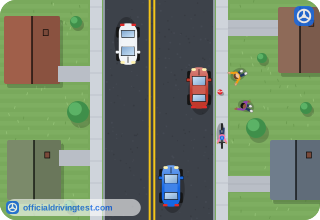
- Drive at the speed limit and keep your horn ready
- Keep up with traffic and use your horn often
- Drive at the speed limit and keep to the center of the street
- Drive slower than the speed limit and be prepared to stop quickly
Show answer
Correct answer: Drive slower than the speed limit and be prepared to stop quickly
Children may run out from between parked vehicles, so driving slower than the limit and being ready to stop is a good idea.
Source: South Dakota Driver License Manual (Revised 11/2024), page 61
-
In a school zone, when must you obey a slower speed limit?
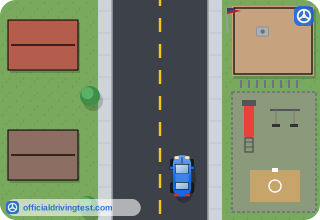
- Only when a school bus is loading
- Only during the morning hours
- Only when a crossing guard is in the street
- When lights are flashing or children are present
Show answer
Correct answer: When lights are flashing or children are present
The manual says to obey a slower speed limit in a school zone when lights are flashing or children are present.
Source: South Dakota Driver License Manual (Revised 11/2024), page 61
-
At a school crossing with a traffic patrol, what must you do if the patrol signals you?
- Slow down and pass with caution
- Stop and yield
- Proceed if no children are in sight
- Sound your horn and proceed
Show answer
Correct answer: Stop and yield
At a school crossing with traffic patrol you stop and yield when signaled to do so.
Source: South Dakota Driver License Manual (Revised 11/2024), page 61