Rhode Island: Signals and vehicle controls — Part 2 Practice Test
Questions in this part include: “During which hours does the law require motorists to turn their headlights on?” · “What does Rhode Island law make the motorist responsible for removing from the vehicle in winter?”
Independent educational site · not affiliated with any government agency or DMV
Ready? Test yourself
- Instant feedback with an explanation
- Every answer cites its source in the manual
- Your best score is saved on this device
- Keyboard: press 1 to 4 to answer and Enter for the next question
Questions are original and based on the official manual "Rhode Island Driver’s Manual" (April 2024), Rhode Island Division of Motor Vehicles (DMV).
All 20 questions in this practice test
Take the test above first, then use this list to study. Tap “Show answer” to see the correct answer and explanation.
Show the questions and answersHide the questions
-
During which hours does the law require motorists to turn their headlights on?
- From sunset to sunrise
- From one hour after sunset to one hour before sunrise
- From 6 p.m. to 6 a.m.
- Only when it is completely dark
Show answer
Correct answer: From sunset to sunrise
The law requires headlights on from sunset to sunrise, whenever you cannot see 500 feet ahead, and when the wipers are in use.
Source: Rhode Island Driver’s Manual (April 2024), page 52
-
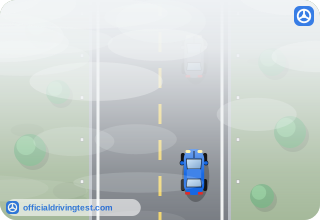
Headlights must be on any time you cannot see how far ahead of you?
- 100 feet
- 300 feet
- 500 feet
- 1,000 feet
Show answer
Correct answer: 500 feet
The law requires headlights on any time you cannot see 500 feet ahead.
Source: Rhode Island Driver’s Manual (April 2024), page 52
-
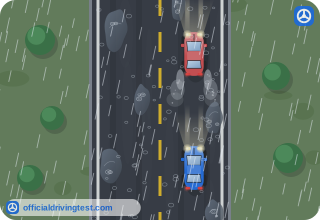
When must you turn your headlights on because of rain, sleet or snow?
- Only after sunset
- Whenever your windshield wipers are in use
- Only when it is also foggy
- Only when you cannot see 100 feet ahead
Show answer
Correct answer: Whenever your windshield wipers are in use
The law requires headlights on when the windshield wipers are in use because of rain, sleet, snow or similar weather.
Source: Rhode Island Driver’s Manual (April 2024), page 52
-
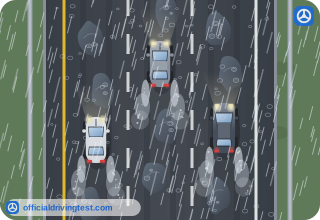
What kind of headlights does the law require you to use in inclement weather such as snow, rain and fog?
- High beam headlights
- Parking lights only
- Fog lights only
- Low beam headlights
Show answer
Correct answer: Low beam headlights
The law requires low beams when weather reduces visibility.
Source: Rhode Island Driver’s Manual (April 2024), page 52
-
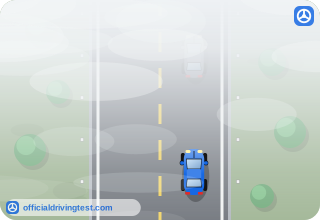
Why should you not use high beams in snow, rain or fog?
- They may reflect off snow, rain or fog and shorten the distance you can see
- They use too much battery power when the wipers are also running
- They make the brake lights of other drivers harder to see ahead
- They are not allowed on any road with a posted speed limit
Show answer
Correct answer: They may reflect off snow, rain or fog and shorten the distance you can see
High beams can reflect off precipitation or fog in the air and reduce how far you can see.
Source: Rhode Island Driver’s Manual (April 2024), page 52
-
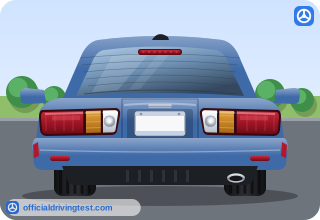
The rear license plate on your vehicle must be lit so it can be seen and read from at least how far behind the vehicle?
- 20 feet
- 100 feet
- 60 feet
- 150 feet
Show answer
Correct answer: 60 feet
The manual says the rear plate must be lit so it can be read at least 60 feet from the back of the vehicle.
Source: Rhode Island Driver’s Manual (April 2024), page 52
-
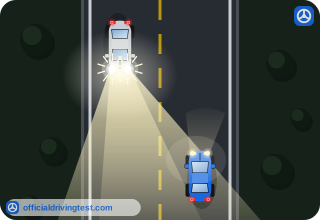
On the open highway at night, at what distance should you dim your high beams when approaching another vehicle?
- At 100 feet
- Promptly, at least 500 feet ahead
- At 300 feet
- Only when the other driver flashes lights at you
Show answer
Correct answer: Promptly, at least 500 feet ahead
The 500/200 rule says to dim promptly at a distance of at least 500 feet when approaching another vehicle.
Source: Rhode Island Driver’s Manual (April 2024), page 53
-
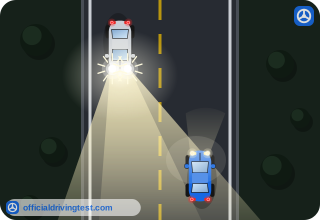
To avoid being temporarily blinded by approaching headlights, where should you glance?
- At the right edge of the roadway
- Directly at the oncoming headlights
- At the center line
- At your rear-view mirror
Show answer
Correct answer: At the right edge of the roadway
Glancing at the right edge of the road or fog line until the bright lights pass helps your vision return to normal.
Source: Rhode Island Driver’s Manual (April 2024), page 53
-
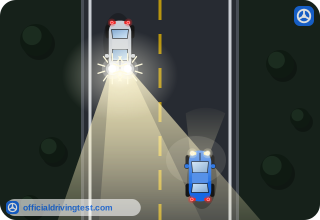
What is the temporary blindness that follows staring into oncoming headlights called?
- Night adjustment time
- Glare recovery time
- Headlight delay
- Reaction recovery period
Show answer
Correct answer: Glare recovery time
The time your body takes to regain sight after glare is called glare recovery time.
Source: Rhode Island Driver’s Manual (April 2024), page 53
-
During which hours must vehicle headlights be on, regardless of weather?
- Only from one hour after sunset to one hour before sunrise
- Only after 9 p.m. each night
- Any time from sunset to sunrise
- Only between midnight and sunrise
Show answer
Correct answer: Any time from sunset to sunrise
The manual says headlights must be on any time from sunset to sunrise, as well as when you cannot see 500 feet ahead.
Source: Rhode Island Driver’s Manual (April 2024), page 58
-
Which situation requires your headlights to be on during the day?
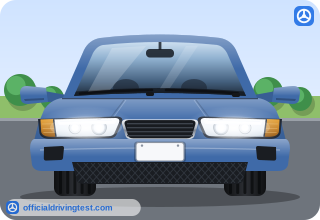
- Any time your windshield wipers are on
- Only when you are driving on a highway
- Only when another vehicle is within 200 feet
- Only when you are carrying passengers
Show answer
Correct answer: Any time your windshield wipers are on
The list of laws says headlights must be on any time the windshield wipers are on.
Source: Rhode Island Driver’s Manual (April 2024), page 58
-
What does Rhode Island law make the motorist responsible for removing from the vehicle in winter?
- Snow and ice that limit vision, including snow on the roof
- Only snow on the windshield, never the roof
- Only ice on the license plate
- Nothing, because snow may stay on the vehicle if it is light
Show answer
Correct answer: Snow and ice that limit vision, including snow on the roof
The motorist must clear snow and ice that limit vision and must clear the roof of snow that could blow onto other vehicles’ windshields.
Source: Rhode Island Driver’s Manual (April 2024), page 58
-
What does the manual say you are required by law to do regarding your vehicle's condition?
- Have a certified mechanic check the whole vehicle every month
- Maintain its serviceability and required equipment
- Replace all four tires every year, worn or not
- Service it only at a licensed dealership
Show answer
Correct answer: Maintain its serviceability and required equipment
The equipment chapter says state law requires you to keep your vehicle serviceable and to comply with the equipment the law mandates.
Source: Rhode Island Driver’s Manual (April 2024), page 68
-
A tire with less than what amount of tread may you not drive on?
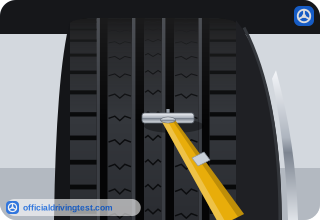
- 2/32 of an inch
- 1/32 of an inch
- 4/32 of an inch
- 6/32 of an inch
Show answer
Correct answer: 2/32 of an inch
The manual says you may not drive on a tire with less than 2/32 of an inch of tread.
Source: Rhode Island Driver’s Manual (April 2024), page 68
-
Which coin does the manual say to use to measure the depth of tire tread?
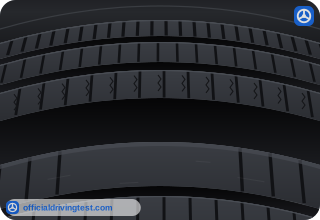
- A penny
- A nickel
- A quarter
- A dime
Show answer
Correct answer: A quarter
The manual says to measure the depth of the tread with a quarter.
Source: Rhode Island Driver’s Manual (April 2024), page 68
-
What does the manual say about mixing radial tires with bias-belted tires on your vehicle?
- It is allowed on the rear axle only
- Never do it
- It is allowed if the tread depth matches
- It is allowed for winter driving only
Show answer
Correct answer: Never do it
The manual says never to mix and match tires, such as radial with bias-belted.
Source: Rhode Island Driver’s Manual (April 2024), page 68
-
To get an accurate reading, when should you measure your tire pressure?
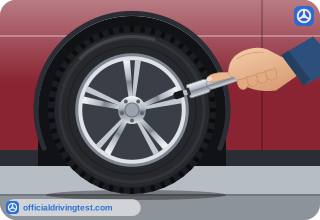
- After a long highway drive
- While the tire is hot
- Right after the engine is started
- While the tire is cold
Show answer
Correct answer: While the tire is cold
The manual says to measure tire pressure while the tire is cold to get an accurate reading.
Source: Rhode Island Driver’s Manual (April 2024), page 68
-
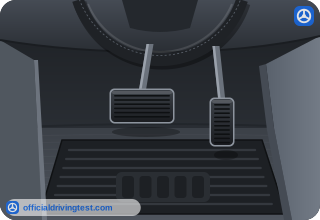
When does the manual say you should schedule brake repairs?
- Only after the pedal touches the floor
- Only when the brake warning light comes on
- Once a year when the vehicle is inspected
- Without waiting for the pedal to touch the floor
Show answer
Correct answer: Without waiting for the pedal to touch the floor
The manual warns not to wait for the brake pedal to touch the floor before scheduling repairs.
Source: Rhode Island Driver’s Manual (April 2024), page 68
-
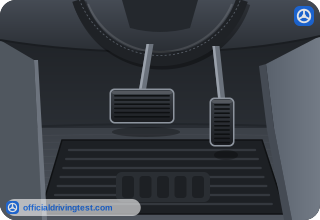
Which brake symptom does the manual say should prompt you to follow the maintenance checks in your owner's manual?
- The pedal feels firm
- The vehicle pulls to one side while braking
- The vehicle stops in a straight line
- The pedal returns quickly after braking
Show answer
Correct answer: The vehicle pulls to one side while braking
The manual says that if the vehicle pulls to one side while braking, or the pedal feels spongy, you should follow the prescribed maintenance checks.
Source: Rhode Island Driver’s Manual (April 2024), page 68
-
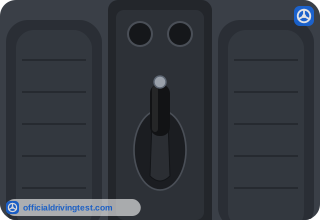
What does the manual say about the parking brake?
- It is optional equipment
- It needs checking only on hills
- It must also be in proper working order
- It needs no maintenance because it is rarely used
Show answer
Correct answer: It must also be in proper working order
The manual says the parking brake helps stop a vehicle's movement, so it too must be in proper working order.
Source: Rhode Island Driver’s Manual (April 2024), page 68