Rhode Island: Signals and vehicle controls — Part 1 Practice Test
Questions in this part include: “If you take your driving skills test in the rain, what should you know beforehand?” · “The manual recommends activating your hazard lights when you back up for a distance greater than how many feet?”
Independent educational site · not affiliated with any government agency or DMV
Ready? Test yourself
- Instant feedback with an explanation
- Every answer cites its source in the manual
- Your best score is saved on this device
- Keyboard: press 1 to 4 to answer and Enter for the next question
Questions are original and based on the official manual "Rhode Island Driver’s Manual" (April 2024), Rhode Island Division of Motor Vehicles (DMV).
All 20 questions in this practice test
Take the test above first, then use this list to study. Tap “Show answer” to see the correct answer and explanation.
Show the questions and answersHide the questions
-
If you take your driving skills test in the rain, what should you know beforehand?
- Which route the examiner will use when the roads are wet
- Where the wiper and headlight controls are and how to adjust them
- Where the radio and air conditioning controls are and how to adjust them
- Where the examiner's own controls are and how to operate them
Show answer
Correct answer: Where the wiper and headlight controls are and how to adjust them
In the rain you should already know where the wiper and headlight controls are and how to adjust them.
Source: Rhode Island Driver’s Manual (April 2024), page 13
-
How familiar must you be with the controls of the vehicle you use for the driving skills test?
- Familiar with the lights and wipers only
- Familiar enough to find them with the examiner's help
- Familiar after a short demonstration by the examiner
- Fully familiar, without having to look for them
Show answer
Correct answer: Fully familiar, without having to look for them
The driver must know every control of the vehicle well enough to use it without searching for it.
Source: Rhode Island Driver’s Manual (April 2024), page 13
-
How is the hazard light button usually indicated?
- By a red or white triangle
- By a blue circle with a white dot
- By a green arrow pointing up
- By a yellow square with an X
Show answer
Correct answer: By a red or white triangle
The hazard light button is usually marked with a red or white triangle.
Source: Rhode Island Driver’s Manual (April 2024), page 13
-
Where is the hazard light button normally located?
- On the floor beside the parking brake or the seat
- On the driver's door panel near the window controls
- On top of the steering column or in the center of the dash
- Under the left side of the dash beside the hood release
Show answer
Correct answer: On top of the steering column or in the center of the dash
The button is normally on top of the steering column or in the center of the dash.
Source: Rhode Island Driver’s Manual (April 2024), page 14
-
What does the manual say to do before entering your vehicle?
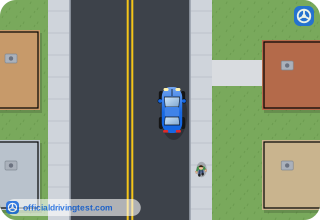
- Check in front and behind it for objects, animals, or persons in your path
- Check the air pressure in every tire with a tire gauge you carry
- Turn on the headlights and the wipers to make sure they both work
- Ask a passenger to walk around the vehicle and sound the horn
Show answer
Correct answer: Check in front and behind it for objects, animals, or persons in your path
Safe driving starts before the engine is on, so the manual says to check the area in front of and behind the vehicle for anything in your path.
Source: Rhode Island Driver’s Manual (April 2024), page 26
-
Which of these is one of the steps the manual lists to take every time you get in your vehicle?
- Set the cruise control
- Turn on the high-beam headlights
- Adjust the head restraint
- Warm up the engine for one minute
Show answer
Correct answer: Adjust the head restraint
The manual's list of steps to take every time you get in includes adjusting the head restraint.
Source: Rhode Island Driver’s Manual (April 2024), page 26
-
Before starting the engine, what does the manual say to ask your passengers to do?
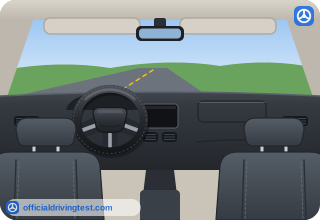
- Turn off their phones
- Fasten their seat belts
- Move to the back seat
- Open their windows
Show answer
Correct answer: Fasten their seat belts
Asking passengers to fasten their seat belts is one of the steps listed for every time you get in your vehicle.
Source: Rhode Island Driver’s Manual (April 2024), page 26
-
On the driving test, what will the examiner tell you to do when you stop and start on a hill?
- Drive to the right side of the road, stop, set the parking brake, and shift to neutral
- Drive to the left side of the road, stop, and put the vehicle in park
- Stop in the travel lane, release the parking brake, and shift to reverse
- Drive to the right side of the road, stop, and keep your foot on the accelerator
Show answer
Correct answer: Drive to the right side of the road, stop, set the parking brake, and shift to neutral
The examiner has you drive to the right side, stop, set the parking brake and shift to neutral.
Source: Rhode Island Driver’s Manual (April 2024), page 33
-
When you stop on a hill with the parking brake set, what must the parking brake do?
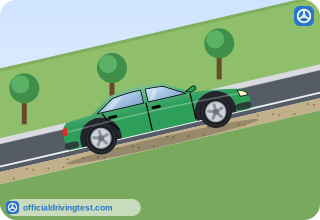
- Slow the vehicle gradually while it is still moving
- Replace the need to shift to neutral
- Hold the vehicle from rolling back
- Release automatically when the engine starts
Show answer
Correct answer: Hold the vehicle from rolling back
The manual says the parking brake must hold the vehicle from rolling back.
Source: Rhode Island Driver’s Manual (April 2024), page 33
-
When starting your vehicle on a hill, which shoulder should you look over to be sure that traffic is clear?
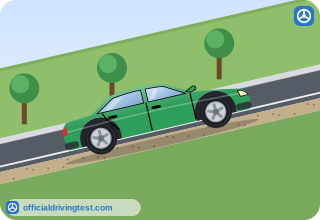
- Your right shoulder
- Your left shoulder
- Neither, because mirrors are enough
- Your right shoulder, but only at night
Show answer
Correct answer: Your left shoulder
Before driving out, you look over your left shoulder to make sure traffic is clear.
Source: Rhode Island Driver’s Manual (April 2024), page 33
-
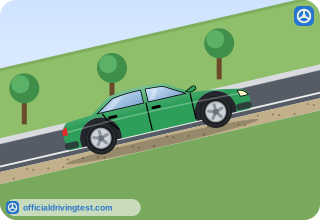
In a vehicle with a standard shift, what should you be able to do when starting on a hill?
- Roll back a short distance before the vehicle moves forward
- Start without releasing the parking brake
- Keep the vehicle in neutral while you drive up the hill
- Drive up the hill without rolling back
Show answer
Correct answer: Drive up the hill without rolling back
The manual says a driver of a standard shift should be able to drive up the hill without rolling back.
Source: Rhode Island Driver’s Manual (April 2024), page 33
-
The manual recommends activating your hazard lights when you back up for a distance greater than how many feet?
- 10 feet
- 20 feet
- 50 feet
- 30 feet
Show answer
Correct answer: 30 feet
It is recommended that you use your hazard lights if you back up more than 30 feet.
Source: Rhode Island Driver’s Manual (April 2024), page 34
-
While backing, over which shoulder should you look?
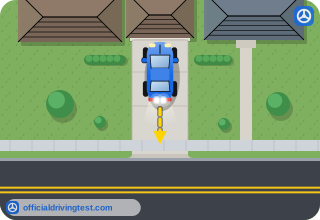
- Your right shoulder, partially turning your body
- Your left shoulder, partially turning your body
- Neither, because the rear-view mirror shows everything
- Your left shoulder, but only when backing into a driveway
Show answer
Correct answer: Your right shoulder, partially turning your body
The manual says to look over your right shoulder while keeping proper control of the vehicle.
Source: Rhode Island Driver’s Manual (April 2024), page 34
-
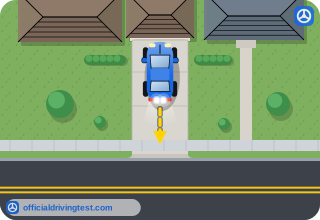
When backing in a straight line, what should you do periodically?
- Sound the horn to warn any pedestrians behind the vehicle
- Tap the brakes so the brake lights flash behind you
- Check all mirrors for vehicles, pedestrians, or obstacles
- Turn off the engine so you can look behind you
Show answer
Correct answer: Check all mirrors for vehicles, pedestrians, or obstacles
You should periodically check all mirrors to be sure nothing is in your path of travel.
Source: Rhode Island Driver’s Manual (April 2024), page 34
-
Which hand signal does the manual give for a left turn?
- Left hand and arm straight out, held still
- Left hand and arm up, held still
- Left hand and arm down, held still
- Right hand and arm straight out, held still
Show answer
Correct answer: Left hand and arm straight out, held still
For a left turn the driver puts the left hand and arm straight out and keeps them still.
Source: Rhode Island Driver’s Manual (April 2024), page 38
-
Which hand signal does the manual give for a right turn?
- Left hand and arm straight out, held still
- Left hand and arm down, held still
- Left hand and arm up, held still
- Right hand and arm straight out, held still
Show answer
Correct answer: Left hand and arm up, held still
For a right turn the driver puts the left hand and arm up and keeps them still.
Source: Rhode Island Driver’s Manual (April 2024), page 38
-
Which hand signal does the manual give for stopping or slowing down?
- Left hand and arm up, held still
- Left hand and arm down, held still
- Left hand and arm straight out, held still
- Right hand and arm up, held still
Show answer
Correct answer: Left hand and arm down, held still
To show that you are stopping or slowing, the left hand and arm go down and stay still.
Source: Rhode Island Driver’s Manual (April 2024), page 38
-
At a minimum, how far before making a turn does Rhode Island law say a driver must signal?
- At least 25 feet
- At least 50 feet
- At least 300 feet
- At least 100 feet
Show answer
Correct answer: At least 100 feet
The law requires a hand or directional-light signal at least 100 feet before a turn.
Source: Rhode Island Driver’s Manual (April 2024), page 38
-
Besides before making a turn, when does Rhode Island law say a driver must signal by hand or by directional lights?
- When driving out of a parking space
- When driving straight through an intersection
- When driving on a road with no other vehicles
- When parked with the engine off
Show answer
Correct answer: When driving out of a parking space
The law names driving out of a parking space as a time to signal, along with at least 100 feet before a turn.
Source: Rhode Island Driver’s Manual (April 2024), page 38
-
When should a driver give a signal?
- Only at the moment the turn actually begins
- Only when a police officer is close behind you
- Early enough for drivers behind to know your plan
- Only when turning to the right at an intersection
Show answer
Correct answer: Early enough for drivers behind to know your plan
Signals should be given early enough that drivers in back of you can tell what you plan to do.
Source: Rhode Island Driver’s Manual (April 2024), page 38