Pavement markings in Rhode Island
The Rhode Island Driver’s Manual shows or names everything on this page: 14 in all, on pages 32, 38–40, 55.
Independent educational site · not affiliated with any government agency or DMV
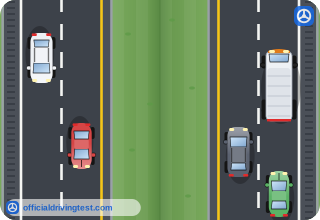
Divided Roadway (Median Strip)
Divided roadway delineated by a median strip, jersey barrier, guard rail, etc.
Manual page 39
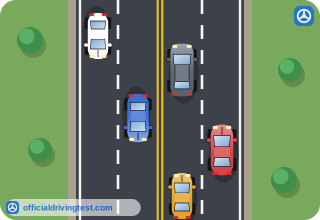
Multi-Lane Roadway
Multi-lane roadway. Solid lines separate lanes of traffic. Motorists are not permitted to pass other vehicles nor change lanes.
Manual page 39
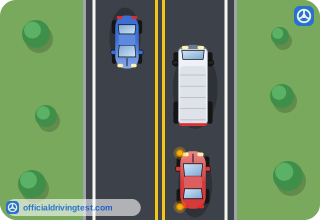
Passing Prohibited Both Directions (Double Solid Line)
Two-lane, two-way roadway, passing prohibited in both directions. Single or double solid yellow lines separate traffic traveling in opposite directions. They prohibit motorists from passing other vehicles.
Manual page 39
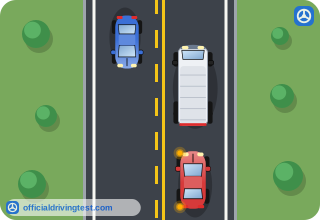
Passing Prohibited One Direction
Two-lane, two-way roadway, passing prohibited in one direction. Motorists with the solid line on their side of the roadway should not pass another vehicle. Motorists with the broken line at the drivers’ side may pass another vehicle with care.
Manual page 39
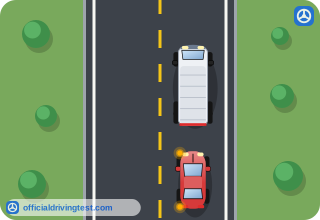
Passing Permitted (Broken Center Line)
Two-lane, two-way roadway, passing is permitted. Broken yellow lines separate traffic traveling in opposite directions. Passing another vehicle is permitted with care.
Manual page 39
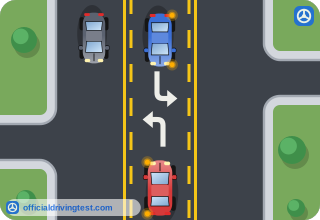
Shared Left Turn Lane
Shared Left Turn Lane: All vehicles use the center lane for left turns in and out of left side streets/driveways. A shared turn lane is the center lane of traffic set apart from the travel lanes by solid single yellow lines on the outside and broken yellow lines inside the shared turn lane. The lane also has arrows painted on the pavement and usually signs indicating restriction for use of the lane for turning only. Motorists wishing to turn shall not enter the lane unless they intend to turn within 100 feet (minimum).
Manual page 39
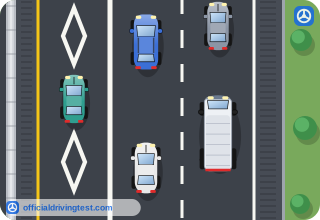
HOV Lane (Diamond Marking)
HOV Lane: High Occupancy Vehicle – Carpooling.
Manual page 39
Reversible Lanes
Reversible Lanes: Motorist may travel in lane with green arrow.
Manual page 39
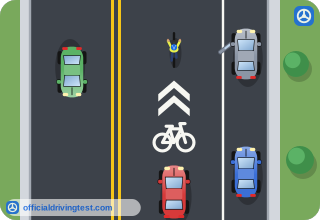
Shared Lane Marking (Sharrow)
The road marking in the picture is a “shared lane” marking. Assist bicyclist with lateral positioning in a shared lane with on-street parallel parking in order to reduce the chance of a bicyclist impacting the door of a parked vehicle. Assist bicyclists with lateral positioning in lanes that are too narrow for a motor vehicle and a bicycle to travel side by side within the same traffic lane. Alert road users of the lateral location bicyclists are likely to occupy within a traveled way. Encourage safe passing of bicyclists by motorists. Reduce the incidence of wrong-way bicycling. A shared-lane marking, installed in the center of a travel lane to indicate that a bicyclist may use the full lane.
Manual page 55
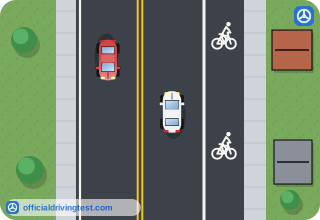
Bicycle Lane
In Rhode Island, bicycle lanes on the road are clearly marked with a solid white line, with the words “Bicycle Lane” and include bicycle symbols. Do not drive in a bicycle lane.
Manual page 55
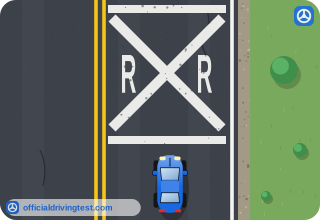
Railroad Crossing Pavement Marking (RR)
Other roadway markings consist of: Crosswalks, Xing, RR, stop lines, parking lanes, reversible lanes, restricted lanes, and shared turn lanes. Be alert to signs and roadway markings indicating a railroad crossing is ahead (RR), circular yellow sign.
Manual page 38
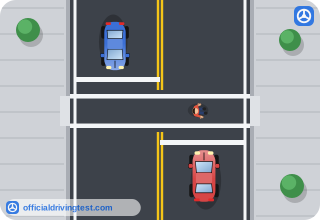
Crosswalk
Use crosswalks. The main purpose of crosswalks is to encourage pedestrians to cross only at certain locations where crossings can be made safely. Any intersection of public roads constitutes a legal crosswalk whether it is marked or not.
Manual page 40
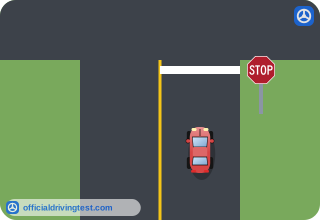
Stop Line
In the event there is no crosswalk, the driver shall stop at a clearly marked stop line.
Manual page 32
Disabled Parking (Pavement Symbol)
Disabled Parking with Permit Only.
Manual page 40