Rhode Island: Pavement markings Practice Test
Solid and broken lines, yellow and white lines, shared left-turn lanes, HOV and reversible lanes, and shared-lane markings for bicycles.
Independent educational site · not affiliated with any government agency or DMV
Ready? Test yourself
- Instant feedback with an explanation
- Every answer cites its source in the manual
- Your best score is saved on this device
- Keyboard: press 1 to 4 to answer and Enter for the next question
Questions are original and based on the official manual "Rhode Island Driver’s Manual" (April 2024), Rhode Island Division of Motor Vehicles (DMV).
All 23 questions in this practice test
Take the test above first, then use this list to study. Tap “Show answer” to see the correct answer and explanation.
Show the questions and answersHide the questions
-
What does a solid line separating lanes of traffic prohibit?
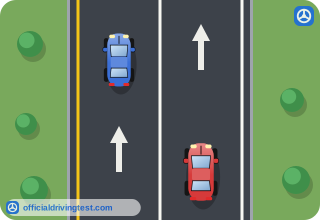
- Stopping for any reason
- Passing other vehicles and changing lanes
- Driving faster than the traffic around you
- Driving below the posted speed limit
Show answer
Correct answer: Passing other vehicles and changing lanes
Motorists are not permitted to pass other vehicles or change lanes across a solid lane line.
Source: Rhode Island Driver’s Manual (April 2024), page 38
-
Broken lines separating lanes allow motorists to change lanes when the lines are which color?
- Yellow
- Red
- Blue
- White
Show answer
Correct answer: White
The manual says broken lines permit passing in yellow or white, and lane changes only for white lines.
Source: Rhode Island Driver’s Manual (April 2024), page 38
-
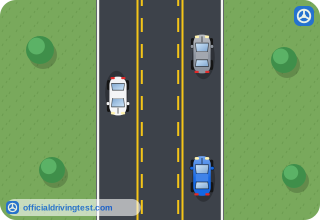
A solid line is painted next to a broken line on a two-lane road. What should a driver with the solid line on their side of the road do?
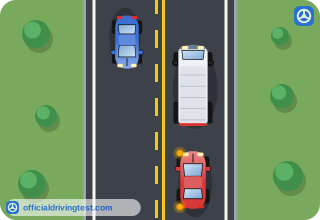
- Not pass another vehicle
- Pass another vehicle only with extra care
- Pass another vehicle only after coming to a stop
- Cross the solid line to pass slow vehicles
Show answer
Correct answer: Not pass another vehicle
A driver with the solid line on their side of the road should not pass another vehicle.
Source: Rhode Island Driver’s Manual (April 2024), page 38
-
A solid line is painted next to a broken line on a two-lane road. What may a driver with the broken line on their side do?
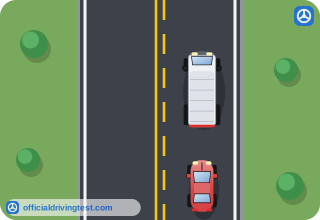
- Never pass under any circumstances
- Pass only after coming to a stop
- Pass another vehicle with care
- Pass only at night
Show answer
Correct answer: Pass another vehicle with care
The driver with the broken line at their side may pass another vehicle with care.
Source: Rhode Island Driver’s Manual (April 2024), page 38
-
What do yellow lines on the road separate?
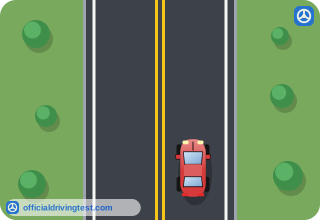
- Traffic moving in the same direction
- Traffic traveling in opposite directions
- Parking spaces from travel lanes
- Bicycle lanes from sidewalks
Show answer
Correct answer: Traffic traveling in opposite directions
Yellow lines separate traffic that travels in opposite directions.
Source: Rhode Island Driver’s Manual (April 2024), page 38
-
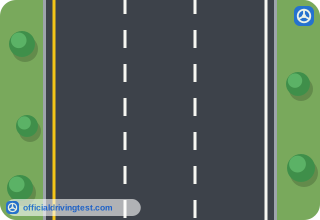
What do white lines on the road separate?
- Traffic traveling in opposite directions
- Cars from pedestrians
- Highways from side roads
- Traffic moving in the same direction
Show answer
Correct answer: Traffic moving in the same direction
White lines are painted to separate traffic moving in the same direction.
Source: Rhode Island Driver’s Manual (April 2024), page 38
-
What do single or double solid yellow lines tell motorists about passing?
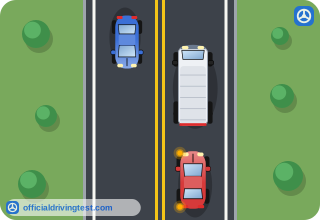
- Passing other vehicles is prohibited
- Passing is allowed with care
- Passing is allowed only during daylight
- Passing is allowed only when the vehicle ahead signals
Show answer
Correct answer: Passing other vehicles is prohibited
Single or double solid yellow lines prohibit motorists from passing other vehicles.
Source: Rhode Island Driver’s Manual (April 2024), page 38
-
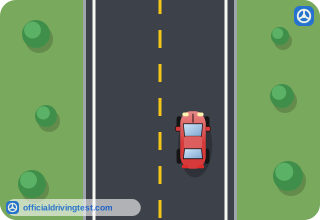
What do broken yellow lines separating traffic in opposite directions allow?
- Passing is prohibited in both directions
- Parking along the lane line
- Passing another vehicle with care
- Left turns only, never passing
Show answer
Correct answer: Passing another vehicle with care
Broken yellow lines separate opposing traffic, and passing another vehicle is permitted with care.
Source: Rhode Island Driver’s Manual (April 2024), page 38
-
Where are solid white lines usually found?
- In the exact center of a two-lane road
- At the far right or far left of the roadway
- Between lanes of opposing traffic
- Only at railroad crossings
Show answer
Correct answer: At the far right or far left of the roadway
Solid white lines are usually at the far right or left of roadways, for example by carpool, restricted or parking lanes.
Source: Rhode Island Driver’s Manual (April 2024), page 38
-
How is a shared turn lane set apart from the travel lanes?
- Solid white lines on the outside and broken white lines inside
- Double solid yellow lines on both sides
- Broken yellow lines on the outside and solid yellow lines inside
- Solid single yellow lines on the outside and broken yellow lines inside
Show answer
Correct answer: Solid single yellow lines on the outside and broken yellow lines inside
A shared turn lane is the center lane, bounded by solid single yellow lines outside and broken yellow lines inside.
Source: Rhode Island Driver’s Manual (April 2024), page 38
-
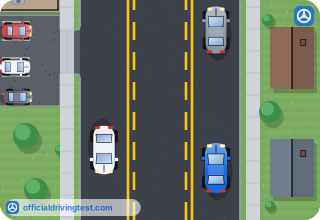
Motorists wishing to turn should not enter a shared turn lane unless they intend to turn within what distance?
- 100 feet
- 25 feet
- 50 feet
- 300 feet
Show answer
Correct answer: 100 feet
Drivers must not enter the shared turn lane unless they intend to turn within 100 feet.
Source: Rhode Island Driver’s Manual (April 2024), page 38
-
A shared turn lane has arrows painted on the pavement. For what use do the signs usually restrict the lane?
- Passing slower vehicles
- Parking
- Turning only
- Through traffic
Show answer
Correct answer: Turning only
The arrows and signs usually show the lane is restricted to turning only.
Source: Rhode Island Driver’s Manual (April 2024), page 38
-
What does a shared-lane marking, installed in the center of a travel lane, indicate?
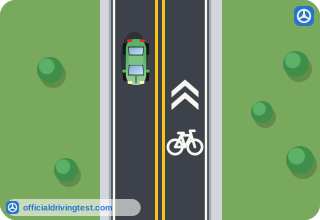
- Bicycles are prohibited in the lane
- A bicyclist may use the full lane
- The lane is for carpool vehicles only
- The lane ends ahead
Show answer
Correct answer: A bicyclist may use the full lane
A shared-lane marking in the center of a travel lane shows that a bicyclist may use the full lane.
Source: Rhode Island Driver’s Manual (April 2024), page 38
-
Besides showing where bicyclists are likely to ride, a shared-lane marking is meant to reduce the incidence of what?
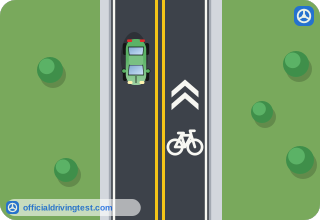
- Parking violations
- Speeding by motorists
- Passing on the right
- Wrong-way bicycling
Show answer
Correct answer: Wrong-way bicycling
The marking alerts motorists to where bicyclists are likely to be and reduces wrong-way bicycling.
Source: Rhode Island Driver’s Manual (April 2024), page 38
-
On a two-lane, two-way road with two solid lines side by side down the center, what does the manual say about passing?
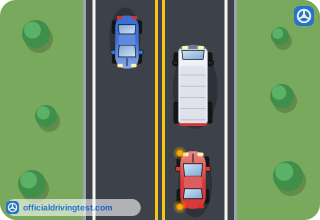
- Passing is prohibited in both directions
- Passing is prohibited in one direction only
- Passing is permitted in both directions
- Passing is permitted for trucks only
Show answer
Correct answer: Passing is prohibited in both directions
Double solid center lines on a two-lane, two-way roadway mean passing is prohibited in both directions.
Source: Rhode Island Driver’s Manual (April 2024), page 39
-
A center lane has curved arrows painted in opposite directions. How do vehicles use it?
- Passing slower traffic ahead in the lane
- Waiting for a green light ahead of the line
- Left turns in and out of side streets and driveways
- Use by emergency vehicles only, at all times
Show answer
Correct answer: Left turns in and out of side streets and driveways
This is a shared left turn lane, used by all vehicles for left turns into and out of side streets and driveways.
Source: Rhode Island Driver’s Manual (April 2024), page 39
-
The manual shows a lane marked with a white diamond. What kind of lane is it?
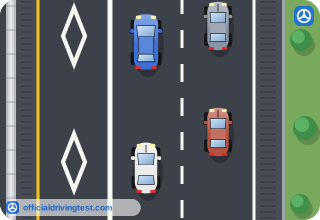
- A reversible lane
- An HOV lane, for carpooling
- A shared left turn lane
- A bicycle lane
Show answer
Correct answer: An HOV lane, for carpooling
The manual labels a lane with a white diamond as an HOV lane, meaning High Occupancy Vehicle (carpooling).
Source: Rhode Island Driver’s Manual (April 2024), page 39
-
In a reversible lane, which lane may a motorist travel in?
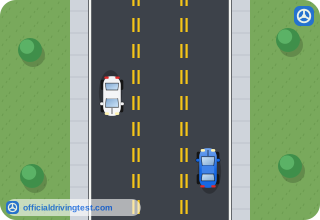
- The lane with the fewest vehicles
- The far-left lane only
- The center lane only
- The lane showing a green arrow
Show answer
Correct answer: The lane showing a green arrow
In reversible lanes the motorist may travel in the lane that shows a green arrow.
Source: Rhode Island Driver’s Manual (April 2024), page 39
-
What may delineate a divided roadway?
- A median strip, jersey barrier or guard rail
- A painted crosswalk across the road
- A row of cars parked along the curb
- A single broken white line in the center
Show answer
Correct answer: A median strip, jersey barrier or guard rail
The manual shows a divided roadway delineated by a median strip, jersey barrier, guard rail and similar barriers.
Source: Rhode Island Driver’s Manual (April 2024), page 39
-
What is the "fog line" the manual mentions?
- The yellow line on the left side of most roadways
- A line painted only on roads that are often foggy
- The white line on the right side of most roadways
- The white line painted at an intersection before the crosswalk
Show answer
Correct answer: The white line on the right side of most roadways
The manual defines the fog line as the white line on the right side of most roadways.
Source: Rhode Island Driver’s Manual (April 2024), page 53
-
A road marking in a travel lane shows a white bicycle symbol. The manual calls it a "shared lane" marking. What is one of its purposes?
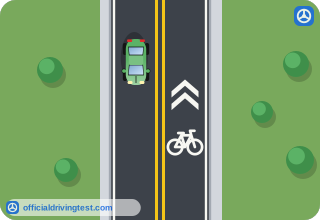
- To mark a lane that motor vehicles are not allowed to use at any time
- To help bicyclists position themselves so they avoid the door of a parked vehicle
- To show bicyclists where bicycles may be parked on the street
- To tell bicyclists to dismount and walk their bicycles ahead
Show answer
Correct answer: To help bicyclists position themselves so they avoid the door of a parked vehicle
A shared lane marking helps bicyclists position themselves in a lane with parallel parking to reduce the chance of hitting a parked car's door.
Source: Rhode Island Driver’s Manual (April 2024), page 55
-
The manual lists the reduction of one kind of bicycling as a purpose of shared lane markings. Which kind?
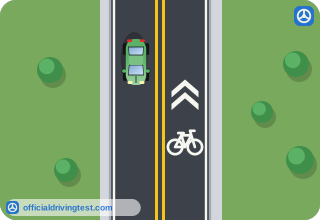
- Night bicycling
- Bicycling on sidewalks
- Bicycling in groups
- Wrong-way bicycling
Show answer
Correct answer: Wrong-way bicycling
One purpose of shared lane markings is to reduce the incidence of wrong-way bicycling.
Source: Rhode Island Driver’s Manual (April 2024), page 55
-
In Rhode Island, how are bicycle lanes on the road marked?
- A broken yellow line with a bicycle sign on a post beside it
- A solid white line, the words "Bicycle Lane" and bicycle symbols
- A solid yellow line with the word "Bikes" and an arrow
- A double white line with arrows pointing down the lane
Show answer
Correct answer: A solid white line, the words "Bicycle Lane" and bicycle symbols
Bicycle lanes are clearly marked with a solid white line, the words "Bicycle Lane" and bicycle symbols.
Source: Rhode Island Driver’s Manual (April 2024), page 55