Oklahoma: Signals and vehicle controls — Part 3 Practice Test
Questions in this part include: “Why does the manual say not to drive with your elbow out the window?”
Independent educational site · not affiliated with any government agency or DMV
Ready? Test yourself
- Instant feedback with an explanation
- Every answer cites its source in the manual
- Your best score is saved on this device
- Keyboard: press 1 to 4 to answer and Enter for the next question
Questions are original and based on the official manual "Oklahoma Driver Manual" (2025 (updated November 24, 2025)), Service Oklahoma.
All 18 questions in this practice test
Take the test above first, then use this list to study. Tap “Show answer” to see the correct answer and explanation.
Show the questions and answersHide the questions
-
How long should you keep looking to the rear when you back up?
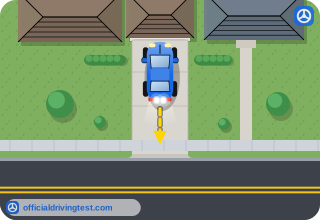
- Until you have backed about one car length
- Until you come to a complete stop
- Until your vehicle is out of the parking space
- Until you have shifted out of reverse
Show answer
Correct answer: Until you come to a complete stop
You keep looking to the rear until the vehicle has come to a complete stop.
Source: Oklahoma Driver Manual (2025 (updated November 24, 2025)), page 39 · Open this page in the manual (Manual page 39)
-
Within how many feet of an oncoming vehicle should you dim your high beam headlights to low beams?
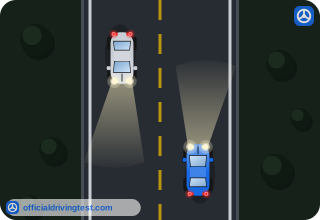
- 1000 feet
- 500 feet
- 300 feet
- 200 feet
Show answer
Correct answer: 1000 feet
High beams must be dimmed to low beams once you are within 1000 feet of an oncoming vehicle, so you do not glare at the other driver.
Source: Oklahoma Driver Manual (2025 (updated November 24, 2025)), page 59 · Open this page in the manual (Manual page 59)
-
How close behind a vehicle you are following must you be before dimming your high beams to low beams?
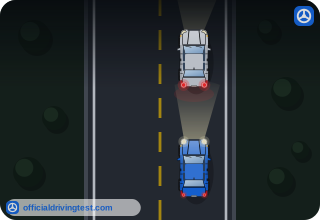
- Within 400 feet
- Within 200 feet
- Within 600 feet
- Within 100 feet
Show answer
Correct answer: Within 600 feet
The manual says to dim high beams to low beams within 600 feet of the vehicle you are following.
Source: Oklahoma Driver Manual (2025 (updated November 24, 2025)), page 59 · Open this page in the manual (Manual page 59)
-
When does the manual say to begin using your headlights in the evening and morning?
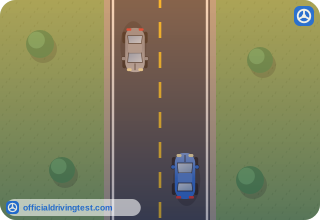
- Only once it is completely dark outside, until the sky is bright
- Beginning 30 minutes after sunset and 30 minutes before sunrise
- From the moment of sunset until the moment of sunrise, never earlier
- One hour after sunset and one hour before sunrise
Show answer
Correct answer: Beginning 30 minutes after sunset and 30 minutes before sunrise
Headlights are used starting 30 minutes after sunset and 30 minutes before sunrise.
Source: Oklahoma Driver Manual (2025 (updated November 24, 2025)), page 59 · Open this page in the manual (Manual page 59)
-
In which situation does the manual say high beams may be used?
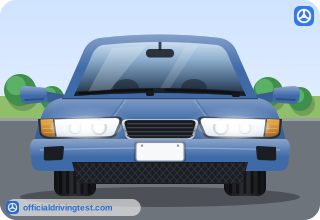
- On a street that has streetlights
- In fog
- In rain or snow
- In open country with no cars nearby
Show answer
Correct answer: In open country with no cars nearby
High beams are for open country with no other cars nearby; streetlights, fog, rain and snow call for low beams.
Source: Oklahoma Driver Manual (2025 (updated November 24, 2025)), page 59 · Open this page in the manual (Manual page 59)
-
Which headlight setting does the manual say to use where there are streetlights, fog, rain or snow?
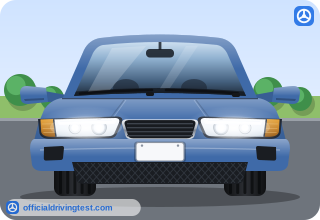
- Low beams
- High beams
- Parking lights only
- Hazard flashers only
Show answer
Correct answer: Low beams
Low beams are the right setting where there are streetlights or fog, rain, snow and other adverse weather.
Source: Oklahoma Driver Manual (2025 (updated November 24, 2025)), page 59 · Open this page in the manual (Manual page 59)
-
How should your speed at night with high beams in open country compare with your speed by day?
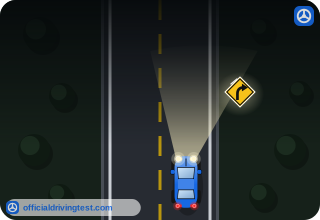
- The same as it is by day
- Faster than it is by day
- Slower than it is by day
- Faster, because high beams show more road
Show answer
Correct answer: Slower than it is by day
When you drive with high beams in open country at night, your speed should be slower than by day.
Source: Oklahoma Driver Manual (2025 (updated November 24, 2025)), page 59 · Open this page in the manual (Manual page 59)
-
What can a driver of a car with a standard transmission use, instead of the brakes, to help slow down?
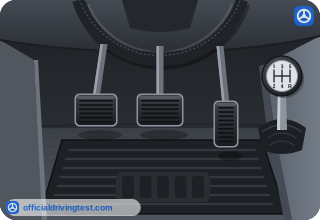
- The clutch pedal alone
- The gears
- The parking brake
- The accelerator pedal
Show answer
Correct answer: The gears
With a standard transmission you control the gear-speed ratio and can use the gears rather than the brakes to help slow the car.
Source: Oklahoma Driver Manual (2025 (updated November 24, 2025)), page 59 · Open this page in the manual (Manual page 59)
-
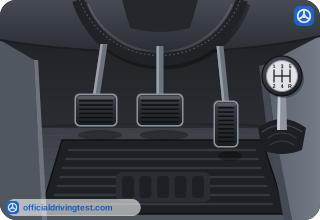
Below what speed should you hold the clutch pedal all the way down as you come to a stop in a standard-transmission car?
- 5 mph
- 15 mph
- 20 mph
- 10 mph
Show answer
Correct answer: 10 mph
The manual says to hold the clutch pedal all the way down when your speed drops below 10 mph while coming to a stop.
Source: Oklahoma Driver Manual (2025 (updated November 24, 2025)), page 59 · Open this page in the manual (Manual page 59)
-
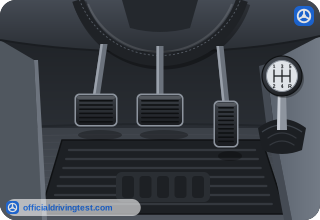
In a standard-transmission car, what does "riding the clutch" mean?
- Driving with your foot resting on the clutch pedal
- Pressing the clutch all the way down to start the motor
- Shifting gears without using the accelerator
- Holding the clutch down only when you stop
Show answer
Correct answer: Driving with your foot resting on the clutch pedal
Riding the clutch means driving with your foot resting on the clutch pedal, which the manual says not to do.
Source: Oklahoma Driver Manual (2025 (updated November 24, 2025)), page 59 · Open this page in the manual (Manual page 59)
-
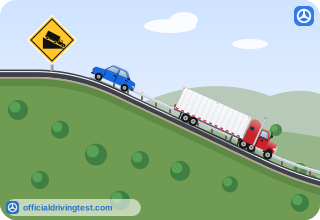
What should you do with a standard-transmission car when going down steep hills?
- Shift the car into neutral
- Push the clutch pedal down and coast
- Put the car in a lower gear
- Shift into a higher gear
Show answer
Correct answer: Put the car in a lower gear
On steep downhill grades the manual says to put the car in a lower gear rather than coasting.
Source: Oklahoma Driver Manual (2025 (updated November 24, 2025)), page 59 · Open this page in the manual (Manual page 59)
-
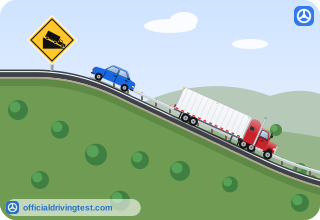
Coasting on a downgrade with the clutch engaged or the vehicle in neutral is described in the manual as what?
- A fuel-saving technique
- A violation of Oklahoma law
- Allowed on long downgrades
- Required on steep hills
Show answer
Correct answer: A violation of Oklahoma law
The manual states that coasting downhill with the clutch engaged or in neutral violates the state traffic statute.
Source: Oklahoma Driver Manual (2025 (updated November 24, 2025)), page 59 · Open this page in the manual (Manual page 59)
-
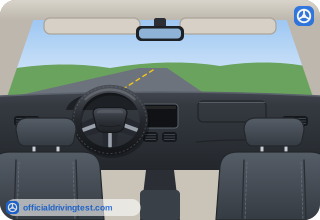
How should you adjust the seat as part of good driving posture?
- As far back as it goes, to stay away from the wheel
- As close to the steering wheel as it goes, to hold it firmly
- Low enough that you sit below the level of the windows
- To a comfortable position with easy pedal reach and good vision
Show answer
Correct answer: To a comfortable position with easy pedal reach and good vision
The seat should let you reach the pedals easily and see well while staying comfortable.
Source: Oklahoma Driver Manual (2025 (updated November 24, 2025)), page 59 · Open this page in the manual (Manual page 59)
-
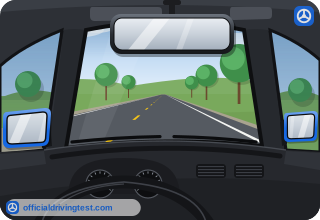
How should you adjust the rearview mirror before driving?
- So that you can see the road behind
- So that you can see the front seat
- So that it points at the left outside mirror
- So that the roof of the car fills most of it
Show answer
Correct answer: So that you can see the road behind
The rearview mirror should be set to show the road behind you.
Source: Oklahoma Driver Manual (2025 (updated November 24, 2025)), page 59 · Open this page in the manual (Manual page 59)
-
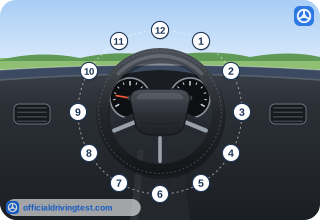
How much of the steering wheel should you have between your hands for a strong turning force with either hand?
- At least 1/2 of the wheel
- At least 1/3 of the wheel
- At least 2/3 of the wheel
- No more than 1/4 of the wheel
Show answer
Correct answer: At least 1/3 of the wheel
Keeping at least a third of the wheel between your hands gives a strong turning force with either hand.
Source: Oklahoma Driver Manual (2025 (updated November 24, 2025)), page 60 · Open this page in the manual (Manual page 60)
-
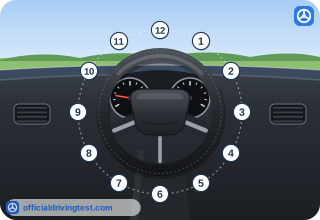
Thinking of the steering wheel as a clock, where should your left hand generally be?
- Between 7:00 and 8:30
- Between 10:30 and 12:00
- Between 11:00 and 1:00
- Between 9:00 and 10:30
Show answer
Correct answer: Between 9:00 and 10:30
The manual says your left hand should generally be between 9:00 and 10:30.
Source: Oklahoma Driver Manual (2025 (updated November 24, 2025)), page 60 · Open this page in the manual (Manual page 60)
-
Thinking of the steering wheel as a clock, where should your right hand generally be?
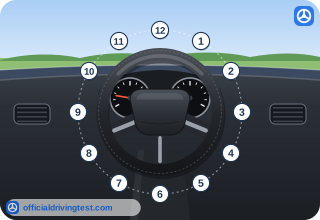
- Between 2:00 and 4:00
- Between 12:00 and 1:30
- Between 4:30 and 6:00
- Between 5:00 and 7:00
Show answer
Correct answer: Between 2:00 and 4:00
The manual says your right hand should generally be between 2:00 and 4:00.
Source: Oklahoma Driver Manual (2025 (updated November 24, 2025)), page 60 · Open this page in the manual (Manual page 60)
-
Why does the manual say not to drive with your elbow out the window?
- It blocks your view of the left mirror
- It lets cold air onto your face
- You lack full control of the steering wheel
- It makes the turn signal harder to see
Show answer
Correct answer: You lack full control of the steering wheel
An elbow out of the window means less than full control of the wheel, and a side-swipe collision could take off the arm.
Source: Oklahoma Driver Manual (2025 (updated November 24, 2025)), page 60 · Open this page in the manual (Manual page 60)