Oklahoma: Pavement markings Practice Test
Yellow and white lines, solid and broken lines, no-passing lines and how lanes are marked on two-lane and multi-lane roads.
Independent educational site · not affiliated with any government agency or DMV
Ready? Test yourself
- Instant feedback with an explanation
- Every answer cites its source in the manual
- Your best score is saved on this device
- Keyboard: press 1 to 4 to answer and Enter for the next question
Questions are original and based on the official manual "Oklahoma Driver Manual" (2025 (updated November 24, 2025)), Service Oklahoma.
All 22 questions in this practice test
Take the test above first, then use this list to study. Tap “Show answer” to see the correct answer and explanation.
Show the questions and answersHide the questions
-
Which of these do yellow and white pavement markings show you?
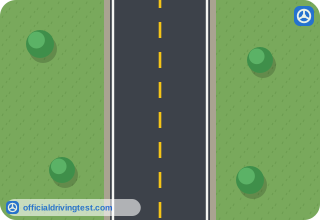
- Where parking is allowed along the side of the road at night
- Where the speed limit changes
- Where you may safely wait for an opportunity to make a left turn
- Where the next exit begins
Show answer
Correct answer: Where you may safely wait for an opportunity to make a left turn
Yellow and white markings show where you may safely wait for an opening to make a left turn.
Source: Oklahoma Driver Manual (2025 (updated November 24, 2025)), page 27 · Open this page in the manual (Manual page 27)
-
Which of these do yellow and white pavement markings show you?
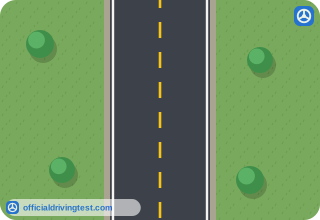
- Where the road is slippery because of rain or ice ahead
- Where traffic is traveling toward you in the next lane
- Where a school zone begins
- Where a bridge ends
Show answer
Correct answer: Where traffic is traveling toward you in the next lane
The markings show where traffic in the next lane travels toward you.
Source: Oklahoma Driver Manual (2025 (updated November 24, 2025)), page 27 · Open this page in the manual (Manual page 27)
-
Which of these do yellow and white pavement markings show you?
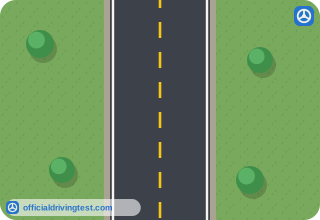
- Where a lane may be reserved for use by buses only
- Where the speed limit changes
- Where a railroad crossing is closed
- Where visibility is limited and passing is dangerous
Show answer
Correct answer: Where visibility is limited and passing is dangerous
Pavement markings show places where visibility is limited and passing is dangerous.
Source: Oklahoma Driver Manual (2025 (updated November 24, 2025)), page 27 · Open this page in the manual (Manual page 27)
-
What does a yellow broken line mean on a two-lane, two-way road?
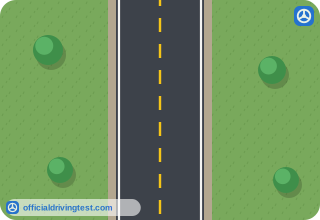
- Passing is permitted
- Passing is not permitted in either direction
- Passing is permitted only in the right lane
- Passing is permitted only for slow-moving vehicles
Show answer
Correct answer: Passing is permitted
A yellow broken line marks two-lane, two-way traffic where passing is permitted.
Source: Oklahoma Driver Manual (2025 (updated November 24, 2025)), page 27 · Open this page in the manual (Manual page 27)
-
What is a lane?
- Part of a roadway wide enough for a car or a single line of vehicles
- A marked part of the roadway reserved for passing other vehicles
- Any hard-surfaced part of the road that is painted white or yellow
- The part of a roadway between the shoulder and the sidewalk
Show answer
Correct answer: Part of a roadway wide enough for a car or a single line of vehicles
A lane is the part of a roadway wide enough for a car or a single line of vehicles to travel safely.
Source: Oklahoma Driver Manual (2025 (updated November 24, 2025)), page 32 · Open this page in the manual (Manual page 32)
-
On a dirt or gravel road where the lanes are not marked, what are you expected to do?
- Use the whole width of the road
- Drive on whichever side has less traffic
- Keep to the center until another vehicle appears
- Still drive in the proper lane
Show answer
Correct answer: Still drive in the proper lane
Lanes exist even when unmarked, and you are expected to always drive in the proper lane.
Source: Oklahoma Driver Manual (2025 (updated November 24, 2025)), page 32 · Open this page in the manual (Manual page 32)
-
What do yellow dashes between lanes tell you?
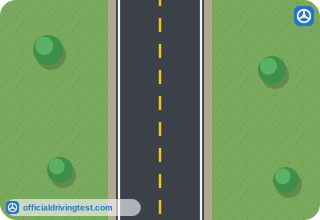
- Traffic moves in the same direction, and passing is permitted when safe
- Traffic moves in opposite directions, and passing is permitted when safe
- Traffic moves in opposite directions, and passing is never permitted
- Traffic moves in the same direction, and passing is never permitted
Show answer
Correct answer: Traffic moves in opposite directions, and passing is permitted when safe
Yellow dashes separate traffic moving in opposite directions, and you may pass when it is safe.
Source: Oklahoma Driver Manual (2025 (updated November 24, 2025)), page 32 · Open this page in the manual (Manual page 32)
-
What do white dashes between lanes tell you?
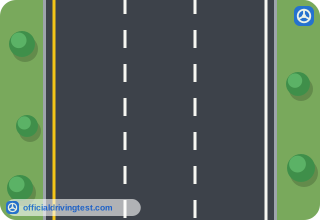
- Traffic moves in opposite directions, and passing is permitted when safe
- Traffic moves in the same direction, and passing is permitted when safe
- Traffic moves in the same direction, and passing is hazardous
- Traffic moves in opposite directions, and passing is not allowed
Show answer
Correct answer: Traffic moves in the same direction, and passing is permitted when safe
White dashes separate traffic moving in the same direction, and you may pass when it is safe.
Source: Oklahoma Driver Manual (2025 (updated November 24, 2025)), page 32 · Open this page in the manual (Manual page 32)
-
If a solid yellow line is on your left, what does it tell you?
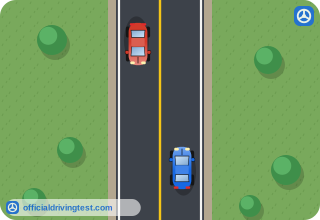
- You are driving on the wrong side of the road
- You are in a lane reserved for left turns
- You are approaching an intersection
- You are on the proper side of the road
Show answer
Correct answer: You are on the proper side of the road
A solid yellow line on your left means you are on the proper side of the road.
Source: Oklahoma Driver Manual (2025 (updated November 24, 2025)), page 32 · Open this page in the manual (Manual page 32)
-
What is the danger if you cross a solid yellow line?
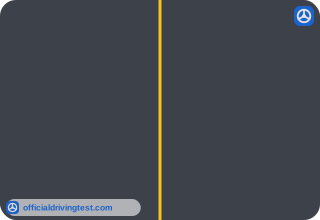
- Danger from approaching vehicles or obstacles in the median
- A danger from vehicles merging in from the right shoulder
- A danger from pedestrians crossing in front of you
- A danger from vehicles overtaking you from behind
Show answer
Correct answer: Danger from approaching vehicles or obstacles in the median
Crossing a solid yellow line puts you at risk from approaching vehicles or obstacles in the median.
Source: Oklahoma Driver Manual (2025 (updated November 24, 2025)), page 32 · Open this page in the manual (Manual page 32)
-
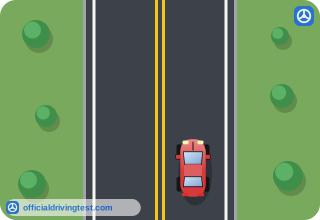
What do single or double solid yellow lines mean?
- Passing is permitted when safe
- Traffic moves in the same direction
- Do not pass
- The lane is for left turns only
Show answer
Correct answer: Do not pass
Single or double solid yellow lines mean do not pass.
Source: Oklahoma Driver Manual (2025 (updated November 24, 2025)), page 32 · Open this page in the manual (Manual page 32)
-
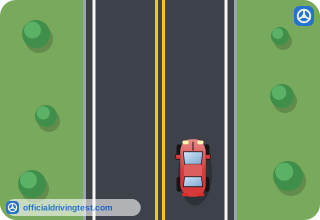
For which purpose may you cross a single or double solid yellow line?
- To pass a slow vehicle
- To pass when no vehicles are approaching
- To change lanes on a four-lane road
- To turn left
Show answer
Correct answer: To turn left
The manual says you may cross a solid yellow line to turn left.
Source: Oklahoma Driver Manual (2025 (updated November 24, 2025)), page 32 · Open this page in the manual (Manual page 32)
-
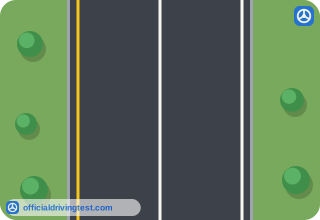
What does a solid white line tell you about passing?
- Traffic moves in the same direction, and passing is permitted when safe
- Traffic moves in the same direction, but passing is hazardous
- Traffic moves in opposite directions, and passing is hazardous
- Traffic moves in the same direction, and passing is encouraged
Show answer
Correct answer: Traffic moves in the same direction, but passing is hazardous
A solid white line separates traffic going the same way, but passing there is hazardous, for example near an intersection or merge area.
Source: Oklahoma Driver Manual (2025 (updated November 24, 2025)), page 32 · Open this page in the manual (Manual page 32)
-
How are two-lane highways marked at the center?
- A double solid white line
- A single solid white centerline
- A single broken yellow centerline
- A dashed white centerline
Show answer
Correct answer: A single broken yellow centerline
Two-lane highways have a single broken yellow centerline.
Source: Oklahoma Driver Manual (2025 (updated November 24, 2025)), page 32 · Open this page in the manual (Manual page 32)
-
On a two-lane highway, where should you always drive?
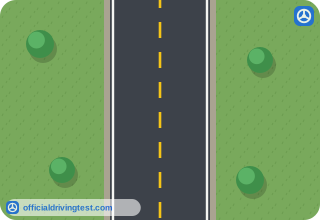
- To the right of the centerline, except to pass safely
- On either side of the centerline when traffic is light
- In the center of the roadway, over the centerline
- To the left of the centerline when the road is clear
Show answer
Correct answer: To the right of the centerline, except to pass safely
You keep to the right of the centerline and cross it only to pass when you can do so safely.
Source: Oklahoma Driver Manual (2025 (updated November 24, 2025)), page 32 · Open this page in the manual (Manual page 32)
-
How may drivers from either direction use the center lane of a three-lane highway?
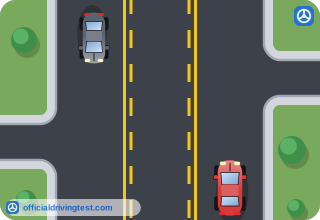
- Only to make a left turn
- To pass slower vehicles
- As a regular lane for through traffic
- To stop and let other vehicles pass
Show answer
Correct answer: Only to make a left turn
The center lane of a three-lane highway is entered only to make a left turn.
Source: Oklahoma Driver Manual (2025 (updated November 24, 2025)), page 32 · Open this page in the manual (Manual page 32)
-
Which statement about passing in the center lane of a three-lane highway is correct?
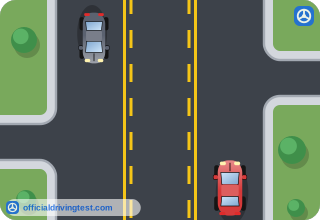
- You may pass when no one is coming from either direction
- You may pass slow vehicles during daylight hours
- You must not pass in this lane
- You may pass if you signal first
Show answer
Correct answer: You must not pass in this lane
The center lane of a three-lane highway is not to be used for passing.
Source: Oklahoma Driver Manual (2025 (updated November 24, 2025)), page 32 · Open this page in the manual (Manual page 32)
-
How is the center lane of a three-lane highway marked?
- A solid white line on each side with white dashes inside them
- A solid yellow line on each side with yellow dashes inside them
- Two solid yellow lines down the middle of the lane
- A broken yellow line on each side with a solid line in the middle
Show answer
Correct answer: A solid yellow line on each side with yellow dashes inside them
The center lane has a solid yellow line on each side with yellow dashed lines on the inside of the solid lines.
Source: Oklahoma Driver Manual (2025 (updated November 24, 2025)), page 32 · Open this page in the manual (Manual page 32)
-
What divides a four-lane highway in half?
- A single broken yellow center line
- A single solid white center line
- Two solid yellow lines in the center
- Two broken white lines down the center
Show answer
Correct answer: Two solid yellow lines in the center
A four-lane highway is divided in half by two solid yellow lines in the center.
Source: Oklahoma Driver Manual (2025 (updated November 24, 2025)), page 32 · Open this page in the manual (Manual page 32)
-
What divides the two lanes on each side of a four-lane highway?
- A dashed white line
- A solid yellow line
- A double yellow line
- A broken yellow line
Show answer
Correct answer: A dashed white line
The two lanes on each side of a four-lane highway are divided by a dashed white line.
Source: Oklahoma Driver Manual (2025 (updated November 24, 2025)), page 32 · Open this page in the manual (Manual page 32)
-
When must you not pass, whether the road has two yellow lines or a single solid line and a dashed line?
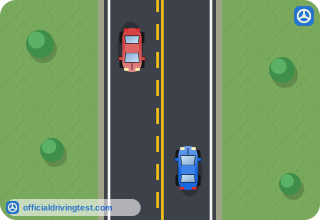
- When the dashed line is on your side of the road
- When the solid yellow line is in your lane
- Only when a vehicle is coming from the opposite direction
- Only when the road has more than one lane in each direction
Show answer
Correct answer: When the solid yellow line is in your lane
A solid yellow line in your lane is a no-passing marking, whether it is a double line or a solid line beside a dashed line.
Source: Oklahoma Driver Manual (2025 (updated November 24, 2025)), page 35 · Open this page in the manual (Manual page 35)
-
The manual says you must not pass on which of these, even if the road is not marked?
- On a straight stretch of two-lane road
- On a one-way road
- On a road with a wide shoulder
- On hills or curves
Show answer
Correct answer: On hills or curves
Hills and curves are no-passing places whether or not the road has markings.
Source: Oklahoma Driver Manual (2025 (updated November 24, 2025)), page 35 · Open this page in the manual (Manual page 35)