Oklahoma: Right-of-way and turning — Part 3 Practice Test
Questions in this part include: “On which type of road may you overtake and pass on the right?” · “How does the speed of traffic affect when you should move into the proper lane for a turn?”
Independent educational site · not affiliated with any government agency or DMV
Ready? Test yourself
- Instant feedback with an explanation
- Every answer cites its source in the manual
- Your best score is saved on this device
- Keyboard: press 1 to 4 to answer and Enter for the next question
Questions are original and based on the official manual "Oklahoma Driver Manual" (2025 (updated November 24, 2025)), Service Oklahoma.
All 17 questions in this practice test
Take the test above first, then use this list to study. Tap “Show answer” to see the correct answer and explanation.
Show the questions and answersHide the questions
-
You may overtake and pass on the right when the road is wide enough for two or more lanes in each direction and what else is true?
- The vehicle ahead is driving well below the posted speed limit
- No oncoming vehicles are in sight
- There are no parked cars or other obstructions on the roadway
- You have already signaled for a right turn
Show answer
Correct answer: There are no parked cars or other obstructions on the roadway
Passing on the right on a wide road requires that no parked cars or other obstructions are on the roadway.
Source: Oklahoma Driver Manual (2025 (updated November 24, 2025)), page 35 · Open this page in the manual (Manual page 35)
-
On which type of road may you overtake and pass on the right?
- A one-way road
- Any road, if you use the paved shoulder
- A road with a hill or curve, if it is unmarked
- A two-lane road, by driving onto the shoulder
Show answer
Correct answer: A one-way road
A one-way road is one of the stated situations in which passing on the right is allowed.
Source: Oklahoma Driver Manual (2025 (updated November 24, 2025)), page 35 · Open this page in the manual (Manual page 35)
-
You may overtake and pass on the right if the vehicle in front of you is doing which of these?
- Making or about to make a left turn
- Driving below the speed limit
- Making or about to make a right turn
- Slowing down for a stop sign
Show answer
Correct answer: Making or about to make a left turn
The manual allows passing on the right when the vehicle ahead is turning left or is about to.
Source: Oklahoma Driver Manual (2025 (updated November 24, 2025)), page 35 · Open this page in the manual (Manual page 35)
-
Which way of passing on the right is never legal?
- Passing a vehicle that is about to turn left
- Passing on a one-way road
- Driving off the pavement or main portion of the highway
- Passing on a road with two lanes each way and no obstructions
Show answer
Correct answer: Driving off the pavement or main portion of the highway
The manual states you can never legally pass on the right by driving off the pavement or the main part of the highway.
Source: Oklahoma Driver Manual (2025 (updated November 24, 2025)), page 35 · Open this page in the manual (Manual page 35)
-
How close to an obstructed view may you not pass?
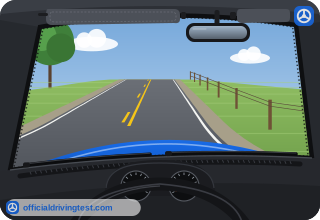
- Within 25 feet
- Within 100 feet
- Within 50 feet
- Within 300 feet
Show answer
Correct answer: Within 100 feet
The manual says not to pass within 100 feet of an obstructed view or if vehicles or pedestrians might cross your path.
Source: Oklahoma Driver Manual (2025 (updated November 24, 2025)), page 35 · Open this page in the manual (Manual page 35)
-
Near which of these should you watch for the need not to pass?
- Toll plazas
- Roadside rest areas
- Wide paved shoulders
- Bridges and tunnels
Show answer
Correct answer: Bridges and tunnels
The manual lists bridges, viaducts, tunnels, overpasses, intersections and crosswalks among the places where you should watch for the need not to pass.
Source: Oklahoma Driver Manual (2025 (updated November 24, 2025)), page 35 · Open this page in the manual (Manual page 35)
-
If another driver is passing you on the left, what should you do?
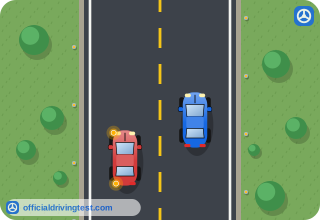
- Stay in your lane and move right
- Move toward the center line to make room
- Speed up and move toward the center line
- Slow down and drive on the left shoulder
Show answer
Correct answer: Stay in your lane and move right
You help the other driver pass by staying in your lane and moving right when you are being passed on the left.
Source: Oklahoma Driver Manual (2025 (updated November 24, 2025)), page 35 · Open this page in the manual (Manual page 35)
-
If a car approaches from the other direction while you are being passed, what should you do?
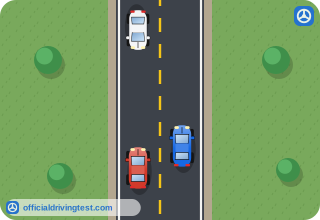
- Speed up so the passing driver falls behind
- Move to the left shoulder and stop
- Slow down and let the passing driver pull in front of you
- Speed up so the passing driver cannot pull in front of you
Show answer
Correct answer: Slow down and let the passing driver pull in front of you
Slowing down lets the passing car pull in front of you and avoids a head-on crash.
Source: Oklahoma Driver Manual (2025 (updated November 24, 2025)), page 35 · Open this page in the manual (Manual page 35)
-
While another driver is passing you, what should you do with your speed?
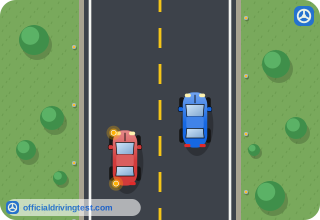
- Increase it to stay even with the other car
- Increase it to make the pass shorter
- Increase it only on a straight road
- Do not increase it
Show answer
Correct answer: Do not increase it
The manual says not to increase your speed when someone is passing you.
Source: Oklahoma Driver Manual (2025 (updated November 24, 2025)), page 35 · Open this page in the manual (Manual page 35)
-
Before you make a left turn, what should you watch for besides the oncoming traffic?
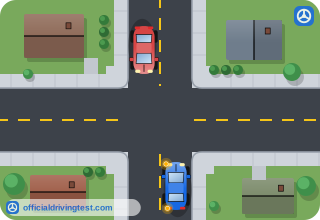
- Cars parked along the street you are leaving
- Cars turning right from the opposite lane
- Cars waiting at the far corner to turn right on red
- Cars trying to pass you while you are turning
Show answer
Correct answer: Cars trying to pass you while you are turning
The manual says to turn when oncoming traffic is clear and to watch behind you for cars trying to pass.
Source: Oklahoma Driver Manual (2025 (updated November 24, 2025)), page 36 · Open this page in the manual (Manual page 36)
-
How does the speed of traffic affect when you should move into the proper lane for a turn?
- The faster the traffic is moving, the sooner you should move
- The faster the traffic is moving, the later you should move
- Speed does not matter; move at the intersection
- You should move only when traffic is at a stop
Show answer
Correct answer: The faster the traffic is moving, the sooner you should move
Fast traffic leaves you less time, so you must get into the turning lane earlier.
Source: Oklahoma Driver Manual (2025 (updated November 24, 2025)), page 36 · Open this page in the manual (Manual page 36)
-
If you are going too fast to make a turn safely, where should you slow down?
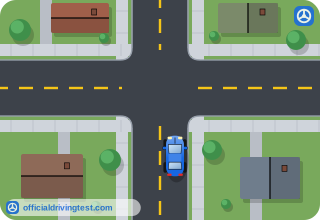
- After you enter the intersection and begin turning
- In the middle of the turn
- Before you reach the stop line or crosswalk
- Right after the turn
Show answer
Correct answer: Before you reach the stop line or crosswalk
The manual says to slow down before reaching the stop line or crosswalk.
Source: Oklahoma Driver Manual (2025 (updated November 24, 2025)), page 36 · Open this page in the manual (Manual page 36)
-
When making a turn, what should you do as you go through it?
- Coast without touching the pedals
- Brake lightly until the turn is finished
- Accelerate hard to clear the intersection
- Accelerate slightly through the turn
Show answer
Correct answer: Accelerate slightly through the turn
After slowing and choosing the gear, you accelerate slightly through the turn.
Source: Oklahoma Driver Manual (2025 (updated November 24, 2025)), page 36 · Open this page in the manual (Manual page 36)
-
Which of these should you not do while you are turning?
- Accelerate slightly
- Brake or depress the clutch
- Look behind and on both sides before the turn
- Finish the turn in the proper lane
Show answer
Correct answer: Brake or depress the clutch
The manual says not to brake or depress the clutch while turning.
Source: Oklahoma Driver Manual (2025 (updated November 24, 2025)), page 36 · Open this page in the manual (Manual page 36)
-
When should you select the proper gear for a turn?
- Halfway through the turn
- Right after the turn is finished
- Before entering the intersection
- In the middle of the intersection
Show answer
Correct answer: Before entering the intersection
The gear is chosen before you enter the intersection; you do not shift gears inside it.
Source: Oklahoma Driver Manual (2025 (updated November 24, 2025)), page 36 · Open this page in the manual (Manual page 36)
-
When may you make a turn?
- Only when the turn is permitted and can be made easily
- Whenever no vehicle is behind you and you have signaled
- Whenever you have signaled
- Whenever the cars ahead of you have turned
Show answer
Correct answer: Only when the turn is permitted and can be made easily
The manual says not to turn unless it is permitted and can be made easily.
Source: Oklahoma Driver Manual (2025 (updated November 24, 2025)), page 36 · Open this page in the manual (Manual page 36)
-
If you are not in the proper lane for a turn, what should you do?
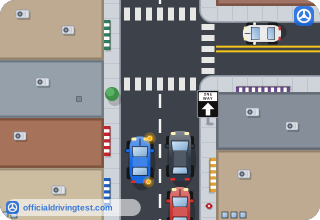
- Drive to the next intersection and turn from the proper lane there
- Cut across the lanes and make the turn
- Stop in your lane and back up to the last intersection to turn
- Turn from the lane you are in if no cars are near you
Show answer
Correct answer: Drive to the next intersection and turn from the proper lane there
Do not turn from the wrong lane; go on to the next intersection, and circle back if necessary.
Source: Oklahoma Driver Manual (2025 (updated November 24, 2025)), page 36 · Open this page in the manual (Manual page 36)