Oklahoma: Right-of-way and turning — Part 2 Practice Test
Questions in this part include: “What should you do with your speed when crossing an intersection?” · “When a driver ahead of you signals a lane change, what should you do?”
Independent educational site · not affiliated with any government agency or DMV
Ready? Test yourself
- Instant feedback with an explanation
- Every answer cites its source in the manual
- Your best score is saved on this device
- Keyboard: press 1 to 4 to answer and Enter for the next question
Questions are original and based on the official manual "Oklahoma Driver Manual" (2025 (updated November 24, 2025)), Service Oklahoma.
All 17 questions in this practice test
Take the test above first, then use this list to study. Tap “Show answer” to see the correct answer and explanation.
Show the questions and answersHide the questions
-
When entering a public road from a private road, alley, driveway or building, where must you stop?
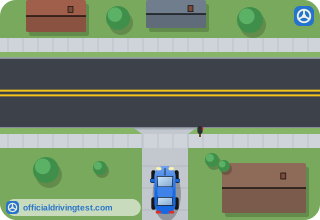
- At the edge of the roadway, past the sidewalk
- On the sidewalk, if you can see traffic
- Before the sidewalk or crosswalk
- Only if traffic is approaching
Show answer
Correct answer: Before the sidewalk or crosswalk
You stop before the sidewalk or crosswalk and go when it is safe.
Source: Oklahoma Driver Manual (2025 (updated November 24, 2025)), page 29 · Open this page in the manual (Manual page 29)
-
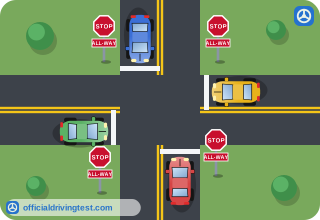
At a four-way stop, or at an intersection without stop signs or signals, who has the right-of-way?
- The vehicle that is traveling at the higher speed
- The larger of the two vehicles, such as a truck
- The driver who signals first, whatever the order of arrival
- The car or truck that entered the intersection first
Show answer
Correct answer: The car or truck that entered the intersection first
The vehicle that enters the intersection first has the right-of-way.
Source: Oklahoma Driver Manual (2025 (updated November 24, 2025)), page 29 · Open this page in the manual (Manual page 29)
-
When two vehicles approach an intersection at the same time, which driver yields?
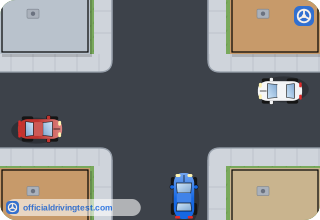
- The driver on the left yields to the driver on the right
- The driver on the right yields to the driver on the left
- The driver in the smaller vehicle yields to the larger one
- The driver traveling faster yields to the slower one
Show answer
Correct answer: The driver on the left yields to the driver on the right
With vehicles arriving together, the one on the left gives way to the one on the right.
Source: Oklahoma Driver Manual (2025 (updated November 24, 2025)), page 29 · Open this page in the manual (Manual page 29)
-
What should you do with your speed when crossing an intersection?
- Slow down gradually while you are turning or crossing
- Keep a constant speed from before the intersection until you clear it
- Slow down before you enter, then speed up until you clear it
- Speed up before you enter, then slow down inside the intersection
Show answer
Correct answer: Slow down before you enter, then speed up until you clear it
You slow down before entering, then increase speed until you are through; slowing while turning or crossing is wrong.
Source: Oklahoma Driver Manual (2025 (updated November 24, 2025)), page 30 · Open this page in the manual (Manual page 30)
-
Before you enter an intersection, the manual says to slow down, look both ways and do what next?
- Honk your horn
- Come to a full stop
- Turn on your hazard lights
- Look left again
Show answer
Correct answer: Look left again
The advice is to slow down, look both ways and then look to the left again before entering.
Source: Oklahoma Driver Manual (2025 (updated November 24, 2025)), page 30 · Open this page in the manual (Manual page 30)
-
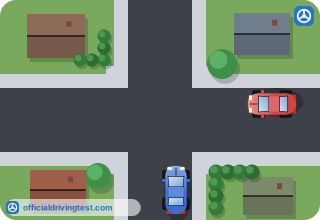
If your view is blocked so that you cannot see traffic on the side street, what should you do?
- Keep your speed and rely on other drivers to see you
- Slow down so you can stop if a car is coming
- Speed up to clear the intersection quickly
- Sound your horn and continue at the same speed
Show answer
Correct answer: Slow down so you can stop if a car is coming
With a blocked view you slow down enough to be able to stop for a car that appears.
Source: Oklahoma Driver Manual (2025 (updated November 24, 2025)), page 30 · Open this page in the manual (Manual page 30)
-
If traffic is stopped and is blocking an intersection, what should you do?
- Enter the intersection and wait for traffic to move
- Drive through the crosswalk and wait in the intersection
- Stop before reaching the crosswalk and wait
- Go around the stopped traffic on the shoulder
Show answer
Correct answer: Stop before reaching the crosswalk and wait
You do not enter a blocked intersection; you stop before the crosswalk until traffic moves.
Source: Oklahoma Driver Manual (2025 (updated November 24, 2025)), page 30 · Open this page in the manual (Manual page 30)
-
Which of these is one of the steps for changing lanes?
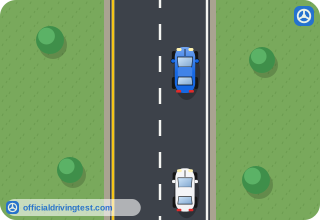
- Sound your horn to alert nearby drivers
- Brake to match the speed of the vehicle beside you
- Move into the lane first, then signal
- Signal your intention to change lanes
Show answer
Correct answer: Signal your intention to change lanes
Before changing lanes you signal your intention.
Source: Oklahoma Driver Manual (2025 (updated November 24, 2025)), page 33 · Open this page in the manual (Manual page 33)
-
Before changing lanes, which way should you look over your shoulder?
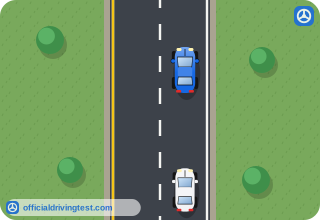
- Away from the direction you will be moving
- In the direction you will be moving
- Straight ahead only
- At the vehicle ahead of you
Show answer
Correct answer: In the direction you will be moving
You look over your shoulder in the direction you will be moving.
Source: Oklahoma Driver Manual (2025 (updated November 24, 2025)), page 33 · Open this page in the manual (Manual page 33)
-
When a driver ahead of you signals a lane change, what should you do?
- Speed up to pass before the change
- Slow down and leave space for the change
- Stay close behind to discourage the change
- Move into the adjacent lane first
Show answer
Correct answer: Slow down and leave space for the change
You slow down and leave room so the other driver can change lanes.
Source: Oklahoma Driver Manual (2025 (updated November 24, 2025)), page 33 · Open this page in the manual (Manual page 33)
-
On a roadway divided into four or more lanes, which statement about the left lane is correct?
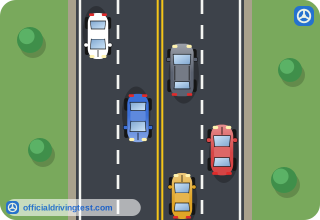
- It is reserved for trucks and buses
- It may be used only in daylight
- A vehicle cannot impede the normal flow of traffic by driving in it
- It may be used only by vehicles going faster than the limit
Show answer
Correct answer: A vehicle cannot impede the normal flow of traffic by driving in it
The manual says a vehicle cannot hold up the normal flow of traffic by staying in the left lane of such a roadway.
Source: Oklahoma Driver Manual (2025 (updated November 24, 2025)), page 35 · Open this page in the manual (Manual page 35)
-
On a roadway with four or more lanes, when are you not prohibited from using a lane other than the right-hand lane?
- Only when you are driving below the speed limit to avoid passing others
- When traffic flow or road layout, like merging traffic, calls for other lanes
- Only when no other vehicle is within sight in any of the lanes
- Only when you are driving in the daytime on a dry roadway
Show answer
Correct answer: When traffic flow or road layout, like merging traffic, calls for other lanes
Other lanes may be used when traffic conditions, flow or road configuration (such as merging traffic) call for them to keep traffic safe.
Source: Oklahoma Driver Manual (2025 (updated November 24, 2025)), page 35 · Open this page in the manual (Manual page 35)
-
What does the manual say about your speed when you pass another vehicle?
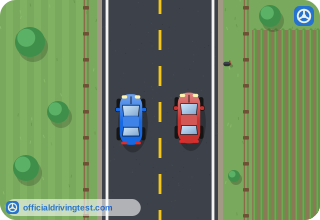
- You may go 5 mph over the limit while passing
- You may exceed the limit if the other driver is slower than the limit
- You may exceed the limit on a divided highway only
- You may not exceed the speed limit to pass
Show answer
Correct answer: You may not exceed the speed limit to pass
Passing never justifies speeding; the posted limit still applies.
Source: Oklahoma Driver Manual (2025 (updated November 24, 2025)), page 35 · Open this page in the manual (Manual page 35)
-
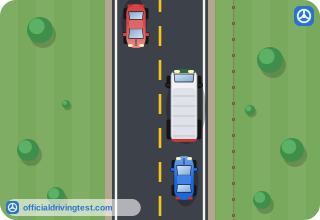
Before you move left to pass, how much clear roadway without a "No Passing Zone" should you check for ahead?
- At least 50 feet
- At least 200 feet
- At least 300 feet
- At least 500 feet
Show answer
Correct answer: At least 200 feet
The first step of passing on the left is to check for at least 200 feet of clear road without a No Passing Zone.
Source: Oklahoma Driver Manual (2025 (updated November 24, 2025)), page 35 · Open this page in the manual (Manual page 35)
-
You are about to pass a large truck or bus. How close should you follow it before you pull out?
- Right behind its bumper, so you can pull out quickly
- Within one car length, so you can speed up faster
- Close enough to stay out of oncoming traffic's view
- Not so close that it blocks your view of the road ahead
Show answer
Correct answer: Not so close that it blocks your view of the road ahead
You should stay back at a safe distance until you can see far enough ahead to pass safely.
Source: Oklahoma Driver Manual (2025 (updated November 24, 2025)), page 35 · Open this page in the manual (Manual page 35)
-
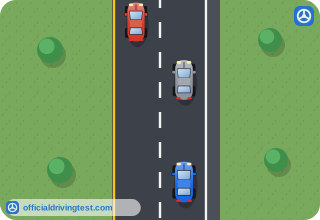
Before moving left to pass, how do you make sure no other car is passing or about to pass you?
- Check the rearview mirror and look over your shoulder at blind spots
- Look only in your rearview mirror and then move over
- Sound your horn and wait for the other driver to answer it
- Look at the left side mirror once and move over
Show answer
Correct answer: Check the rearview mirror and look over your shoulder at blind spots
The manual says to check the rearview mirror and also look over your shoulder to cover the blind spots.
Source: Oklahoma Driver Manual (2025 (updated November 24, 2025)), page 35 · Open this page in the manual (Manual page 35)
-
After you pass a car on the left, when may you return to the right lane?
- As soon as your front bumper is even with that car
- As soon as the other car begins to slow down
- After you have driven 100 feet beyond that car
- When you can see that car in your rearview mirror
Show answer
Correct answer: When you can see that car in your rearview mirror
You wait until the passed car shows in your rearview mirror before you pull back right.
Source: Oklahoma Driver Manual (2025 (updated November 24, 2025)), page 35 · Open this page in the manual (Manual page 35)