Ohio: Emergencies and special situations
Skids, vehicle malfunctions, crashes, fog, night and winter driving. Split into 4 shorter tests so you're not stuck in one long quiz.
Independent educational site · not affiliated with any government agency or DMV
Choose a part
Emergencies and special situations — Part 1
Questions in this part include: “If you are involved in a crash in fog, what should you do?”
StartEmergencies and special situations — Part 2
Questions in this part include: “If a child goes missing, what does the manual say to check?”
StartEmergencies and special situations — Part 3
Questions in this part include: “If using the parking brake does not stop your vehicle after brake failure, what should you do?”
StartEmergencies and special situations — Part 4
Questions in this part include: “What should you do about other drivers after a crash, even if the crash is minor?”
StartAll 68 Emergencies and special situations questions with answers
Choose a part above to take a practice test, or study every question and answer here.
Show the questions and answersHide the questions
-
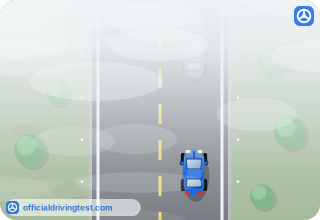
How should you drive in fog in relation to other traffic?
- Faster than traffic so you pass the fog quickly
- Right behind the vehicle ahead to follow its lights
- With the flow of traffic, but drive slower, ready to stop
- At the speed limit regardless of the conditions
Show answer
Correct answer: With the flow of traffic, but drive slower, ready to stop
The manual says to move with the flow of traffic but drive slower, expecting to stop at any time.
Source: Ohio Driver Manual (HSY 7607 10/25 (October 2025)), page 29
-
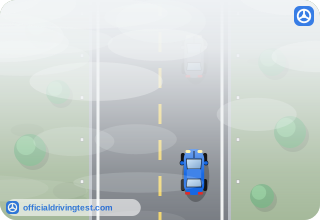
When driving in fog, what should you do about your distance behind the vehicle in front of you?
- Follow as closely as possible
- Keep a consistent distance
- Keep changing your distance
- Pass the vehicle
Show answer
Correct answer: Keep a consistent distance
The manual says to keep a consistent distance behind the vehicle in front of you.
Source: Ohio Driver Manual (HSY 7607 10/25 (October 2025)), page 29
-
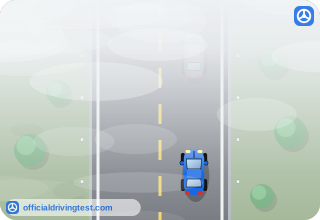
Which headlights should you use in fog?
- Hazard lights only
- Parking lights only
- No headlights
- Low beam headlights
Show answer
Correct answer: Low beam headlights
The manual says to use low beam headlights, not high beam lights, in fog.
Source: Ohio Driver Manual (HSY 7607 10/25 (October 2025)), page 29
-
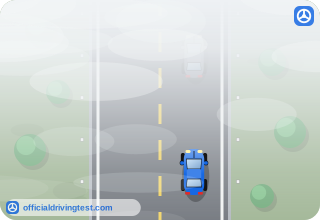
When driving in fog, what should you do with your gaze?
- Stare at the center line
- Stare at the taillights ahead
- Shift it instead of staring
- Keep it fixed on the hood
Show answer
Correct answer: Shift it instead of staring
The manual says to shift your gaze instead of staring.
Source: Ohio Driver Manual (HSY 7607 10/25 (October 2025)), page 29
-
If you are involved in a crash in fog, what should you do?
- Get your vehicle off the road as soon as safely possible
- Stay in the traffic lane with your brake lights on
- Turn off all of your lights to avoid being hit by others
- Get out and stand behind your vehicle to wave down help
Show answer
Correct answer: Get your vehicle off the road as soon as safely possible
The manual says to get your vehicle off the road as soon as safely possible.
Source: Ohio Driver Manual (HSY 7607 10/25 (October 2025)), page 29
-
After a crash in fog, what should you do if the vehicle cannot move?
- Turn off your lights and flashers to save the battery
- Leave your lights on but turn off the flashers
- Flash the high beams at oncoming drivers
- Leave your flashers and lights on and set up flares if possible
Show answer
Correct answer: Leave your flashers and lights on and set up flares if possible
If the vehicle cannot move, leave your flashers and lights on and set up flares if possible.
Source: Ohio Driver Manual (HSY 7607 10/25 (October 2025)), page 29
-
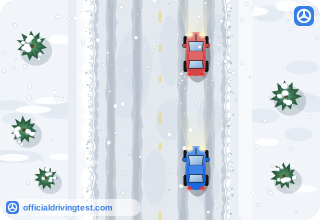
Why should you put a greater distance than usual between you and other vehicles in winter?
- Winter headlights are not as bright as they are in summer
- Vehicles need a greater stopping distance on slippery roads
- Other drivers tend to brake much harder in cold weather
- Vehicles are heavier when the weather is very cold
Show answer
Correct answer: Vehicles need a greater stopping distance on slippery roads
The manual says vehicles need a greater stopping distance on slippery roads.
Source: Ohio Driver Manual (HSY 7607 10/25 (October 2025)), page 29
-
When is a slower speed especially important in winter driving?
- On snow-covered or icy roads
- On dry pavement
- In the early morning only
- On roads with many lanes
Show answer
Correct answer: On snow-covered or icy roads
A slower speed is necessary for safe handling, but especially important on snow-covered or icy roads.
Source: Ohio Driver Manual (HSY 7607 10/25 (October 2025)), page 29
-
Which parts of a highway ice first?
- Straight, flat sections in the sun
- Roads near the center line only
- Bridges, overpasses, and shaded spots
- The right shoulder of the highway only
Show answer
Correct answer: Bridges, overpasses, and shaded spots
The manual says bridges, overpasses, and shaded spots on a highway ice first.
Source: Ohio Driver Manual (HSY 7607 10/25 (October 2025)), page 29
-
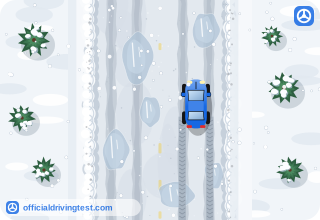
How can you reduce momentum without losing traction on slippery roads?
- Press the brake pedal hard
- Lightly tap on the brake
- Shift into reverse
- Turn the steering wheel sharply
Show answer
Correct answer: Lightly tap on the brake
Lightly tapping on the brake helps to reduce momentum without losing traction.
Source: Ohio Driver Manual (HSY 7607 10/25 (October 2025)), page 29
-
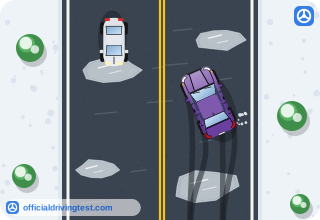
What should you do if your vehicle starts to skid?
- Press the accelerator and turn the steering wheel away from the skid
- Brake hard and turn the steering wheel away from the skid
- Hold the steering wheel straight and shift into neutral
- Take your foot off the accelerator and steer in the direction of the skid
Show answer
Correct answer: Take your foot off the accelerator and steer in the direction of the skid
The manual says to take your foot off the accelerator and steer in the direction of the skid.
Source: Ohio Driver Manual (HSY 7607 10/25 (October 2025)), page 29
-
About how many children die each year in the U.S. from vehicular heatstroke, according to the manual?
- About 3
- About 380
- About 38
- About 3,800
Show answer
Correct answer: About 38
The manual cites about 38 kids dying each year in the U.S. from vehicular heatstroke.
Source: Ohio Driver Manual (HSY 7607 10/25 (October 2025)), page 33
-
What does the manual say about leaving children in or around cars?
- Never leave children alone in or around cars
- Children may stay alone for a few minutes if the windows are open
- Children older than 5 may be left in the car
- Children may stay in the car if it is parked in the shade
Show answer
Correct answer: Never leave children alone in or around cars
The manual says to never leave children alone in, or around, cars.
Source: Ohio Driver Manual (HSY 7607 10/25 (October 2025)), page 33
-
What habit does the "Look Before You Lock" campaign encourage?
- Locking the doors before you start the engine
- Checking the trunk before you begin to drive
- Looking at the parking brake before you lock up
- Looking in the backseat before you lock the doors
Show answer
Correct answer: Looking in the backseat before you lock the doors
The manual says to make it a habit to look in the backseat before locking your doors.
Source: Ohio Driver Manual (HSY 7607 10/25 (October 2025)), page 33
-
Which of these is a reminder the manual suggests to help you check the back seat?
- Hang a small mirror on the steering wheel
- Keep a stuffed animal in the front passenger seat
- Keep the radio on whenever you drive
- Leave the trunk open while you are parked
Show answer
Correct answer: Keep a stuffed animal in the front passenger seat
The manual lists keeping a stuffed animal in the front passenger seat as a visual reminder to check the back seat.
Source: Ohio Driver Manual (HSY 7607 10/25 (October 2025)), page 33
-
What is a "Drop-off Policy" the manual recommends setting up?
- Ask your childcare provider to contact you if your child does not arrive
- Drop your child off at the curb in front of the building each day
- Leave the car running while you are dropping your child off there
- Drop your child off at exactly the same time each day of the week
Show answer
Correct answer: Ask your childcare provider to contact you if your child does not arrive
The manual recommends asking your childcare provider to contact you if your child does not arrive as scheduled.
Source: Ohio Driver Manual (HSY 7607 10/25 (October 2025)), page 33
-
What habit does the manual recommend about locking your vehicle?
- Lock the doors only in winter
- Leave the trunk unlocked so a child can get out
- Always lock the doors and trunk, year-round
- Lock the doors only when you are away overnight
Show answer
Correct answer: Always lock the doors and trunk, year-round
The manual says to create the habit of always locking your vehicle's doors and trunk, year-round.
Source: Ohio Driver Manual (HSY 7607 10/25 (October 2025)), page 33
-
If a child goes missing, what does the manual say to check?
- Only unlocked vehicles in the area
- The passenger compartments and trunks of all vehicles nearby, even if locked
- Only the trunk and passenger seat of your own vehicle
- Only the vehicles nearby that have an engine that is currently running
Show answer
Correct answer: The passenger compartments and trunks of all vehicles nearby, even if locked
If a child goes missing, check the passenger compartments and trunks of all vehicles in the area, even if locked, because a child may lock the doors after entering.
Source: Ohio Driver Manual (HSY 7607 10/25 (October 2025)), page 33
-
What is the first thing the manual says to do if you see a child alone in a vehicle?
- Wait about 30 minutes to see if a parent returns
- Knock on the window and leave
- Move the vehicle into the shade
- Call 911 immediately
Show answer
Correct answer: Call 911 immediately
If you see a child alone in a vehicle, call 911 immediately and check for unlocked doors while you try to locate the parent.
Source: Ohio Driver Manual (HSY 7607 10/25 (October 2025)), page 33
-
If a child alone in a vehicle is in distress or unresponsive, what does the manual say you should do?
- Wait for the police before touching the vehicle at all
- Wait for the parent, even if it takes a long time
- Take action to remove the child, breaking a window if necessary
- Leave a note and come back in about 10 minutes
Show answer
Correct answer: Take action to remove the child, breaking a window if necessary
The manual says to take action to remove a child who is in distress or unresponsive, and to break a window if necessary.
Source: Ohio Driver Manual (HSY 7607 10/25 (October 2025)), page 33
-
What do "Good Samaritan" laws do, according to the manual?
- Protect people from lawsuits after responding in an emergency
- Require every driver to carry a first aid kit in the car
- Require drivers to stop at the scene of every crash
- Forbid anyone from breaking a window of a car
Show answer
Correct answer: Protect people from lawsuits after responding in an emergency
The manual says many states, including Ohio, have Good Samaritan laws that protect people from lawsuits after responding in an emergency.
Source: Ohio Driver Manual (HSY 7607 10/25 (October 2025)), page 33
-
After you call 911 about a child alone in a vehicle, what should you do?
- Go home and wait for a call
- Drive the child to the nearest police station
- Stay in your car and monitor the situation
- Stay with the child until help arrives
Show answer
Correct answer: Stay with the child until help arrives
The manual says to stay with the child until help arrives.
Source: Ohio Driver Manual (HSY 7607 10/25 (October 2025)), page 33
-
How much can the temperature inside a vehicle rise in 10 minutes, even with the windows cracked?
- About 2 degrees Fahrenheit
- About 20 degrees Fahrenheit
- About 5 degrees Fahrenheit
- About 50 degrees Fahrenheit
Show answer
Correct answer: About 20 degrees Fahrenheit
Even with the windows cracked, the temperature in a vehicle can increase 20 degrees (Fahrenheit) in just 10 minutes.
Source: Ohio Driver Manual (HSY 7607 10/25 (October 2025)), page 33
-
According to the manual, who has the responsibility to prevent crashes?
- Only new drivers
- All drivers
- Only law enforcement officers
- Only drivers of large trucks
Show answer
Correct answer: All drivers
The manual states that all drivers have the responsibility to prevent crashes.
Source: Ohio Driver Manual (HSY 7607 10/25 (October 2025)), page 39
-
What is an ABS (anti-lock braking system) designed to do?
- Increase your vehicle's top speed
- Keep your headlights on at night
- Turn your wheels when you steer
- Stop your vehicle without skidding
Show answer
Correct answer: Stop your vehicle without skidding
Most new vehicles are equipped with ABS (anti-lock braking system) to stop your vehicle without skidding.
Source: Ohio Driver Manual (HSY 7607 10/25 (October 2025)), page 39
-
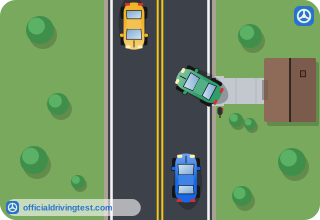
How should you hold the steering wheel when you swerve to avoid a crash?
- Hold it with one hand and brake hard at the same time
- Release it so the vehicle can straighten by itself
- Grip it with both hands and steer to avoid other traffic
- Grip it lightly and steer toward the other traffic
Show answer
Correct answer: Grip it with both hands and steer to avoid other traffic
To swerve, grip the steering wheel in both hands and steer in the direction to avoid other traffic.
Source: Ohio Driver Manual (HSY 7607 10/25 (October 2025)), page 39
-
After swerving around a problem, how do you straighten out your vehicle and gain control?
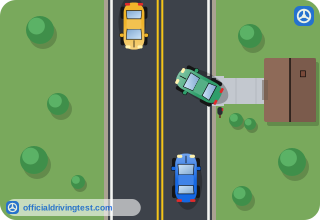
- Steer in the opposite direction and start slowing
- Steer in the same direction and speed up
- Release the wheel and brake as hard as you can
- Keep the same steering and shift to neutral
Show answer
Correct answer: Steer in the opposite direction and start slowing
After swerving, steer in the opposite direction to straighten out your vehicle, gain control, and start slowing.
Source: Ohio Driver Manual (HSY 7607 10/25 (October 2025)), page 39
-
When might it be necessary to accelerate to avoid a crash?
- When another vehicle is stopped ahead of you in the lane
- When you are approaching a yield sign in the roadway
- When your vehicle is beginning to hydroplane in the lane
- When another vehicle is about to hit you from behind or the side
Show answer
Correct answer: When another vehicle is about to hit you from behind or the side
It may be necessary to accelerate to avoid a crash when another vehicle is about to hit you from behind or the side.
Source: Ohio Driver Manual (HSY 7607 10/25 (October 2025)), page 39
-
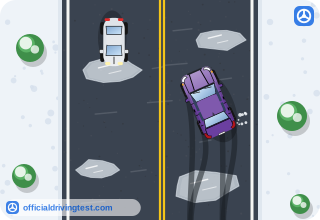
Which of these can cause a skid?
- Driving slowly for conditions
- Stopping too suddenly
- Braking gently and early
- Using your turn signal
Show answer
Correct answer: Stopping too suddenly
Skids are caused when you are traveling too fast for conditions, when you stop too suddenly, or when the tires can no longer grip the roadway.
Source: Ohio Driver Manual (HSY 7607 10/25 (October 2025)), page 39
-
What should you do when you begin to skid?
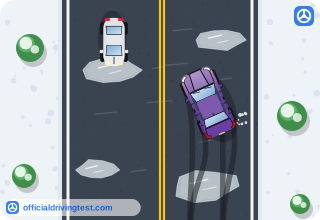
- Release the brake or accelerator and turn the wheel into the skid
- Press the brake pedal harder and turn away from the skid
- Press the accelerator harder and hold the wheel straight
- Shift to neutral and turn the wheel away from the skid
Show answer
Correct answer: Release the brake or accelerator and turn the wheel into the skid
When you begin to skid, release pressure from the brake or accelerator and turn the wheel into the skid.
Source: Ohio Driver Manual (HSY 7607 10/25 (October 2025)), page 39
-
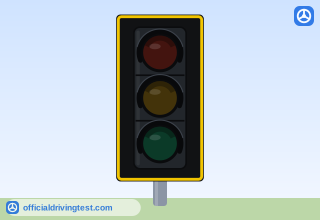
What must you do at an intersection when the traffic signal is not working because of a power outage and no officer is directing traffic?
- Treat it as a yield sign
- Treat it as a green light
- Treat it as a four-way stop
- Wait for power to return
Show answer
Correct answer: Treat it as a four-way stop
By law, unless a law enforcement officer is directing traffic, drivers must treat a non-working traffic signal as a four-way stop.
Source: Ohio Driver Manual (HSY 7607 10/25 (October 2025)), page 39
-
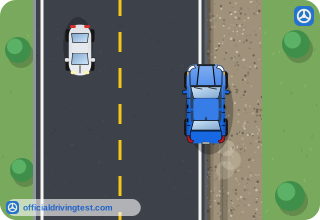
Your vehicle leaves the paved road surface. What should you do?
- Brake hard and turn sharply back onto the pavement right away
- Let off the accelerator, slow down, and return to the pavement when safe
- Speed up and steer back onto the pavement as fast as possible
- Stop on the edge of the road and wait for help to arrive there
Show answer
Correct answer: Let off the accelerator, slow down, and return to the pavement when safe
If your vehicle leaves the paved road surface, let off the accelerator, slow down gradually, and when safe to do so, return to the pavement.
Source: Ohio Driver Manual (HSY 7607 10/25 (October 2025)), page 39
-
If your brakes fail while driving, what is the first thing the manual says to do?
- Shift into reverse gear
- Turn off the engine right away
- Pump the gas pedal repeatedly
- Use the parking brake
Show answer
Correct answer: Use the parking brake
If your brakes fail, use the parking brake.
Source: Ohio Driver Manual (HSY 7607 10/25 (October 2025)), page 40
-
How should you apply the parking brake when your brakes fail?
- Quickly and with full force so you stop right away
- Only after you have turned off the engine completely
- Slowly, so you do not lock the rear wheels and cause a skid
- After shifting the vehicle into reverse gear first
Show answer
Correct answer: Slowly, so you do not lock the rear wheels and cause a skid
The parking brake should be applied slowly so that you will not lock the rear wheels and cause a skid.
Source: Ohio Driver Manual (HSY 7607 10/25 (October 2025)), page 40
-
If using the parking brake does not stop your vehicle after brake failure, what should you do?
- Turn off the engine, pull off the road, and use flashers
- Shift into PARK and keep the vehicle going straight
- Turn off the engine and continue down the road
- Turn on the flashers and accelerate to pass traffic
Show answer
Correct answer: Turn off the engine, pull off the road, and use flashers
If the parking brake does not work, turn off the engine, pull off the road, and turn on emergency flashers.
Source: Ohio Driver Manual (HSY 7607 10/25 (October 2025)), page 40
-
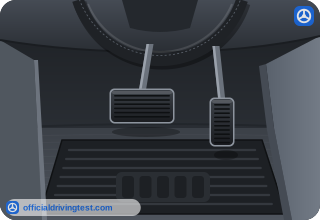
What are the first steps if your vehicle is accelerating out of control?
- Shift to PARK and turn off the engine as soon as possible
- Turn off the flashers and brake as hard as you can at once
- Shift into a lower gear and keep your speed up steadily
- Turn on flashers, shift to NEUTRAL, search for an escape route
Show answer
Correct answer: Turn on flashers, shift to NEUTRAL, search for an escape route
For a stuck accelerator, turn on emergency flashers, shift to NEUTRAL gear, and search for an escape route.
Source: Ohio Driver Manual (HSY 7607 10/25 (October 2025)), page 40
-
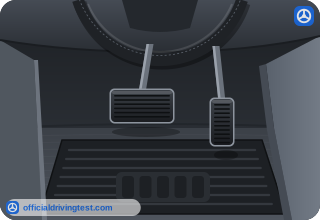
After shifting to neutral with a stuck accelerator, what should you do next?
- Steer sharply and brake as hard as you can to stop
- Steer smoothly, brake gradually, and pull off the roadway
- Keep driving until the engine stops by itself
- Shift back into drive and speed up to pass traffic
Show answer
Correct answer: Steer smoothly, brake gradually, and pull off the roadway
After shifting to neutral, steer smoothly, brake gradually, and pull off the roadway, then shift to PARK and turn off the engine.
Source: Ohio Driver Manual (HSY 7607 10/25 (October 2025)), page 40
-
What will happen if a front tire blows out?
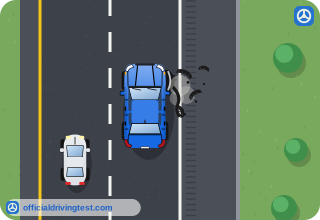
- The vehicle will pull sharply in the direction of the blowout
- The vehicle will pull sharply in the opposite direction
- The vehicle will wobble and shake but hold its line
- The vehicle will speed up without warning
Show answer
Correct answer: The vehicle will pull sharply in the direction of the blowout
If a front tire blows out, the vehicle will pull sharply in the direction of the blowout.
Source: Ohio Driver Manual (HSY 7607 10/25 (October 2025)), page 40
-
What will happen if a rear tire blows out?
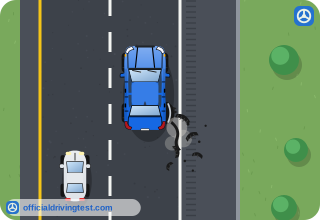
- It pulls sharply in the opposite direction of the blowout
- It stops right away without any shaking or pulling at all
- It wobbles, shakes, and pulls some in the direction of the blowout
- It lifts at the rear and then slides sideways down the road
Show answer
Correct answer: It wobbles, shakes, and pulls some in the direction of the blowout
If a rear tire blows out, the vehicle will wobble, shake, and pull some in the direction of the blowout.
Source: Ohio Driver Manual (HSY 7607 10/25 (October 2025)), page 40
-
What should you do with the steering wheel after a tire blowout?
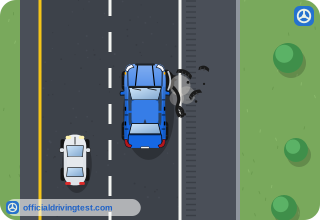
- Turn sharply away from the blown tire at once
- Grip it firmly and keep the vehicle going straight
- Turn sharply toward the blown tire and brake
- Let go of it so that the car can settle down
Show answer
Correct answer: Grip it firmly and keep the vehicle going straight
After a tire blowout, grip the steering wheel firmly and keep the vehicle going straight.
Source: Ohio Driver Manual (HSY 7607 10/25 (October 2025)), page 40
-
What should you do about braking after a tire blowout?
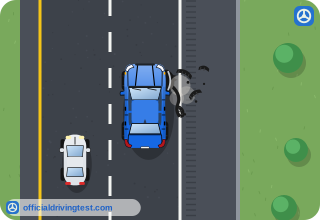
- Brake hard right away, then release
- Pump the brake quickly and repeatedly
- Brake firmly and steer to the left
- Do not brake; slow down gradually
Show answer
Correct answer: Do not brake; slow down gradually
After a tire blowout, do not brake; slow down gradually.
Source: Ohio Driver Manual (HSY 7607 10/25 (October 2025)), page 40
-
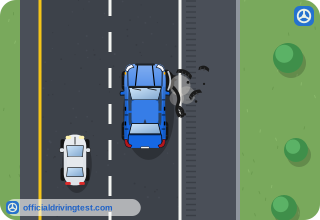
After you slow down following a tire blowout, what should you do?
- Stop in your lane, turn off the hazard lights, and shift to neutral
- Drive on at a low speed until you reach a repair shop
- Pull off safely, turn on hazard lights, shift to PARK, turn off the engine
- Stop in your lane and keep the engine running until help arrives
Show answer
Correct answer: Pull off safely, turn on hazard lights, shift to PARK, turn off the engine
Pull off the road in a safe place and turn on hazard lights, shift to PARK, and turn off the engine.
Source: Ohio Driver Manual (HSY 7607 10/25 (October 2025)), page 40
-
If your engine shuts off while you are driving, what should you expect about the steering wheel?
- It may be difficult to turn, but you can turn it
- It will lock so it cannot be turned at all
- It will turn more easily than normal
- It will turn only to the right
Show answer
Correct answer: It may be difficult to turn, but you can turn it
If the engine shuts off, the steering wheel may be difficult to turn, but you can turn it.
Source: Ohio Driver Manual (HSY 7607 10/25 (October 2025)), page 40
-
How should you brake if your engine shuts off while you are driving?
- By pumping the pedal quickly while you steer the car
- By using only the parking brake at full force right away
- By shifting into reverse gear to stop the vehicle faster
- With steady pressure on the pedal, then pull off the roadway
Show answer
Correct answer: With steady pressure on the pedal, then pull off the roadway
Brake with steady pressure on the pedal, slow down, and pull off the roadway.
Source: Ohio Driver Manual (HSY 7607 10/25 (October 2025)), page 40
-
After pulling off the road with a power failure, what should you do if the engine does not restart?
- Keep trying to restart it while the car rolls
- Raise the hood and turn on the emergency flashers
- Leave the vehicle and walk out into traffic
- Shift into neutral and wait in the traffic lane
Show answer
Correct answer: Raise the hood and turn on the emergency flashers
Shift to PARK and try to restart the engine; if unsuccessful, raise the hood and turn on the emergency flashers.
Source: Ohio Driver Manual (HSY 7607 10/25 (October 2025)), page 40
-
If your vehicle breaks down, where should you try to move it?
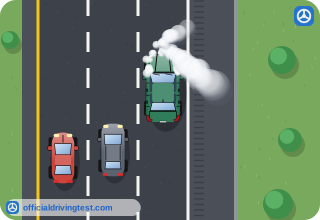
- Off the road and away from traffic, if possible
- To the center of the road, to be seen
- Next to the nearest intersection or crosswalk
- To the left lane, to let traffic pass you
Show answer
Correct answer: Off the road and away from traffic, if possible
If your vehicle breaks down, get it off the road and away from traffic, if possible.
Source: Ohio Driver Manual (HSY 7607 10/25 (October 2025)), page 40
-
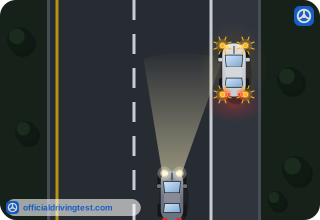
How far behind your disabled vehicle should you place emergency flares, if possible?
- About 20 to 30 feet
- About 50 to 100 feet
- About 200 to 300 feet
- About 500 to 600 feet
Show answer
Correct answer: About 200 to 300 feet
If possible, place emergency flares about 200 to 300 feet behind the vehicle to alert other drivers.
Source: Ohio Driver Manual (HSY 7607 10/25 (October 2025)), page 40
-
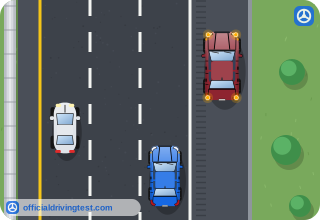
What should you do after your vehicle breaks down and you have warned other road users?
- Stand behind your vehicle and wave traffic down
- Stay in your vehicle until help arrives
- Walk along the roadway to find help
- Wait on the road beside your vehicle
Show answer
Correct answer: Stay in your vehicle until help arrives
The manual says to stay in your vehicle until help arrives.
Source: Ohio Driver Manual (HSY 7607 10/25 (October 2025)), page 40
-
What signal should you turn on when your vehicle breaks down to show it is disabled?
- Your high beam headlights
- Your left turn signal only
- Your windshield wipers
- Your emergency flashers
Show answer
Correct answer: Your emergency flashers
If your vehicle breaks down, turn on your emergency flashers to show that your vehicle is disabled.
Source: Ohio Driver Manual (HSY 7607 10/25 (October 2025)), page 40
-
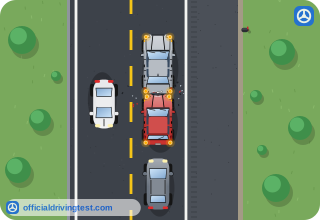
If you are involved in a crash, what should you do first with your vehicle?
- Leave it where it stopped and turn off the lights
- Turn it around to face oncoming traffic
- Move it off the roadway as far as possible
- Leave it in the lane until police arrive
Show answer
Correct answer: Move it off the roadway as far as possible
If you are involved in a crash, move your vehicle off the roadway as far as possible.
Source: Ohio Driver Manual (HSY 7607 10/25 (October 2025)), page 41
-
If you cannot move your vehicle after a crash, what should you do?
- Make sure your hazard lights are on and set up flares if you have them
- Turn off the hazard lights to save the vehicle's battery power
- Leave the scene at once and call for help from somewhere else
- Stand behind your vehicle and wave to warn oncoming traffic
Show answer
Correct answer: Make sure your hazard lights are on and set up flares if you have them
If you cannot move your vehicle, ensure your hazard lights are on and set up road flares if you have them.
Source: Ohio Driver Manual (HSY 7607 10/25 (October 2025)), page 41
-
What should you do about other drivers after a crash, even if the crash is minor?
- Wave traffic toward the side of the road where you stand
- Turn off your vehicle's lights so you will not distract traffic
- Leave the scene at once so traffic can keep moving
- Warn approaching traffic right away and turn on your hazard lights
Show answer
Correct answer: Warn approaching traffic right away and turn on your hazard lights
Stop and take immediate steps to warn approaching traffic, and turn on your hazard lights.
Source: Ohio Driver Manual (HSY 7607 10/25 (October 2025)), page 41
-
How should you behave at the scene of a crash?
- Argue firmly about who was at fault here
- Remain as calm as possible and avoid any argument
- Tell the other drivers how to fix their cars
- Leave before any other people arrive
Show answer
Correct answer: Remain as calm as possible and avoid any argument
The manual says to remain as calm as possible and avoid any argument.
Source: Ohio Driver Manual (HSY 7607 10/25 (October 2025)), page 41
-
What must you do before you leave the scene of a crash?
- After exchanging contact and insurance information with the others
- As soon as you have given your name to one of the witnesses
- As soon as the other driver has left the scene of the crash
- As soon as you have phoned your own insurance company agent
Show answer
Correct answer: After exchanging contact and insurance information with the others
Do not leave the scene until you have exchanged contact and insurance information with those involved.
Source: Ohio Driver Manual (HSY 7607 10/25 (October 2025)), page 41
-
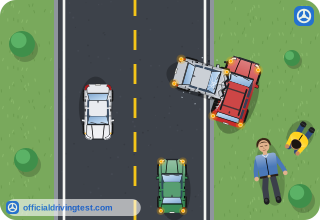
What should you do if anyone has been injured in a crash?
- Wait to see whether the injured person asks for help
- Call emergency services (911)
- Drive the injured person to a doctor yourself
- Ask the other driver to call later
Show answer
Correct answer: Call emergency services (911)
Call emergency services (911) if anyone has been injured.
Source: Ohio Driver Manual (HSY 7607 10/25 (October 2025)), page 41
-
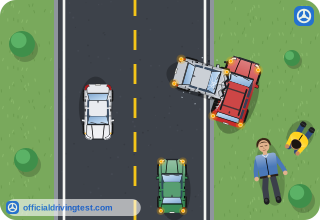
What does the manual say about an injured person at a crash scene?
- Move them to the roadside right away
- Sit them up and give them water
- Move them into the nearest vehicle
- Do not move the injured; keep them warm
Show answer
Correct answer: Do not move the injured; keep them warm
The manual says not to move the injured and to keep them warm.
Source: Ohio Driver Manual (HSY 7607 10/25 (October 2025)), page 41
-
Which authorities should you notify after a crash?
- Only the fire department that serves the local area
- Only the Bureau of Motor Vehicles and its offices
- The Ohio State Highway Patrol, a Sheriff, or the local police
- Only the tow truck company that is nearest to the crash
Show answer
Correct answer: The Ohio State Highway Patrol, a Sheriff, or the local police
Notify the proper authorities: either the Ohio State Highway Patrol, Sheriff, or local police.
Source: Ohio Driver Manual (HSY 7607 10/25 (October 2025)), page 41
-
What should you not discuss when you exchange information after a crash?
- Fault or insurance coverage
- Your name and address
- Your license plate number
- The make and model of your vehicle
Show answer
Correct answer: Fault or insurance coverage
Exchange information with others involved, but do not discuss fault or insurance coverage.
Source: Ohio Driver Manual (HSY 7607 10/25 (October 2025)), page 41
-
Which vehicle details should you provide and collect after a crash?
- Vehicle color and the number of passengers
- Odometer reading and the brand of the tires
- Fuel type and the year the vehicle was bought
- License plate number and vehicle make and model
Show answer
Correct answer: License plate number and vehicle make and model
You should provide and collect the license plate number and vehicle make and model of the vehicles involved.
Source: Ohio Driver Manual (HSY 7607 10/25 (October 2025)), page 41
-
Which insurance details should you provide and collect after a crash?
- Only the name of the insurance agent you deal with
- Name, address, and policy number of the insurance company
- Only the amount of your yearly premium payments
- Only the date that your policy first began
Show answer
Correct answer: Name, address, and policy number of the insurance company
You should provide and collect the name, address, and policy number of the insurance company.
Source: Ohio Driver Manual (HSY 7607 10/25 (October 2025)), page 41
-
Whose names and addresses should you collect after a crash, besides those involved?
- Those who witnessed the crash
- Drivers who passed the scene
- The people who own nearby buildings
- Police officers who were not at the scene
Show answer
Correct answer: Those who witnessed the crash
You should collect the names and addresses of those involved or those who witnessed the crash.
Source: Ohio Driver Manual (HSY 7607 10/25 (October 2025)), page 41
-
Which of these should you take note of after a crash?
- The phone numbers of other drivers who stopped nearby
- Your own opinion of who was at fault in the crash
- Chain of events, weather, road conditions, and traffic controls
- The estimated price of repairs to each of the vehicles
Show answer
Correct answer: Chain of events, weather, road conditions, and traffic controls
Take note of the circumstances of the crash, such as the chain of events, weather, road conditions, and traffic controls.
Source: Ohio Driver Manual (HSY 7607 10/25 (October 2025)), page 41
-
How should you handle questions about the crash from the investigating officer and from others?
- Discuss the accident freely with everyone that you meet
- Answer the officer's questions, but do not discuss it with others
- Refuse to answer any of the officer's questions at all
- Answer questions only from the other driver involved
Show answer
Correct answer: Answer the officer's questions, but do not discuss it with others
Answer all of the investigating officer's questions, but do not discuss the accident with others.
Source: Ohio Driver Manual (HSY 7607 10/25 (October 2025)), page 41
-
When should you notify your insurance company after a crash?
- Within one year
- After the vehicle is repaired
- Only if you were at fault
- As soon as possible
Show answer
Correct answer: As soon as possible
The manual says to notify your insurance company as soon as possible.
Source: Ohio Driver Manual (HSY 7607 10/25 (October 2025)), page 41
-
What must you do if you are involved in a crash with an unattended vehicle?
- Drive away if no one is hurt and nothing is badly damaged
- Move the unattended vehicle completely out of the roadway
- Report the crash to police or leave the necessary information
- Wait at the scene until the owner of the vehicle comes back
Show answer
Correct answer: Report the crash to police or leave the necessary information
If involved in a crash with an unattended vehicle, you must report the crash to the police or leave necessary information at the scene.
Source: Ohio Driver Manual (HSY 7607 10/25 (October 2025)), page 41
-
Within how long after a crash may the driver file a Crash Report with the Ohio Bureau of Motor Vehicles, if the conditions apply?
- Within six months
- Within 10 days
- Within 30 days
- Within one year
Show answer
Correct answer: Within six months
The driver may file a Crash Report with the BMV within six months after the crash if both conditions apply.
Source: Ohio Driver Manual (HSY 7607 10/25 (October 2025)), page 41
-
What damage level, or injury, is one of the conditions for filing a Crash Report with the BMV?
- Damage in excess of $50, or no injury
- Damage in excess of $4,000, or death only
- Damage in excess of $100, with no injury
- Damage in excess of $400, or personal injury
Show answer
Correct answer: Damage in excess of $400, or personal injury
One condition is damage in excess of $400, or personal injury.
Source: Ohio Driver Manual (HSY 7607 10/25 (October 2025)), page 41
-
What is the other condition for a driver to file a Crash Report with the BMV?
- The other driver left the scene of the crash before police arrived
- The other driver or owner had no insurance or financial responsibility coverage
- The other driver was under 21 years of age at the time of the crash
- The other vehicle was a commercial vehicle carrying passengers
Show answer
Correct answer: The other driver or owner had no insurance or financial responsibility coverage
The second condition is that the driver or owner of the other vehicle did not have insurance or other financial responsibility coverage at the time of the crash.
Source: Ohio Driver Manual (HSY 7607 10/25 (October 2025)), page 41