Ohio: Emergencies and special situations — Part 3 Practice Test
Questions in this part include: “If using the parking brake does not stop your vehicle after brake failure, what should you do?” · “After pulling off the road with a power failure, what should you do if the engine does not restart?”
Independent educational site · not affiliated with any government agency or DMV
Ready? Test yourself
- Instant feedback with an explanation
- Every answer cites its source in the manual
- Your best score is saved on this device
Questions are original and based on the official manual "Ohio Driver Manual" (HSY 7607 10/25 (October 2025)), Ohio Bureau of Motor Vehicles.
All 17 questions in this practice test
Take the test above first, then use this list to study. Tap “Show answer” to see the correct answer and explanation.
Show the questions and answersHide the questions
-
If using the parking brake does not stop your vehicle after brake failure, what should you do?
- Turn off the engine, pull off the road, and use flashers
- Shift into PARK and keep the vehicle going straight
- Turn off the engine and continue down the road
- Turn on the flashers and accelerate to pass traffic
Show answer
Correct answer: Turn off the engine, pull off the road, and use flashers
If the parking brake does not work, turn off the engine, pull off the road, and turn on emergency flashers.
Source: Ohio Driver Manual (HSY 7607 10/25 (October 2025)), page 40
-
What are the first steps if your vehicle is accelerating out of control?
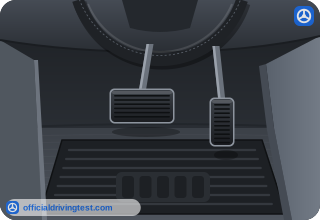
- Shift to PARK and turn off the engine as soon as possible
- Turn off the flashers and brake as hard as you can at once
- Shift into a lower gear and keep your speed up steadily
- Turn on flashers, shift to NEUTRAL, search for an escape route
Show answer
Correct answer: Turn on flashers, shift to NEUTRAL, search for an escape route
For a stuck accelerator, turn on emergency flashers, shift to NEUTRAL gear, and search for an escape route.
Source: Ohio Driver Manual (HSY 7607 10/25 (October 2025)), page 40
-
After shifting to neutral with a stuck accelerator, what should you do next?
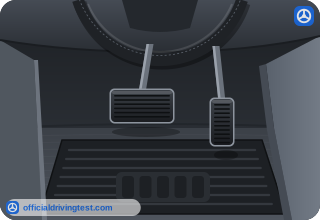
- Steer sharply and brake as hard as you can to stop
- Steer smoothly, brake gradually, and pull off the roadway
- Keep driving until the engine stops by itself
- Shift back into drive and speed up to pass traffic
Show answer
Correct answer: Steer smoothly, brake gradually, and pull off the roadway
After shifting to neutral, steer smoothly, brake gradually, and pull off the roadway, then shift to PARK and turn off the engine.
Source: Ohio Driver Manual (HSY 7607 10/25 (October 2025)), page 40
-
What will happen if a front tire blows out?
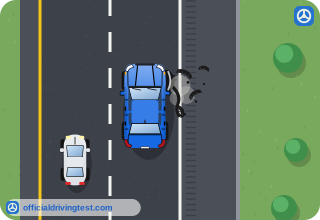
- The vehicle will pull sharply in the direction of the blowout
- The vehicle will pull sharply in the opposite direction
- The vehicle will wobble and shake but hold its line
- The vehicle will speed up without warning
Show answer
Correct answer: The vehicle will pull sharply in the direction of the blowout
If a front tire blows out, the vehicle will pull sharply in the direction of the blowout.
Source: Ohio Driver Manual (HSY 7607 10/25 (October 2025)), page 40
-
What will happen if a rear tire blows out?
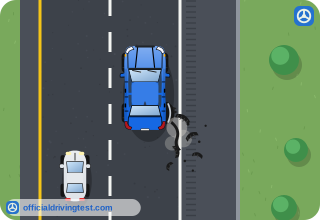
- It pulls sharply in the opposite direction of the blowout
- It stops right away without any shaking or pulling at all
- It wobbles, shakes, and pulls some in the direction of the blowout
- It lifts at the rear and then slides sideways down the road
Show answer
Correct answer: It wobbles, shakes, and pulls some in the direction of the blowout
If a rear tire blows out, the vehicle will wobble, shake, and pull some in the direction of the blowout.
Source: Ohio Driver Manual (HSY 7607 10/25 (October 2025)), page 40
-
What should you do with the steering wheel after a tire blowout?
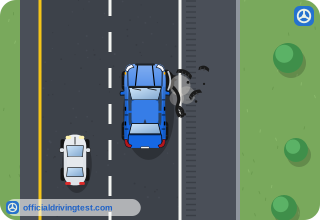
- Turn sharply away from the blown tire at once
- Grip it firmly and keep the vehicle going straight
- Turn sharply toward the blown tire and brake
- Let go of it so that the car can settle down
Show answer
Correct answer: Grip it firmly and keep the vehicle going straight
After a tire blowout, grip the steering wheel firmly and keep the vehicle going straight.
Source: Ohio Driver Manual (HSY 7607 10/25 (October 2025)), page 40
-
What should you do about braking after a tire blowout?
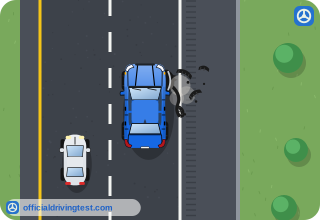
- Brake hard right away, then release
- Pump the brake quickly and repeatedly
- Brake firmly and steer to the left
- Do not brake; slow down gradually
Show answer
Correct answer: Do not brake; slow down gradually
After a tire blowout, do not brake; slow down gradually.
Source: Ohio Driver Manual (HSY 7607 10/25 (October 2025)), page 40
-
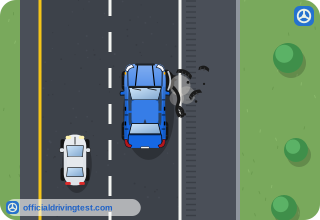
After you slow down following a tire blowout, what should you do?
- Stop in your lane, turn off the hazard lights, and shift to neutral
- Drive on at a low speed until you reach a repair shop
- Pull off safely, turn on hazard lights, shift to PARK, turn off the engine
- Stop in your lane and keep the engine running until help arrives
Show answer
Correct answer: Pull off safely, turn on hazard lights, shift to PARK, turn off the engine
Pull off the road in a safe place and turn on hazard lights, shift to PARK, and turn off the engine.
Source: Ohio Driver Manual (HSY 7607 10/25 (October 2025)), page 40
-
If your engine shuts off while you are driving, what should you expect about the steering wheel?
- It may be difficult to turn, but you can turn it
- It will lock so it cannot be turned at all
- It will turn more easily than normal
- It will turn only to the right
Show answer
Correct answer: It may be difficult to turn, but you can turn it
If the engine shuts off, the steering wheel may be difficult to turn, but you can turn it.
Source: Ohio Driver Manual (HSY 7607 10/25 (October 2025)), page 40
-
How should you brake if your engine shuts off while you are driving?
- By pumping the pedal quickly while you steer the car
- By using only the parking brake at full force right away
- By shifting into reverse gear to stop the vehicle faster
- With steady pressure on the pedal, then pull off the roadway
Show answer
Correct answer: With steady pressure on the pedal, then pull off the roadway
Brake with steady pressure on the pedal, slow down, and pull off the roadway.
Source: Ohio Driver Manual (HSY 7607 10/25 (October 2025)), page 40
-
After pulling off the road with a power failure, what should you do if the engine does not restart?
- Keep trying to restart it while the car rolls
- Raise the hood and turn on the emergency flashers
- Leave the vehicle and walk out into traffic
- Shift into neutral and wait in the traffic lane
Show answer
Correct answer: Raise the hood and turn on the emergency flashers
Shift to PARK and try to restart the engine; if unsuccessful, raise the hood and turn on the emergency flashers.
Source: Ohio Driver Manual (HSY 7607 10/25 (October 2025)), page 40
-
If your vehicle breaks down, where should you try to move it?
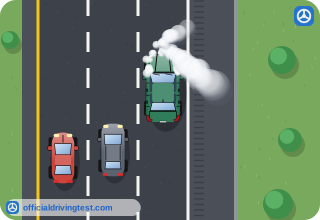
- Off the road and away from traffic, if possible
- To the center of the road, to be seen
- Next to the nearest intersection or crosswalk
- To the left lane, to let traffic pass you
Show answer
Correct answer: Off the road and away from traffic, if possible
If your vehicle breaks down, get it off the road and away from traffic, if possible.
Source: Ohio Driver Manual (HSY 7607 10/25 (October 2025)), page 40
-
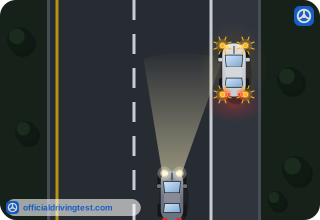
How far behind your disabled vehicle should you place emergency flares, if possible?
- About 20 to 30 feet
- About 50 to 100 feet
- About 200 to 300 feet
- About 500 to 600 feet
Show answer
Correct answer: About 200 to 300 feet
If possible, place emergency flares about 200 to 300 feet behind the vehicle to alert other drivers.
Source: Ohio Driver Manual (HSY 7607 10/25 (October 2025)), page 40
-
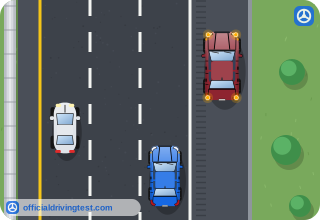
What should you do after your vehicle breaks down and you have warned other road users?
- Stand behind your vehicle and wave traffic down
- Stay in your vehicle until help arrives
- Walk along the roadway to find help
- Wait on the road beside your vehicle
Show answer
Correct answer: Stay in your vehicle until help arrives
The manual says to stay in your vehicle until help arrives.
Source: Ohio Driver Manual (HSY 7607 10/25 (October 2025)), page 40
-
What signal should you turn on when your vehicle breaks down to show it is disabled?
- Your high beam headlights
- Your left turn signal only
- Your windshield wipers
- Your emergency flashers
Show answer
Correct answer: Your emergency flashers
If your vehicle breaks down, turn on your emergency flashers to show that your vehicle is disabled.
Source: Ohio Driver Manual (HSY 7607 10/25 (October 2025)), page 40
-
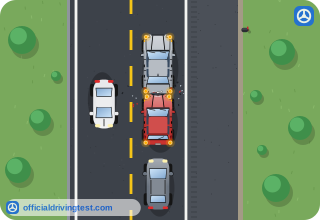
If you are involved in a crash, what should you do first with your vehicle?
- Leave it where it stopped and turn off the lights
- Turn it around to face oncoming traffic
- Move it off the roadway as far as possible
- Leave it in the lane until police arrive
Show answer
Correct answer: Move it off the roadway as far as possible
If you are involved in a crash, move your vehicle off the roadway as far as possible.
Source: Ohio Driver Manual (HSY 7607 10/25 (October 2025)), page 41
-
If you cannot move your vehicle after a crash, what should you do?
- Make sure your hazard lights are on and set up flares if you have them
- Turn off the hazard lights to save the vehicle's battery power
- Leave the scene at once and call for help from somewhere else
- Stand behind your vehicle and wave to warn oncoming traffic
Show answer
Correct answer: Make sure your hazard lights are on and set up flares if you have them
If you cannot move your vehicle, ensure your hazard lights are on and set up road flares if you have them.
Source: Ohio Driver Manual (HSY 7607 10/25 (October 2025)), page 41