Ohio: Emergencies and special situations — Part 2 Practice Test
Questions in this part include: “If a child goes missing, what does the manual say to check?” · “How much can the temperature inside a vehicle rise in 10 minutes, even with the windows cracked?”
Independent educational site · not affiliated with any government agency or DMV
Ready? Test yourself
- Instant feedback with an explanation
- Every answer cites its source in the manual
- Your best score is saved on this device
Questions are original and based on the official manual "Ohio Driver Manual" (HSY 7607 10/25 (October 2025)), Ohio Bureau of Motor Vehicles.
All 17 questions in this practice test
Take the test above first, then use this list to study. Tap “Show answer” to see the correct answer and explanation.
Show the questions and answersHide the questions
-
If a child goes missing, what does the manual say to check?
- Only unlocked vehicles in the area
- The passenger compartments and trunks of all vehicles nearby, even if locked
- Only the trunk and passenger seat of your own vehicle
- Only the vehicles nearby that have an engine that is currently running
Show answer
Correct answer: The passenger compartments and trunks of all vehicles nearby, even if locked
If a child goes missing, check the passenger compartments and trunks of all vehicles in the area, even if locked, because a child may lock the doors after entering.
Source: Ohio Driver Manual (HSY 7607 10/25 (October 2025)), page 33
-
What is the first thing the manual says to do if you see a child alone in a vehicle?
- Wait about 30 minutes to see if a parent returns
- Knock on the window and leave
- Move the vehicle into the shade
- Call 911 immediately
Show answer
Correct answer: Call 911 immediately
If you see a child alone in a vehicle, call 911 immediately and check for unlocked doors while you try to locate the parent.
Source: Ohio Driver Manual (HSY 7607 10/25 (October 2025)), page 33
-
If a child alone in a vehicle is in distress or unresponsive, what does the manual say you should do?
- Wait for the police before touching the vehicle at all
- Wait for the parent, even if it takes a long time
- Take action to remove the child, breaking a window if necessary
- Leave a note and come back in about 10 minutes
Show answer
Correct answer: Take action to remove the child, breaking a window if necessary
The manual says to take action to remove a child who is in distress or unresponsive, and to break a window if necessary.
Source: Ohio Driver Manual (HSY 7607 10/25 (October 2025)), page 33
-
What do "Good Samaritan" laws do, according to the manual?
- Protect people from lawsuits after responding in an emergency
- Require every driver to carry a first aid kit in the car
- Require drivers to stop at the scene of every crash
- Forbid anyone from breaking a window of a car
Show answer
Correct answer: Protect people from lawsuits after responding in an emergency
The manual says many states, including Ohio, have Good Samaritan laws that protect people from lawsuits after responding in an emergency.
Source: Ohio Driver Manual (HSY 7607 10/25 (October 2025)), page 33
-
After you call 911 about a child alone in a vehicle, what should you do?
- Go home and wait for a call
- Drive the child to the nearest police station
- Stay in your car and monitor the situation
- Stay with the child until help arrives
Show answer
Correct answer: Stay with the child until help arrives
The manual says to stay with the child until help arrives.
Source: Ohio Driver Manual (HSY 7607 10/25 (October 2025)), page 33
-
How much can the temperature inside a vehicle rise in 10 minutes, even with the windows cracked?
- About 2 degrees Fahrenheit
- About 20 degrees Fahrenheit
- About 5 degrees Fahrenheit
- About 50 degrees Fahrenheit
Show answer
Correct answer: About 20 degrees Fahrenheit
Even with the windows cracked, the temperature in a vehicle can increase 20 degrees (Fahrenheit) in just 10 minutes.
Source: Ohio Driver Manual (HSY 7607 10/25 (October 2025)), page 33
-
According to the manual, who has the responsibility to prevent crashes?
- Only new drivers
- All drivers
- Only law enforcement officers
- Only drivers of large trucks
Show answer
Correct answer: All drivers
The manual states that all drivers have the responsibility to prevent crashes.
Source: Ohio Driver Manual (HSY 7607 10/25 (October 2025)), page 39
-
What is an ABS (anti-lock braking system) designed to do?
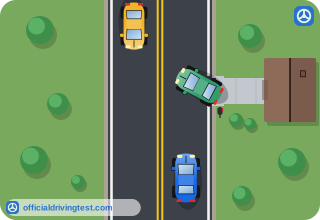
- Increase your vehicle's top speed
- Keep your headlights on at night
- Turn your wheels when you steer
- Stop your vehicle without skidding
Show answer
Correct answer: Stop your vehicle without skidding
Most new vehicles are equipped with ABS (anti-lock braking system) to stop your vehicle without skidding.
Source: Ohio Driver Manual (HSY 7607 10/25 (October 2025)), page 39
-
How should you hold the steering wheel when you swerve to avoid a crash?
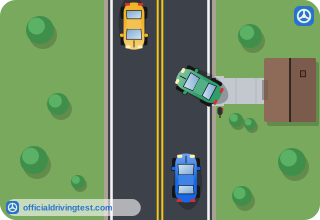
- Hold it with one hand and brake hard at the same time
- Release it so the vehicle can straighten by itself
- Grip it with both hands and steer to avoid other traffic
- Grip it lightly and steer toward the other traffic
Show answer
Correct answer: Grip it with both hands and steer to avoid other traffic
To swerve, grip the steering wheel in both hands and steer in the direction to avoid other traffic.
Source: Ohio Driver Manual (HSY 7607 10/25 (October 2025)), page 39
-
After swerving around a problem, how do you straighten out your vehicle and gain control?
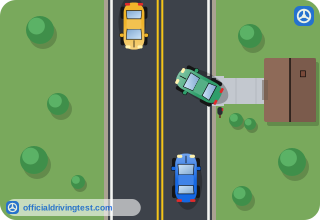
- Steer in the opposite direction and start slowing
- Steer in the same direction and speed up
- Release the wheel and brake as hard as you can
- Keep the same steering and shift to neutral
Show answer
Correct answer: Steer in the opposite direction and start slowing
After swerving, steer in the opposite direction to straighten out your vehicle, gain control, and start slowing.
Source: Ohio Driver Manual (HSY 7607 10/25 (October 2025)), page 39
-
When might it be necessary to accelerate to avoid a crash?
- When another vehicle is stopped ahead of you in the lane
- When you are approaching a yield sign in the roadway
- When your vehicle is beginning to hydroplane in the lane
- When another vehicle is about to hit you from behind or the side
Show answer
Correct answer: When another vehicle is about to hit you from behind or the side
It may be necessary to accelerate to avoid a crash when another vehicle is about to hit you from behind or the side.
Source: Ohio Driver Manual (HSY 7607 10/25 (October 2025)), page 39
-
Which of these can cause a skid?
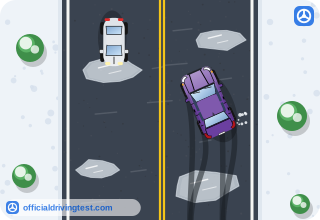
- Driving slowly for conditions
- Stopping too suddenly
- Braking gently and early
- Using your turn signal
Show answer
Correct answer: Stopping too suddenly
Skids are caused when you are traveling too fast for conditions, when you stop too suddenly, or when the tires can no longer grip the roadway.
Source: Ohio Driver Manual (HSY 7607 10/25 (October 2025)), page 39
-
What should you do when you begin to skid?
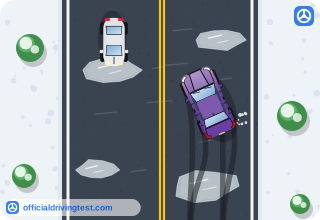
- Release the brake or accelerator and turn the wheel into the skid
- Press the brake pedal harder and turn away from the skid
- Press the accelerator harder and hold the wheel straight
- Shift to neutral and turn the wheel away from the skid
Show answer
Correct answer: Release the brake or accelerator and turn the wheel into the skid
When you begin to skid, release pressure from the brake or accelerator and turn the wheel into the skid.
Source: Ohio Driver Manual (HSY 7607 10/25 (October 2025)), page 39
-
What must you do at an intersection when the traffic signal is not working because of a power outage and no officer is directing traffic?
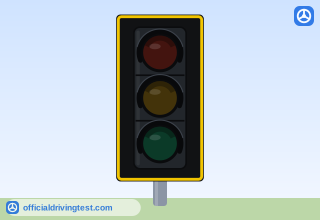
- Treat it as a yield sign
- Treat it as a green light
- Treat it as a four-way stop
- Wait for power to return
Show answer
Correct answer: Treat it as a four-way stop
By law, unless a law enforcement officer is directing traffic, drivers must treat a non-working traffic signal as a four-way stop.
Source: Ohio Driver Manual (HSY 7607 10/25 (October 2025)), page 39
-
Your vehicle leaves the paved road surface. What should you do?
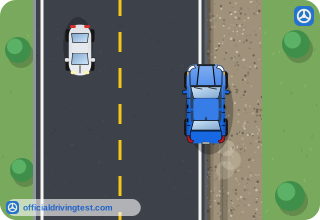
- Brake hard and turn sharply back onto the pavement right away
- Let off the accelerator, slow down, and return to the pavement when safe
- Speed up and steer back onto the pavement as fast as possible
- Stop on the edge of the road and wait for help to arrive there
Show answer
Correct answer: Let off the accelerator, slow down, and return to the pavement when safe
If your vehicle leaves the paved road surface, let off the accelerator, slow down gradually, and when safe to do so, return to the pavement.
Source: Ohio Driver Manual (HSY 7607 10/25 (October 2025)), page 39
-
If your brakes fail while driving, what is the first thing the manual says to do?
- Shift into reverse gear
- Turn off the engine right away
- Pump the gas pedal repeatedly
- Use the parking brake
Show answer
Correct answer: Use the parking brake
If your brakes fail, use the parking brake.
Source: Ohio Driver Manual (HSY 7607 10/25 (October 2025)), page 40
-
How should you apply the parking brake when your brakes fail?
- Quickly and with full force so you stop right away
- Only after you have turned off the engine completely
- Slowly, so you do not lock the rear wheels and cause a skid
- After shifting the vehicle into reverse gear first
Show answer
Correct answer: Slowly, so you do not lock the rear wheels and cause a skid
The parking brake should be applied slowly so that you will not lock the rear wheels and cause a skid.
Source: Ohio Driver Manual (HSY 7607 10/25 (October 2025)), page 40