North Dakota: Right-of-way and turning — Part 2 Practice Test
Questions in this part include: “When making any turn, what should you check?” · “To turn left from a two-way road onto a one-way road, which lane of the one-way road do you enter?”
Independent educational site · not affiliated with any government agency or DMV
Ready? Test yourself
- Instant feedback with an explanation
- Every answer cites its source in the manual
- Your best score is saved on this device
- Keyboard: press 1 to 4 to answer and Enter for the next question
Questions are original and based on the official manual "North Dakota Noncommercial Driver License Manual" (2025-2027), North Dakota Department of Transportation (NDDOT).
All 22 questions in this practice test
Take the test above first, then use this list to study. Tap “Show answer” to see the correct answer and explanation.
Show the questions and answersHide the questions
-
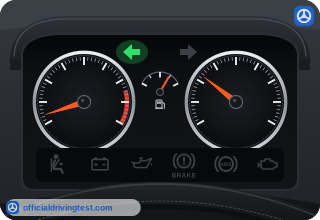
When should you cancel your turn signal after a lane change?
- Before you begin moving over
- After you have driven one mile
- When you complete the lane change
- When the next intersection is reached
Show answer
Correct answer: When you complete the lane change
You should cancel your signal when you complete the lane change.
Source: North Dakota Noncommercial Driver License Manual (2025-2027), page 21 · Open this page in the manual (Manual page 21)
-
Who is responsible for safely changing lanes?
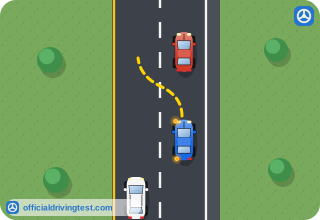
- The driver of the vehicle making the lane change
- The driver of the vehicle already in the lane
- The driver of the larger vehicle
- The driver who is traveling faster
Show answer
Correct answer: The driver of the vehicle making the lane change
The driver of the vehicle making the lane change is responsible for safely changing lanes.
Source: North Dakota Noncommercial Driver License Manual (2025-2027), page 21 · Open this page in the manual (Manual page 21)
-
For how far before a turn must you signal continuously?
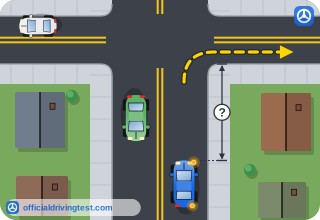
- The last 100 feet
- The last 25 feet
- The last 200 feet
- The last 500 feet
Show answer
Correct answer: The last 100 feet
You must signal continuously for the last 100 feet before the turn.
Source: North Dakota Noncommercial Driver License Manual (2025-2027), page 22 · Open this page in the manual (Manual page 22)
-
When making any turn, what should you check?
- Only the lane that you are entering
- Only for oncoming vehicles
- Only for vehicles coming from behind
- Both ways for traffic and pedestrians
Show answer
Correct answer: Both ways for traffic and pedestrians
When making any turn, you should check both ways for traffic and pedestrians.
Source: North Dakota Noncommercial Driver License Manual (2025-2027), page 22 · Open this page in the manual (Manual page 22)
-
When approaching an intersection to make a right turn, where should you position your vehicle?
- In the center of the roadway, then swing right at the corner
- As far to the right as possible, turning close to the right curb
- Near the center line, then swing right to make the turn
- In the left lane, then cut across to the right curb
Show answer
Correct answer: As far to the right as possible, turning close to the right curb
For a right turn, stay as far to the right as possible and make the turn close to the right curb.
Source: North Dakota Noncommercial Driver License Manual (2025-2027), page 22 · Open this page in the manual (Manual page 22)
-
To turn left from a one-way road onto a two-way road, where should you begin?
- In the left turn lane
- In the right lane
- As close to the right curb as possible
- In the center of the intersection
Show answer
Correct answer: In the left turn lane
To turn left from a one-way road onto a two-way road, begin in the left turn lane.
Source: North Dakota Noncommercial Driver License Manual (2025-2027), page 22 · Open this page in the manual (Manual page 22)
-
To turn left from a one-way road onto a one-way road, how should you make the turn?
- Begin from the right lane and swing wide to the left
- Begin from the center of the road and stay on the center line
- Begin from the left lane and make the turn close to the left curb
- Begin from the right lane and finish in the left lane
Show answer
Correct answer: Begin from the left lane and make the turn close to the left curb
When turning left from a one-way to a one-way, begin the turn from the left lane and make the turn close to the left curb.
Source: North Dakota Noncommercial Driver License Manual (2025-2027), page 22 · Open this page in the manual (Manual page 22)
-
When turning left from a two-way road onto a two-way road, where should you begin the turn?
- As far to the right as possible
- As close to the centerline as possible
- In the center of the intersection
- Close to the right curb
Show answer
Correct answer: As close to the centerline as possible
When turning left from a two-way road onto a two-way road, begin as close to the centerline as possible.
Source: North Dakota Noncommercial Driver License Manual (2025-2027), page 22 · Open this page in the manual (Manual page 22)
-
To turn left from a two-way road onto a one-way road, which lane of the one-way road do you enter?
- The right lane
- Either lane
- The center lane
- The left lane
Show answer
Correct answer: The left lane
When turning left onto a one-way road from a two-way road, make the turn before reaching the center of the intersection and enter the left lane of the one-way road.
Source: North Dakota Noncommercial Driver License Manual (2025-2027), page 23 · Open this page in the manual (Manual page 23)
-
To turn left from a two-way road onto a one-way road, how should you approach the turn?
- With your right wheels close to the right-hand curb
- With your car stopped in the middle of the intersection
- With your left wheels close to the centerline of the road
- With your car in the far right lane
Show answer
Correct answer: With your left wheels close to the centerline of the road
You approach the turn with your left wheels close to the centerline of the road.
Source: North Dakota Noncommercial Driver License Manual (2025-2027), page 23 · Open this page in the manual (Manual page 23)
-
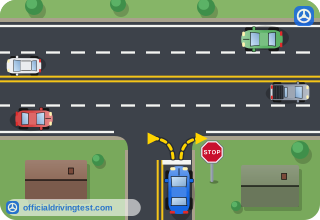
When you turn left from a two-way road onto a four-lane highway, which lane do you enter?
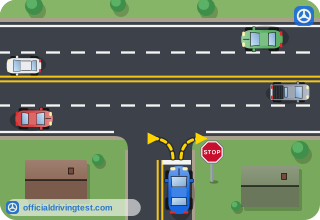
- The passing lane
- The lane next to the curb
- The lane farthest from the centerline
- Any lane that is open
Show answer
Correct answer: The passing lane
You make the turn so that you enter the passing lane of the four-lane highway, then move right when traffic permits.
Source: North Dakota Noncommercial Driver License Manual (2025-2027), page 23 · Open this page in the manual (Manual page 23)
-
After you turn left from a two-way road onto a four-lane highway and enter the passing lane, what should you do when traffic permits?
- Stay in the passing lane until you reach your exit
- Stop on the shoulder and wait for a gap
- Make a U-turn at the next opportunity
- Move to the right, out of the passing lane
Show answer
Correct answer: Move to the right, out of the passing lane
When traffic permits, you should move to the right, out of the passing lane.
Source: North Dakota Noncommercial Driver License Manual (2025-2027), page 23 · Open this page in the manual (Manual page 23)
-
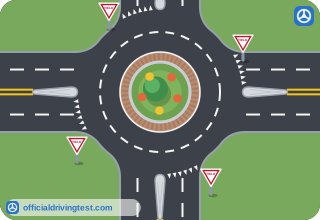
In which direction do vehicles travel around the center island of a roundabout?
- Clockwise
- Counter-clockwise
- Straight across the island
- In either direction
Show answer
Correct answer: Counter-clockwise
A roundabout is a circular intersection where vehicles travel around a center island in a counter-clockwise direction.
Source: North Dakota Noncommercial Driver License Manual (2025-2027), page 23 · Open this page in the manual (Manual page 23)
-
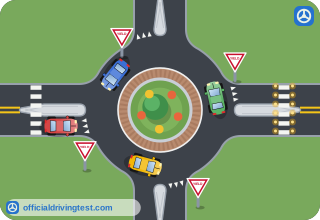
What are roundabouts designed to do?
- Reduce the number and severity of collisions
- Increase the speed limit on side streets
- Remove the need for lane markings
- Allow vehicles to stop in the center island
Show answer
Correct answer: Reduce the number and severity of collisions
Roundabouts are designed to reduce the number and severity of collisions and to improve the flow of traffic.
Source: North Dakota Noncommercial Driver License Manual (2025-2027), page 23 · Open this page in the manual (Manual page 23)
-
What is the first step the manual lists when approaching a roundabout?
- Stop completely at the entrance
- Change to the left lane
- Reduce your speed
- Sound your horn
Show answer
Correct answer: Reduce your speed
The first step when approaching a roundabout is to reduce your speed.
Source: North Dakota Noncommercial Driver License Manual (2025-2027), page 23 · Open this page in the manual (Manual page 23)
-
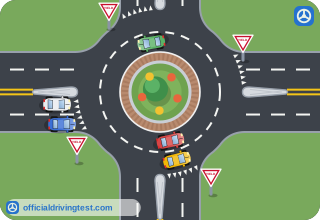
At a roundabout with more than one lane, which lane do you use to turn right, unless signs and pavement markings direct otherwise?
- The left lane
- The right lane
- The center island
- Any lane
Show answer
Correct answer: The right lane
If more than one lane exists, use the left lane to turn left, the right lane to turn right, and all lanes to go through unless directed otherwise.
Source: North Dakota Noncommercial Driver License Manual (2025-2027), page 23 · Open this page in the manual (Manual page 23)
-
At a roundabout, which of these must you yield to?
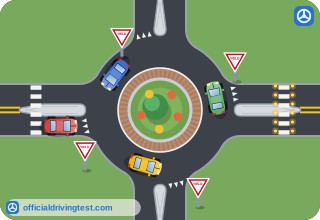
- Only vehicles that are larger than yours
- Only vehicles leaving the roundabout
- Only vehicles entering from your left
- Pedestrians and bicyclists
Show answer
Correct answer: Pedestrians and bicyclists
When approaching a roundabout, you must yield to pedestrians and bicyclists.
Source: North Dakota Noncommercial Driver License Manual (2025-2027), page 23 · Open this page in the manual (Manual page 23)
-
When entering a roundabout, whom do you yield to?
- Traffic waiting behind you
- Vehicles leaving the roundabout
- Circulating traffic
- Nobody; entering vehicles go first
Show answer
Correct answer: Circulating traffic
You yield to circulating traffic when entering the roundabout.
Source: North Dakota Noncommercial Driver License Manual (2025-2027), page 23 · Open this page in the manual (Manual page 23)
-
Within a roundabout, what should you do about your lane?
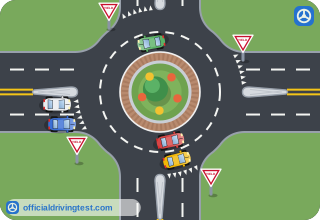
- Stay in your lane
- Change lanes to pass slow vehicles
- Move to the center island
- Cross to the outer lane to exit
Show answer
Correct answer: Stay in your lane
The manual says to stay in your lane within the roundabout.
Source: North Dakota Noncommercial Driver License Manual (2025-2027), page 23 · Open this page in the manual (Manual page 23)
-
What should you assume about trucks in a roundabout?
- They will always yield to cars
- They must stop before entering the roundabout
- They need less space than a car
- They need all available space, so do not pass them
Show answer
Correct answer: They need all available space, so do not pass them
Always assume trucks need all available space in a roundabout, and do not pass them.
Source: North Dakota Noncommercial Driver License Manual (2025-2027), page 23 · Open this page in the manual (Manual page 23)
-
What does the center island of a roundabout include to assist large trucks?
- An apron to accommodate the rear wheels of the vehicle
- An extra travel lane inside the center island
- A stop sign at each entrance to the roundabout
- A pedestrian crosswalk across the center island
Show answer
Correct answer: An apron to accommodate the rear wheels of the vehicle
To assist large trucks, the center island includes an apron to accommodate the rear wheels of the vehicle.
Source: North Dakota Noncommercial Driver License Manual (2025-2027), page 23 · Open this page in the manual (Manual page 23)
-
What do the practice tips say a driver should do before a right turn at a red light?
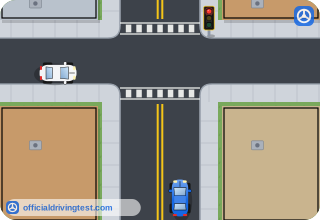
- Slow down and roll through if clear
- Honk the horn to warn other drivers
- Come to a complete stop
- Turn only when a green arrow appears
Show answer
Correct answer: Come to a complete stop
The practice tips say to come to a complete stop at stop signs and for right turns at red lights.
Source: North Dakota Noncommercial Driver License Manual (2025-2027), page 41 · Open this page in the manual (Manual page 41)