North Dakota: Right-of-way and turning — Part 1 Practice Test
Questions in this part include: “A driver is turning left at an intersection. Whom must the driver yield to?” · “According to the manual, in which situation should you never pass?”
Independent educational site · not affiliated with any government agency or DMV
Ready? Test yourself
- Instant feedback with an explanation
- Every answer cites its source in the manual
- Your best score is saved on this device
- Keyboard: press 1 to 4 to answer and Enter for the next question
Questions are original and based on the official manual "North Dakota Noncommercial Driver License Manual" (2025-2027), North Dakota Department of Transportation (NDDOT).
All 23 questions in this practice test
Take the test above first, then use this list to study. Tap “Show answer” to see the correct answer and explanation.
Show the questions and answersHide the questions
-
Two vehicles approach an unsigned intersection at approximately the same time. Which vehicle must yield?
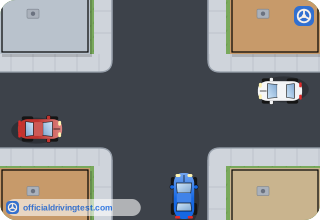
- The vehicle on the left yields to the vehicle on the right.
- The vehicle on the right yields to the vehicle on the left.
- The faster vehicle yields to the slower vehicle.
- The larger vehicle yields to the smaller vehicle.
Show answer
Correct answer: The vehicle on the left yields to the vehicle on the right.
When two vehicles reach an unsigned intersection at about the same time, the vehicle on the left side must yield to the vehicle on the right.
Source: North Dakota Noncommercial Driver License Manual (2025-2027), page 19 · Open this page in the manual (Manual page 19)
-
At an uncontrolled T-intersection, which vehicle must yield?
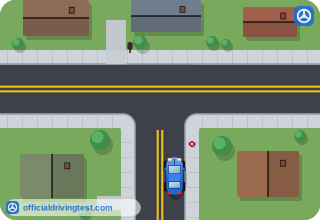
- The vehicle on the continuing street yields to vehicles on the terminating street.
- The vehicle on the terminating street yields to vehicles on the continuing street.
- The vehicle that arrives with fewer passengers yields.
- The vehicle turning right yields to the vehicle going straight.
Show answer
Correct answer: The vehicle on the terminating street yields to vehicles on the continuing street.
At an uncontrolled T-intersection, the vehicle on the street that ends must yield to vehicles on the street that continues.
Source: North Dakota Noncommercial Driver License Manual (2025-2027), page 19 · Open this page in the manual (Manual page 19)
-
A driver is turning left at an intersection. Whom must the driver yield to?
- Traffic approaching from behind
- Vehicles on the cross street only
- Nobody, because turning vehicles go first
- Oncoming traffic
Show answer
Correct answer: Oncoming traffic
Vehicles turning left must yield to oncoming traffic.
Source: North Dakota Noncommercial Driver License Manual (2025-2027), page 19 · Open this page in the manual (Manual page 19)
-
When you turn left at an intersection, what should you watch for?
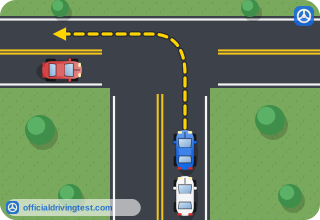
- Vehicles passing on the left side of the vehicle turning left
- Pedestrians crossing only on the far side of the road
- Vehicles passing on the right side of the vehicle turning left
- Vehicles backing out of a driveway behind you
Show answer
Correct answer: Vehicles passing on the right side of the vehicle turning left
The manual warns drivers to watch for vehicles passing on the right side of a vehicle that is turning left.
Source: North Dakota Noncommercial Driver License Manual (2025-2027), page 19 · Open this page in the manual (Manual page 19)
-
At a four-way stop, which vehicle goes first?
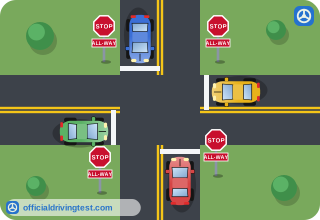
- The vehicle that stops first
- The vehicle that is turning right
- The vehicle that is the largest
- The vehicle that arrives on the left
Show answer
Correct answer: The vehicle that stops first
At a four-way stop, the vehicle that stops first goes first.
Source: North Dakota Noncommercial Driver License Manual (2025-2027), page 19 · Open this page in the manual (Manual page 19)
-
At a four-way stop, another vehicle goes out of turn. What should you do?
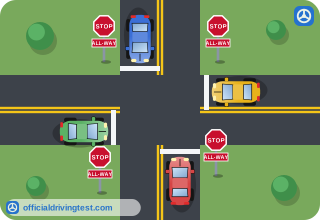
- Sound your horn and go at the same time
- Pull forward to block the other vehicle
- Wait until the other vehicle has stopped again
- Yield to that vehicle so that you do not cause a crash
Show answer
Correct answer: Yield to that vehicle so that you do not cause a crash
If one vehicle goes out of turn at a four-way stop, you should yield to it so that you do not cause a crash.
Source: North Dakota Noncommercial Driver License Manual (2025-2027), page 19 · Open this page in the manual (Manual page 19)
-
A vehicle is entering or crossing a roadway from a private drive. What must it do?
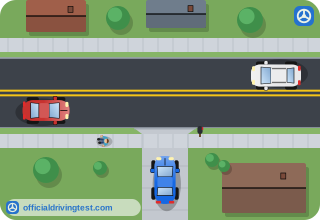
- Yield only to vehicles on its right
- Go first because the road is public
- Flash its lights and then go
- Yield to all oncoming traffic
Show answer
Correct answer: Yield to all oncoming traffic
Vehicles entering or crossing a roadway from a private drive must yield to all oncoming traffic.
Source: North Dakota Noncommercial Driver License Manual (2025-2027), page 20 · Open this page in the manual (Manual page 20)
-
You are leaving a driveway, alley, or private road within a business or residential district where there is a sidewalk. Where must you stop?
- At the edge of the roadway beyond the sidewalk
- Only if pedestrians are on the sidewalk
- Immediately before crossing the sidewalk area
- In the middle of the sidewalk
Show answer
Correct answer: Immediately before crossing the sidewalk area
Vehicles emerging from a driveway, alley, private road, or building must come to a complete stop immediately before crossing a sidewalk area.
Source: North Dakota Noncommercial Driver License Manual (2025-2027), page 20 · Open this page in the manual (Manual page 20)
-
You may not make a U-turn near the crest of a hill or any curve where you cannot see how far?
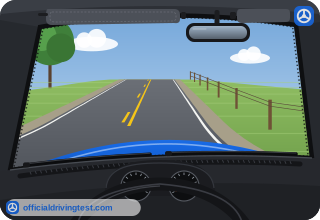
- 500 feet or more
- 200 feet or more
- 100 feet or more
- 1,000 feet or more
Show answer
Correct answer: 500 feet or more
A U-turn may not be made near the crest of a hill or any curve where the driver cannot see 500 feet or more.
Source: North Dakota Noncommercial Driver License Manual (2025-2027), page 20 · Open this page in the manual (Manual page 20)
-
On two-way roads, which side of the roadway must you drive on?
- The left-hand side
- The center of the road
- Whichever side has less traffic
- The right-hand side
Show answer
Correct answer: The right-hand side
On two-way roads you must drive on the right-hand side of the roadway; passing means driving against the flow of oncoming traffic.
Source: North Dakota Noncommercial Driver License Manual (2025-2027), page 21 · Open this page in the manual (Manual page 21)
-
When there is a hill or a curve ahead, how must you treat it before passing?
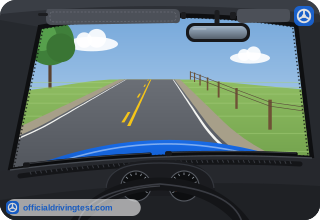
- As if the road beyond it is clear
- As if there is oncoming traffic just beyond it
- As if oncoming traffic is a mile away
- As a safe place to pass if you are fast
Show answer
Correct answer: As if there is oncoming traffic just beyond it
Whenever there is a hill or a curve ahead, you must treat it as if there is oncoming traffic just beyond it.
Source: North Dakota Noncommercial Driver License Manual (2025-2027), page 21 · Open this page in the manual (Manual page 21)
-
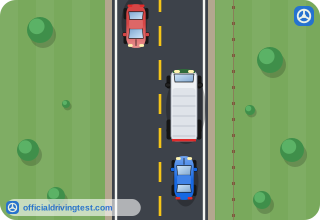
After passing, you should return to your proper lane at least how far before meeting an approaching vehicle?
- 200 feet
- 50 feet
- 100 feet
- 500 feet
Show answer
Correct answer: 200 feet
You should return to your proper lane at least 200 feet before meeting an approaching vehicle.
Source: North Dakota Noncommercial Driver License Manual (2025-2027), page 21 · Open this page in the manual (Manual page 21)
-
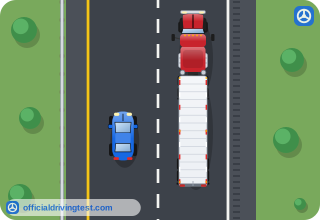
When may you return to your lane after passing another vehicle?
- As soon as your front bumper passes the other vehicle’s rear bumper
- As soon as the other driver slows down to let you back in
- When you see the whole front of the passed vehicle in your inside mirror
- After you have counted to three beyond the passed vehicle
Show answer
Correct answer: When you see the whole front of the passed vehicle in your inside mirror
Do not return to your lane until you can see the image of the entire front of the vehicle you passed within the inside rear-view mirror.
Source: North Dakota Noncommercial Driver License Manual (2025-2027), page 21 · Open this page in the manual (Manual page 21)
-
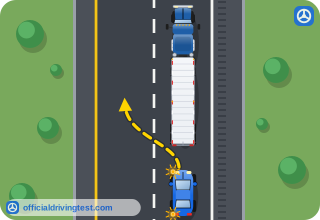
When passing, what should you never leave?
- Your turn signal on
- The main-traveled roadway
- The lane you started in
- Your following distance
Show answer
Correct answer: The main-traveled roadway
The manual says that when passing, you should never leave the main-traveled roadway.
Source: North Dakota Noncommercial Driver License Manual (2025-2027), page 21 · Open this page in the manual (Manual page 21)
-
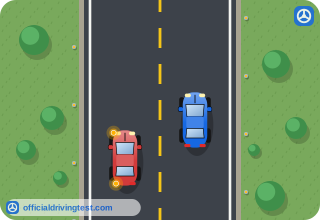
You are being passed by another vehicle. What should you do?
- Speed up to stay even
- Move onto the shoulder
- Flash your headlights
- Do not speed up
Show answer
Correct answer: Do not speed up
The manual says that when being passed, you should not speed up.
Source: North Dakota Noncommercial Driver License Manual (2025-2027), page 21 · Open this page in the manual (Manual page 21)
-
You should never pass within what distance of an intersection, a railroad crossing, or a tunnel?
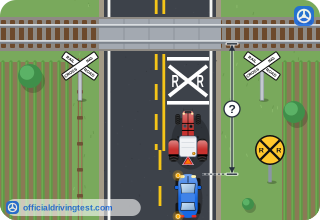
- 25 feet
- 200 feet
- 100 feet
- 300 feet
Show answer
Correct answer: 100 feet
The manual says never to pass within 100 feet of an intersection, a railroad crossing, or a tunnel.
Source: North Dakota Noncommercial Driver License Manual (2025-2027), page 21 · Open this page in the manual (Manual page 21)
-
According to the manual, in which situation should you never pass?
- When your view of the road is reduced by fog, snow, or rain
- When the vehicle ahead is traveling below the speed limit
- When it is daytime and the pavement is dry
- When a vehicle behind you is following closely
Show answer
Correct answer: When your view of the road is reduced by fog, snow, or rain
You should never pass when your view of the road is reduced or obstructed by fog, snow, or rain.
Source: North Dakota Noncommercial Driver License Manual (2025-2027), page 21 · Open this page in the manual (Manual page 21)
-
You see a pavement marking or sign indicating NO PASSING. What does the manual say about passing?
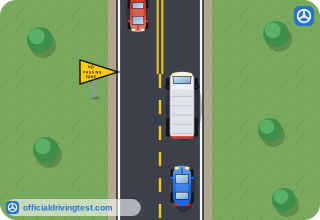
- Pass only if the road ahead is clear
- Pass only if you are driving a fast vehicle
- Pass only during daylight
- Never pass
Show answer
Correct answer: Never pass
The manual lists seeing any pavement marking or sign indicating NO PASSING as a time when you must never pass.
Source: North Dakota Noncommercial Driver License Manual (2025-2027), page 21 · Open this page in the manual (Manual page 21)
-
What danger does the manual mention even when driving in the left lane of a four-lane highway?
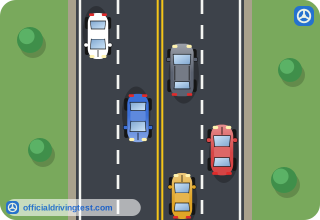
- You might be stopped suddenly by a railroad crossing
- You might collide with a vehicle going the wrong way
- You might be forced to pass on the right side
- You might enter a roundabout by mistake
Show answer
Correct answer: You might collide with a vehicle going the wrong way
Many head-on collisions occur while passing; even in the left lane of a four-lane highway, you might collide with a vehicle going the wrong way.
Source: North Dakota Noncommercial Driver License Manual (2025-2027), page 21 · Open this page in the manual (Manual page 21)
-
If possible, where should you avoid changing lanes?
- Within an intersection
- On a straight road
- On a one-way street
- On a road with two lanes in your direction
Show answer
Correct answer: Within an intersection
The manual says that, if possible, you should avoid changing lanes within an intersection.
Source: North Dakota Noncommercial Driver License Manual (2025-2027), page 21 · Open this page in the manual (Manual page 21)
-
Besides checking your mirrors, what should you do before changing lanes?
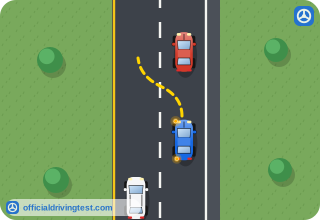
- Sound your horn to warn the drivers around you of your move
- Slow down to a complete stop before you move over
- Look over your shoulder for vehicles already in the other lane
- Turn on your hazard lights until the lane change ends
Show answer
Correct answer: Look over your shoulder for vehicles already in the other lane
Before changing lanes, check your mirrors and look over your shoulder for vehicles behind you and already in the other lane.
Source: North Dakota Noncommercial Driver License Manual (2025-2027), page 21 · Open this page in the manual (Manual page 21)
-
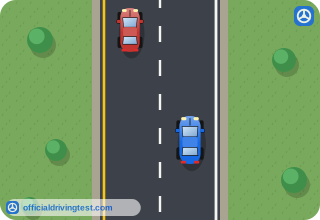
What is a “blind spot”?
- An area that is hidden from view by darkness or glare
- An area where mirrors fail to pick up approaching traffic
- An area where no traffic signs are posted along the road
- An area beyond the reach of your headlights at night
Show answer
Correct answer: An area where mirrors fail to pick up approaching traffic
Blind spots are areas where mirrors fail to pick up approaching traffic.
Source: North Dakota Noncommercial Driver License Manual (2025-2027), page 21 · Open this page in the manual (Manual page 21)
-
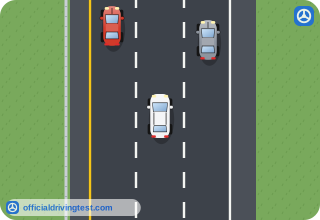
How many lanes should you change at a time?
- As many as needed to reach your lane
- Two lanes if the road is clear
- Three lanes if you signal early
- Only one lane at a time
Show answer
Correct answer: Only one lane at a time
The manual says to change only one lane at a time.
Source: North Dakota Noncommercial Driver License Manual (2025-2027), page 21 · Open this page in the manual (Manual page 21)