North Dakota: Railroad crossings Practice Test
Crossbucks, warning signs and markings, flashing lights and gates, how far to stop and the vehicles that must always stop.
Independent educational site · not affiliated with any government agency or DMV
Ready? Test yourself
- Instant feedback with an explanation
- Every answer cites its source in the manual
- Your best score is saved on this device
- Keyboard: press 1 to 4 to answer and Enter for the next question
Questions are original and based on the official manual "North Dakota Noncommercial Driver License Manual" (2025-2027), North Dakota Department of Transportation (NDDOT).
All 21 questions in this practice test
Take the test above first, then use this list to study. Tap “Show answer” to see the correct answer and explanation.
Show the questions and answersHide the questions
-
Which four types of devices can mark a railroad crossing?
- Warning signs, speed bumps, crossbucks, and stop lines
- Pavement markings, mile markers, crossbucks, and school zone signs
- Warning signs, pavement markings, crossbucks, and signal lights
- Warning signs, guardrails, crossbucks, and rumble strips
Show answer
Correct answer: Warning signs, pavement markings, crossbucks, and signal lights
Railroad crossings can be marked with warning signs, pavement markings, crossbucks, and signal lights.
Source: North Dakota Noncommercial Driver License Manual (2025-2027), page 18 · Open this page in the manual (Manual page 18)
-
What should you do when you see railroad warning devices?
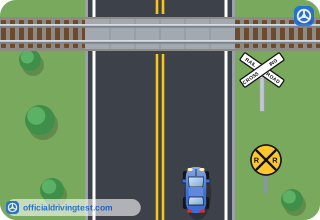
- Look, listen, and slow down, because you may have to stop
- Speed up so that you can cross before a train arrives
- Honk your horn and keep a steady speed
- Slow down only if you can already see a train
Show answer
Correct answer: Look, listen, and slow down, because you may have to stop
When you see railroad warning devices, look, listen, and slow down; you may have to stop.
Source: North Dakota Noncommercial Driver License Manual (2025-2027), page 18 · Open this page in the manual (Manual page 18)
-
What should you do when you see the round yellow railroad advance-warning sign?
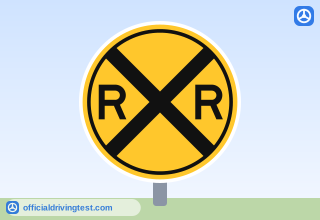
- Begin to slow down and be prepared to stop
- Stop at once and wait for a flagperson
- Maintain your speed and watch for the gates
- Move to the left lane and speed up
Show answer
Correct answer: Begin to slow down and be prepared to stop
Advance-warning signs tell you a railroad crossing is ahead, so begin to slow down and be prepared to stop.
Source: North Dakota Noncommercial Driver License Manual (2025-2027), page 18 · Open this page in the manual (Manual page 18)
-
At a railroad crossing with more than one track, what does the sign below the crossbuck tell you?
- The distance to the next crossing
- Which railroad owns the tracks
- The number of tracks
- The speed limit for trains
Show answer
Correct answer: The number of tracks
If there is more than one track, the sign below the crossbuck tells you the number of tracks.
Source: North Dakota Noncommercial Driver License Manual (2025-2027), page 18 · Open this page in the manual (Manual page 18)
-
What does the manual say about stopping or parking on railroad tracks?
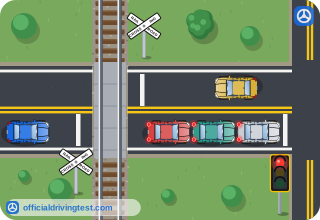
- Do it only briefly when traffic is backed up
- Never do it, for any reason
- Do it only if you turn on your hazard lights
- Do it only if no train is in sight
Show answer
Correct answer: Never do it, for any reason
For safety, you should never stop or park on railroad tracks for any reason.
Source: North Dakota Noncommercial Driver License Manual (2025-2027), page 18 · Open this page in the manual (Manual page 18)
-
If you are required to stop at a railroad crossing, where should you stop your vehicle?
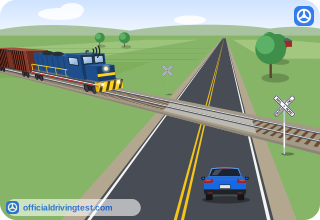
- Directly on the first set of tracks
- Just beyond the last track
- On the tracks if no train is coming
- Prior to the railroad crossing
Show answer
Correct answer: Prior to the railroad crossing
If a stop is required, you must make sure you stop your vehicle prior to the railroad crossing.
Source: North Dakota Noncommercial Driver License Manual (2025-2027), page 18 · Open this page in the manual (Manual page 18)
-
What should you remember when approaching multiple tracks?
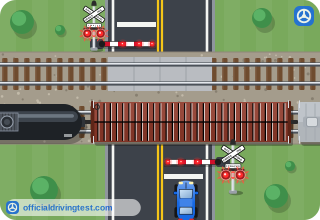
- A second train never approaches until the first train has completely passed out of sight
- All tracks are safe as soon as one train has passed
- Crossing signals reset after every train
- An additional train can approach from the opposite direction after the previous train has cleared
Show answer
Correct answer: An additional train can approach from the opposite direction after the previous train has cleared
At multiple tracks, another train can be approaching from the opposite direction after the previous train has cleared.
Source: North Dakota Noncommercial Driver License Manual (2025-2027), page 18 · Open this page in the manual (Manual page 18)
-
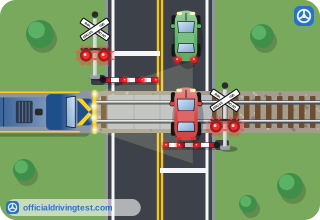
If your vehicle is trapped or stuck on the tracks, what does the manual tell you to do?
- Stay in the vehicle with your seat belt fastened and honk your horn until the driver sees you
- Evacuate and walk away from the tracks at a 45 degree angle, in the direction of the oncoming train
- Evacuate and walk away from the tracks at a 45 degree angle, opposite the direction of the oncoming train
- Evacuate and walk straight away from the tracks at a 90 degree angle, toward the oncoming train
Show answer
Correct answer: Evacuate and walk away from the tracks at a 45 degree angle, in the direction of the oncoming train
The manual says to evacuate your vehicle and walk in the direction of the oncoming train and away from the tracks at a 45 degree angle.
Source: North Dakota Noncommercial Driver License Manual (2025-2027), page 18 · Open this page in the manual (Manual page 18)
-
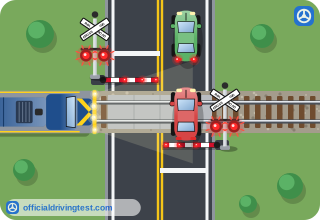
If your vehicle is struck by a moving train, in which direction will the debris spread out from the tracks?
- Back toward the direction the train came from
- Evenly in all directions
- In the same direction the train is moving
- Straight up, then back onto the tracks
Show answer
Correct answer: In the same direction the train is moving
When a moving train strikes a vehicle, the debris spreads out from the tracks in the same direction the train is moving.
Source: North Dakota Noncommercial Driver License Manual (2025-2027), page 18 · Open this page in the manual (Manual page 18)
-
After you evacuate a vehicle that is stuck on the tracks, how should you report the emergency?
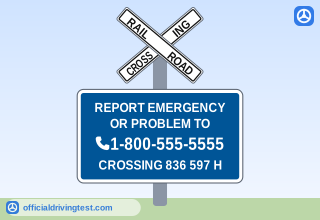
- Call the ENS number, and then call 911
- Call 911, and then call the ENS number
- Call a tow truck, and then call 911
- Call only the railroad company that owns the tracks
Show answer
Correct answer: Call the ENS number, and then call 911
The manual says to call the Emergency Notification System (ENS) number to report the emergency and then call 911.
Source: North Dakota Noncommercial Driver License Manual (2025-2027), page 18 · Open this page in the manual (Manual page 18)
-
When a train is crossing, how far before the crossing should you stop?
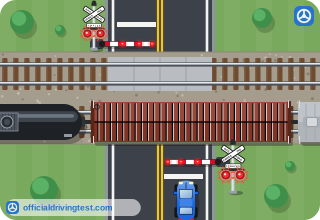
- At least 15 feet
- At least 5 feet
- At least 50 feet
- At least 100 feet
Show answer
Correct answer: At least 15 feet
When a train is crossing, you stop at least 15 feet before the crossing.
Source: North Dakota Noncommercial Driver License Manual (2025-2027), page 18 · Open this page in the manual (Manual page 18)
-
At a railroad crossing, when must you not cross the tracks?
- When the crossbuck is visible
- When the crossing has pavement markings
- When the red lights are flashing
- When the tracks are wet
Show answer
Correct answer: When the red lights are flashing
You must not cross the tracks when the red lights are flashing.
Source: North Dakota Noncommercial Driver License Manual (2025-2027), page 18 · Open this page in the manual (Manual page 18)
-
What must you never do when railroad gates are down?
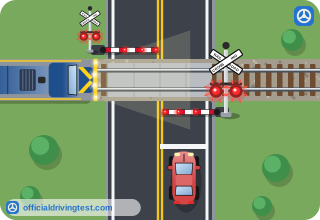
- Stop at least 15 feet from the gates
- Drive around the gates
- Look and listen for a train
- Wait until the gates are raised
Show answer
Correct answer: Drive around the gates
You must never drive around the gates when they are down.
Source: North Dakota Noncommercial Driver License Manual (2025-2027), page 18 · Open this page in the manual (Manual page 18)
-
Which vehicles must stop at railroad crossings?
- Tow trucks, delivery vans, and vehicles that are pulling a trailer of any kind or size
- Motorcycles, mopeds, and any vehicle driven by a new driver with a permit
- Farm tractors, snowplows, and vehicles with a slow-moving vehicle sign
- School buses, vehicles carrying explosives or flammable liquids, and buses carrying passengers
Show answer
Correct answer: School buses, vehicles carrying explosives or flammable liquids, and buses carrying passengers
School buses, vehicles carrying explosives or flammable liquids such as gasoline trucks, and buses carrying passengers must stop at railroad crossings.
Source: North Dakota Noncommercial Driver License Manual (2025-2027), page 18 · Open this page in the manual (Manual page 18)
-
How far from the tracks must school buses and vehicles carrying explosives or flammable liquids stop at a railroad crossing?
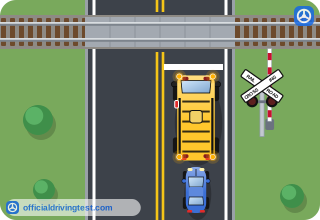
- Within 100 feet and not less than 50 feet
- Within 25 feet and not less than 5 feet
- Within 15 feet and not less than 1 foot
- Within 50 feet and not less than 15 feet
Show answer
Correct answer: Within 50 feet and not less than 15 feet
These vehicles must stop within 50 feet and not less than 15 feet from the tracks.
Source: North Dakota Noncommercial Driver License Manual (2025-2027), page 18 · Open this page in the manual (Manual page 18)
-
What should you do when a school bus or a gasoline truck is stopped at a railroad crossing?
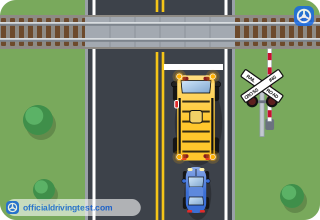
- Pass it on the left if no train is in sight
- Do not pass it
- Pass it on the right if the gates are up
- Sound your horn and pass it
Show answer
Correct answer: Do not pass it
You should watch out for these vehicles and not pass them when they are stopped at the crossing.
Source: North Dakota Noncommercial Driver License Manual (2025-2027), page 18 · Open this page in the manual (Manual page 18)
-
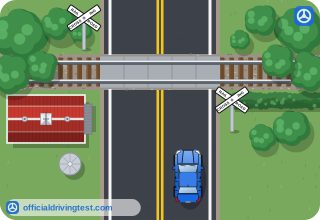
Every railroad crossing must be approached with what expectation?
- That the crossing is inactive
- That the gates will warn you in time
- That a train is coming
- That a train will always sound its horn
Show answer
Correct answer: That a train is coming
Railroad crossings are always dangerous, so every crossing must be approached with the expectation that a train is coming.
Source: North Dakota Noncommercial Driver License Manual (2025-2027), page 18 · Open this page in the manual (Manual page 18)
-
What type of crossing has no traffic control device and leaves the decision to stop or proceed entirely to you?
- Passive crossing
- Active crossing
- Gated crossing
- Signal crossing
Show answer
Correct answer: Passive crossing
A passive crossing has no traffic control device, so the decision to stop or proceed rests entirely with the driver.
Source: North Dakota Noncommercial Driver License Manual (2025-2027), page 18 · Open this page in the manual (Manual page 18)
-
What does an active railroad crossing have?
- A traffic control device installed at the crossing to regulate traffic
- Only a crossbuck and pavement markings to help you recognize it
- A flagperson stationed at every crossing
- A speed limit sign for each approaching train
Show answer
Correct answer: A traffic control device installed at the crossing to regulate traffic
An active crossing has a traffic control device installed at the crossing to regulate traffic, such as flashing red lights, with or without bells, or lights with bells and gates.
Source: North Dakota Noncommercial Driver License Manual (2025-2027), page 18 · Open this page in the manual (Manual page 18)
-
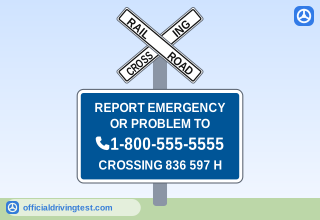
Who posts emergency phone numbers on railroad crossing posts or the metal control boxes near the tracks?
- The Federal Highway Administration
- The North Dakota Highway Patrol
- The Federal Railroad Administration
- Each local police department
Show answer
Correct answer: The Federal Railroad Administration
The Federal Railroad Administration posts the Emergency Notification System phone numbers on crossing posts or the metal control boxes near the tracks.
Source: North Dakota Noncommercial Driver License Manual (2025-2027), page 18 · Open this page in the manual (Manual page 18)
-
When should you call the Emergency Notification System (ENS) number at a railroad crossing?
- Only when a train is already approaching your vehicle and you cannot get away
- If you see an obstruction on the tracks or lights or gates are not working properly
- When you want to find out the schedule of the next train
- Only when your own vehicle has stalled
Show answer
Correct answer: If you see an obstruction on the tracks or lights or gates are not working properly
You call the ENS number if you see an obstruction on the tracks or any other problem at the crossing, such as lights or gates not working properly.
Source: North Dakota Noncommercial Driver License Manual (2025-2027), page 18 · Open this page in the manual (Manual page 18)