North Dakota: Emergencies and winter driving — Part 3 Practice Test
Questions in this part include: “How does the manual describe the steering of front-wheel drive vehicles?” · “Where can floodwaters be found, according to the manual?”
Independent educational site · not affiliated with any government agency or DMV
Ready? Test yourself
- Instant feedback with an explanation
- Every answer cites its source in the manual
- Your best score is saved on this device
- Keyboard: press 1 to 4 to answer and Enter for the next question
Questions are original and based on the official manual "North Dakota Noncommercial Driver License Manual" (2025-2027), North Dakota Department of Transportation (NDDOT).
All 17 questions in this practice test
Take the test above first, then use this list to study. Tap “Show answer” to see the correct answer and explanation.
Show the questions and answersHide the questions
-
How does the manual describe the steering of front-wheel drive vehicles?
- Slow and heavy
- Loose and unpredictable
- Positive, accurate, and quick
- Delayed at moderate speeds
Show answer
Correct answer: Positive, accurate, and quick
The manual says front-wheel drive vehicles have positive, accurate, and quick steering and go exactly where you point them.
Source: North Dakota Noncommercial Driver License Manual (2025-2027), page 29 · Open this page in the manual (Manual page 29)
-
What tendency do four-wheel drive vehicles have, according to the manual?
- Needing less following distance on ice
- Giving the driver a false sense of security
- Skidding less on slippery surfaces
- Steering more slowly than other vehicles
Show answer
Correct answer: Giving the driver a false sense of security
The manual says four-wheel drive vehicles tend to give the driver a false sense of security, so slower speeds on slippery surfaces are extremely important.
Source: North Dakota Noncommercial Driver License Manual (2025-2027), page 29 · Open this page in the manual (Manual page 29)
-
A four-wheel drive vehicle skids while traveling at moderate speeds. What should you do?

- Brake firmly and steer away from the skid
- Ease off the accelerator and hold the wheel still
- Shift into reverse and steer straight ahead
- Accelerate and steer into the direction of the skid
Show answer
Correct answer: Accelerate and steer into the direction of the skid
For four-wheel drive vehicles at moderate speeds, the manual says to accelerate and steer into the direction of the skid.
Source: North Dakota Noncommercial Driver License Manual (2025-2027), page 29 · Open this page in the manual (Manual page 29)
-
A four-wheel drive vehicle with automatic transmission skids at higher speeds, and there is no room to accelerate. What should you do?

- Shift into neutral
- Shift into park
- Shift into reverse
- Turn off the engine
Show answer
Correct answer: Shift into neutral
At higher speeds or with no room to accelerate, the manual says to push in the clutch or, with automatic transmission vehicles, shift into neutral.
Source: North Dakota Noncommercial Driver License Manual (2025-2027), page 29 · Open this page in the manual (Manual page 29)
-
When is a hard surface roadway very slippery during rain?
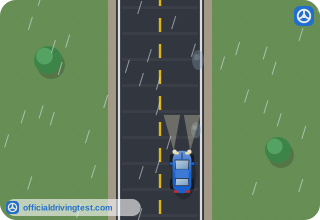
- After it has rained for several hours
- Once the rain has stopped
- Just after it starts raining
- Only when the temperature drops below freezing
Show answer
Correct answer: Just after it starts raining
The manual says a hard surface roadway is very slippery just after it starts raining.
Source: North Dakota Noncommercial Driver License Manual (2025-2027), page 29 · Open this page in the manual (Manual page 29)
-
Why is a hard surface roadway very slippery just after it starts raining?
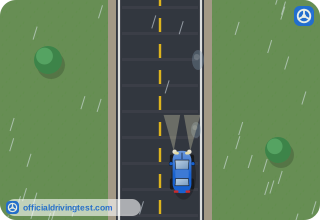
- Rain freezes on contact with the cold pavement surface
- Water combines with road dirt and oil to form a slick film
- Rain washes loose sand and gravel onto the pavement
- Water softens the pavement so that tires sink into it
Show answer
Correct answer: Water combines with road dirt and oil to form a slick film
The manual says water combines with the road dirt and oil to form a slick film between your tires and the roadway surface.
Source: North Dakota Noncommercial Driver License Manual (2025-2027), page 29 · Open this page in the manual (Manual page 29)
-
What is hydroplaning?
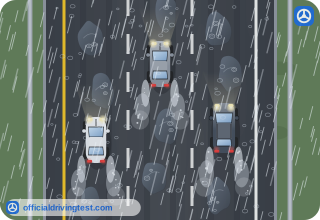
- Your tires lose air pressure because of cold water on the roadway
- Your brakes overheat after driving through deep water
- Your vehicle slides sideways because of strong crosswinds
- Your tires ride on the water and not on the roadway surface
Show answer
Correct answer: Your tires ride on the water and not on the roadway surface
The manual says hydroplaning occurs when your tires ride on the water and not on the roadway surface.
Source: North Dakota Noncommercial Driver License Manual (2025-2027), page 29 · Open this page in the manual (Manual page 29)
-
Rain reduces visibility and increases the possibility of a dangerous skid. What should you do?
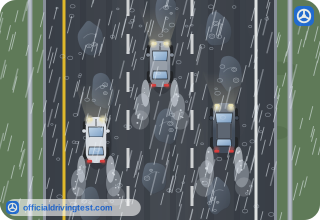
- Slow down and be alert
- Keep your speed and watch the road
- Speed up to leave the rain behind
- Follow the vehicle ahead more closely
Show answer
Correct answer: Slow down and be alert
The manual says that rain reduces visibility and increases the possibility of a dangerous skid, so slow down and be alert.
Source: North Dakota Noncommercial Driver License Manual (2025-2027), page 29 · Open this page in the manual (Manual page 29)
-
Which of these can cause flooding, according to the manual?
- Several days of dry weather
- Light frost on the roads
- Run-off from deep snow
- Strong crosswinds
Show answer
Correct answer: Run-off from deep snow
The manual lists run-off from deep snow among the causes of flooding.
Source: North Dakota Noncommercial Driver License Manual (2025-2027), page 29 · Open this page in the manual (Manual page 29)
-
Where can floodwaters be found, according to the manual?
- Only on dirt roads in rural areas
- On roads, bridges and low areas
- Only on hills near rivers
- Only in the lanes next to the median
Show answer
Correct answer: On roads, bridges and low areas
The manual says floodwaters can be found on roads, bridges and low areas.
Source: North Dakota Noncommercial Driver License Manual (2025-2027), page 29 · Open this page in the manual (Manual page 29)
-
How quickly can flash floods occur after excessive rainfall?
- Only after several days
- Only after the rain stops
- Not until the next week
- Within a few minutes or hours
Show answer
Correct answer: Within a few minutes or hours
The manual says flash floods can come rapidly and unexpectedly, within a few minutes or hours of excessive rainfall.
Source: North Dakota Noncommercial Driver License Manual (2025-2027), page 29 · Open this page in the manual (Manual page 29)
-
If you see a flooded roadway ahead, what should you do?
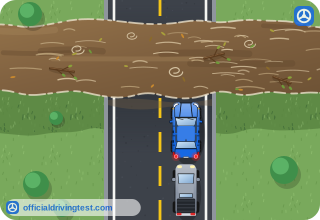
- Turn around and find another route
- Drive through it slowly in a low gear
- Follow the vehicle ahead through the water
- Wait for other traffic and then cross
Show answer
Correct answer: Turn around and find another route
The manual says not to drive through flooded areas; turn around and find another route to your destination.
Source: North Dakota Noncommercial Driver License Manual (2025-2027), page 29 · Open this page in the manual (Manual page 29)
-
When does the manual say to be especially cautious around floodwaters?
- At noon, when glare is strongest
- In the morning, when roads are icy
- At night, when visibility is limited
- Only during a strong crosswind
Show answer
Correct answer: At night, when visibility is limited
The manual says to be cautious around floodwaters, especially at night, when the visibility is limited.
Source: North Dakota Noncommercial Driver License Manual (2025-2027), page 29 · Open this page in the manual (Manual page 29)
-
What does the manual say about six inches of water on a road?
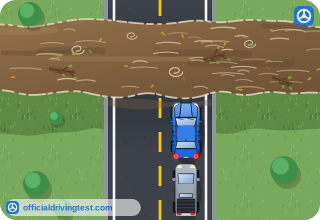
- It is shallow enough for most passenger cars to cross without any risk of stalling
- It will reach the bottom of most passenger cars, causing loss of control or possible stalling
- It can carry away most passenger cars, including sport utility vehicles
- It will lift most passenger cars off the pavement and onto the shoulder
Show answer
Correct answer: It will reach the bottom of most passenger cars, causing loss of control or possible stalling
The manual says six inches of water will reach the bottom of most passenger cars, causing loss of control or possible stalling.
Source: North Dakota Noncommercial Driver License Manual (2025-2027), page 29 · Open this page in the manual (Manual page 29)
-
What can two feet of moving water do?
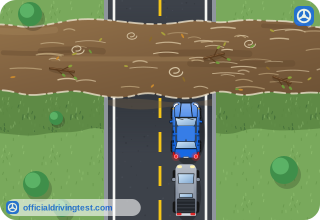
- Stall small passenger cars but not larger vehicles such as pick-up trucks
- Pull the tires off most vehicles that drive through it
- Lift only small passenger cars off the roadway surface
- Carry away most vehicles, including sport utility vehicles and pick-up trucks
Show answer
Correct answer: Carry away most vehicles, including sport utility vehicles and pick-up trucks
The manual says two feet of moving water can carry away most vehicles including sport utility vehicles and pick-up trucks.
Source: North Dakota Noncommercial Driver License Manual (2025-2027), page 29 · Open this page in the manual (Manual page 29)
-
Why should you not attempt to cross a flooded road even if the water appears shallow?
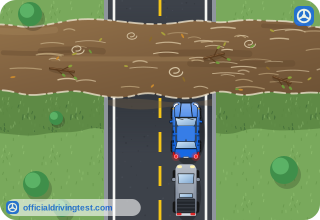
- Water can hide dips, and floodwaters can wash away the road surface underneath
- Shallow water always splashes onto the engine and stops it from running
- Crossing is only allowed for four-wheel drive vehicles
- Shallow water makes the tires lock up and the vehicle skid
Show answer
Correct answer: Water can hide dips, and floodwaters can wash away the road surface underneath
The manual says water can hide dips, and floodwaters can damage roadways by washing away the underlying road surface.
Source: North Dakota Noncommercial Driver License Manual (2025-2027), page 29 · Open this page in the manual (Manual page 29)
-
If there is no other route around floodwater, what does the manual say to do?
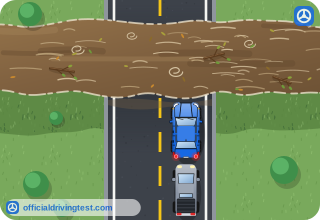
- Cross at a slow speed in the lane with the shallowest water
- Park beside the water and wait for traffic to clear it
- Proceed to higher ground and wait for the water to subside
- Wait in the lowest nearby area until the water goes down
Show answer
Correct answer: Proceed to higher ground and wait for the water to subside
The manual says that if there is no other route, you should proceed to higher ground and wait for the water to subside.
Source: North Dakota Noncommercial Driver License Manual (2025-2027), page 29 · Open this page in the manual (Manual page 29)