North Dakota: Emergencies and winter driving
Skids, brake failure, blowouts, running off the pavement, winter storms, floods and what to do after a crash. Split into 4 shorter tests so you're not stuck in one long quiz.
Independent educational site · not affiliated with any government agency or DMV
Choose a part
Emergencies and winter driving — Part 1
Questions in this part include: “A crash must be reported if the combined damage reaches what amount, or if it results in injury or death?”
StartEmergencies and winter driving — Part 2
Questions in this part include: “Where do frost and ice form quicker and stay longer than on the rest of the roadway?”
StartEmergencies and winter driving — Part 3
Questions in this part include: “How does the manual describe the steering of front-wheel drive vehicles?”
StartEmergencies and winter driving — Part 4
Questions in this part include: “What may result if you turn the engine off when your accelerator pedal is stuck?”
StartAll 67 Emergencies and winter driving questions with answers
Choose a part above to take a practice test, or study every question and answer here.
Show the questions and answersHide the questions
-
Why should you not swerve to avoid an animal?
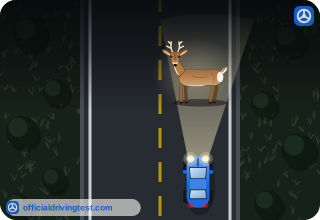
- The animal will always run toward your swerving car
- Swerving always damages the tires of your car
- Swerving is illegal anywhere in North Dakota
- It could cause a more serious crash, like hitting a tree
Show answer
Correct answer: It could cause a more serious crash, like hitting a tree
Swerving to avoid an animal could result in a more serious crash like hitting a tree or another vehicle, or possibly rolling over.
Source: North Dakota Noncommercial Driver License Manual (2025-2027), page 25 · Open this page in the manual (Manual page 25)
-
When you have to make an emergency stop, where should you park, if possible?
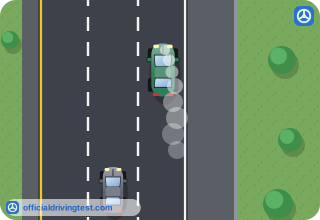
- With all four wheels off the traveled pavement
- With two wheels on the traveled pavement
- In the middle of the lane you are driving in
- On the center line of the road
Show answer
Correct answer: With all four wheels off the traveled pavement
When you have to make an emergency stop, park with all four wheels off the traveled pavement, if possible.
Source: North Dakota Noncommercial Driver License Manual (2025-2027), page 26 · Open this page in the manual (Manual page 26)
-
A crash must be reported if the combined damage reaches what amount, or if it results in injury or death?
- $500 or more
- $1,000 or more
- $2,500 or more
- $4,000 or more
Show answer
Correct answer: $4,000 or more
You must report a crash that results in combined damage of $4,000 or more, or in personal injury or death.
Source: North Dakota Noncommercial Driver License Manual (2025-2027), page 27 · Open this page in the manual (Manual page 27)
-
If a reportable crash happens in a city, to whom must you immediately report it?
- The Highway Patrol
- The County Sheriff’s Office
- The local police
- The Driver License Division
Show answer
Correct answer: The local police
In a city, you must immediately report a reportable crash to the local police.
Source: North Dakota Noncommercial Driver License Manual (2025-2027), page 27 · Open this page in the manual (Manual page 27)
-
If a reportable crash happens outside city limits, to whom must you immediately report it?
- The Highway Patrol or the County Sheriff’s Office
- The local police department in the nearest city
- The Driver License Division at the NDDOT office
- Your insurance company, but not the police
Show answer
Correct answer: The Highway Patrol or the County Sheriff’s Office
Outside city limits, you must immediately report a reportable crash to the Highway Patrol or the County Sheriff’s Office.
Source: North Dakota Noncommercial Driver License Manual (2025-2027), page 27 · Open this page in the manual (Manual page 27)
-
In all crashes involving injury or damage, which information must the drivers exchange?
- Name, address, license plate number, and phone number
- Name, date of birth, Social Security number, and employer
- Name, address, vehicle make, and vehicle color
- Name, address, motor vehicle insurance company, and policy number
Show answer
Correct answer: Name, address, motor vehicle insurance company, and policy number
In all crashes involving injury or damage, drivers must exchange name, address, motor vehicle insurance company, and policy number.
Source: North Dakota Noncommercial Driver License Manual (2025-2027), page 27 · Open this page in the manual (Manual page 27)
-
A driver is physically incapable of giving notice of a crash and is not the owner of the vehicle. Within how many days after learning of the crash must the owner give notice and insurance information?
- One day
- Five days
- Three days
- Ten days
Show answer
Correct answer: Five days
The owner of the vehicle shall, within five days after learning of the crash, give notice and insurance information not given by the driver.
Source: North Dakota Noncommercial Driver License Manual (2025-2027), page 27 · Open this page in the manual (Manual page 27)
-
You hit an unattended vehicle and cannot find its owner. What must you do?
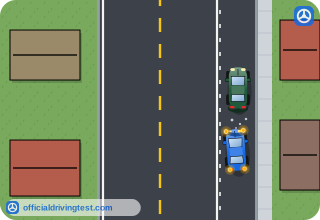
- Leave a note on it listing your name, address, and insurance company
- Drive away if the damage is small and no one saw it happen
- Leave only your phone number on the vehicle windshield
- Report it to the police a week after the crash happens
Show answer
Correct answer: Leave a note on it listing your name, address, and insurance company
You must immediately try to locate the owner; if you cannot, leave a note at a conspicuous place listing your name, address, and motor vehicle insurance company.
Source: North Dakota Noncommercial Driver License Manual (2025-2027), page 27 · Open this page in the manual (Manual page 27)
-
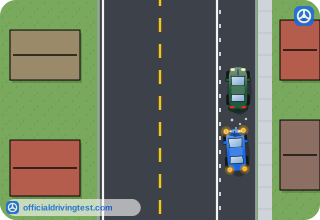
A driver who hits an unattended vehicle must immediately do what first?
- Move the vehicle off the road
- Drive to the nearest police station
- Locate and notify the owner
- Leave a note and drive away
Show answer
Correct answer: Locate and notify the owner
Any driver who hits an unattended vehicle must immediately locate and notify the owner.
Source: North Dakota Noncommercial Driver License Manual (2025-2027), page 27 · Open this page in the manual (Manual page 27)
-
What is the penalty in North Dakota for entering a road that is officially closed due to hazardous conditions?
- A $250 fine
- A $100 fine
- A $500 fine
- A $50 fine
Show answer
Correct answer: A $250 fine
The manual says it is not legal to enter a road officially closed due to hazardous conditions, and the penalty is a $250 fine.
Source: North Dakota Noncommercial Driver License Manual (2025-2027), page 27 · Open this page in the manual (Manual page 27)
-
According to the manual, when do your brakes work best?
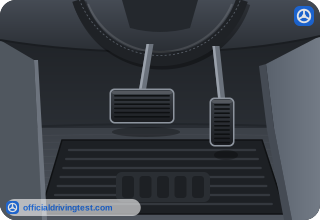
- Just after your tires start to skid or slide
- Only when you press the pedal as hard as you can
- Just before your tires start to skid or slide
- Only after the vehicle has slowed to a crawl
Show answer
Correct answer: Just before your tires start to skid or slide
The manual says brakes work best just before your tires start to skid or slide on the road surface.
Source: North Dakota Noncommercial Driver License Manual (2025-2027), page 27 · Open this page in the manual (Manual page 27)
-
The manual says there will be situations when a driver needs to reduce speed immediately. What is one of the reasons it gives?
- To save fuel on a long trip
- To regain control of the vehicle
- To pass a slower vehicle
- To prepare for a lane change
Show answer
Correct answer: To regain control of the vehicle
The manual says you may need to reduce your speed immediately, sometimes to regain control of your vehicle and other times to come to a complete stop.
Source: North Dakota Noncommercial Driver License Manual (2025-2027), page 27 · Open this page in the manual (Manual page 27)
-
When scraping ice off the windows in winter, what should you allow to warm up properly?
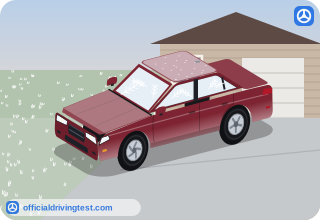
- The engine
- The brakes
- The tires
- The defroster
Show answer
Correct answer: The defroster
The manual says to keep the windshield clear and allow the defroster to warm up properly while scraping the ice off windows.
Source: North Dakota Noncommercial Driver License Manual (2025-2027), page 28 · Open this page in the manual (Manual page 28)
-
What should the windshield washing fluid contain for winter driving?
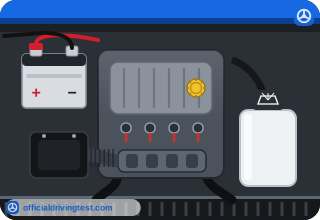
- An anti-freeze solution
- Plain water with no additives
- A little engine oil
- Extra window wax
Show answer
Correct answer: An anti-freeze solution
The manual says the windshield washing fluid should contain an anti-freeze solution.
Source: North Dakota Noncommercial Driver License Manual (2025-2027), page 28 · Open this page in the manual (Manual page 28)
-
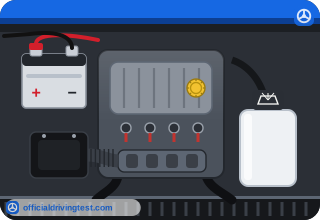
Even with an anti-freeze solution, what may windshield washing fluid do at high speeds in very cold temperatures?
- Freeze inside the tank and crack the washer pump
- Leave an oily film that smears across the glass
- Freeze on the windshield and totally obscure your vision
- Turn to slush that the wipers push off the glass
Show answer
Correct answer: Freeze on the windshield and totally obscure your vision
The manual warns that at high speeds in very cold temperatures the fluid may freeze on the windshield and totally obscure your vision.
Source: North Dakota Noncommercial Driver License Manual (2025-2027), page 28 · Open this page in the manual (Manual page 28)
-
How can you get the feel of the roadway in winter?
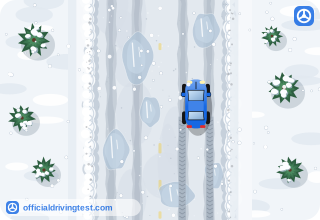
- Accelerate quickly on an empty stretch
- Try your brakes while driving slowly
- Brake hard at your normal highway speed
- Turn the steering wheel sharply back and forth
Show answer
Correct answer: Try your brakes while driving slowly
The manual says to try your brakes while driving slowly and adjust your speed to how much traction you have.
Source: North Dakota Noncommercial Driver License Manual (2025-2027), page 28 · Open this page in the manual (Manual page 28)
-
When may studded snow tires be used in North Dakota?
- From October 15 to April 15
- From November 1 to March 31
- From October 1 to April 1
- From November 15 to April 30
Show answer
Correct answer: From October 15 to April 15
The manual says studded snow tires may be used from October 15 to April 15.
Source: North Dakota Noncommercial Driver License Manual (2025-2027), page 28 · Open this page in the manual (Manual page 28)
-
What should you do when a passing truck creates snow fog?
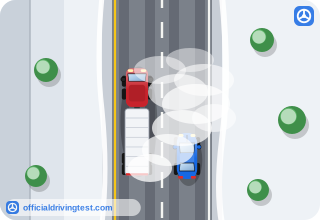
- Stop in the traffic lane until the fog clears
- Stay close behind the truck so you can follow its taillights
- Look ahead for curves, look behind for following vehicles, and slow down
- Move onto the shoulder and turn off your headlights
Show answer
Correct answer: Look ahead for curves, look behind for following vehicles, and slow down
Snow fog greatly reduces visibility, so the manual says to look ahead for curves, look behind for vehicles following, and slow down.
Source: North Dakota Noncommercial Driver License Manual (2025-2027), page 28 · Open this page in the manual (Manual page 28)
-
Where do frost and ice form quicker and stay longer than on the rest of the roadway?
- On wide, straight stretches of highway
- On bridges and in shaded spots
- On roads that were recently sanded
- On long, uphill stretches of road
Show answer
Correct answer: On bridges and in shaded spots
The manual says frost and ice form quicker and are retained longer on bridges and shaded spots than on the rest of the roadway.
Source: North Dakota Noncommercial Driver License Manual (2025-2027), page 28 · Open this page in the manual (Manual page 28)
-
To stop on ice in a vehicle with drum-type brakes on all four wheels, what should you do?
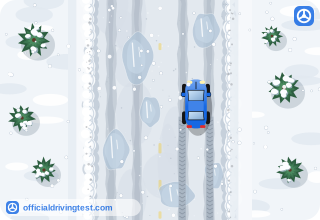
- Press the pedal to the floor and hold it
- Stay off the brakes entirely
- Release the pedal and coast to a stop
- Pump the brakes
Show answer
Correct answer: Pump the brakes
The manual says to pump the brakes on vehicles equipped with drum-type brakes on all four wheels.
Source: North Dakota Noncommercial Driver License Manual (2025-2027), page 28 · Open this page in the manual (Manual page 28)
-
What kind of braking do vehicles with disc brakes require when stopping on ice?
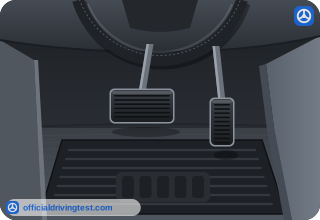
- A slow, intermittent action, fully on and then fully off
- One hard application held until the vehicle stops
- Light, continuous pressure with the pedal half down
- Quick taps on the pedal as fast as you can
Show answer
Correct answer: A slow, intermittent action, fully on and then fully off
For disc brakes the manual calls for a slow, intermittent braking action, fully on and then fully off, long enough to let the brakes release so all wheels are rolling again.
Source: North Dakota Noncommercial Driver License Manual (2025-2027), page 28 · Open this page in the manual (Manual page 28)
-
What happens if you slam on your brakes when stopping on ice?
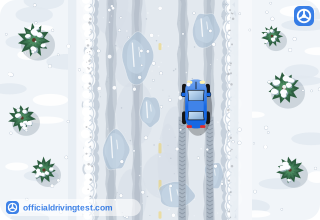
- The vehicle will stop in a shorter distance
- The tires will grip the ice better
- Your wheels will lock and your tires will skid
- The brakes will release by themselves
Show answer
Correct answer: Your wheels will lock and your tires will skid
The manual says that if you slam on your brakes on ice, your wheels will lock and your tires will skid.
Source: North Dakota Noncommercial Driver License Manual (2025-2027), page 28 · Open this page in the manual (Manual page 28)
-
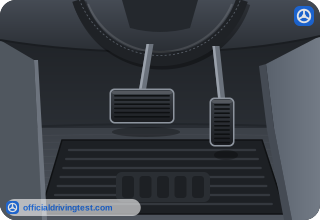
How should you use antilock brakes (ABS) when you need to stop?
- Pump them repeatedly
- Keep firm and continuous pressure
- Let up on them and press again
- Tap them in short bursts
Show answer
Correct answer: Keep firm and continuous pressure
The manual says to keep firm and continuous pressure on antilock brakes (ABS).
Source: North Dakota Noncommercial Driver License Manual (2025-2027), page 28 · Open this page in the manual (Manual page 28)
-
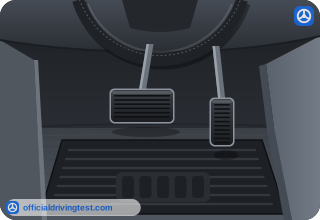
According to the manual, what does manually pumping antilock brakes do to the system?
- It overheats the brake fluid
- It locks the wheels permanently
- It wears down the brake pads
- It turns the system off and on
Show answer
Correct answer: It turns the system off and on
Manually pumping antilock brakes, or letting up on them, decreases their effectiveness because it turns the system off and on.
Source: North Dakota Noncommercial Driver License Manual (2025-2027), page 28 · Open this page in the manual (Manual page 28)
-
Which of these does the manual list for a winter survival kit?
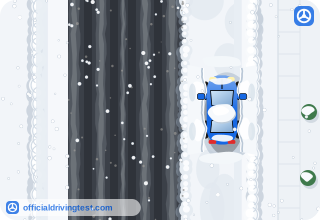
- A shovel
- A tow rope
- Jumper cables
- A tire jack
Show answer
Correct answer: A shovel
The manual lists warm clothing, footwear, a shovel and energy food, among other things, for a winter survival kit.
Source: North Dakota Noncommercial Driver License Manual (2025-2027), page 28 · Open this page in the manual (Manual page 28)
-
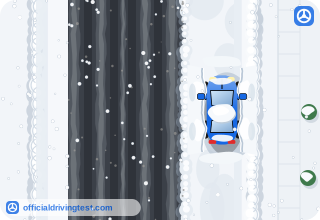
What should you do if your vehicle becomes stuck in a snowstorm?
- Walk to the nearest town for help
- Leave the vehicle and follow the road
- Stay with the vehicle
- Leave the vehicle once the snow slows down
Show answer
Correct answer: Stay with the vehicle
The manual says to stay with the vehicle, because most deaths occur when people leave their vehicles and get lost.
Source: North Dakota Noncommercial Driver License Manual (2025-2027), page 28 · Open this page in the manual (Manual page 28)
-
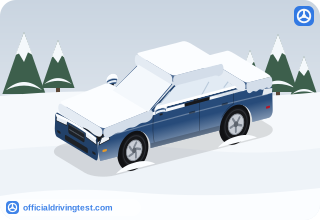
How should you run the vehicle and heater when stuck in a snowstorm to avoid carbon monoxide poisoning?
- Continuously, with all the windows closed tight
- For only short periods, with the windows open slightly
- Once, for a full hour, with the windows closed
- Only while the vehicle is moving slowly
Show answer
Correct answer: For only short periods, with the windows open slightly
The manual says to open your windows slightly and run the vehicle and heater for only short periods of time to avoid carbon monoxide poisoning.
Source: North Dakota Noncommercial Driver License Manual (2025-2027), page 28 · Open this page in the manual (Manual page 28)
-
What does the manual say to do about “whiteouts” caused by crosswinds or plowing light snow?
- Never drive through them; be patient and wait until you can see
- Drive through them slowly with your high beams and flashers on
- Follow a snowplow closely until the whiteout has cleared away
- Drive through them only on Interstate highways or other main roads
Show answer
Correct answer: Never drive through them; be patient and wait until you can see
The manual says never to drive through whiteouts caused by crosswinds or plowing light snow, and to be patient and wait until you can see.
Source: North Dakota Noncommercial Driver License Manual (2025-2027), page 28 · Open this page in the manual (Manual page 28)
-
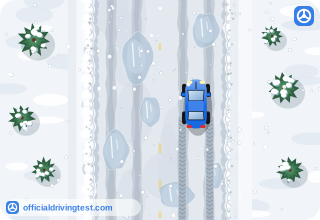
Why should you not assume you will have good traction on a road that looks sanded?
- The sand freezes into a layer of ice on the surface
- The sand can sink into the snow-pack, leaving a slick surface
- Passing traffic sweeps the sand off the road within minutes
- The sand makes the snow-pack melt into slush
Show answer
Correct answer: The sand can sink into the snow-pack, leaving a slick surface
The manual warns that sand can sink into the snow-pack, leaving a slick surface.
Source: North Dakota Noncommercial Driver License Manual (2025-2027), page 28 · Open this page in the manual (Manual page 28)
-
According to the manual, what is the cause of most skids?
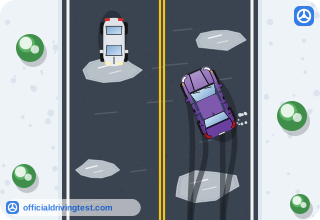
- Driving too fast for the road conditions on slippery roadways
- Braking too lightly when approaching a slippery roadway
- Steering too slowly on a wet or icy roadway
- Tires that are overinflated for the roadway
Show answer
Correct answer: Driving too fast for the road conditions on slippery roadways
The manual says most skids result from driving too fast for the road conditions on slippery roadways, and that slower speeds are the key to safe vehicle operation.
Source: North Dakota Noncommercial Driver License Manual (2025-2027), page 29 · Open this page in the manual (Manual page 29)
-
In a rear-wheel drive automobile that starts to skid, what should you do with the brakes and the accelerator?
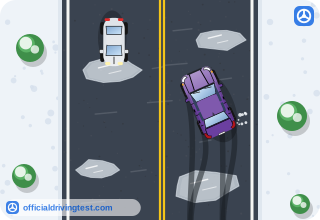
- Brake hard and keep your foot down on the accelerator
- Press the brakes gently and accelerate slightly
- Stay off the brakes and gradually ease off the accelerator
- Pump the brakes quickly and accelerate briefly
Show answer
Correct answer: Stay off the brakes and gradually ease off the accelerator
For a rear-wheel drive automobile the manual says to stay off the brakes and gradually ease off the accelerator.
Source: North Dakota Noncommercial Driver License Manual (2025-2027), page 29 · Open this page in the manual (Manual page 29)
-
The rear end of your rear-wheel drive vehicle is skidding to the right. Which way should you steer?
- To the left
- To the right
- Straight ahead
- Alternately left and right
Show answer
Correct answer: To the right
The manual says to turn your wheels in the direction the rear end is skidding: if it skids right, steer right.
Source: North Dakota Noncommercial Driver License Manual (2025-2027), page 29 · Open this page in the manual (Manual page 29)
-
A front-wheel drive vehicle starts to skid at moderate speeds. What should you do?
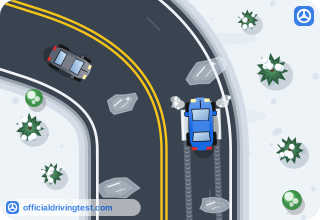
- Brake hard and steer toward the shoulder
- Ease off the accelerator and steer the opposite way
- Shift into park and release the steering wheel
- Accelerate slightly and steer in the direction you want to go
Show answer
Correct answer: Accelerate slightly and steer in the direction you want to go
For front-wheel drive vehicles skidding at moderate speeds, the manual says to accelerate slightly and steer in the direction you want to go.
Source: North Dakota Noncommercial Driver License Manual (2025-2027), page 29 · Open this page in the manual (Manual page 29)
-
If there is no room to accelerate while a front-wheel drive vehicle is skidding, what should you do?
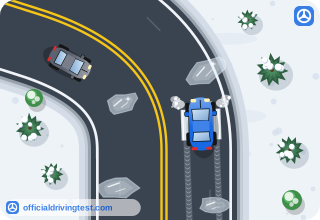
- Shift into neutral or push in the clutch
- Brake as hard as possible
- Turn the wheel sharply to the right
- Turn off the ignition
Show answer
Correct answer: Shift into neutral or push in the clutch
The manual says that if there is no room to accelerate, shift into neutral or push in the clutch.
Source: North Dakota Noncommercial Driver License Manual (2025-2027), page 29 · Open this page in the manual (Manual page 29)
-
How does the manual describe the steering of front-wheel drive vehicles?
- Slow and heavy
- Loose and unpredictable
- Positive, accurate, and quick
- Delayed at moderate speeds
Show answer
Correct answer: Positive, accurate, and quick
The manual says front-wheel drive vehicles have positive, accurate, and quick steering and go exactly where you point them.
Source: North Dakota Noncommercial Driver License Manual (2025-2027), page 29 · Open this page in the manual (Manual page 29)
-
What tendency do four-wheel drive vehicles have, according to the manual?
- Needing less following distance on ice
- Giving the driver a false sense of security
- Skidding less on slippery surfaces
- Steering more slowly than other vehicles
Show answer
Correct answer: Giving the driver a false sense of security
The manual says four-wheel drive vehicles tend to give the driver a false sense of security, so slower speeds on slippery surfaces are extremely important.
Source: North Dakota Noncommercial Driver License Manual (2025-2027), page 29 · Open this page in the manual (Manual page 29)
-
A four-wheel drive vehicle skids while traveling at moderate speeds. What should you do?
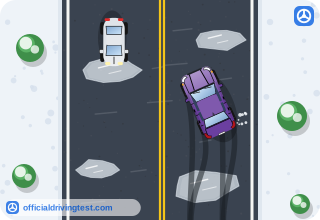
- Brake firmly and steer away from the skid
- Ease off the accelerator and hold the wheel still
- Shift into reverse and steer straight ahead
- Accelerate and steer into the direction of the skid
Show answer
Correct answer: Accelerate and steer into the direction of the skid
For four-wheel drive vehicles at moderate speeds, the manual says to accelerate and steer into the direction of the skid.
Source: North Dakota Noncommercial Driver License Manual (2025-2027), page 29 · Open this page in the manual (Manual page 29)
-
A four-wheel drive vehicle with automatic transmission skids at higher speeds, and there is no room to accelerate. What should you do?
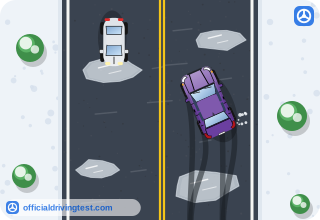
- Shift into neutral
- Shift into park
- Shift into reverse
- Turn off the engine
Show answer
Correct answer: Shift into neutral
At higher speeds or with no room to accelerate, the manual says to push in the clutch or, with automatic transmission vehicles, shift into neutral.
Source: North Dakota Noncommercial Driver License Manual (2025-2027), page 29 · Open this page in the manual (Manual page 29)
-
When is a hard surface roadway very slippery during rain?
- After it has rained for several hours
- Once the rain has stopped
- Just after it starts raining
- Only when the temperature drops below freezing
Show answer
Correct answer: Just after it starts raining
The manual says a hard surface roadway is very slippery just after it starts raining.
Source: North Dakota Noncommercial Driver License Manual (2025-2027), page 29 · Open this page in the manual (Manual page 29)
-
Why is a hard surface roadway very slippery just after it starts raining?
- Rain freezes on contact with the cold pavement surface
- Water combines with road dirt and oil to form a slick film
- Rain washes loose sand and gravel onto the pavement
- Water softens the pavement so that tires sink into it
Show answer
Correct answer: Water combines with road dirt and oil to form a slick film
The manual says water combines with the road dirt and oil to form a slick film between your tires and the roadway surface.
Source: North Dakota Noncommercial Driver License Manual (2025-2027), page 29 · Open this page in the manual (Manual page 29)
-
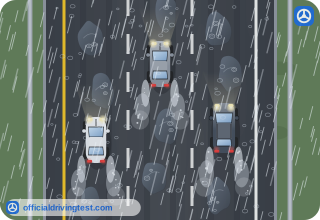
What is hydroplaning?
- Your tires lose air pressure because of cold water on the roadway
- Your brakes overheat after driving through deep water
- Your vehicle slides sideways because of strong crosswinds
- Your tires ride on the water and not on the roadway surface
Show answer
Correct answer: Your tires ride on the water and not on the roadway surface
The manual says hydroplaning occurs when your tires ride on the water and not on the roadway surface.
Source: North Dakota Noncommercial Driver License Manual (2025-2027), page 29 · Open this page in the manual (Manual page 29)
-
Rain reduces visibility and increases the possibility of a dangerous skid. What should you do?
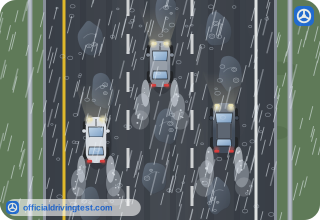
- Slow down and be alert
- Keep your speed and watch the road
- Speed up to leave the rain behind
- Follow the vehicle ahead more closely
Show answer
Correct answer: Slow down and be alert
The manual says that rain reduces visibility and increases the possibility of a dangerous skid, so slow down and be alert.
Source: North Dakota Noncommercial Driver License Manual (2025-2027), page 29 · Open this page in the manual (Manual page 29)
-
Which of these can cause flooding, according to the manual?
- Several days of dry weather
- Light frost on the roads
- Run-off from deep snow
- Strong crosswinds
Show answer
Correct answer: Run-off from deep snow
The manual lists run-off from deep snow among the causes of flooding.
Source: North Dakota Noncommercial Driver License Manual (2025-2027), page 29 · Open this page in the manual (Manual page 29)
-
Where can floodwaters be found, according to the manual?
- Only on dirt roads in rural areas
- On roads, bridges and low areas
- Only on hills near rivers
- Only in the lanes next to the median
Show answer
Correct answer: On roads, bridges and low areas
The manual says floodwaters can be found on roads, bridges and low areas.
Source: North Dakota Noncommercial Driver License Manual (2025-2027), page 29 · Open this page in the manual (Manual page 29)
-
How quickly can flash floods occur after excessive rainfall?
- Only after several days
- Only after the rain stops
- Not until the next week
- Within a few minutes or hours
Show answer
Correct answer: Within a few minutes or hours
The manual says flash floods can come rapidly and unexpectedly, within a few minutes or hours of excessive rainfall.
Source: North Dakota Noncommercial Driver License Manual (2025-2027), page 29 · Open this page in the manual (Manual page 29)
-
If you see a flooded roadway ahead, what should you do?
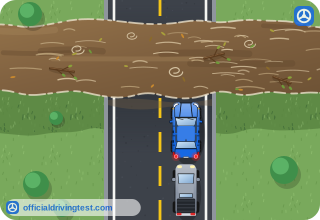
- Turn around and find another route
- Drive through it slowly in a low gear
- Follow the vehicle ahead through the water
- Wait for other traffic and then cross
Show answer
Correct answer: Turn around and find another route
The manual says not to drive through flooded areas; turn around and find another route to your destination.
Source: North Dakota Noncommercial Driver License Manual (2025-2027), page 29 · Open this page in the manual (Manual page 29)
-
When does the manual say to be especially cautious around floodwaters?
- At noon, when glare is strongest
- In the morning, when roads are icy
- At night, when visibility is limited
- Only during a strong crosswind
Show answer
Correct answer: At night, when visibility is limited
The manual says to be cautious around floodwaters, especially at night, when the visibility is limited.
Source: North Dakota Noncommercial Driver License Manual (2025-2027), page 29 · Open this page in the manual (Manual page 29)
-
What does the manual say about six inches of water on a road?
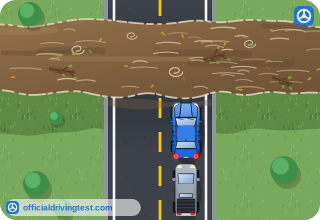
- It is shallow enough for most passenger cars to cross without any risk of stalling
- It will reach the bottom of most passenger cars, causing loss of control or possible stalling
- It can carry away most passenger cars, including sport utility vehicles
- It will lift most passenger cars off the pavement and onto the shoulder
Show answer
Correct answer: It will reach the bottom of most passenger cars, causing loss of control or possible stalling
The manual says six inches of water will reach the bottom of most passenger cars, causing loss of control or possible stalling.
Source: North Dakota Noncommercial Driver License Manual (2025-2027), page 29 · Open this page in the manual (Manual page 29)
-
What can two feet of moving water do?
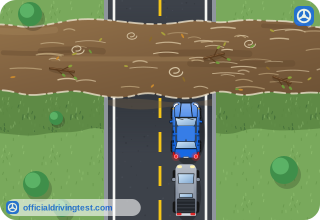
- Stall small passenger cars but not larger vehicles such as pick-up trucks
- Pull the tires off most vehicles that drive through it
- Lift only small passenger cars off the roadway surface
- Carry away most vehicles, including sport utility vehicles and pick-up trucks
Show answer
Correct answer: Carry away most vehicles, including sport utility vehicles and pick-up trucks
The manual says two feet of moving water can carry away most vehicles including sport utility vehicles and pick-up trucks.
Source: North Dakota Noncommercial Driver License Manual (2025-2027), page 29 · Open this page in the manual (Manual page 29)
-
Why should you not attempt to cross a flooded road even if the water appears shallow?
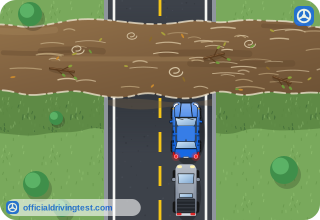
- Water can hide dips, and floodwaters can wash away the road surface underneath
- Shallow water always splashes onto the engine and stops it from running
- Crossing is only allowed for four-wheel drive vehicles
- Shallow water makes the tires lock up and the vehicle skid
Show answer
Correct answer: Water can hide dips, and floodwaters can wash away the road surface underneath
The manual says water can hide dips, and floodwaters can damage roadways by washing away the underlying road surface.
Source: North Dakota Noncommercial Driver License Manual (2025-2027), page 29 · Open this page in the manual (Manual page 29)
-
If there is no other route around floodwater, what does the manual say to do?
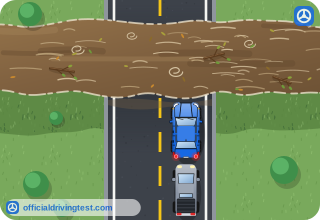
- Cross at a slow speed in the lane with the shallowest water
- Park beside the water and wait for traffic to clear it
- Proceed to higher ground and wait for the water to subside
- Wait in the lowest nearby area until the water goes down
Show answer
Correct answer: Proceed to higher ground and wait for the water to subside
The manual says that if there is no other route, you should proceed to higher ground and wait for the water to subside.
Source: North Dakota Noncommercial Driver License Manual (2025-2027), page 29 · Open this page in the manual (Manual page 29)
-
What is the warning sign to listen for that a tire has gone flat or is blowing out?
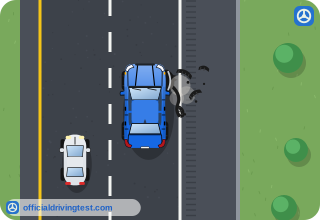
- A hissing sound
- A thumping sound
- A high squealing sound
- A grinding sound
Show answer
Correct answer: A thumping sound
The manual says the warning sign to listen for is a thumping sound.
Source: North Dakota Noncommercial Driver License Manual (2025-2027), page 30 · Open this page in the manual (Manual page 30)
-
What happens if a front tire blows out?
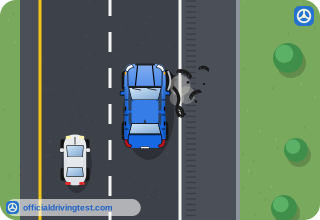
- Your vehicle will pull away from the blown tire
- Your vehicle will sway back and forth
- Your vehicle will continue straight with no change
- Your vehicle will pull in the direction of the blown tire
Show answer
Correct answer: Your vehicle will pull in the direction of the blown tire
The manual says that if a front tire blows out, your vehicle will pull in the direction of the blown tire.
Source: North Dakota Noncommercial Driver License Manual (2025-2027), page 30 · Open this page in the manual (Manual page 30)
-
What does a flat rear tire cause the vehicle to do?
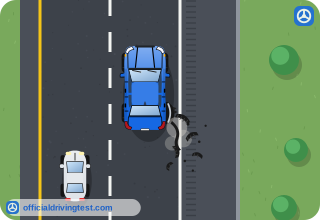
- Sway back and forth
- Pull sharply to the left
- Pull in the direction of the flat tire
- Drift straight ahead
Show answer
Correct answer: Sway back and forth
The manual says a flat rear tire will cause the vehicle to sway back and forth.
Source: North Dakota Noncommercial Driver License Manual (2025-2027), page 30 · Open this page in the manual (Manual page 30)
-
To regain control after a tire goes flat or blows out, what should you do with the steering wheel?
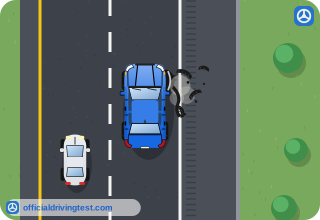
- Turn it sharply toward the shoulder
- Hold it loosely and let the vehicle straighten itself
- Grasp it tightly and steer straight ahead
- Turn it away from the side of the blown tire
Show answer
Correct answer: Grasp it tightly and steer straight ahead
The manual says to grasp the steering wheel tightly and steer straight ahead.
Source: North Dakota Noncommercial Driver License Manual (2025-2027), page 30 · Open this page in the manual (Manual page 30)
-
After a tire blowout, when should you brake?
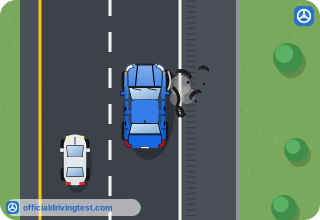
- Immediately and as hard as possible
- Not until you have regained full control
- As soon as you hear the thumping sound
- Right after you reach the shoulder
Show answer
Correct answer: Not until you have regained full control
The manual says to ease up on the accelerator but not to brake until you have regained full control.
Source: North Dakota Noncommercial Driver License Manual (2025-2027), page 30 · Open this page in the manual (Manual page 30)
-
After a tire blowout, when should you turn onto the shoulder?
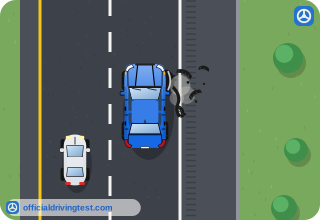
- As soon as the tire blows out
- Before you ease up on the accelerator
- As soon as you regain steering control
- When your vehicle is almost stopped
Show answer
Correct answer: When your vehicle is almost stopped
The manual says to turn onto the shoulder when your vehicle is almost stopped.
Source: North Dakota Noncommercial Driver License Manual (2025-2027), page 30 · Open this page in the manual (Manual page 30)
-
Why should you not try to swerve back onto the pavement if a tire drops off the edge onto the shoulder?
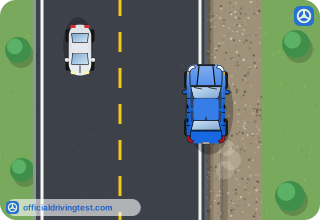
- You may lose control of your vehicle
- The pavement edge will always cut the tire
- Other drivers cannot see a vehicle on the shoulder
- The vehicle will stall as soon as it swerves
Show answer
Correct answer: You may lose control of your vehicle
The manual says not to swerve back onto the pavement because you may lose control of your vehicle.
Source: North Dakota Noncommercial Driver License Manual (2025-2027), page 30 · Open this page in the manual (Manual page 30)
-
If a tire drops off the edge of the pavement, what may happen if you brake hard?
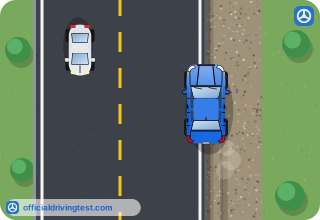
- The tire may blow out
- The steering may lock
- You may go into a skid
- The engine may stall
Show answer
Correct answer: You may go into a skid
The manual says that if you brake hard after a tire drops off the pavement, you may go into a skid.
Source: North Dakota Noncommercial Driver License Manual (2025-2027), page 30 · Open this page in the manual (Manual page 30)
-
After a tire drops off the pavement edge and you have slowed down and are in complete control, what should you do?
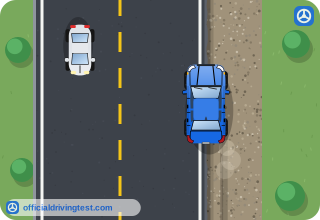
- Turn sharply back onto the pavement before any traffic approaches you
- Look for traffic behind you, signal, and turn gently back onto the pavement
- Signal and then accelerate quickly back onto the pavement
- Stop on the shoulder and turn on your headlights
Show answer
Correct answer: Look for traffic behind you, signal, and turn gently back onto the pavement
The manual says to look for traffic behind you, signal, and turn gently back onto the pavement once you are slowed and in complete control.
Source: North Dakota Noncommercial Driver License Manual (2025-2027), page 30 · Open this page in the manual (Manual page 30)
-
What should you try if your headlights suddenly fail?
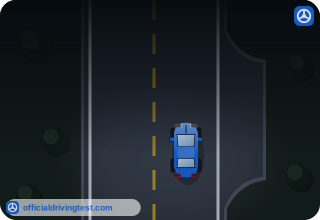
- Your high beams and horn
- Your windshield wipers and defroster
- Your dome light and interior lights
- Your parking lights and turn signals
Show answer
Correct answer: Your parking lights and turn signals
The manual says to try your parking lights and turn signals and leave the roadway as soon as you have slowed down, since without lights other drivers can no longer see you.
Source: North Dakota Noncommercial Driver License Manual (2025-2027), page 30 · Open this page in the manual (Manual page 30)
-
What does the manual say to do if your windshield wipers fail in rain or snow?
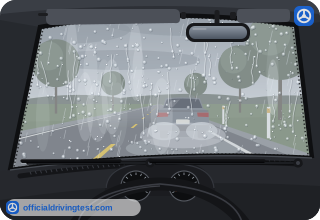
- Slow down and stick your head out your side window to see as you leave the roadway
- Stop in your lane with the hazard lights on and wait for the weather to clear
- Speed up to reach the next exit before visibility gets worse
- Keep driving at the same speed with your hazard lights on
Show answer
Correct answer: Slow down and stick your head out your side window to see as you leave the roadway
The manual says to slow down and stick your head out your side window in order to see as you leave the roadway.
Source: North Dakota Noncommercial Driver License Manual (2025-2027), page 30 · Open this page in the manual (Manual page 30)
-
If your accelerator pedal sticks, what should you do?
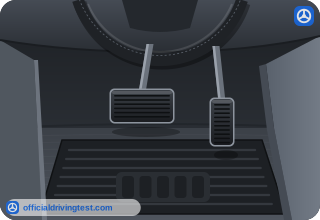
- Turn the ignition to the “lock” position
- Pump the accelerator pedal repeatedly
- Depress the clutch or shift into neutral
- Shift into park immediately
Show answer
Correct answer: Depress the clutch or shift into neutral
The manual says that if your accelerator pedal sticks, depress the clutch or shift it into neutral.
Source: North Dakota Noncommercial Driver License Manual (2025-2027), page 30 · Open this page in the manual (Manual page 30)
-
What may result if you turn the engine off when your accelerator pedal is stuck?
- Loss of the turn signals and horn
- Loss of power steering and power brakes
- Loss of the headlights and instrument lights
- A sudden increase in engine speed
Show answer
Correct answer: Loss of power steering and power brakes
The manual says you may turn the engine off, but this may result in the loss of power steering and power brakes.
Source: North Dakota Noncommercial Driver License Manual (2025-2027), page 30 · Open this page in the manual (Manual page 30)
-
If an oncoming vehicle crosses into your lane, what does the manual say to do first?
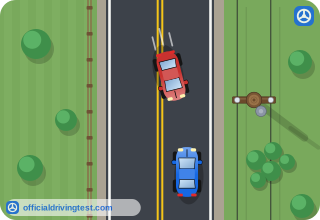
- Slow down and try to warn the driver by flashing your headlights
- Speed up and try to pass the other vehicle as quickly as possible
- Steer left across the center line
- Brake hard and stop in the middle of your lane
Show answer
Correct answer: Slow down and try to warn the driver by flashing your headlights
The manual says to slow down and try to warn the oncoming driver by flashing your headlights.
Source: North Dakota Noncommercial Driver License Manual (2025-2027), page 30 · Open this page in the manual (Manual page 30)
-
If an oncoming vehicle that crossed into your lane keeps coming, what should you do?
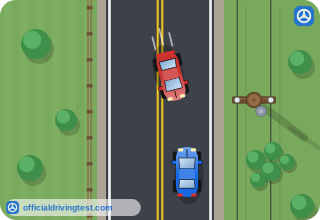
- Pull as far to the left as possible
- Stop in the middle of your lane
- Pull as far to the right as possible
- Hold the center of your lane
Show answer
Correct answer: Pull as far to the right as possible
The manual says that if the vehicle keeps coming, you should pull as far to the right as possible.
Source: North Dakota Noncommercial Driver License Manual (2025-2027), page 30 · Open this page in the manual (Manual page 30)
-
If there could be a collision with an oncoming vehicle in your lane, what does the manual say to do?
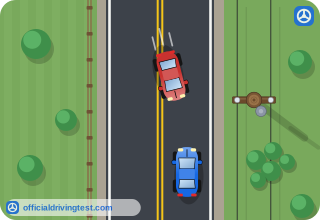
- Steer off the road to the left when conditions permit, or stop on the median
- Steer off the road to the right when conditions permit, or stop on the far right shoulder
- Stay in your lane and brake as hard as you can until you stop
- Steer into the oncoming lane and accelerate past the vehicle
Show answer
Correct answer: Steer off the road to the right when conditions permit, or stop on the far right shoulder
The manual says to steer off the road to the right when conditions permit, or to stop on the far right shoulder of the road.
Source: North Dakota Noncommercial Driver License Manual (2025-2027), page 30 · Open this page in the manual (Manual page 30)