North Carolina: Railroad crossings
Crossing signs, signals and gates, and what to do at a crossing. Split into 3 shorter tests so you're not stuck in one long quiz.
Independent educational site · not affiliated with any government agency or DMV
Choose a part
Railroad crossings — Part 1
Questions in this part include: “When you must stop at a railroad crossing, how far from the nearest rail must you stop?”
StartRailroad crossings — Part 2
Questions in this part include: “Where must you never stop for any reason?”
StartRailroad crossings — Part 3
Questions in this part include: “What is the Railroad Emergency Notification System sign also known as?”
StartAll 51 Railroad crossings questions with answers
Choose a part above to take a practice test, or study every question and answer here.
Show the questions and answersHide the questions
-
When you must stop at a railroad crossing, how far from the nearest rail must you stop?
- Within 50 feet, but not less than 15 feet
- Within 100 feet, but not less than 50 feet
- Within 25 feet, but not less than 5 feet
- Within 30 feet, but not less than 10 feet
Show answer
Correct answer: Within 50 feet, but not less than 15 feet
G.S. 20-142.1 requires the driver to stop within 50 feet but not less than 15 feet from the nearest rail.
Source: North Carolina Driver Handbook (Revised May 2025), page 60 · Open this page in the manual (Manual page 60)
-
You must stop at a crossing when a train that is an immediate hazard emits an audible signal from within approximately how far of the crossing?
- 1,500 feet
- 500 feet
- 1,000 feet
- 2,500 feet
Show answer
Correct answer: 1,500 feet
A train approaching within approximately 1,500 feet that emits an audible signal and is an immediate hazard requires you to stop.
Source: North Carolina Driver Handbook (Revised May 2025), page 60 · Open this page in the manual (Manual page 60)
-
When must you stop for an approaching railroad train that is plainly visible?
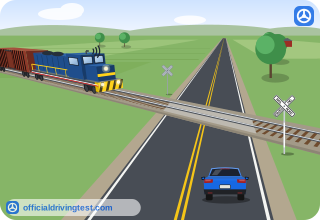
- Only when its whistle can be heard from 500 feet
- Only when the train is less than one mile from the crossing
- When it is in hazardous proximity to the crossing
- Only when a flagger signals you to stop
Show answer
Correct answer: When it is in hazardous proximity to the crossing
You must stop when an approaching train is plainly visible and in hazardous proximity to the crossing.
Source: North Carolina Driver Handbook (Revised May 2025), page 60 · Open this page in the manual (Manual page 60)
-
Which of these does the law prohibit at a railroad crossing?
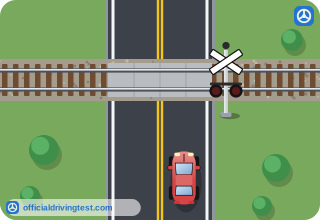
- Stopping within 50 feet of a gate that is fully raised and open
- Driving around a gate that is closed or is being opened or closed
- Waiting behind a lowered gate until the train has passed
- Stopping at least 15 feet from the nearest rail before a gate lowers
Show answer
Correct answer: Driving around a gate that is closed or is being opened or closed
No person shall drive through, around or under a crossing gate while it is closed or being opened or closed.
Source: North Carolina Driver Handbook (Revised May 2025), page 60 · Open this page in the manual (Manual page 60)
-
When stopping as required at a railroad crossing, how should you position your vehicle?
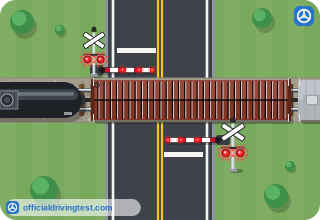
- In the center of the roadway so that others can pass on either side
- Forming two lanes of traffic wherever the road is wide enough
- Straddling the center line so you can see both directions
- As far to the right of the highway as possible
Show answer
Correct answer: As far to the right of the highway as possible
The driver shall keep as far to the right of the highway as possible when stopping at a railroad crossing.
Source: North Carolina Driver Handbook (Revised May 2025), page 60 · Open this page in the manual (Manual page 60)
-
When may drivers stopped at a railroad crossing form two lanes of traffic?
- Only when the roadway is marked for two or more lanes
- Whenever the shoulder is wide enough for a second line of vehicles
- Only when the roadway is marked for four or more lanes of traffic
- Only when an officer at the crossing directs traffic to do so
Show answer
Correct answer: Only when the roadway is marked for four or more lanes of traffic
Drivers shall not form two lanes at a crossing unless the roadway is marked for four or more lanes of traffic.
Source: North Carolina Driver Handbook (Revised May 2025), page 60 · Open this page in the manual (Manual page 60)
-
According to G.S. 20-142.1, what is a driver who violates the railroad signal law guilty of?
- An infraction
- A felony
- A Class 1 misdemeanor
- Nothing, if no crash occurs
Show answer
Correct answer: An infraction
The statute says anyone who violates its provisions is guilty of an infraction.
Source: North Carolina Driver Handbook (Revised May 2025), page 60 · Open this page in the manual (Manual page 60)
-
An employer who knowingly authorizes a commercial motor vehicle driver to violate the railroad crossing law is guilty of an infraction and also subject to what?
- Loss of the company's business license
- A mandatory driver-safety course for staff
- Suspension of every driver's license
- A civil penalty under G.S. 20-37.21
Show answer
Correct answer: A civil penalty under G.S. 20-37.21
The employer is guilty of an infraction and will also be subject to a civil penalty under G.S. 20-37.21.
Source: North Carolina Driver Handbook (Revised May 2025), page 60 · Open this page in the manual (Manual page 60)
-
About how many miles of railroad tracks are there in N.C.?
- Over 1,000 miles
- Over 5,000 miles
- Over 2,500 miles
- Over 10,000 miles
Show answer
Correct answer: Over 5,000 miles
The manual says there are over 5,000 miles of railroad tracks in N.C.
Source: North Carolina Driver Handbook (Revised May 2025), page 60 · Open this page in the manual (Manual page 60)
-
About how many railroad crossings are there in N.C.?
- 2,800
- 6,800
- 4,800
- 9,800
Show answer
Correct answer: 6,800
The manual says there are 6,800 railroad crossings in N.C.
Source: North Carolina Driver Handbook (Revised May 2025), page 60 · Open this page in the manual (Manual page 60)
-
How far does a train traveling at 55 mph take to come to a stop?
- About 500 feet
- About a quarter of a mile
- About half a mile
- More than a mile
Show answer
Correct answer: More than a mile
A train that is traveling at 55 mph takes more than a mile to come to a stop.
Source: North Carolina Driver Handbook (Revised May 2025), page 60 · Open this page in the manual (Manual page 60)
-
What does a yellow and black “RR” sign indicate?
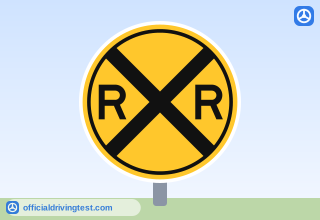
- You are approaching a railroad crossing
- Trains stop at a station ahead
- Trains are prohibited from crossing the road ahead
- The road ahead is closed to all vehicle traffic
Show answer
Correct answer: You are approaching a railroad crossing
A yellow and black “RR” sign indicates that you are approaching a railroad crossing.
Source: North Carolina Driver Handbook (Revised May 2025), page 60 · Open this page in the manual (Manual page 60)
-
As you approach the railroad tracks, what should you do?
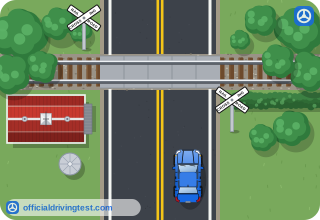
- Speed up so you clear the tracks before a train arrives
- Look only in the direction from which trains normally come
- Look both ways and listen because you may have to stop
- Stop only if you see a train or a flashing light
Show answer
Correct answer: Look both ways and listen because you may have to stop
The manual says to look both ways and listen as you approach the tracks because you may have to stop.
Source: North Carolina Driver Handbook (Revised May 2025), page 60 · Open this page in the manual (Manual page 60)
-
From which direction and at what time can trains approach a crossing?
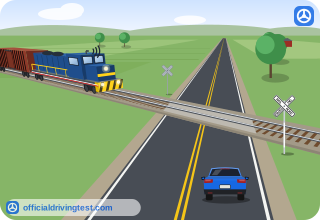
- Only at scheduled times of the day
- Only from one direction on a single track
- Only when the warning lights are flashing
- At any time from any direction
Show answer
Correct answer: At any time from any direction
The manual says trains can approach a crossing at any time from any direction.
Source: North Carolina Driver Handbook (Revised May 2025), page 60 · Open this page in the manual (Manual page 60)
-
Who always has the right of way at a railroad crossing?
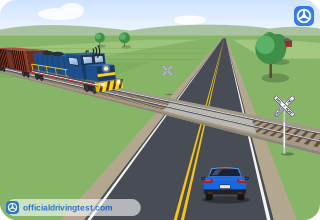
- The largest vehicle
- The train
- The first vehicle to arrive
- Emergency vehicles
Show answer
Correct answer: The train
The train always has the right of way at a railroad crossing.
Source: North Carolina Driver Handbook (Revised May 2025), page 60 · Open this page in the manual (Manual page 60)
-
If there is a stop sign at a railroad crossing, what must you do?
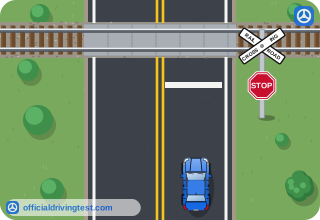
- Slow down and cross if no train is visible
- Stop only if a train is in sight
- Come to a full stop before safely crossing
- Yield to the vehicle ahead and follow it across
Show answer
Correct answer: Come to a full stop before safely crossing
If there is a stop sign at a crossing, you must come to a full stop before safely crossing.
Source: North Carolina Driver Handbook (Revised May 2025), page 60 · Open this page in the manual (Manual page 60)
-
Trains have the right of way over which highway traffic?
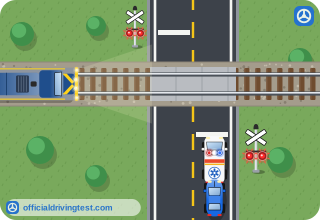
- All highway traffic, including police, fire and ambulance emergency vehicles
- All traffic except police, fire and ambulance emergency vehicles
- Only private vehicles, but not buses or commercial trucks
- Only vehicles that have stopped at the crossing
Show answer
Correct answer: All highway traffic, including police, fire and ambulance emergency vehicles
Trains have the right of way over all highway traffic, including police, fire and ambulance emergency vehicles.
Source: North Carolina Driver Handbook (Revised May 2025), page 60 · Open this page in the manual (Manual page 60)
-
Where must you never stop for any reason?
- On train tracks
- On a highway shoulder
- In front of a driveway
- In a school zone
Show answer
Correct answer: On train tracks
The manual says never to stop on train tracks for any reason.
Source: North Carolina Driver Handbook (Revised May 2025), page 61 · Open this page in the manual (Manual page 61)
-
What is the X-shaped railroad grade crossing sign known as?
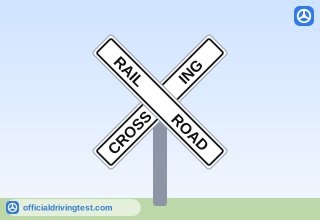
- A Grade Sign
- A Rail Marker
- A Crossbuck Sign
- A Stop Warning Sign
Show answer
Correct answer: A Crossbuck Sign
The X-shaped railroad grade crossing sign is known as a Crossbuck Sign.
Source: North Carolina Driver Handbook (Revised May 2025), page 61 · Open this page in the manual (Manual page 61)
-
What does a smaller sign below the crossbuck indicate?
- That a train stops at the crossing
- That there is more than one track
- That the crossing is closed at night
- That the crossing has no gate
Show answer
Correct answer: That there is more than one track
A smaller sign below the crossbuck indicates if there is more than one track.
Source: North Carolina Driver Handbook (Revised May 2025), page 61 · Open this page in the manual (Manual page 61)
-
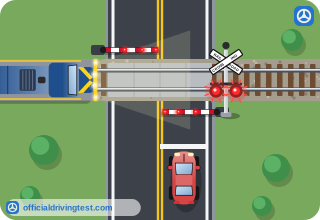
If the railroad warning signal activates as you approach, when must you stop?
- After you cross the first set of tracks
- As soon as you can see the train itself
- Only after the gate touches the front of your vehicle
- Before the gates lower across your side of the road
Show answer
Correct answer: Before the gates lower across your side of the road
If the warning signal activates you must stop before the gates lower across your side of the road.
Source: North Carolina Driver Handbook (Revised May 2025), page 61 · Open this page in the manual (Manual page 61)
-
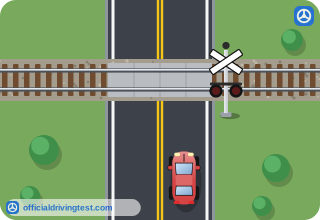
What is unlawful and extremely dangerous at a railroad crossing?
- Stopping behind the gate when it is lowered across your side
- Slowing down as you approach the tracks with a train in view
- Moving through the crossing when the gates are lowered
- Looking both ways before you cross the tracks
Show answer
Correct answer: Moving through the crossing when the gates are lowered
It is unlawful and extremely dangerous to move through a railroad crossing when the gates are lowered.
Source: North Carolina Driver Handbook (Revised May 2025), page 61 · Open this page in the manual (Manual page 61)
-
Which is one thing you must do as you approach a railroad crossing?
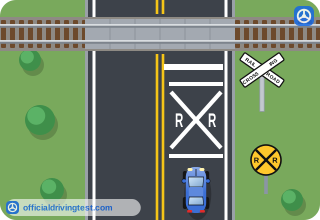
- Slow your speed
- Increase your speed
- Sound your horn continuously
- Turn on your high beams
Show answer
Correct answer: Slow your speed
As you approach a railroad crossing you must slow your speed, look both ways, listen for the train, keep alert and watch for the signal.
Source: North Carolina Driver Handbook (Revised May 2025), page 61 · Open this page in the manual (Manual page 61)
-
What does the manual say about railroads and where you may cross the tracks?
- Railroads are public property; cross wherever the tracks are level
- Railroads are private property; cross wherever there is no train in sight
- Railroads are public property; cross at any point without a fence
- Railroads are private property; cross only at designated railroad crossings
Show answer
Correct answer: Railroads are private property; cross only at designated railroad crossings
Railroads are private property, and it is illegal and dangerous to drive on or cross the tracks except at designated crossings.
Source: North Carolina Driver Handbook (Revised May 2025), page 61 · Open this page in the manual (Manual page 61)
-
At a crossing that has only a crossbuck and no lights or gates, what must vehicles do?
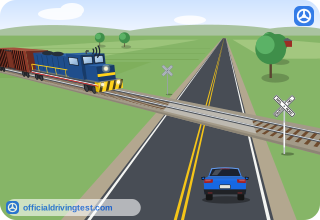
- Cross if no train is in sight without slowing
- Always yield to a train
- Slow down only if the crossing is marked with gates
- Stop only if a train is visible
Show answer
Correct answer: Always yield to a train
Vehicles must always yield to a train even when the crossing only has a crossbuck and no lights or gates.
Source: North Carolina Driver Handbook (Revised May 2025), page 61 · Open this page in the manual (Manual page 61)
-
When flashing red lights are used with crossbuck signs at a railroad crossing, what must you do?
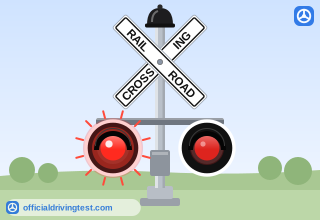
- Slow down and proceed when the road appears clear to you
- Stop, just as you would for any flashing red traffic signal
- Yield to the train only if it is close to the crossing
- Stop only if you see a train approaching the crossing
Show answer
Correct answer: Stop, just as you would for any flashing red traffic signal
With flashing red lights at a crossing you must stop, just as you would stop for any flashing red traffic signal.
Source: North Carolina Driver Handbook (Revised May 2025), page 61 · Open this page in the manual (Manual page 61)
-
Why should you not move immediately after a train has passed?
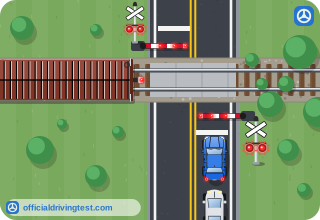
- The crossing signals may need time to reset before you can go
- The road surface near the tracks may be too slippery to cross
- The engineer may signal you to wait for the next car
- Another train may be moving from the opposite direction or behind
Show answer
Correct answer: Another train may be moving from the opposite direction or behind
There may be another train moving in the opposite direction from, or following, the first train.
Source: North Carolina Driver Handbook (Revised May 2025), page 61 · Open this page in the manual (Manual page 61)
-
When may you move ahead at a crossing with flashing red lights?
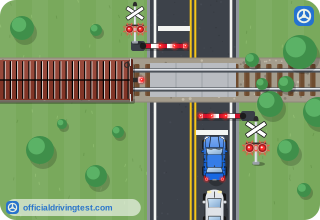
- Only after the red lights have stopped flashing
- As soon as the last train car has passed you
- When the vehicle ahead of you starts to cross
- After the gates start to rise, even if lights still flash
Show answer
Correct answer: Only after the red lights have stopped flashing
The manual says to always wait until the red lights have stopped flashing before moving ahead.
Source: North Carolina Driver Handbook (Revised May 2025), page 61 · Open this page in the manual (Manual page 61)
-
You should be prepared to stop at a railroad crossing for which vehicle, because it must stop there?
- A motorcycle carrying one rider on the highway
- A pickup truck hauling firewood to a nearby home
- A vehicle transporting explosives or hazardous materials
- A truck hauling only sand or gravel to a work site
Show answer
Correct answer: A vehicle transporting explosives or hazardous materials
Vehicles that must stop at crossings include school buses, passenger-carrying and for-hire vehicles, and vehicles transporting explosives or hazardous materials.
Source: North Carolina Driver Handbook (Revised May 2025), page 61 · Open this page in the manual (Manual page 61)
-
You are crossing the tracks when the warning lights begin flashing or the gates start to come down. What should you do?
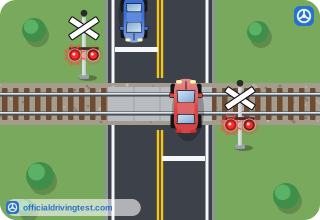
- Stop immediately and back away from the tracks
- Stop on the tracks and wait for the gate to rise
- Back up quickly to leave the crossing
- Do not stop or back up; keep moving
Show answer
Correct answer: Do not stop or back up; keep moving
If you are already crossing when the warning lights flash or gates come down, do not stop, do not back up, keep moving.
Source: North Carolina Driver Handbook (Revised May 2025), page 61 · Open this page in the manual (Manual page 61)
-
If the gate on the far side of the tracks comes down before you get across, what should you do?
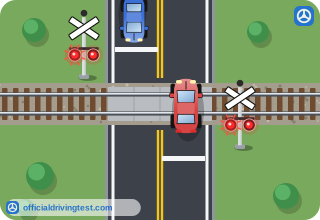
- Stop on the tracks and wait for the gate to be raised again
- Drive through the gate, which is flexible and will not block you in
- Back up across the tracks to the side you came from
- Turn off the engine and leave the vehicle immediately
Show answer
Correct answer: Drive through the gate, which is flexible and will not block you in
The manual says to drive through the gate because it is flexible and will not block you in.
Source: North Carolina Driver Handbook (Revised May 2025), page 62 · Open this page in the manual (Manual page 62)
-
What may happen if you stop and try to back up when a crossing gate comes down?
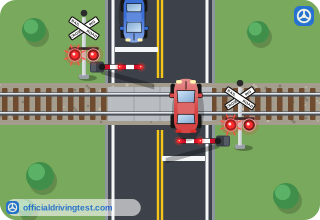
- The gate may lock and trap you
- The train's engineer may stop the train
- Your vehicle may stall
- The crossing lights will reset
Show answer
Correct answer: Your vehicle may stall
The manual warns that if you stop and try to back up, your vehicle may stall.
Source: North Carolina Driver Handbook (Revised May 2025), page 62 · Open this page in the manual (Manual page 62)
-
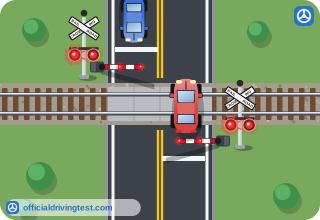
Crossing gates will not trap you, but what might?
- Stopping traffic
- The railroad crossing lights
- A train that stops on the tracks
- The crossbuck sign
Show answer
Correct answer: Stopping traffic
The manual says crossing gates will not trap you, but stopping traffic might.
Source: North Carolina Driver Handbook (Revised May 2025), page 62 · Open this page in the manual (Manual page 62)
-
Before you cross railroad tracks, what should you be sure of?
- That traffic ahead will not stop and block you in on the tracks
- That no vehicle is following you closely across the tracks
- That the crossing gate has already been raised for the train
- That your hazard lights are turned on before you cross them
Show answer
Correct answer: That traffic ahead will not stop and block you in on the tracks
You should be sure the traffic ahead will not stop and block you in on the tracks.
Source: North Carolina Driver Handbook (Revised May 2025), page 62 · Open this page in the manual (Manual page 62)
-
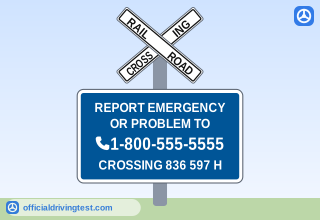
What is the Railroad Emergency Notification System sign also known as?
- The Green Sign
- The Red Sign
- The Blue Sign
- The Yellow Sign
Show answer
Correct answer: The Blue Sign
The Railroad Emergency Notification System sign is also known as the Blue Sign.
Source: North Carolina Driver Handbook (Revised May 2025), page 62 · Open this page in the manual (Manual page 62)
-
How must the Emergency Notification System (ENS) sign be posted at all highway-railroad crossings in North Carolina?
- Only on the approach with the most traffic
- In each traffic direction
- Only at crossings that have gates
- Only on the side facing the train
Show answer
Correct answer: In each traffic direction
All highway-railroad crossings in North Carolina must have an ENS sign posted in each traffic direction.
Source: North Carolina Driver Handbook (Revised May 2025), page 62 · Open this page in the manual (Manual page 62)
-
Which information does the ENS “Blue sign” contain?
- The crossing's speed limit, the train schedule and the nearest station
- The number of tracks, the speed of the train and the gate height
- The county name, the road number and the date of the last inspection
- Crossing ID number, railroad company name and an emergency phone number
Show answer
Correct answer: Crossing ID number, railroad company name and an emergency phone number
The ENS sign contains the railroad crossing identification number, name of the railroad company and an emergency telephone number.
Source: North Carolina Driver Handbook (Revised May 2025), page 62 · Open this page in the manual (Manual page 62)
-
What does each railroad crossing have that is unique?
- A separate speed limit for the trains
- A locked gate control box at the site
- A USDOT crossing identification number
- A color-coded warning light on its gate
Show answer
Correct answer: A USDOT crossing identification number
Each railroad company has its own emergency telephone number and each crossing has a unique USDOT crossing identification number.
Source: North Carolina Driver Handbook (Revised May 2025), page 62 · Open this page in the manual (Manual page 62)
-
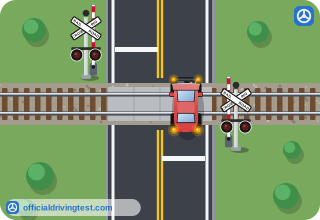
If your vehicle stalls on or near the tracks, what should you do?
- Get out immediately
- Try to restart the engine
- Stay inside and call for help
- Wait for the gates to lower
Show answer
Correct answer: Get out immediately
If your vehicle stalls on or near the tracks, get out immediately.
Source: North Carolina Driver Handbook (Revised May 2025), page 62 · Open this page in the manual (Manual page 62)
-
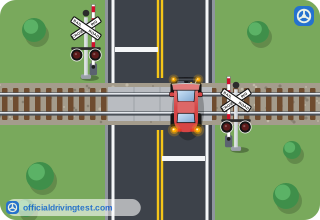
After getting out of a vehicle stalled on or near the tracks, what should you do?
- Stay close to the tracks so you can wave down the train
- Wait inside the vehicle with the doors locked and hazard lights on
- Walk down the tracks in the direction the train will come
- Walk quickly along the roadway to a safe location away from the tracks
Show answer
Correct answer: Walk quickly along the roadway to a safe location away from the tracks
The manual says to move away from your vehicle and the tracks and walk quickly along the roadway to a safe location.
Source: North Carolina Driver Handbook (Revised May 2025), page 62 · Open this page in the manual (Manual page 62)
-
When you are safely away from the tracks, what should you find to report the emergency?
- The nearest police vehicle on the highway
- The blue sign at or near the railroad crossing
- The railroad's mile marker along the tracks
- The stop sign at the next intersection
Show answer
Correct answer: The blue sign at or near the railroad crossing
When safely away, find the blue sign at or near the crossing and report the emergency using the information on it.
Source: North Carolina Driver Handbook (Revised May 2025), page 62 · Open this page in the manual (Manual page 62)
-
Who should you contact about damaged or missing Emergency Notification System signs?
- The railroad company that owns the tracks
- The USDOT Federal Railroad Administration
- The local county sheriff's department
- The North Carolina State Highway Patrol
Show answer
Correct answer: The USDOT Federal Railroad Administration
For damaged or missing signs, the manual says to contact the USDOT Federal Railroad Administration.
Source: North Carolina Driver Handbook (Revised May 2025), page 62 · Open this page in the manual (Manual page 62)
-
When a train hits a 4,000-lb. car, what is it like?
- A truck hitting a mailbox
- A bicycle hitting a curb
- Your car running over a pothole
- Your car running over a soda can
Show answer
Correct answer: Your car running over a soda can
The manual compares a train hitting a 4,000-lb. car to your car running over a soda can.
Source: North Carolina Driver Handbook (Revised May 2025), page 62 · Open this page in the manual (Manual page 62)
-
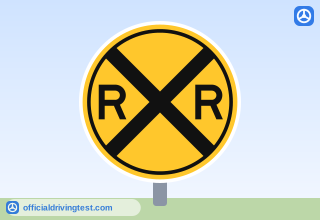
What does a circular yellow sign with a black cross and the letters “RR” warn of?
- A school crossing ahead
- A railroad crossing ahead
- A road-work zone ahead
- A steep downgrade ahead
Show answer
Correct answer: A railroad crossing ahead
The circular yellow sign with a black cross and RR gives advance warning of a railroad crossing.
Source: North Carolina Driver Handbook (Revised May 2025), page 84 · Open this page in the manual (Manual page 84)
-
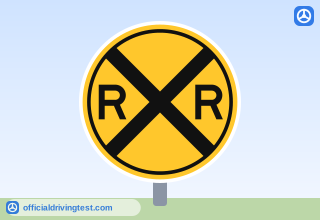
What should you do when you see the circular yellow sign with the letters “RR”?
- Keep your speed if no train is in sight
- Stop every time and wait for a train to pass
- Sound your horn and continue
- Slow down, and stop if necessary
Show answer
Correct answer: Slow down, and stop if necessary
You should slow down and stop if necessary to be sure you can safely clear the crossing.
Source: North Carolina Driver Handbook (Revised May 2025), page 84 · Open this page in the manual (Manual page 84)
-
What words are printed in black on the white crosspieces of the crossbuck sign at a railroad crossing?
- “RAILROAD CROSSING”
- “TRAIN CROSSING”
- “RAILWAY STOP”
- “LOOK FOR TRAINS”
Show answer
Correct answer: “RAILROAD CROSSING”
The words RAILROAD CROSSING are printed in black on the white crosspieces of the crossbuck.
Source: North Carolina Driver Handbook (Revised May 2025), page 84 · Open this page in the manual (Manual page 84)
-
How are multiple tracks at a railroad crossing shown?
- On a sign above the crossbuck
- By additional crosspieces on the crossbuck
- On a sign below the crossbuck
- By a second set of flashing lights
Show answer
Correct answer: On a sign below the crossbuck
Multiple tracks are shown on a sign below the crossbuck.
Source: North Carolina Driver Handbook (Revised May 2025), page 84 · Open this page in the manual (Manual page 84)
-
When must you stop at a railroad crossing?
- Only when you can see or hear a train approaching the crossing
- Whenever a flagger, signal or gate indicates an approaching train
- Only when you are driving a bus or a vehicle carrying passengers
- Only when the crossing is located outside a city or town
Show answer
Correct answer: Whenever a flagger, signal or gate indicates an approaching train
You must stop whenever a flagger, signal or gate indicates an approaching train.
Source: North Carolina Driver Handbook (Revised May 2025), page 84 · Open this page in the manual (Manual page 84)
-
How long must you remain stopped at a railroad crossing when a train is approaching?
- Until you have counted ten seconds after the train’s horn stops
- Until the vehicle ahead of you starts to cross the tracks
- Until you no longer hear the train, even if the gate is down
- Until the gate lifts or the signal or flagger indicates it is safe
Show answer
Correct answer: Until the gate lifts or the signal or flagger indicates it is safe
You must stay stopped until the gate lifts or the signal or flagger indicates it is safe to proceed.
Source: North Carolina Driver Handbook (Revised May 2025), page 84 · Open this page in the manual (Manual page 84)
-
How many times in each direction should you check before crossing a railroad track?
- Twice
- Once
- Three times
- Four times
Show answer
Correct answer: Twice
The manual advises checking twice in each direction before crossing a railroad track.
Source: North Carolina Driver Handbook (Revised May 2025), page 84 · Open this page in the manual (Manual page 84)
-
What does the DO NOT STOP ON TRACKS sign remind the driver of?
- Not to stop on the railroad track for any reason
- To stop before the railroad track when a train is near
- To stop and look both ways before crossing the track
- Not to stop on the track unless traffic ahead has stopped
Show answer
Correct answer: Not to stop on the railroad track for any reason
The sign reminds drivers not to stop on the railroad track for any reason.
Source: North Carolina Driver Handbook (Revised May 2025), page 86 · Open this page in the manual (Manual page 86)