North Carolina: Railroad crossings — Part 2 Practice Test
Questions in this part include: “Where must you never stop for any reason?” · “What does the manual say about railroads and where you may cross the tracks?”
Independent educational site · not affiliated with any government agency or DMV
Ready? Test yourself
- Instant feedback with an explanation
- Every answer cites its source in the manual
- Your best score is saved on this device
Questions are original and based on the official manual "North Carolina Driver Handbook" (Revised May 2025), North Carolina Division of Motor Vehicles (NCDMV).
All 17 questions in this practice test
Take the test above first, then use this list to study. Tap “Show answer” to see the correct answer and explanation.
Show the questions and answersHide the questions
-
Where must you never stop for any reason?
- On train tracks
- On a highway shoulder
- In front of a driveway
- In a school zone
Show answer
Correct answer: On train tracks
The manual says never to stop on train tracks for any reason.
Source: North Carolina Driver Handbook (Revised May 2025), page 61 · Open this page in the manual (Manual page 61)
-
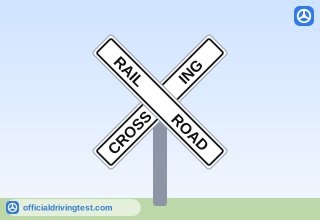
What is the X-shaped railroad grade crossing sign known as?
- A Grade Sign
- A Rail Marker
- A Crossbuck Sign
- A Stop Warning Sign
Show answer
Correct answer: A Crossbuck Sign
The X-shaped railroad grade crossing sign is known as a Crossbuck Sign.
Source: North Carolina Driver Handbook (Revised May 2025), page 61 · Open this page in the manual (Manual page 61)
-
What does a smaller sign below the crossbuck indicate?
- That a train stops at the crossing
- That there is more than one track
- That the crossing is closed at night
- That the crossing has no gate
Show answer
Correct answer: That there is more than one track
A smaller sign below the crossbuck indicates if there is more than one track.
Source: North Carolina Driver Handbook (Revised May 2025), page 61 · Open this page in the manual (Manual page 61)
-
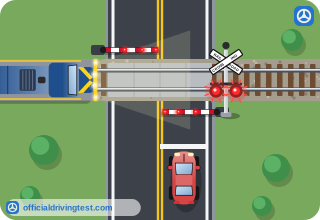
If the railroad warning signal activates as you approach, when must you stop?
- After you cross the first set of tracks
- As soon as you can see the train itself
- Only after the gate touches the front of your vehicle
- Before the gates lower across your side of the road
Show answer
Correct answer: Before the gates lower across your side of the road
If the warning signal activates you must stop before the gates lower across your side of the road.
Source: North Carolina Driver Handbook (Revised May 2025), page 61 · Open this page in the manual (Manual page 61)
-
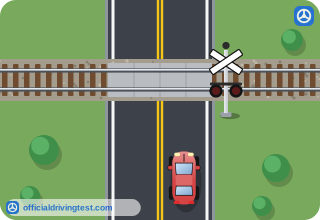
What is unlawful and extremely dangerous at a railroad crossing?
- Stopping behind the gate when it is lowered across your side
- Slowing down as you approach the tracks with a train in view
- Moving through the crossing when the gates are lowered
- Looking both ways before you cross the tracks
Show answer
Correct answer: Moving through the crossing when the gates are lowered
It is unlawful and extremely dangerous to move through a railroad crossing when the gates are lowered.
Source: North Carolina Driver Handbook (Revised May 2025), page 61 · Open this page in the manual (Manual page 61)
-
Which is one thing you must do as you approach a railroad crossing?
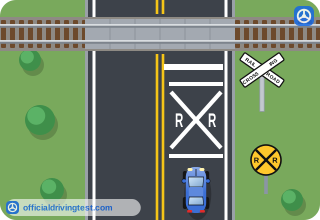
- Slow your speed
- Increase your speed
- Sound your horn continuously
- Turn on your high beams
Show answer
Correct answer: Slow your speed
As you approach a railroad crossing you must slow your speed, look both ways, listen for the train, keep alert and watch for the signal.
Source: North Carolina Driver Handbook (Revised May 2025), page 61 · Open this page in the manual (Manual page 61)
-
What does the manual say about railroads and where you may cross the tracks?
- Railroads are public property; cross wherever the tracks are level
- Railroads are private property; cross wherever there is no train in sight
- Railroads are public property; cross at any point without a fence
- Railroads are private property; cross only at designated railroad crossings
Show answer
Correct answer: Railroads are private property; cross only at designated railroad crossings
Railroads are private property, and it is illegal and dangerous to drive on or cross the tracks except at designated crossings.
Source: North Carolina Driver Handbook (Revised May 2025), page 61 · Open this page in the manual (Manual page 61)
-
At a crossing that has only a crossbuck and no lights or gates, what must vehicles do?
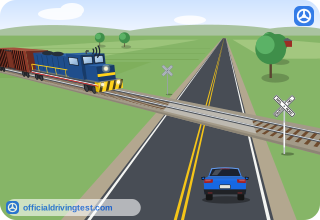
- Cross if no train is in sight without slowing
- Always yield to a train
- Slow down only if the crossing is marked with gates
- Stop only if a train is visible
Show answer
Correct answer: Always yield to a train
Vehicles must always yield to a train even when the crossing only has a crossbuck and no lights or gates.
Source: North Carolina Driver Handbook (Revised May 2025), page 61 · Open this page in the manual (Manual page 61)
-
When flashing red lights are used with crossbuck signs at a railroad crossing, what must you do?
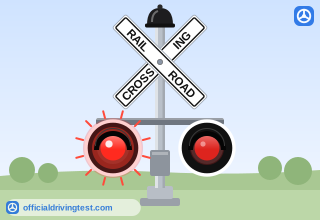
- Slow down and proceed when the road appears clear to you
- Stop, just as you would for any flashing red traffic signal
- Yield to the train only if it is close to the crossing
- Stop only if you see a train approaching the crossing
Show answer
Correct answer: Stop, just as you would for any flashing red traffic signal
With flashing red lights at a crossing you must stop, just as you would stop for any flashing red traffic signal.
Source: North Carolina Driver Handbook (Revised May 2025), page 61 · Open this page in the manual (Manual page 61)
-
Why should you not move immediately after a train has passed?
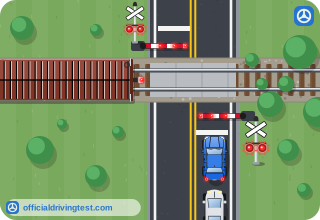
- The crossing signals may need time to reset before you can go
- The road surface near the tracks may be too slippery to cross
- The engineer may signal you to wait for the next car
- Another train may be moving from the opposite direction or behind
Show answer
Correct answer: Another train may be moving from the opposite direction or behind
There may be another train moving in the opposite direction from, or following, the first train.
Source: North Carolina Driver Handbook (Revised May 2025), page 61 · Open this page in the manual (Manual page 61)
-
When may you move ahead at a crossing with flashing red lights?
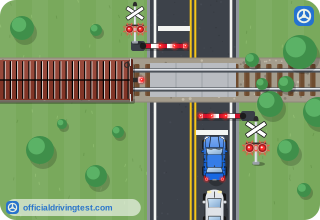
- Only after the red lights have stopped flashing
- As soon as the last train car has passed you
- When the vehicle ahead of you starts to cross
- After the gates start to rise, even if lights still flash
Show answer
Correct answer: Only after the red lights have stopped flashing
The manual says to always wait until the red lights have stopped flashing before moving ahead.
Source: North Carolina Driver Handbook (Revised May 2025), page 61 · Open this page in the manual (Manual page 61)
-
You should be prepared to stop at a railroad crossing for which vehicle, because it must stop there?
- A motorcycle carrying one rider on the highway
- A pickup truck hauling firewood to a nearby home
- A vehicle transporting explosives or hazardous materials
- A truck hauling only sand or gravel to a work site
Show answer
Correct answer: A vehicle transporting explosives or hazardous materials
Vehicles that must stop at crossings include school buses, passenger-carrying and for-hire vehicles, and vehicles transporting explosives or hazardous materials.
Source: North Carolina Driver Handbook (Revised May 2025), page 61 · Open this page in the manual (Manual page 61)
-
You are crossing the tracks when the warning lights begin flashing or the gates start to come down. What should you do?
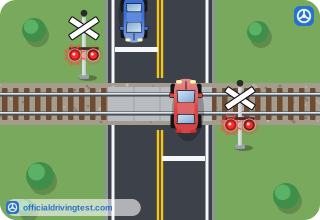
- Stop immediately and back away from the tracks
- Stop on the tracks and wait for the gate to rise
- Back up quickly to leave the crossing
- Do not stop or back up; keep moving
Show answer
Correct answer: Do not stop or back up; keep moving
If you are already crossing when the warning lights flash or gates come down, do not stop, do not back up, keep moving.
Source: North Carolina Driver Handbook (Revised May 2025), page 61 · Open this page in the manual (Manual page 61)
-
If the gate on the far side of the tracks comes down before you get across, what should you do?
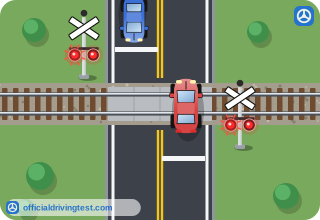
- Stop on the tracks and wait for the gate to be raised again
- Drive through the gate, which is flexible and will not block you in
- Back up across the tracks to the side you came from
- Turn off the engine and leave the vehicle immediately
Show answer
Correct answer: Drive through the gate, which is flexible and will not block you in
The manual says to drive through the gate because it is flexible and will not block you in.
Source: North Carolina Driver Handbook (Revised May 2025), page 62 · Open this page in the manual (Manual page 62)
-
What may happen if you stop and try to back up when a crossing gate comes down?
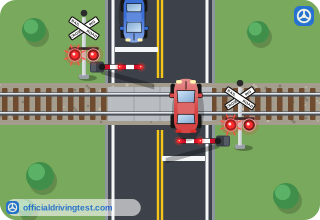
- The gate may lock and trap you
- The train's engineer may stop the train
- Your vehicle may stall
- The crossing lights will reset
Show answer
Correct answer: Your vehicle may stall
The manual warns that if you stop and try to back up, your vehicle may stall.
Source: North Carolina Driver Handbook (Revised May 2025), page 62 · Open this page in the manual (Manual page 62)
-
Crossing gates will not trap you, but what might?
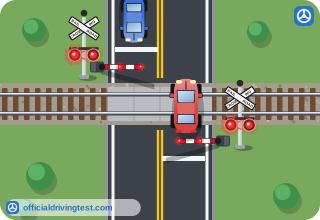
- Stopping traffic
- The railroad crossing lights
- A train that stops on the tracks
- The crossbuck sign
Show answer
Correct answer: Stopping traffic
The manual says crossing gates will not trap you, but stopping traffic might.
Source: North Carolina Driver Handbook (Revised May 2025), page 62 · Open this page in the manual (Manual page 62)
-
Before you cross railroad tracks, what should you be sure of?
- That traffic ahead will not stop and block you in on the tracks
- That no vehicle is following you closely across the tracks
- That the crossing gate has already been raised for the train
- That your hazard lights are turned on before you cross them
Show answer
Correct answer: That traffic ahead will not stop and block you in on the tracks
You should be sure the traffic ahead will not stop and block you in on the tracks.
Source: North Carolina Driver Handbook (Revised May 2025), page 62 · Open this page in the manual (Manual page 62)