North Carolina: Emergencies and special situations — Part 2 Practice Test
Questions in this part include: “According to the manual, half of the inland flooding deaths in North Carolina tropical weather were caused by what?” · “According to the manual, how deep does fast moving water need to be to float a car or cause it to turn over?”
Independent educational site · not affiliated with any government agency or DMV
Ready? Test yourself
- Instant feedback with an explanation
- Every answer cites its source in the manual
- Your best score is saved on this device
Questions are original and based on the official manual "North Carolina Driver Handbook" (Revised May 2025), North Carolina Division of Motor Vehicles (NCDMV).
All 19 questions in this practice test
Take the test above first, then use this list to study. Tap “Show answer” to see the correct answer and explanation.
Show the questions and answersHide the questions
-
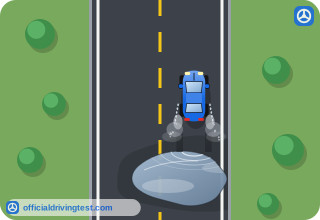
How long can puddles left by rain cause a car to hydroplane?
- Only while it is still raining
- For about 10 minutes after the rain stops
- For several hours, even days after the showers stop
- Only for the first hour after the rain stops
Show answer
Correct answer: For several hours, even days after the showers stop
The manual says rain leaves puddles for several hours, even days after the showers stop, that can cause a car to hydroplane.
Source: North Carolina Driver Handbook (Revised May 2025), page 72 · Open this page in the manual (Manual page 72)
-
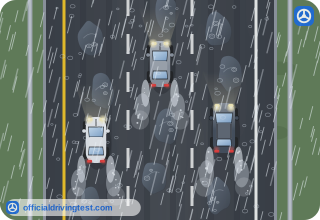
What should you never use when it is raining or after it has been raining?
- Your headlights
- Cruise control
- Your windshield wipers
- Your turn signals
Show answer
Correct answer: Cruise control
The manual says never to use cruise control when it is raining or after it has been raining.
Source: North Carolina Driver Handbook (Revised May 2025), page 72 · Open this page in the manual (Manual page 72)
-
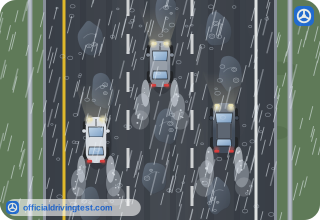
Why should you not use cruise control in wet conditions?
- Cruise control makes the tires lose air more quickly in wet weather
- Cruise control turns off the windshield wipers on wet pavement
- Cruise control increases the fuel used when the road is wet
- Turning it off could cost you time you need to keep control
Show answer
Correct answer: Turning it off could cost you time you need to keep control
The manual says if your vehicle starts to hydroplane, the time it takes to turn off the cruise control or tap the brake pedal could mean the difference in maintaining or losing control.
Source: North Carolina Driver Handbook (Revised May 2025), page 72 · Open this page in the manual (Manual page 72)
-
Since 1970, what share of deaths associated with tropical weather in North Carolina has inland flooding been responsible for?
- 85 percent
- 35 percent
- 60 percent
- 95 percent
Show answer
Correct answer: 85 percent
The manual states that inland flooding has caused 85 percent of tropical-weather deaths in North Carolina since 1970.
Source: North Carolina Driver Handbook (Revised May 2025), page 73 · Open this page in the manual (Manual page 73)
-
According to the manual, half of the inland flooding deaths in North Carolina tropical weather were caused by what?
- Trees falling onto moving vehicles
- Drivers speeding on wet pavement
- People driving into known flooded roads
- Vehicles stalling in heavy fog
Show answer
Correct answer: People driving into known flooded roads
The manual says half of these deaths were caused by people driving into roads they knew were flooded.
Source: North Carolina Driver Handbook (Revised May 2025), page 73 · Open this page in the manual (Manual page 73)
-
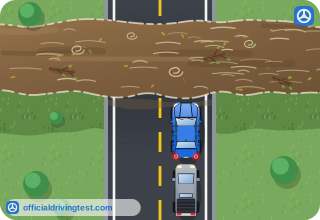
Why should you never drive through standing water on a roadway?
- Standing water always damages the brake linings beyond repair
- The water may be deeper than it looks, and the road may be washed away
- The road surface under standing water is always covered with ice
- Driving through water is allowed only when another vehicle goes first
Show answer
Correct answer: The water may be deeper than it looks, and the road may be washed away
The manual warns that water can be much higher than it appears and the roadway beneath may have washed away.
Source: North Carolina Driver Handbook (Revised May 2025), page 73 · Open this page in the manual (Manual page 73)
-
How deep can fast moving water be and still sweep a car off the highway, according to reports in the manual?
- Two inches
- Nine inches
- Twenty-four inches
- Six inches
Show answer
Correct answer: Six inches
The manual says reports show six inches of fast moving water can sweep a car off the highway.
Source: North Carolina Driver Handbook (Revised May 2025), page 73 · Open this page in the manual (Manual page 73)
-
According to the manual, how deep does fast moving water need to be to float a car or cause it to turn over?
- 12 inches
- 2 inches
- 30 inches
- 48 inches
Show answer
Correct answer: 12 inches
The manual states that 12 inches of fast moving water can float a car or cause it to turn over.
Source: North Carolina Driver Handbook (Revised May 2025), page 73 · Open this page in the manual (Manual page 73)
-
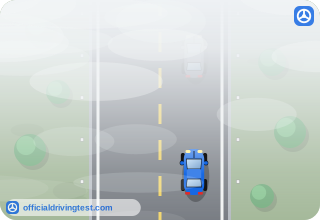
If you must drive during fog, what should you do with your headlights?
- Turn on the high beam headlights
- Turn on the low beam headlights
- Use only the parking lights
- Turn them off so you do not reflect glare
Show answer
Correct answer: Turn on the low beam headlights
The manual says to turn on the low beam headlights when you must drive during fog.
Source: North Carolina Driver Handbook (Revised May 2025), page 73 · Open this page in the manual (Manual page 73)
-
If you have extreme trouble seeing while driving in fog, what should you do?
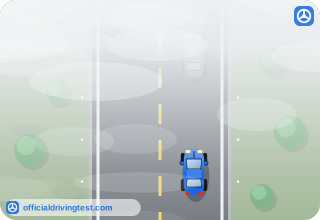
- Pull far off the road, stop, secure the vehicle and use the flashers
- Slow to a crawl and keep driving in the center of the lane
- Stop in the travel lane and turn on the high beam headlights
- Follow the tail lights of the next vehicle until the fog clears
Show answer
Correct answer: Pull far off the road, stop, secure the vehicle and use the flashers
With extreme trouble seeing, the manual says to pull far off the roadway, stop, secure the vehicle and use emergency flashers.
Source: North Carolina Driver Handbook (Revised May 2025), page 73 · Open this page in the manual (Manual page 73)
-
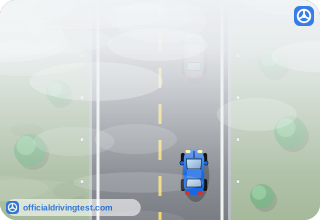
If you must drive during fog, what should you also watch for besides the tail lights ahead?
- Pedestrians walking on the shoulder
- Animals crossing at the road edge
- The vehicles behind you
- Signs warning of a railroad crossing
Show answer
Correct answer: The vehicles behind you
The manual lists watching for the vehicles behind you as one of the steps for driving in fog.
Source: North Carolina Driver Handbook (Revised May 2025), page 73 · Open this page in the manual (Manual page 73)
-
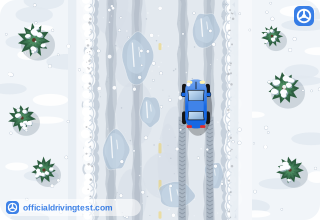
When driving in snow and ice, which places are often the first to freeze as the temperature drops?
- Sunny straight stretches of highway
- Shady spots, bridges and overpasses
- Roads with the most traffic
- Intersections controlled by traffic signals
Show answer
Correct answer: Shady spots, bridges and overpasses
The manual says shady spots, bridges and overpasses are often the first places to freeze.
Source: North Carolina Driver Handbook (Revised May 2025), page 73 · Open this page in the manual (Manual page 73)
-
According to the manual, what increases the danger of skidding?
- Dry pavement
- Light rain on a warm day
- A full tank of fuel
- Hard-packed snow
Show answer
Correct answer: Hard-packed snow
The manual states that hard-packed snow increases the danger of skidding.
Source: North Carolina Driver Handbook (Revised May 2025), page 73 · Open this page in the manual (Manual page 73)
-
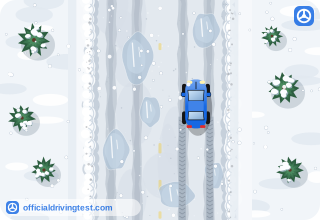
When you stop on snowy or icy roads, what does the manual tell you to do?
- Keep your foot off the brake and let the engine slow the vehicle
- Press the brake pedal hard and hold it down until you stop
- Shift into neutral and coast to the stop
- Switch off the engine and steer to the shoulder
Show answer
Correct answer: Keep your foot off the brake and let the engine slow the vehicle
The manual says to keep your foot off the brake and let the engine slow the vehicle when stopping on snow or ice.
Source: North Carolina Driver Handbook (Revised May 2025), page 73 · Open this page in the manual (Manual page 73)
-
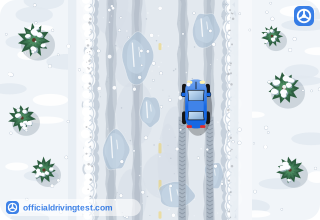
When starting or stopping on snowy or icy roads, how should you increase your speed?
- Quickly, to build traction
- In short, sudden bursts
- Slowly
- Only while braking
Show answer
Correct answer: Slowly
The manual lists increasing your speed slowly as a step when starting or stopping on snow and ice.
Source: North Carolina Driver Handbook (Revised May 2025), page 73 · Open this page in the manual (Manual page 73)
-
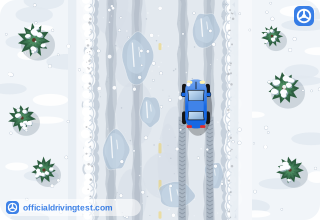
When starting or stopping on snowy or icy roads, how do you get the “feel of the road”?
- By driving faster to test tire grip
- By testing your steering control and the braking friction
- By opening the window to listen to the tire noise
- By pulling the parking brake at low speed
Show answer
Correct answer: By testing your steering control and the braking friction
The manual says to get the feel of the road by testing steering control and braking friction.
Source: North Carolina Driver Handbook (Revised May 2025), page 73 · Open this page in the manual (Manual page 73)
-
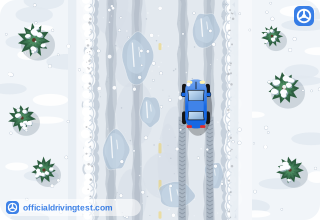
If you must drive during a snowstorm, what should you do?
- Keep your normal speed and turn on the high-beam headlights
- Use only the parking lights and drive in the center of the road
- Turn off the windshield wipers to keep the glass from freezing
- Reduce speed, use windshield wipers and turn on the low-beam headlights
Show answer
Correct answer: Reduce speed, use windshield wipers and turn on the low-beam headlights
The manual says to reduce speed, use wipers and turn on low-beam headlights in a snowstorm.
Source: North Carolina Driver Handbook (Revised May 2025), page 73 · Open this page in the manual (Manual page 73)
-
What does the manual warn about chains and snow tires?
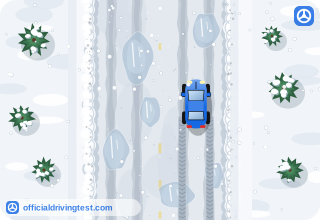
- They can still slide on ice and packed snow
- They make skidding impossible
- They work only on packed snow, never on ice
- They should never be used in North Carolina
Show answer
Correct answer: They can still slide on ice and packed snow
The manual reminds drivers that even chains and snow tires can slide on ice and packed snow.
Source: North Carolina Driver Handbook (Revised May 2025), page 74 · Open this page in the manual (Manual page 74)
-
According to the manual, why are wildlife-vehicle collisions on the rise?
- More wildlife is being released near highways by state agencies each year
- Drivers now travel much faster on rural roads at night
- Urban development cuts through wildlife corridors, forcing animals across roads
- Animals have become less afraid of headlights
Show answer
Correct answer: Urban development cuts through wildlife corridors, forcing animals across roads
The manual attributes rising collisions to urban development cutting through vital wildlife corridors.
Source: North Carolina Driver Handbook (Revised May 2025), page 74 · Open this page in the manual (Manual page 74)