New Jersey: Right of way & turning — Part 3 Practice Test
Questions in this part include: “When preparing to turn left from a two-way road onto another two-way road, where should you position your vehicle?” · “How does the New Jersey Driver Manual describe failing to yield the right of way?”
Independent educational site · not affiliated with any government agency or DMV
Ready? Test yourself
- Instant feedback with an explanation
- Every answer cites its source in the manual
- Your best score is saved on this device
Questions are original and based on the official manual "New Jersey Driver Manual" (2026), New Jersey Motor Vehicle Commission (MVC).
All 17 questions in this practice test
Take the test above first, then use this list to study. Tap “Show answer” to see the correct answer and explanation.
Show the questions and answersHide the questions
-
When turning left from a one-way road onto another one-way road, which lane should you turn into?
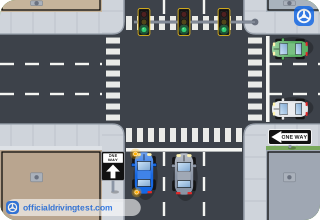
- The right lane of the road you enter
- Any lane that happens to be open
- The left lane of the road you enter
- The center lane of the road you enter
Show answer
Correct answer: The left lane of the road you enter
Approach in the left lane and turn into the left lane of the one-way road you are entering.
Source: New Jersey Driver Manual (2026), page 73 · Open this page in the manual (Manual page 73)
-
When turning left from a two-way road onto another two-way road, where should your vehicle end up?
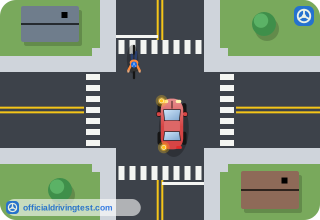
- To the right of the center line of the new road
- To the left of the center line of the new road
- Straddling the center line of the new road
- On the shoulder until traffic clears
Show answer
Correct answer: To the right of the center line of the new road
Keep to the right of the center line of the road you are entering, without crossing lane markings.
Source: New Jersey Driver Manual (2026), page 73 · Open this page in the manual (Manual page 73)
-
When preparing to turn left from a two-way road onto another two-way road, where should you position your vehicle?
- Squarely in the middle of your own travel lane
- Close to the right-hand curb or edge
- Close to the line nearest the road's center
- Partly on the right shoulder of the road
Show answer
Correct answer: Close to the line nearest the road's center
Approach the turn as close as possible to the line nearest the center of the road.
Source: New Jersey Driver Manual (2026), page 73 · Open this page in the manual (Manual page 73)
-
When turning left from a two-way road onto a four-lane highway, when should you make the turn?
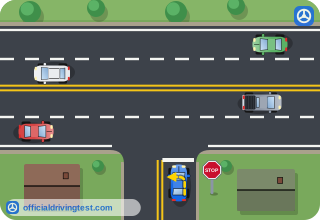
- After pulling onto the far shoulder first
- After passing the center of the intersection
- After stopping in the middle of the intersection
- Before reaching the center of the intersection
Show answer
Correct answer: Before reaching the center of the intersection
Approach close to the center line and make the turn before reaching the center of the intersection.
Source: New Jersey Driver Manual (2026), page 73 · Open this page in the manual (Manual page 73)
-
When turning left from a two-way road onto a four-lane highway, which lane should you turn into?
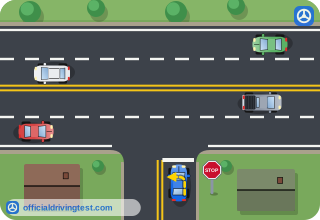
- The lane nearest the center line, on the right side
- The far lane on the left side of the road
- The lane nearest the right-hand curb of the highway
- The shoulder, until traffic clears
Show answer
Correct answer: The lane nearest the center line, on the right side
Turn into the lane nearest the center line on the right side of the other road, which is the passing lane of the four-lane highway.
Source: New Jersey Driver Manual (2026), page 73 · Open this page in the manual (Manual page 73)
-
After turning left into the passing lane of a four-lane highway, what should you do?
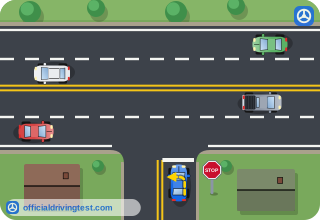
- Slow down and wait right there for traffic to clear
- Stay in the passing lane until your exit
- Pull onto the shoulder right away to check
- Move right, out of that lane, when traffic allows
Show answer
Correct answer: Move right, out of that lane, when traffic allows
When traffic permits, move to the right, out of the passing lane.
Source: New Jersey Driver Manual (2026), page 73 · Open this page in the manual (Manual page 73)
-
In New Jersey, what must you do when you are coming out of an alley, a private driveway, or a building onto the road?
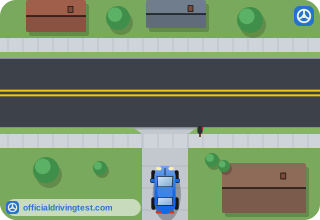
- Come to a stop
- Slow to 10 mph without stopping
- Flash your headlights and keep going
- Sound your horn and keep going
Show answer
Correct answer: Come to a stop
The manual lists coming from an alley, private driveway, or building as a situation in which a motorist must stop.
Source: New Jersey Driver Manual (2026), page 75 · Open this page in the manual (Manual page 75)
-
Which of these is a situation in which the New Jersey Driver Manual says a motorist must stop?
- When the vehicle ahead is towing a boat
- At a bridge span that is about to open for boat traffic
- When driving onto any bridge that crosses water
- When you pass a boat trailer that is parked on the road shoulder
Show answer
Correct answer: At a bridge span that is about to open for boat traffic
A motorist must stop at a bridge span that is about to open for boat traffic.
Source: New Jersey Driver Manual (2026), page 75 · Open this page in the manual (Manual page 75)
-
How does the New Jersey Driver Manual describe failing to yield the right of way?
- A problem only at railroad crossings
- A common, but potentially fatal, mistake
- A minor error that rarely causes harm
- A mistake made only by commercial drivers
Show answer
Correct answer: A common, but potentially fatal, mistake
The manual calls failing to yield the right of way a common, but potentially fatal, mistake.
Source: New Jersey Driver Manual (2026), page 91 · Open this page in the manual (Manual page 91)
-
According to the New Jersey Driver Manual, which lane should a motorist stay in when planning a turn?
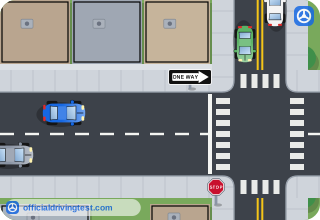
- The lane that has the least traffic in it
- The center lane until the very last moment
- The lane that shows where they intend to turn
- Any lane at all, as long as they signal
Show answer
Correct answer: The lane that shows where they intend to turn
A motorist should always stay in the lane that shows where they intend to turn, which communicates their plan to other motorists.
Source: New Jersey Driver Manual (2026), page 93 · Open this page in the manual (Manual page 93)
-
When approaching an intersection on city streets, the manual says you should:
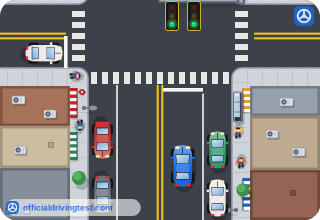
- Glance to the right only, since traffic coming from the left must yield
- Keep your speed steady and look straight ahead at the traffic signal
- Speed up slightly so that you clear it before the light has a chance to change
- Reduce speed, glance left and then right, and keep your foot on the brake
Show answer
Correct answer: Reduce speed, glance left and then right, and keep your foot on the brake
When nearing an intersection, reduce speed, glance left and then right, and keep your foot on the brake.
Source: New Jersey Driver Manual (2026), page 101 · Open this page in the manual (Manual page 101)
-
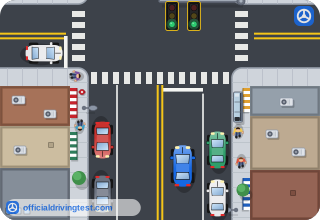
When you are in the middle of a city block, what does the manual tell you to do?
- Speed up before the next signal changes
- Move into the left lane so you are ready to pass
- Check intersections ahead for traffic controls
- Pull over and adjust your mirrors
Show answer
Correct answer: Check intersections ahead for traffic controls
One of the manual's city safety tips is to check intersections ahead for traffic controls when you are in the middle of a block.
Source: New Jersey Driver Manual (2026), page 101 · Open this page in the manual (Manual page 101)
-
According to the New Jersey Driver Manual, what do many new motorists fail to see on city streets?
- Loading zones
- Intersections
- Bus stops
- Parking meters
Show answer
Correct answer: Intersections
The manual warns that motorists pass through intersections very often on city streets and that many new motorists fail to see intersections.
Source: New Jersey Driver Manual (2026), page 101 · Open this page in the manual (Manual page 101)
-
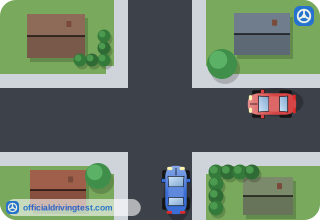
At an intersection with no traffic signals or signs, the manual warns that:
- A wide, smooth or busy road is protected from cross traffic
- Drivers on the narrower road must always stop
- There is no traffic control; avoiding crashes is up to you
- The busier road always has the right of way
Show answer
Correct answer: There is no traffic control; avoiding crashes is up to you
Do not assume a road is protected because it is wide, smooth or busy; with no traffic signals there is no traffic control, and avoiding crashes is up to the motorist.
Source: New Jersey Driver Manual (2026), page 102 · Open this page in the manual (Manual page 102)
-
What is a roundabout?
- A highway interchange with loop ramps
- A one-way circle around a center island
- A four-way stop with a traffic island
- A two-way circle where cars may go either way
Show answer
Correct answer: A one-way circle around a center island
A roundabout is a one-way, circular intersection in which traffic flows around a center island.
Source: New Jersey Driver Manual (2026), page 218 · Open this page in the manual (Manual page 218)
-
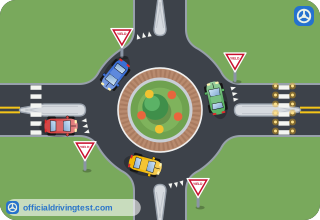
Why is the occurrence of severe crashes substantially reduced at roundabouts?
- All vehicles must stop before entering
- Traffic signals control every entry
- Higher speeds help traffic clear the circle faster
- Traffic enters and exits only by right turns
Show answer
Correct answer: Traffic enters and exits only by right turns
Because roundabout traffic enters or exits only through right turns, the occurrence of severe crashes is substantially reduced.
Source: New Jersey Driver Manual (2026), page 218 · Open this page in the manual (Manual page 218)
-
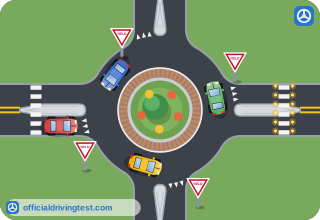
Roundabouts are designed to meet the needs of which road users?
- Drivers only, since pedestrians must go around
- All users: drivers, pedestrians and bicyclists
- Only drivers of cars, vans and pickup trucks
- Mainly large trucks, buses and farm vehicles
Show answer
Correct answer: All users: drivers, pedestrians and bicyclists
Roundabouts are designed to meet the needs of all road users: drivers, pedestrians, pedestrians with disabilities, and bicyclists.
Source: New Jersey Driver Manual (2026), page 218 · Open this page in the manual (Manual page 218)