New Jersey: Emergencies and special situations — Part 3 Practice Test
Skids, breakdowns, crashes, bad weather, night driving and traffic stops. — Part 3
Independent educational site · not affiliated with any government agency or DMV
Ready? Test yourself
- Instant feedback with an explanation
- Every answer cites its source in the manual
- Your best score is saved on this device
Questions are original and based on the official manual "New Jersey Driver Manual" (2026), New Jersey Motor Vehicle Commission (MVC).
All 35 questions in this practice test
Take the test above first, then use this list to study. Tap “Show answer” to see the correct answer and explanation.
Show the questions and answersHide the questions
-
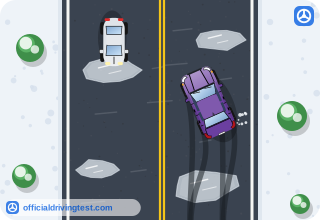
To avoid a spin during a skid, which way should you steer?
- Quickly away from the direction of the skid
- The way the rear is skidding, without oversteering
- Back and forth rapidly until the tires grip again
- Straight ahead while braking as hard as you can
Show answer
Correct answer: The way the rear is skidding, without oversteering
A vehicle may spin if the wheel is turned quickly away from the skid; instead, turn in the direction the rear is skidding, without oversteering.
Source: New Jersey Driver Manual (2026), page 104 · Open this page in the manual (Manual page 104)
-
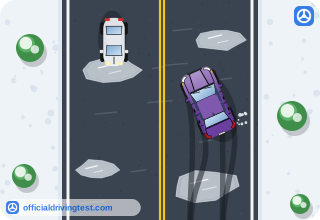
When your vehicle is skidding, where should you look?
- Down at the steering wheel
- At the rear-view mirror
- At the obstacle you are trying to avoid
- In the direction you want to go
Show answer
Correct answer: In the direction you want to go
The manual says that when skidding, a motorist should look in the direction they want to go.
Source: New Jersey Driver Manual (2026), page 104 · Open this page in the manual (Manual page 104)
-
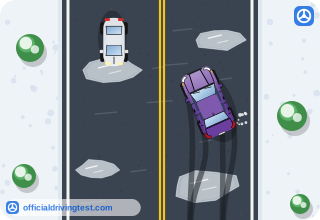
Once you feel your vehicle is back under control after a skid, you should:
- Shift to a higher gear
- Brake firmly
- Turn the wheel sharply the other way
- Straighten the wheels
Show answer
Correct answer: Straighten the wheels
You will be able to feel when the vehicle is back under control, and you should then straighten the wheels.
Source: New Jersey Driver Manual (2026), page 104 · Open this page in the manual (Manual page 104)
-
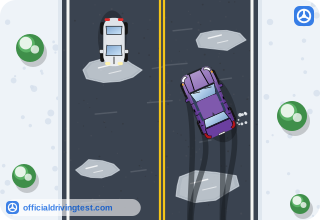
During a side skid, what should you avoid?
- Looking where you want to go
- Easing off the gas pedal
- Using the brakes
- Steering gently
Show answer
Correct answer: Using the brakes
The manual says to avoid using the brakes during a side skid.
Source: New Jersey Driver Manual (2026), page 104 · Open this page in the manual (Manual page 104)
-
If you must make an emergency stop on a highway with paved shoulders, what should you do?
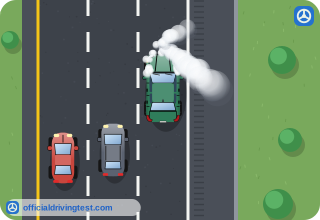
- Pull onto the shoulder without signaling so you can stop sooner
- Slow down in the travel lane first, then move onto the shoulder
- Signal, turn onto the shoulder near traffic speed, then slow down
- Stop right in the travel lane and turn on your emergency flashers
Show answer
Correct answer: Signal, turn onto the shoulder near traffic speed, then slow down
On a highway with paved shoulders, signal and turn onto the shoulder at or near traffic speed, and only then begin to slow down.
Source: New Jersey Driver Manual (2026), page 105 · Open this page in the manual (Manual page 105)
-
If the shoulder is unpaved and you must make an emergency stop, you should:
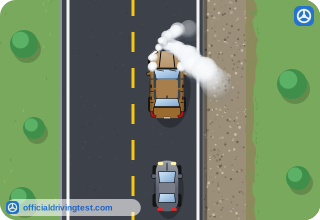
- Signal and slow down to a safe speed before turning off
- Turn off without signaling, then brake
- Stop in the travel lane rather than use the shoulder
- Turn onto the shoulder at traffic speed, then brake hard
Show answer
Correct answer: Signal and slow down to a safe speed before turning off
Where the shoulder is unpaved, signal a turn and slow down to a safe speed before turning off the road.
Source: New Jersey Driver Manual (2026), page 105 · Open this page in the manual (Manual page 105)
-
At night, why should you not stand or work behind your vehicle when it is stopped on the shoulder?
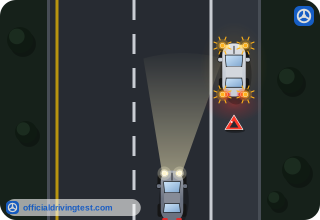
- It drains the battery faster
- Your headlights would dim
- Exhaust fumes are heavier at night
- You would block the taillights
Show answer
Correct answer: You would block the taillights
The manual warns never to block the taillights at night by standing or working behind the vehicle.
Source: New Jersey Driver Manual (2026), page 105 · Open this page in the manual (Manual page 105)
-
After an emergency stop on the shoulder, one flare or warning sign goes just behind your vehicle. How far back should you put another warning device?
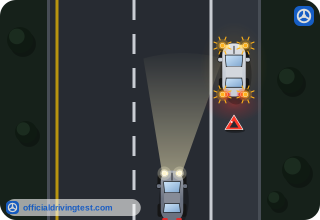
- At least 1,000 feet (about 400 paces)
- At least 300 feet (about 120 paces)
- At least 100 feet (about 40 paces)
- At least 50 feet (about 20 paces)
Show answer
Correct answer: At least 300 feet (about 120 paces)
Day or night, put a flare or warning sign just behind the vehicle and another warning device at least 300 feet back, about 120 paces.
Source: New Jersey Driver Manual (2026), page 105 · Open this page in the manual (Manual page 105)
-
After an emergency stop, the manual says that if you need help you should raise the hood and tie a white handkerchief to:
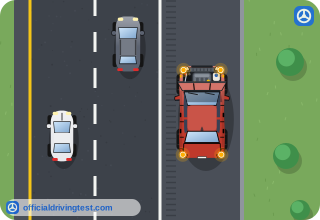
- The antenna or the left door handle
- The right-side mirror or right door handle
- The steering wheel inside the car
- The rear bumper or the trunk lid
Show answer
Correct answer: The antenna or the left door handle
The manual says to raise the hood and tie a white handkerchief to the antenna or left door handle as a signal if help is needed.
Source: New Jersey Driver Manual (2026), page 105 · Open this page in the manual (Manual page 105)
-
If your wheels drift onto the shoulder of the road, what should you do?
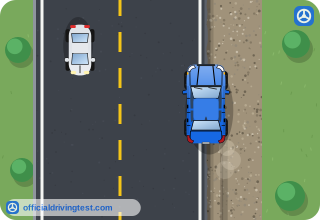
- Brake hard immediately
- Speed up so the tires can climb the pavement edge
- Steer sharply back onto the pavement right away
- Stay on the shoulder and ease up on the gas pedal
Show answer
Correct answer: Stay on the shoulder and ease up on the gas pedal
Do not try to turn back onto the pavement right away; stay on the shoulder and ease up on the gas pedal.
Source: New Jersey Driver Manual (2026), page 105 · Open this page in the manual (Manual page 105)
-
Why should you not steer abruptly back onto the road when your wheels run off the pavement?
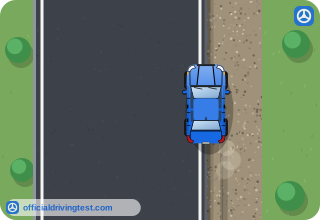
- The sudden turn will set off the front and side air bags
- It may damage the pavement edge and the road shoulder
- The vehicle can slingshot across the road or into traffic
- It will usually stall the engine and cut the power steering
Show answer
Correct answer: The vehicle can slingshot across the road or into traffic
Motorists who panic and steer abruptly to return to the road can cause the vehicle to slingshot across the roadway or into traffic.
Source: New Jersey Driver Manual (2026), page 105 · Open this page in the manual (Manual page 105)
-
After your wheels run off the pavement, you may turn back onto the road once you have slowed to:
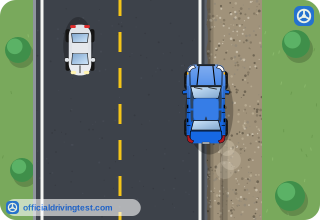
- 10 mph or less
- 35 mph or less
- 45 mph or less
- 25 mph or less
Show answer
Correct answer: 25 mph or less
After the vehicle has slowed to 25 mph or less, you may turn back onto the road.
Source: New Jersey Driver Manual (2026), page 105 · Open this page in the manual (Manual page 105)
-
When returning to the road after running off the pavement, how far should you turn the steering wheel toward the roadway?
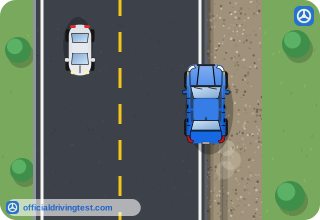
- One full turn
- One-half turn
- One-quarter turn
- As far as it will go
Show answer
Correct answer: One-quarter turn
Turn the steering wheel one-quarter turn toward the roadway, which lets the tires climb the pavement edge and get back onto the pavement.
Source: New Jersey Driver Manual (2026), page 105 · Open this page in the manual (Manual page 105)
-
According to the manual, what causes most car fires?
- Short circuits in the electrical system
- Lit cigarettes dropped on the seats
- Leaking brake fluid on hot brakes
- Overheated tires rubbing on the wheel wells
Show answer
Correct answer: Short circuits in the electrical system
The manual says most car fires are caused by short circuits in the electrical system.
Source: New Jersey Driver Manual (2026), page 106 · Open this page in the manual (Manual page 106)
-
If your car catches fire, what should you do?
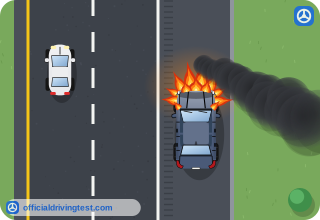
- Drive to the nearest service station for help
- Get everyone out and away at once and call for help
- Open the hood to find the source of the flames
- Try to put out the fire yourself with an extinguisher
Show answer
Correct answer: Get everyone out and away at once and call for help
In case of fire, get passengers out and away from the vehicle at once and call for help; never attempt to put out the fire yourself.
Source: New Jersey Driver Manual (2026), page 106 · Open this page in the manual (Manual page 106)
-
According to the manual, which emergency causes more panic than any other?
- A car fire
- Plunging into water
- A tire blowout
- Brake failure
Show answer
Correct answer: Plunging into water
The manual says water causes more panic than any other emergency.
Source: New Jersey Driver Manual (2026), page 106 · Open this page in the manual (Manual page 106)
-
About how long will a vehicle with its windows and doors closed float after plunging into water?
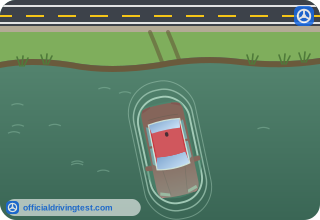
- About three to ten minutes
- About 30 seconds
- About 20 to 30 minutes
- About one hour
Show answer
Correct answer: About three to ten minutes
Tests show a vehicle with windows and doors closed will float for about three to ten minutes.
Source: New Jersey Driver Manual (2026), page 106 · Open this page in the manual (Manual page 106)
-
If your vehicle plunges into water and is still floating on the surface, what is the best way out?
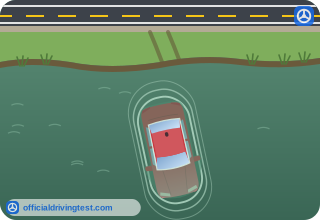
- Force a door open right away
- Climb out through the trunk
- Kick out the front windshield
- Escape through an open window
Show answer
Correct answer: Escape through an open window
While the vehicle still floats, escape through an open window: it is hard to open a door against water pressure, but a window can be rolled down easily.
Source: New Jersey Driver Manual (2026), page 106 · Open this page in the manual (Manual page 106)
-
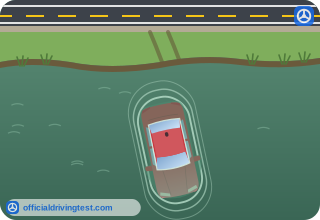
If your vehicle goes into water, why should you try to open power windows at once?
- They work only when the engine is off
- They lock automatically after one minute
- They may short out
- They open faster once under water
Show answer
Correct answer: They may short out
Power windows may short out, so try to open them immediately.
Source: New Jersey Driver Manual (2026), page 106 · Open this page in the manual (Manual page 106)
-
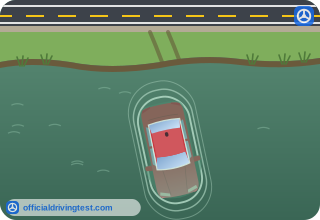
How can the glass in a vehicle's side and rear windows be broken?
- Only with a heavy, hard object
- By kicking it with your foot
- By pressing on it with both hands
- Easily with your elbow
Show answer
Correct answer: Only with a heavy, hard object
The manual says glass in the side and rear windows can be broken, but only with a heavy, hard object.
Source: New Jersey Driver Manual (2026), page 106 · Open this page in the manual (Manual page 106)
-
How will a front-engine vehicle sink in water?
- Flat and level
- On its side
- Nose first
- Rear end first
Show answer
Correct answer: Nose first
A front-engine vehicle sinks nose first, and some air may be pushed to the rear, near the roof.
Source: New Jersey Driver Manual (2026), page 106 · Open this page in the manual (Manual page 106)
-
As a front-engine vehicle sinks, where may some air be pushed?
- Down under the seats
- To the rear, near the roof
- To the front, near the engine
- Out through the exhaust
Show answer
Correct answer: To the rear, near the roof
Because the vehicle sinks nose first, some air may be pushed to the rear, near the roof.
Source: New Jersey Driver Manual (2026), page 106 · Open this page in the manual (Manual page 106)
-
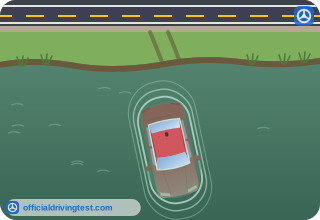
When is it easier to open the door of a vehicle that is under water?
- When the windows are fully closed
- While the engine and electrical system still work
- As soon as the vehicle first hits the water's surface
- When the pressure inside and outside is equal
Show answer
Correct answer: When the pressure inside and outside is equal
It is hard to open a door against water pressure; it becomes easier when the pressure inside and outside the vehicle is equal.
Source: New Jersey Driver Manual (2026), page 106 · Open this page in the manual (Manual page 106)
-
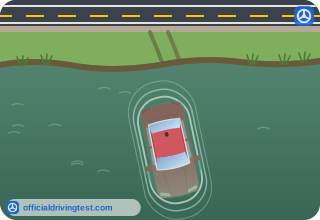
If a vehicle plunges into water, what does the manual call the best insurance against being knocked unconscious?
- Sitting low in the seat
- Keeping the windows closed
- Turning off the engine
- Wearing a seat belt
Show answer
Correct answer: Wearing a seat belt
Wearing a seat belt is the best insurance against being knocked unconscious, and it increases the chance of surviving the initial impact with the water.
Source: New Jersey Driver Manual (2026), page 106 · Open this page in the manual (Manual page 106)
-
Once out of a submerged vehicle, how can you find your way to the surface?
- Follow the air bubbles
- Follow the vehicle's headlights
- Swim down first, then up
- Swim toward the darkest water
Show answer
Correct answer: Follow the air bubbles
You may become disoriented underwater, so always follow the air bubbles to reach the surface.
Source: New Jersey Driver Manual (2026), page 106 · Open this page in the manual (Manual page 106)
-
If your vehicle's conventional disc and drum brakes suddenly fail, what should you do first?
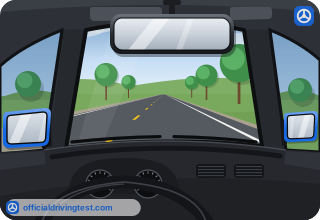
- Shift to neutral and coast until the vehicle stops by itself
- Shift to a lower gear and pump the brake pedal fast and hard
- Pull the parking brake as hard as you can and hold it there
- Turn off the engine and let the vehicle roll to a stop
Show answer
Correct answer: Shift to a lower gear and pump the brake pedal fast and hard
Shift to a lower gear and pump the brake pedal fast and hard several times; this may build up enough brake pressure to stop.
Source: New Jersey Driver Manual (2026), page 107 · Open this page in the manual (Manual page 107)
-
After a brake failure, if pumping the brake pedal does not stop the vehicle, you should:
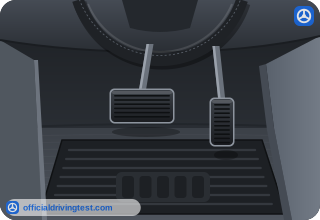
- Turn the ignition key to the lock position right away
- Steer gently into the nearest parked car to stop
- Use the parking brake while holding the brake release
- Shift into reverse to slow the vehicle more quickly
Show answer
Correct answer: Use the parking brake while holding the brake release
Use the parking brake while holding the brake release, so you can let up if the rear wheels lock and the vehicle begins to skid.
Source: New Jersey Driver Manual (2026), page 107 · Open this page in the manual (Manual page 107)
-
If you have a flat tire or blowout, how should you steer?
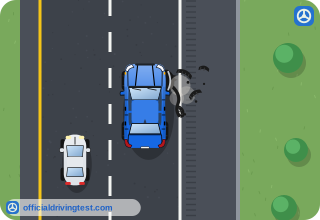
- Turn toward the side of the flat tire
- Turn sharply onto the shoulder right away
- Loosen your grip and let the vehicle find its path
- Hold the wheel firmly and keep the vehicle straight
Show answer
Correct answer: Hold the wheel firmly and keep the vehicle straight
In a blowout, hold the steering wheel firmly and keep the vehicle straight while gradually slowing down.
Source: New Jersey Driver Manual (2026), page 107 · Open this page in the manual (Manual page 107)
-
During a tire blowout, what should you do with the pedals?
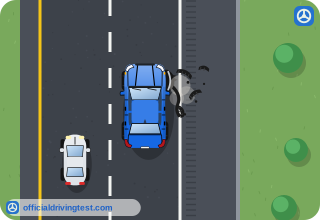
- Take your foot off the gas and do not use the brakes
- Pump the brake pedal quickly until you have stopped
- Press the gas harder to keep your speed and momentum
- Brake hard right away to stop as quickly as possible
Show answer
Correct answer: Take your foot off the gas and do not use the brakes
Remove your foot from the gas pedal but do not brake; let the vehicle coast to a stop as you pull to a safe area off the road.
Source: New Jersey Driver Manual (2026), page 107 · Open this page in the manual (Manual page 107)
-
When an engine dies and the power steering fails, what should you do?
- Turn the ignition key to the lock position to stop quickly
- Keep a firm grip, since extra hand power is needed to steer
- Let go of the wheel and let the vehicle slow to a stop
- Restart the engine while the vehicle is still moving fast
Show answer
Correct answer: Keep a firm grip, since extra hand power is needed to steer
When the engine dies, the steering fails; keep a firm grip because extra hand power will be needed to turn or keep control, then stop in a safe area.
Source: New Jersey Driver Manual (2026), page 107 · Open this page in the manual (Manual page 107)
-
If your headlights suddenly go out, what may help get them to come on again?
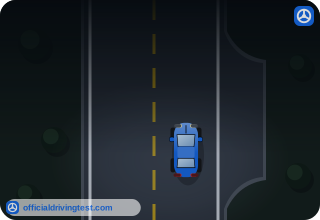
- Turning on the windshield wipers
- Restarting the engine while driving
- The headlight or dimmer switches
- Pumping the brake pedal
Show answer
Correct answer: The headlight or dimmer switches
After stopping safely off the road, the headlight or dimmer switches may help the lights go on again.
Source: New Jersey Driver Manual (2026), page 107 · Open this page in the manual (Manual page 107)
-
If your headlights fail and the switches do not bring them back, what should you do?
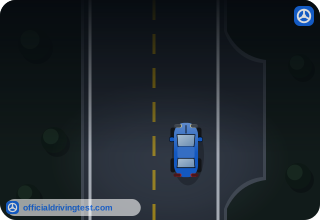
- Drive slowly to the nearest repair shop with the flashers on
- Keep driving slowly by the light of the vehicles around you
- Follow closely behind another vehicle and use its taillights
- Use parking lights, flashers or turn signals and call for help
Show answer
Correct answer: Use parking lights, flashers or turn signals and call for help
Stop in a safe area off the road; if the switches do not work, put on the parking lights, emergency flashers or turn signals and call for help.
Source: New Jersey Driver Manual (2026), page 107 · Open this page in the manual (Manual page 107)
-
If your headlights suddenly go out while you are driving, what should you do first?
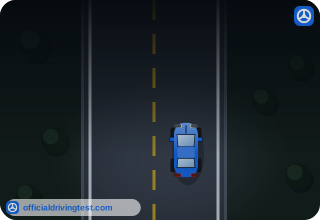
- Follow the taillights of the car ahead
- Turn on the interior dome light
- Stop in a safe area off the roadway
- Speed up to reach a lighted area sooner
Show answer
Correct answer: Stop in a safe area off the roadway
If headlights suddenly go out, safely bring the vehicle to a stop in a safe area off the roadway; then try the headlight or dimmer switches.
Source: New Jersey Driver Manual (2026), page 107 · Open this page in the manual (Manual page 107)
-
If your gas pedal sticks, what should you do?
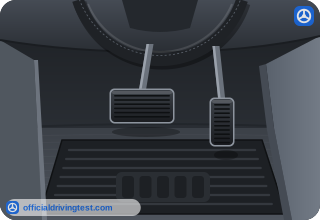
- Keep your eyes on the road and quickly shift to neutral
- Turn the ignition to the lock position right away
- Look down and try to free the stuck pedal with your hand
- Pull the parking brake as hard as you can and hold it
Show answer
Correct answer: Keep your eyes on the road and quickly shift to neutral
Keep your eyes on the road while quickly shifting to neutral, then steer to a safe area off the road, turn the engine off and call for help.
Source: New Jersey Driver Manual (2026), page 108 · Open this page in the manual (Manual page 108)
-
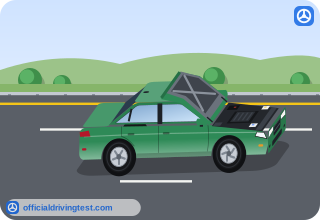
If your hood suddenly flies up while you are driving, you should slow down immediately and:
- Brake hard and stop right where you are in your lane
- Speed up so the wind pushes the hood back down again
- Reach out of the window and try to pull the hood down
- Look under the hood or out of the side window around it
Show answer
Correct answer: Look under the hood or out of the side window around it
Slow down at once and try to look under the hood to see the road, or out of the side window around the hood.
Source: New Jersey Driver Manual (2026), page 108 · Open this page in the manual (Manual page 108)