Pavement markings in Nevada
The Nevada Driver's Handbook shows or names everything on this page: 19 in all, on pages 32, 37, 39, 48.
Independent educational site · not affiliated with any government agency or DMV
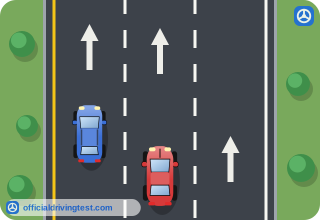
Broken White Lane Lines
Broken or dashed white lines are used to mark traffic lanes on roads which have more than one lane moving in the same direction. You should drive within these lanes and not straddle the lines. Passing is permitted when it is safe to do so [see picture (A) below].
Manual page 32 · Open this page in the manual (Manual page 32)
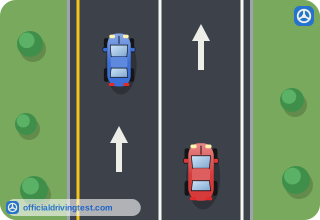
Solid White Line
Solid white lines are used in several ways. When solid white lines separate lanes of traffic moving in the same direction, do not change lanes or pass. A solid white line is also used to mark the edge of the highway as well as the boundary between a travel lane and a highway shoulder.
Manual page 32 · Open this page in the manual (Manual page 32)
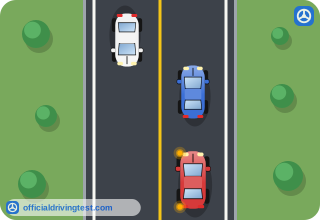
Yellow Center Line
Yellow lines separate lanes of traffic moving in opposite directions.
Manual page 32 · Open this page in the manual (Manual page 32)
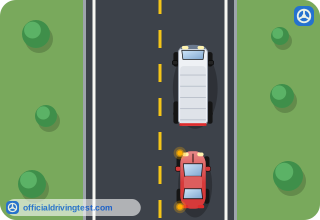
Broken Yellow Center Line
Broken or dashed yellow lines mean you may pass when it is safe to do so [see (B)].
Manual page 32 · Open this page in the manual (Manual page 32)
Solid Yellow Line
Solid yellow lines indicate that you are not to cross over or pass. A solid yellow line is also used to mark the left edge on multi-lane divided highways.
Manual page 32 · Open this page in the manual (Manual page 32)
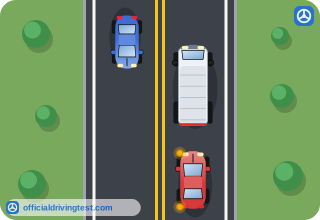
Double Solid Yellow Lines
Double yellow lines mean you cannot pass if the lines on your side are solid [see picture (C)].
Manual page 32 · Open this page in the manual (Manual page 32)
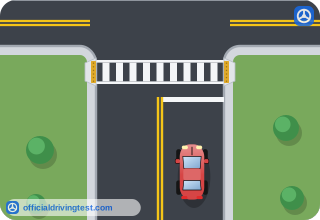
Crosswalk (Ladder Marking)
Crosswalk lines are marked by solid white lines or various patterns. Vehicles should always be stopped before the crosswalk. At some intersections, especially in small towns or residential areas, crosswalks may not be marked. Drivers still must yield to pedestrians in the intersection.
Manual page 32 · Open this page in the manual (Manual page 32)
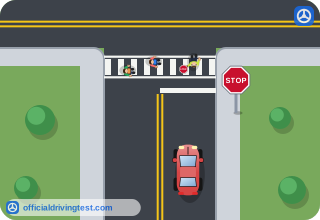
Stop Line
Stop lines are the wide white lines painted across a traffic lane where you must stop before you enter the intersection. You should be able to see traffic coming from all directions.
Manual page 32 · Open this page in the manual (Manual page 32)
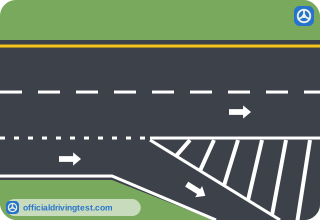
Dotted White Line
Dotted white lines may either indicate an extension of a lane line through an intersection or may indicate exit-only lanes on a freeway.
Manual page 32 · Open this page in the manual (Manual page 32)
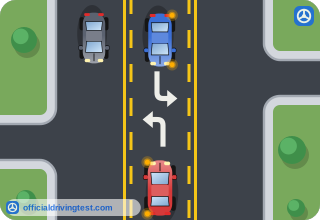
Center Turn Lane
Center lanes for left turns appear on many streets and roads. Most are marked on each side by solid yellow and broken yellow lines. Drivers may cross these lines only to make a left turn onto or from the highway. These are not travel lanes and may not be used for passing. Drivers may not travel more than 200 feet in a center turn lane before making a left-hand turn and they may not travel more than 50 feet in a center lane after making a left-hand turn onto the highway before merging with traffic per NRS 484B.223 (3).
Manual page 32 · Open this page in the manual (Manual page 32)
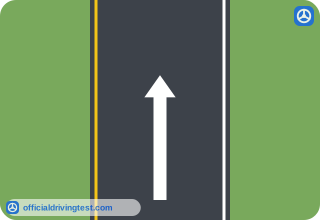
White Lane Arrow
The manual does not state it
Manual page 32 · Open this page in the manual (Manual page 32)
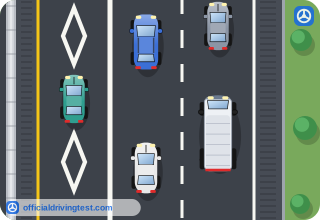
HOV Diamond Lane Marking
Some metered freeway ramps have High Occupancy Vehicle (HOV) bypass lanes, also known as carpool lanes. These lanes are marked with a diamond on the pavement and are not metered. If you are in a carpool of two or more people, you may use the HOV ramp meter bypass lane without stopping.
Manual page 37 · Open this page in the manual (Manual page 37)
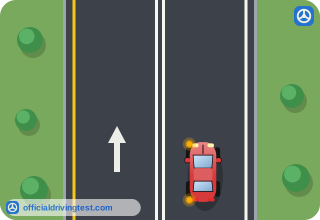
Double Solid White Line (carpool lane)
For carpool lanes, there will be specific locations to enter or exit the carpool lane. A double solid white line means that you cannot cross the lines to enter or exit the car pool lane.
Manual page 39 · Open this page in the manual (Manual page 39)
HOV Lane Entrance / Exit (Broken White Line)
You can enter or exit the carpool lane where there is a broken white line.
Manual page 39 · Open this page in the manual (Manual page 39)
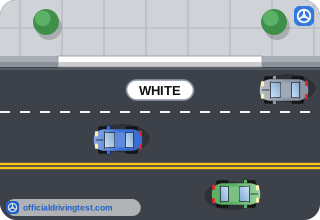
White Curb
White usually indicates you are allowed a very short stop only to take on or let off passengers, or to drop mail in a mailbox.
Manual page 48 · Open this page in the manual (Manual page 48)
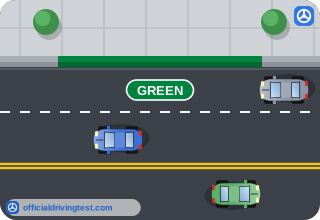
Green Curb
Green allows you to park for a limited time. The amount of time is usually shown on a sign.
Manual page 48 · Open this page in the manual (Manual page 48)
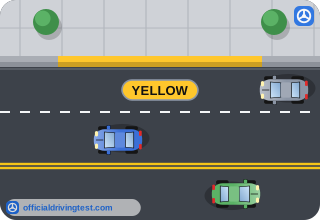
Yellow Curb
Yellow means a loading zone and rules depend on local laws.
Manual page 48 · Open this page in the manual (Manual page 48)
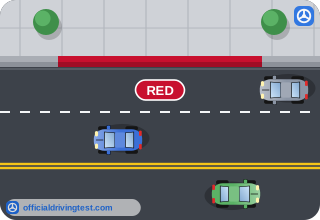
Red Curb
Red means no stopping, standing or parking; local laws apply.
Manual page 48 · Open this page in the manual (Manual page 48)
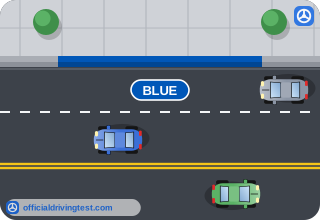
Blue Curb
Blue designates handicapped parking areas.
Manual page 48 · Open this page in the manual (Manual page 48)