Pavement markings in Nebraska
The Nebraska Driver's Manual shows or names everything on this page: 16 in all, on pages 44–47, 54, 56, 60.
Independent educational site · not affiliated with any government agency or DMV
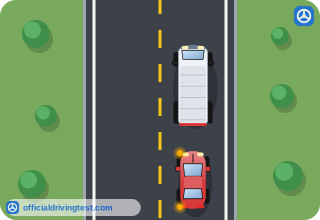
Broken Yellow Center Line
A broken yellow line indicates that passing on the left is permitted when the way ahead is clear. Overtaking and passing should be done with care because of oncoming traffic.
Manual page 44 · Open this page in the manual (Manual page 44)
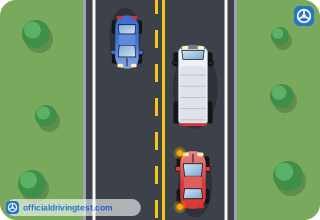
Solid and Broken Yellow Lines
A broken yellow line alongside a solid yellow line indicates that passing is permitted on the side of the broken line, but not on the side of the solid line.
Manual page 44 · Open this page in the manual (Manual page 44)
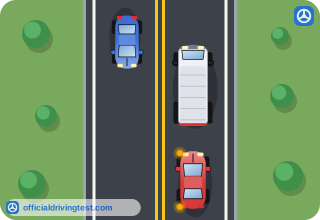
Double Solid Yellow Lines
Double solid yellow lines mark the center of the road and separate oncoming traffic. Passing is not allowed in either direction. Making a left turn or avoiding an obstruction are the only lawful crossings allowed over double yellow lines, when turning into or from an alley, private road, or driveway unless otherwise prohibited by signs.
Manual page 44 · Open this page in the manual (Manual page 44)
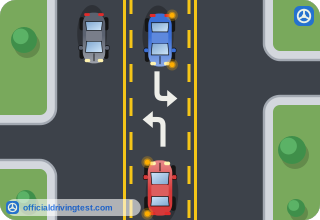
Shared Center Left Turn Lane
A center lane separated with solid and broken yellow lines reserves a lane for left turns shared with traffic from the opposite direction. Motorists entering this lane should use caution and may only turn left. Using this lane to pass is prohibited. Signs or arrow markings on the pavement will assist drivers in recognizing this useful turning lane.
Manual page 45 · Open this page in the manual (Manual page 45)
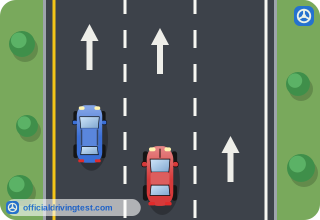
Broken White Lane Line
Broken white lines separate lanes of traffic going in the same direction, and may be crossed with care.
Manual page 45 · Open this page in the manual (Manual page 45)
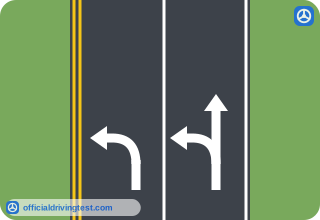
Solid White Lane Lines with Turn Lane Arrows
Solid white lines are used for turn lanes and to discourage lane changes near intersections. Arrows are often used with the white lines to indicate which turn may be made from the lane. When a lane is marked with a curved arrow and the word ONLY, you must turn in the direction of the arrow. When a lane is marked with both a curved and straight arrow, turning or proceeding straight ahead is allowed.
Manual page 45 · Open this page in the manual (Manual page 45)
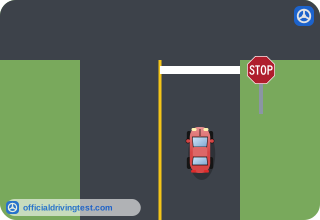
Stop Line
Stop lines are white lines painted across the pavement at intersections indicating the position to stop. In urban areas, the line is usually located about four feet before a crosswalk. Drivers must stop at the line (when present), not at the stop sign or traffic control signal.
Manual page 46 · Open this page in the manual (Manual page 46)
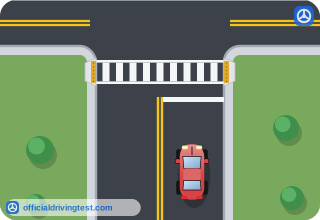
Crosswalk Markings
These lines are painted across or partially across the pavement. Pedestrians have the right of way when pedestrians are in these crosswalks. Crosswalks are sometimes in the middle of the block in residential areas and school areas. Crosswalk areas may also be unpainted.
Manual page 46 · Open this page in the manual (Manual page 46)
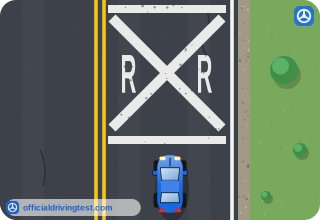
Railroad Crossing Marking (R X R)
In advance of a railroad crossing, the white letters “RxR” is set into the surface of, or applied to or attached to, the pavement, which is for the purpose of advising, warning or guiding traffic.
Manual page 46 · Open this page in the manual (Manual page 46)
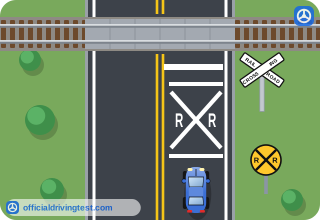
Yellow No-Passing Line at a Railroad Crossing
At railroad crossings, a yellow line may be placed on the right side of the center line to prevent passing.
Manual page 46 · Open this page in the manual (Manual page 46)
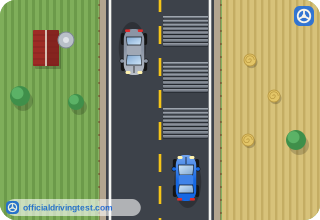
Rumble Strips
Rumble strips are a series of indented elements installed on a paved roadway shoulder near the travel lane, on a two-lane roadway near the center line, or in the lane of traffic approaching a stop sign or signal. Rumble strips are intended to alert drowsy or inattentive drivers through vibration and sound that their vehicles have left the travel lane or are approaching a stop sign or signal.
Manual page 46 · Open this page in the manual (Manual page 46)
Bike Lane at a Right Turn Only Lane
Bike lanes are a portion of a roadway that has been designated for the exclusive use by bicyclists. Bike lanes are designed to separate bicycle traffic from motorized vehicle traffic. It is illegal to drive in these lanes. However, motorists may cross over the bike lane to move into another appropriate travel lane, to enter or exit on-street parking spaces or to enter or exit private property. Before crossing a bike lane, make sure it is safe to do so. Yield the right-of-way to approaching bicyclists.
Manual page 46 · Open this page in the manual (Manual page 46)
Shared Lane (Bicycle Lanes at a Right Turn)
Shared lane markings are used to indicate the lane is shared by both motor vehicles and bicyclists. The markings may be placed in the travel lane to indicate where bicyclists should preferably ride. Motorists should avoid passing bicyclists until a safe distance of no less than three feet clearance exists.
Manual page 47 · Open this page in the manual (Manual page 47)
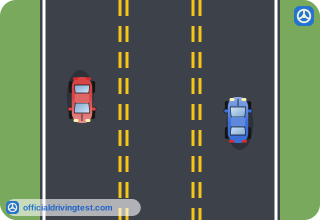
Double Broken Yellow Lines (Lane Boundaries)
Reversible Lanes are double-dashed broken yellow lines indicating the lane changes direction of traffic flow as is indicated by traffic signs or signals.
Manual page 54 · Open this page in the manual (Manual page 54)
Dual Turn Lanes with Guide Line
Double turning lanes are indicated by regulatory signs and lane markings. Traffic in lane nearest curb should turn into the traffic lane nearest the curb. The second lane from the curb should follow the lane line into the nearest lane as indicated by the lane line.
Manual page 56 · Open this page in the manual (Manual page 56)
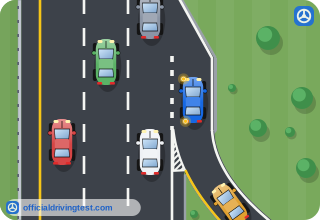
Entrance Ramp Merge
When using the entrance ramps notice the solid white line to the left. The solid white line separates lanes of traffic going in the same direction. When the broken white line begins, adjust your speed, use your turn signal, and merge into a traffic gap when safe to do so.
Manual page 60 · Open this page in the manual (Manual page 60)