Montana: Emergencies — Part 2 Practice Test
Questions in this part include: “If you cannot get a disabled vehicle off the roadway, where should you try to stop it?” · “What greatly reduces the chance that your vehicle will have a problem while driving?”
Independent educational site · not affiliated with any government agency or DMV
Ready? Test yourself
- Instant feedback with an explanation
- Every answer cites its source in the manual
- Your best score is saved on this device
- Keyboard: press 1 to 4 to answer and Enter for the next question
Questions are original and based on the official manual "Montana Driver Manual" (Revised April 2024), Montana Department of Justice, Motor Vehicle Division.
All 18 questions in this practice test
Take the test above first, then use this list to study. Tap “Show answer” to see the correct answer and explanation.
Show the questions and answersHide the questions
-
If you are having vehicle trouble and need to stop, what does the manual say to turn on?
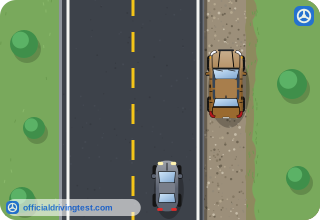
- Your emergency flashers
- Your high beams
- Your windshield wipers
- Your left turn signal only
Show answer
Correct answer: Your emergency flashers
Turn on your emergency flashers to show you are having trouble.
Source: Montana Driver Manual (Revised April 2024), page 56
-
If you cannot get a disabled vehicle off the roadway, where should you try to stop it?
- Where other drivers have a clear view of it
- Just over a hill, so you are off the main road
- Just around a curve, near the road edge
- Near the centerline, where traffic can pass on both sides
Show answer
Correct answer: Where other drivers have a clear view of it
The manual says to stop where other drivers have a clear view of the vehicle, and not just over a hill or just around a curve.
Source: Montana Driver Manual (Revised April 2024), page 57
-
Your car has stopped on the road. Where does the manual say to place emergency flares?
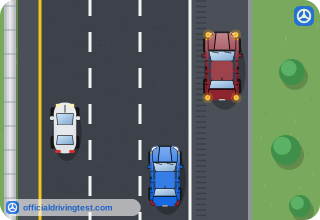
- Inside, on the dashboard
- On the hood
- Behind the vehicle
- On the roof
Show answer
Correct answer: Behind the vehicle
Flares placed behind the vehicle allow other drivers to change lanes if necessary.
Source: Montana Driver Manual (Revised April 2024), page 57
-
You have no emergency flares or other warning devices. What does the manual say to do?
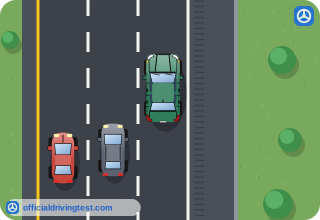
- Stand in the lane behind your vehicle and wave traffic around it
- Stand safely at the side of the road and wave traffic around
- Walk down the center of the road and flag down passing vehicles
- Stay in the lane beside your vehicle and wave a white cloth
Show answer
Correct answer: Stand safely at the side of the road and wave traffic around
Without flares you should stand by the side of the road where you are safe and wave traffic around your vehicle, using a white cloth if you have one.
Source: Montana Driver Manual (Revised April 2024), page 57
-
Your vehicle is stopped in a traffic lane and has a flat tire. What does the manual say about changing the tire?
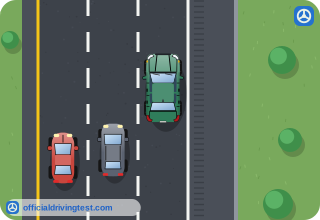
- Change it quickly, watching your mirrors for traffic
- Change it only after you place flares behind the vehicle
- Change it only if your hazard lights are flashing
- Do not even try if you have to be in a traffic lane
Show answer
Correct answer: Do not even try if you have to be in a traffic lane
The manual says to never stand in the roadway and not even to try to change a tire if it means being in a traffic lane.
Source: Montana Driver Manual (Revised April 2024), page 57
-
How does the manual say you can signal an emergency when your vehicle is disabled?
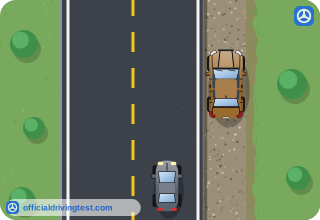
- Open the trunk lid and both rear doors wide
- Tie a yellow cloth to the antenna, mirror, or door handle
- Turn the front wheels sharply toward the center of the road
- Lift the hood or tie a white cloth to the antenna or a mirror
Show answer
Correct answer: Lift the hood or tie a white cloth to the antenna or a mirror
Lifting the hood or tying a white cloth to the antenna, side mirror, or door handle signals an emergency.
Source: Montana Driver Manual (Revised April 2024), page 57
-
Why does the manual say to stay in the car if you are stranded in a snowstorm?
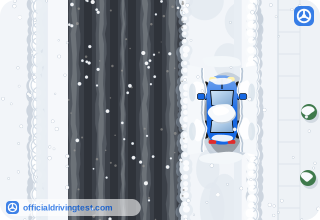
- The car will keep running on idle
- Walking in snow is against the law
- You are more likely to be found
- Help will always arrive within an hour
Show answer
Correct answer: You are more likely to be found
The manual says staying in the car is best because you are more likely to be found.
Source: Montana Driver Manual (Revised April 2024), page 60
-
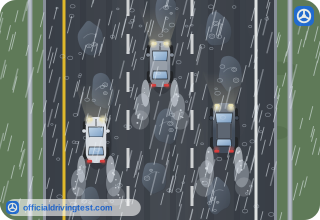
If it feels like your tires have lost traction with the road, what should you do with the gas pedal?
- Press it harder to regain grip
- Ease your foot off it
- Pump it quickly several times
- Hold it steady while you steer
Show answer
Correct answer: Ease your foot off it
The manual says to ease your foot off the gas pedal when the tires have lost traction.
Source: Montana Driver Manual (Revised April 2024), page 60
-
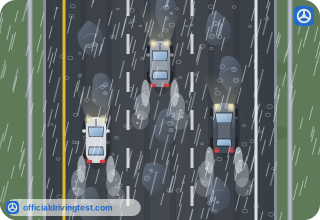
If it feels like your tires have lost traction, how should you handle the steering wheel?
- Turn it sharply toward the shoulder to leave the water
- Turn it quickly back and forth to regain grip
- Keep it straight, and if you must turn, do it slowly
- Turn it slowly toward the center of the road at once
Show answer
Correct answer: Keep it straight, and if you must turn, do it slowly
Keep the steering wheel straight and only try to turn in an emergency; if you must turn, do it slowly or you will cause a skid.
Source: Montana Driver Manual (Revised April 2024), page 60
-
When your tires have lost traction, when should you try to stop or turn?
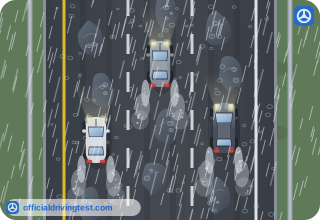
- Not until your tires are gripping the road again
- As soon as you feel the vehicle floating
- Right away, using firm brake pressure
- Once your speed has dropped below 50 mph
Show answer
Correct answer: Not until your tires are gripping the road again
The manual says not to try to stop or turn until your tires are gripping the road again.
Source: Montana Driver Manual (Revised April 2024), page 60
-
According to the manual, what is the best skid control?
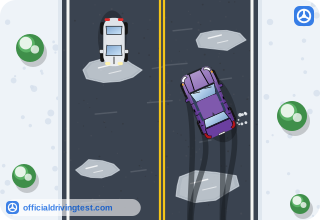
- Hard braking
- Quick acceleration
- Fast steering
- Prevention
Show answer
Correct answer: Prevention
The best skid control is prevention: judging weather and road conditions and knowing where skids are likely to occur, such as on curves or bridges.
Source: Montana Driver Manual (Revised April 2024), page 60
-
If your vehicle begins to slide, what should you do with the brake?
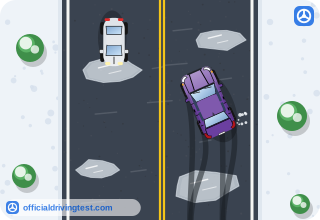
- Stay off the brake
- Pull the parking brake
- Brake while turning the wheel sharply
- Tap it lightly
Show answer
Correct answer: Stay off the brake
Until the vehicle slows, your brakes will not work and could cause you to skid more.
Source: Montana Driver Manual (Revised April 2024), page 60
-
If your vehicle begins to slide, where should you look?
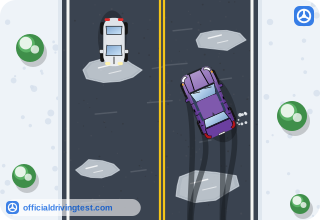
- At the obstacle you are trying to avoid
- At the front of your own vehicle
- Where you want the vehicle to go
- At the road directly beneath the hood
Show answer
Correct answer: Where you want the vehicle to go
The manual says to take your foot off the accelerator and look where you want to go.
Source: Montana Driver Manual (Revised April 2024), page 60
-
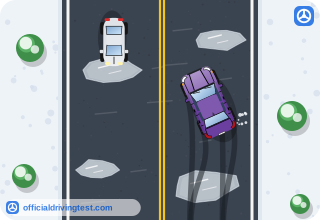
During a skid, as soon as the vehicle begins to straighten out, what should you do?
- Hold the wheel steady in that position
- Brake firmly to stop the vehicle
- Turn the steering wheel back the other way
- Turn the wheel farther in the same direction
Show answer
Correct answer: Turn the steering wheel back the other way
If you do not turn the wheel back the other way, your vehicle may swing around in the other direction and you could start a new skid.
Source: Montana Driver Manual (Revised April 2024), page 60
-
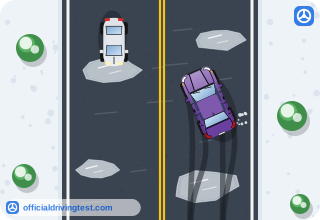
During a skid, until when should you keep correcting your steering left and right?
- Until the vehicle is moving down the road under your control
- Until you have come to a complete stop on the shoulder
- Until the vehicle first begins to straighten out
- Until you have passed the place where the skid began
Show answer
Correct answer: Until the vehicle is moving down the road under your control
The manual says to continue to correct your steering, left and right, until the vehicle is again moving down the road under your control.
Source: Montana Driver Manual (Revised April 2024), page 61
-
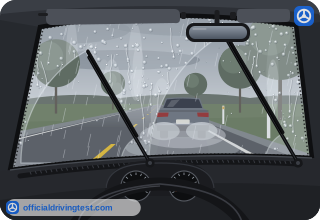
In a very heavy downpour you may not be able to see well enough to drive. What should you do?
- Pull off the road in a safe place and wait until the weather clears
- Slow to a crawl in the left lane with your hazard lights on
- Stop in your lane with your headlights on until it clears
- Follow the taillights of the vehicle ahead until it clears
Show answer
Correct answer: Pull off the road in a safe place and wait until the weather clears
If you cannot see well enough to drive in a very heavy downpour, pull off the road in a safe place and wait until the weather clears.
Source: Montana Driver Manual (Revised April 2024), page 63
-
What greatly reduces the chance that your vehicle will have a problem while driving?
- A fixed repair visit every thousand miles
- The tire pressure printed on the door
- The maintenance schedule in the owner’s manual
- The advice of other drivers on the road
Show answer
Correct answer: The maintenance schedule in the owner’s manual
Following the recommended maintenance schedule listed in the vehicle owner’s manual greatly reduces the chance of a vehicle problem.
Source: Montana Driver Manual (Revised April 2024), page 77
-
Your brakes stop working while you are driving. What does the manual say to do first?
- Pump the brake pedal several times
- Shift into neutral and coast to a stop
- Pull the parking brake handle as hard as you can
- Turn off the engine and steer to the shoulder
Show answer
Correct answer: Pump the brake pedal several times
Pumping the brake pedal several times often builds up enough brake pressure to let you stop.
Source: Montana Driver Manual (Revised April 2024), page 77