Montana: Emergencies — Part 1 Practice Test
Questions in this part include: “What is the minimum number of flares, red electric lanterns, or portable red reflectors that a passenger bus must carry?” · “Which vehicles may not carry any warning device that produces a signal by flame?”
Independent educational site · not affiliated with any government agency or DMV
Ready? Test yourself
- Instant feedback with an explanation
- Every answer cites its source in the manual
- Your best score is saved on this device
- Keyboard: press 1 to 4 to answer and Enter for the next question
Questions are original and based on the official manual "Montana Driver Manual" (Revised April 2024), Montana Department of Justice, Motor Vehicle Division.
All 18 questions in this practice test
Take the test above first, then use this list to study. Tap “Show answer” to see the correct answer and explanation.
Show the questions and answersHide the questions
-
What is the minimum number of flares, red electric lanterns, or portable red reflectors that a passenger bus must carry?
- One
- Two
- Four
- Three
Show answer
Correct answer: Three
The manual says a passenger bus must carry at least three flares, three red electric lanterns, or three portable red reflectors.
Source: Montana Driver Manual (Revised April 2024), page 17
-
Which of these must be equipped with at least three flares, red lanterns, or portable red reflectors?
- A passenger car
- A truck tractor
- A motorcycle
- A bicycle
Show answer
Correct answer: A truck tractor
The manual lists every truck of one-ton capacity or larger, passenger bus, and truck tractor as required to carry these warning devices.
Source: Montana Driver Manual (Revised April 2024), page 17
-
The flares, red electric lanterns or red reflectors that a truck of one-ton capacity or larger must carry must be visible at night from what distance?
- Not less than 100 feet
- Not less than 300 feet
- Not less than 600 feet
- Not less than 1000 feet
Show answer
Correct answer: Not less than 600 feet
The manual says all must be capable of being seen at a distance of not less than 600 feet at night.
Source: Montana Driver Manual (Revised April 2024), page 17
-
Reflectors used as required warning devices must display a minimum of how much reflective surface?
- 24 square inches
- 6 square inches
- 12 square inches
- 48 square inches
Show answer
Correct answer: 24 square inches
The manual says reflectors used must display a minimum of 24 square inches of reflective surface.
Source: Montana Driver Manual (Revised April 2024), page 17
-
Along with the required flares or reflectors, what else must a truck of one-ton capacity or larger carry?
- Two white cloth flags at least 6 inches square
- Two red cloth flags at least 12 inches square
- One red cloth flag at least 24 inches square
- Three orange cones with reflective stripes
Show answer
Correct answer: Two red cloth flags at least 12 inches square
The manual lists two red cloth flags at least 12 inches square with standards to support and display them.
Source: Montana Driver Manual (Revised April 2024), page 17
-
Which vehicles may not carry any warning device that produces a signal by flame?
- Vehicles carrying more than 3000 pounds of cargo
- Vehicles with air or vacuum brakes installed
- Vehicles that are driven only at night
- Vehicles transporting explosives or flammable liquids
Show answer
Correct answer: Vehicles transporting explosives or flammable liquids
The manual says vehicles transporting explosives, flammable liquids, compressed gases, or using compressed gases as a fuel may not carry any flame-producing warning device.
Source: Montana Driver Manual (Revised April 2024), page 17
-
As an alternative to the flares, lanterns, or reflectors, what may be carried?
- Three emergency reflective triangles conforming to USDOT Motor Vehicle Safety Standard 125
- Two emergency reflective triangles conforming to USDOT Motor Vehicle Safety Standard 125
- Three orange traffic cones with reflective bands
- Three white lanterns with reflective bands
Show answer
Correct answer: Three emergency reflective triangles conforming to USDOT Motor Vehicle Safety Standard 125
The manual says three emergency reflective triangles conforming to USDOT Motor Vehicles Safety Standard 125 may be carried instead.
Source: Montana Driver Manual (Revised April 2024), page 17
-
When a truck is disabled on a highway at a time when lighted lamps are required, where must the first warning device be placed immediately?
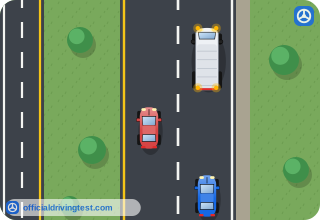
- On the roof of the disabled vehicle
- Inside the cab of the disabled vehicle
- At the traffic side, toward approaching traffic
- At the side away from approaching traffic
Show answer
Correct answer: At the traffic side, toward approaching traffic
The manual says the first warning device is placed immediately at the traffic side of the vehicle in the direction of approaching traffic.
Source: Montana Driver Manual (Revised April 2024), page 18
-
On a divided highway, how far behind a disabled truck, in the center of its lane, is a warning device placed?
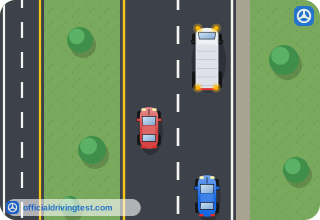
- 50 feet
- 100 feet
- 200 feet
- 500 feet
Show answer
Correct answer: 200 feet
The manual says one warning device goes 100 feet behind the vehicle, or 200 feet on a divided highway.
Source: Montana Driver Manual (Revised April 2024), page 18
-
A disabled truck is within 500 feet of a curve, hill, or other obstruction to view. How far from the vehicle must the warning signal in that direction be placed?
- No less than 500 feet
- No less than 100 feet
- No less than 200 feet
- No less than 300 feet
Show answer
Correct answer: No less than 500 feet
The manual says the warning signal in that direction must be placed no less than 500 feet from the vehicle.
Source: Montana Driver Manual (Revised April 2024), page 18
-
A truck is disabled on a roadway when the warning devices are not required. What must the driver display?
- One red flag
- Two white flags
- One red lantern
- Two red flags
Show answer
Correct answer: Two red flags
The manual says the driver must display two red flags in the lane of the disabled vehicle or 100 feet to the front and rear.
Source: Montana Driver Manual (Revised April 2024), page 18
-
A vehicle transporting explosives is disabled. What must the driver immediately display at the traffic side of the vehicle?
- A lit flare beside the traffic side
- A red electric lantern or red reflector
- A burning red fuse on the traffic side
- A red cloth flag on a standard
Show answer
Correct answer: A red electric lantern or red reflector
The manual says the driver must immediately display a red electric lantern or portable red emergency reflector at the traffic side.
Source: Montana Driver Manual (Revised April 2024), page 18
-
If you have mechanical problems or a tire failure, what does the manual say to do first?
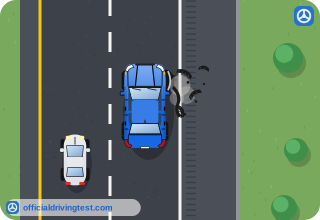
- Brake as hard as you can to stop the vehicle right in the lane
- Slow down gently; do not try to pull off until the vehicle is under control
- Pull off the road at once, at the same speed you were traveling
- Turn the steering wheel sharply to the right to leave the lane
Show answer
Correct answer: Slow down gently; do not try to pull off until the vehicle is under control
Slow down gently, and make no attempt to pull off the road until your vehicle is under control; then move to your right, out of the traffic lane, as far as safely possible.
Source: Montana Driver Manual (Revised April 2024), page 55
-
If you have a mechanical problem or tire failure at night and have pulled off the road, which lights does the manual say to leave on?
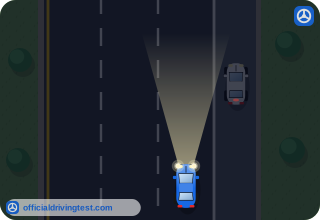
- Your high beams, with the parking lights switched off
- Your headlights on upper beam so others see you well
- No lights at all, to save the vehicle's battery power
- Your parking lights, with any headlights that are on dimmed
Show answer
Correct answer: Your parking lights, with any headlights that are on dimmed
If at night, leave your parking lights on, and if your headlights are on, make sure that they are dimmed.
Source: Montana Driver Manual (Revised April 2024), page 55
-
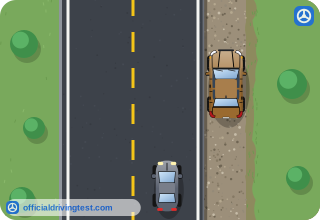
If your vehicle breaks down on a highway, what does the manual say you should make sure?
- That other drivers can see it
- That the engine stays running
- That the doors are locked
- That the headlights are on high beam
Show answer
Correct answer: That other drivers can see it
The manual says to make sure other drivers can see the vehicle, because crashes often occur when a driver does not see a stalled vehicle until it is too late to stop.
Source: Montana Driver Manual (Revised April 2024), page 56
-
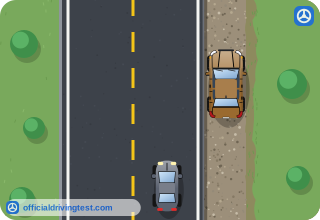
If your vehicle breaks down on a highway, what does the manual say to use, if available, to notify authorities?
- Your horn in short, repeated bursts
- Your vehicle's headlights flashed on and off
- Your two-way radio or mobile phone
- The next vehicle that stops to help you
Show answer
Correct answer: Your two-way radio or mobile phone
If available, use your two-way radio or mobile phone to notify authorities that you or someone else has broken down.
Source: Montana Driver Manual (Revised April 2024), page 56
-
What do many roadways have signs that tell you?
- The distance to the nearest garage or repair shop
- The CB channel or telephone number to call in an emergency
- The location of the next rest area on the highway
- The name of the nearest tow company you can call
Show answer
Correct answer: The CB channel or telephone number to call in an emergency
Many roadways have signs that tell you the CB channel or telephone number to call in an emergency.
Source: Montana Driver Manual (Revised April 2024), page 56
-
If you are having vehicle trouble and need to stop, what should you do if at all possible?
- Stop in the traffic lane with your headlights turned off
- Stop on the center line so that other drivers see you
- Keep driving slowly in the traffic lane until help arrives
- Get your vehicle off the road and away from traffic
Show answer
Correct answer: Get your vehicle off the road and away from traffic
If at all possible, get your vehicle off the road and away from traffic.
Source: Montana Driver Manual (Revised April 2024), page 56