Pavement markings in Missouri
The Missouri Driver Guide shows or names everything on this page: 13 in all, on pages 26, 31, 35, 42–43, 49.
Independent educational site · not affiliated with any government agency or DMV
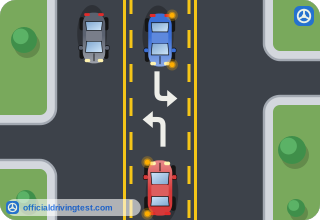
Two-Way Left-Turn Lane
Vehicles moving in both directions may use these center lanes for making left turns (or U-turns when they are permitted). On the pavement, left-turn arrows for traffic in one direction alternate with left-turn arrows for traffic coming from the other direction. These lanes are marked on each side by a solid yellow and dashed yellow lines. Turn from this lane as soon as your path is clear.
Manual page 26 · Open this page in the manual (Manual page 26)
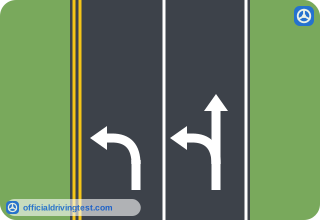
Multiple Left-Turn Lanes
Some streets may have more than one lane marked for left turns. If you are turning from the left side, left-turn lane, enter the left lane on the right of the yellow dividing line. If you are turning from the right side, left-turn lane, enter the right lane.
Manual page 26 · Open this page in the manual (Manual page 26)
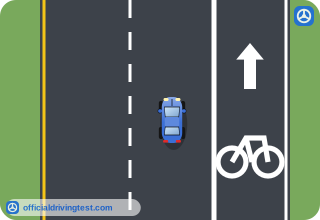
Bicycle Lane
A bicycle lane is a portion of a roadway designated by striping to be used by bicycles. You may cross a bicycle lane when turning or when entering or leaving the roadway. You must yield to bicyclists in a bicycle lane.
Manual page 31 · Open this page in the manual (Manual page 31)
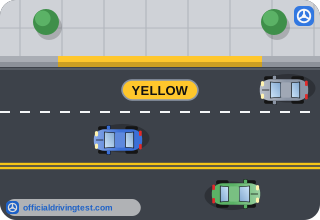
Yellow Curb
Some parking restrictions are indicated by colored curb markings. Do not park: Alongside a curb that is painted yellow.
Manual page 35 · Open this page in the manual (Manual page 35)
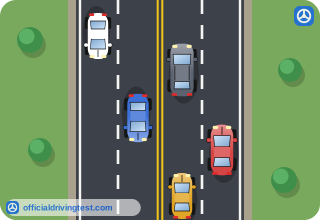
Four-Lane Road Center Marking
The center marking for roads with four lanes consists of two solid yellow lines. The yellow lines tell you the traffic on the other side of the lines is moving in the opposite direction. You should never cross the two solid yellow lines to pass.
Manual page 42 · Open this page in the manual (Manual page 42)
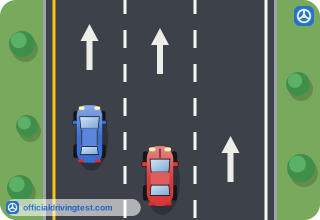
Broken White Lane Line
Broken Lines may be crossed in a passing maneuver. White separates traffic traveling in the same direction.
Manual page 42 · Open this page in the manual (Manual page 42)
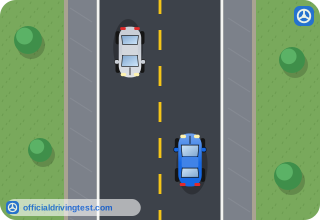
Solid White Edge Line
When the line on the left of you is white, the traffic is moving in the same direction. A solid white line marks the right edge of many roads.
Manual page 42 · Open this page in the manual (Manual page 42)
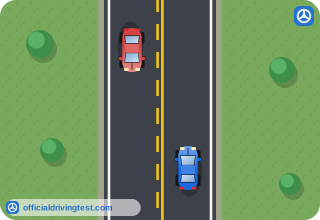
NO PASSING ZONE (Solid Yellow Line)
Two-lane roads may have "no passing zones" marked with a solid yellow line. No passing zones are on hills or curves where you cannot see far enough ahead to pass safely. You must complete passing before you enter the no passing zone. When you see a solid yellow line on your side of the center line, do not try to pass.
Manual page 42 · Open this page in the manual (Manual page 42)
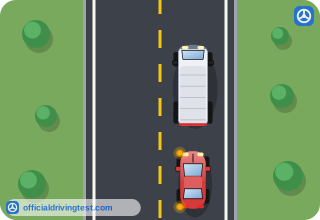
Broken Yellow Center Line
Broken Lines may be crossed in a passing maneuver. Yellow separates traffic traveling in opposite directions. If the line on the left of you is yellow, the traffic on the other side of the line is moving in the opposite direction.
Manual page 42 · Open this page in the manual (Manual page 42)
Left-Turn Lane Taper (Painted Median)
Some roads have marked left-turn lanes. Notice the solid yellow lines and the thick yellow stripes in the illustration below.
Manual page 42 · Open this page in the manual (Manual page 42)
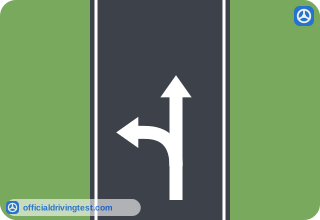
Straight and Left Pavement Arrow
Dual-use lanes have both a turn arrow and a straight arrow. When both arrows appear on the electric traffic signal, you may either turn or go straight. But if you want to turn, and only the straight arrow is showing, you must wait for the turn arrow.
Manual page 43 · Open this page in the manual (Manual page 43)
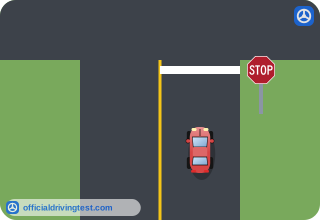
Stop Line
When required to stop because of a sign or signal, you must stop before your vehicle reaches the stop line or, if there is one, the crosswalk.
Manual page 49 · Open this page in the manual (Manual page 49)
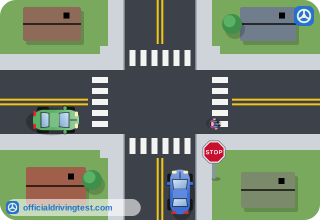
Stop Before the Crosswalk
Crosswalks define the area where pedestrians are to cross the roadway. You must yield to pedestrians in or about to enter a crosswalk. Not all crosswalks are marked.
Manual page 49 · Open this page in the manual (Manual page 49)