Missouri: Pavement markings Practice Test
Yellow and white lines, no-passing zones, crosswalks, stop lines and lane arrows.
Independent educational site · not affiliated with any government agency or DMV
Ready? Test yourself
- Instant feedback with an explanation
- Every answer cites its source in the manual
- Your best score is saved on this device
Questions are original and based on the official manual "Missouri Driver Guide" (Revised August 2026), Missouri Department of Revenue.
All 17 questions in this practice test
Take the test above first, then use this list to study. Tap “Show answer” to see the correct answer and explanation.
Show the questions and answersHide the questions
-
On the roadway, a broken line may be:
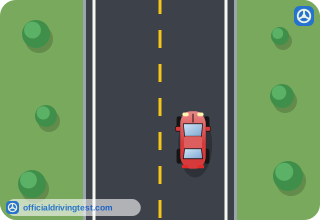
- Crossed in a passing maneuver
- Crossed only by emergency vehicles
- Used only at the edge of the road
- Crossed only when turning right
Show answer
Correct answer: Crossed in a passing maneuver
Broken lines may be crossed in a passing maneuver.
Source: Missouri Driver Guide (Revised August 2026), page 42 · Open this page in the manual (Manual page 42)
-
How should you treat a solid line on the road when passing?
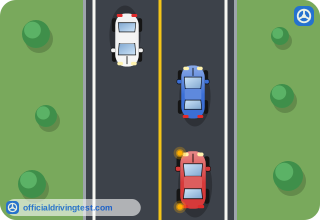
- You may cross it if no vehicle is coming
- You may cross it only on a hill
- You should not cross it in a passing maneuver
- You may cross it if the vehicle ahead is slow
Show answer
Correct answer: You should not cross it in a passing maneuver
Solid lines should not be crossed in a passing maneuver.
Source: Missouri Driver Guide (Revised August 2026), page 42 · Open this page in the manual (Manual page 42)
-
What do yellow pavement lines separate?
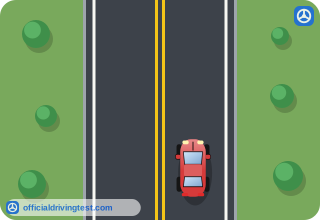
- Traffic traveling in the same direction
- Traffic traveling in opposite directions
- Bike lanes from traffic lanes
- Parking spaces from travel lanes
Show answer
Correct answer: Traffic traveling in opposite directions
Yellow lines separate traffic traveling in opposite directions.
Source: Missouri Driver Guide (Revised August 2026), page 42 · Open this page in the manual (Manual page 42)
-
What do white pavement lines separate?
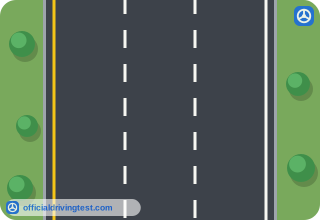
- Traffic traveling in opposite directions
- Construction zones from open lanes
- Parking areas from the sidewalk
- Traffic traveling in the same direction
Show answer
Correct answer: Traffic traveling in the same direction
White lines separate traffic traveling in the same direction.
Source: Missouri Driver Guide (Revised August 2026), page 42 · Open this page in the manual (Manual page 42)
-
What does a solid white line mark on many roads?
- The center of the road
- A no passing zone
- The right edge of the road
- The start of a school zone
Show answer
Correct answer: The right edge of the road
A solid white line marks the right edge of many roads.
Source: Missouri Driver Guide (Revised August 2026), page 42 · Open this page in the manual (Manual page 42)
-
What is the center marking for a road with four lanes?
- Two solid yellow lines
- Two broken white lines
- One broken white line
- A single solid white line
Show answer
Correct answer: Two solid yellow lines
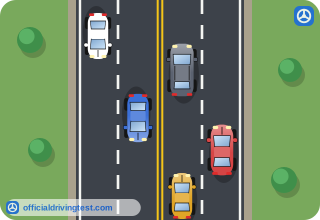
The center marking for roads with four lanes consists of two solid yellow lines, which tell you traffic on the other side moves in the opposite direction.
Source: Missouri Driver Guide (Revised August 2026), page 42 · Open this page in the manual (Manual page 42)
-
May you cross the two solid yellow lines in the center of a four-lane road to pass?
- Yes, when no vehicle is coming
- Yes, if you are driving a slow vehicle
- Yes, during daylight hours
- No, you should never cross them to pass
Show answer
Correct answer: No, you should never cross them to pass
You should never cross the two solid yellow lines to pass.
Source: Missouri Driver Guide (Revised August 2026), page 42 · Open this page in the manual (Manual page 42)
-
How may a no passing zone on a two-lane road be marked?
- With a broken white line
- With a solid yellow line
- With a solid white line
- With two broken yellow lines
Show answer
Correct answer: With a solid yellow line
Two-lane roads may have no passing zones marked with a solid yellow line.
Source: Missouri Driver Guide (Revised August 2026), page 42 · Open this page in the manual (Manual page 42)
-
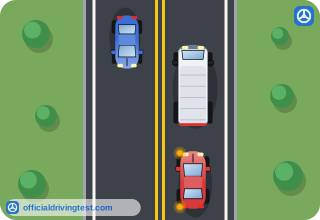
Where are no passing zones found?
- Only near schools and crosswalks
- On hills or curves where you cannot see far
- Only on roads with four or more lanes
- Only where the speed limit is 25 mph
Show answer
Correct answer: On hills or curves where you cannot see far
No passing zones are on hills or curves where you cannot see far enough ahead to pass safely.
Source: Missouri Driver Guide (Revised August 2026), page 42 · Open this page in the manual (Manual page 42)
-
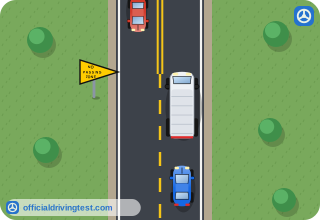
When must you complete a pass in relation to a no passing zone?
- Before the vehicle ahead slows down
- Before you reach the next intersection
- Within the first part of the zone
- Before you enter the no passing zone
Show answer
Correct answer: Before you enter the no passing zone
You must complete passing before you enter the no passing zone.
Source: Missouri Driver Guide (Revised August 2026), page 42 · Open this page in the manual (Manual page 42)
-
What should you do when you see a solid yellow line on your side of the center line?
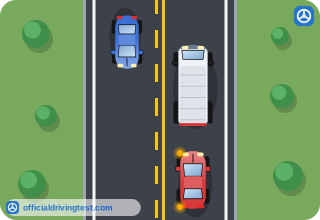
- Do not try to pass
- Pass only if the road ahead looks clear
- Pass only at a speed under 25 mph
- Pass only after honking your horn
Show answer
Correct answer: Do not try to pass
When you see a solid yellow line on your side of the center line, do not try to pass.
Source: Missouri Driver Guide (Revised August 2026), page 42 · Open this page in the manual (Manual page 42)
-
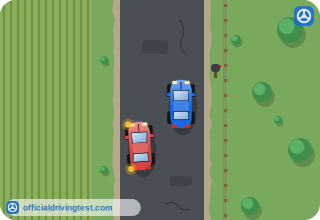
On a two-lane road with no marking on the pavement, when should you never pass?
- When another vehicle is following closely
- When the speed limit is below 45 mph
- When you cannot see far enough to pass safely
- When the road has a paved shoulder
Show answer
Correct answer: When you cannot see far enough to pass safely
On any two-lane road, never pass if you cannot see the road is clear for the distance you need to make a pass, even if there is no marking on the roadway.
Source: Missouri Driver Guide (Revised August 2026), page 42 · Open this page in the manual (Manual page 42)
-
Which markings does the manual point out on a marked left-turn lane?
- Solid white lines and thick white stripes
- Broken white lines and diagonal stripes only
- Two broken white lines with white arrows
- Solid yellow lines and thick yellow stripes
Show answer
Correct answer: Solid yellow lines and thick yellow stripes
Marked left-turn lanes have solid yellow lines and thick yellow stripes.
Source: Missouri Driver Guide (Revised August 2026), page 42 · Open this page in the manual (Manual page 42)
-
When you are required to stop because of a sign or signal, where must you stop?
- In the middle of the crosswalk so you can see cross traffic
- Before the stop line or, if there is one, the crosswalk
- Just past the crosswalk, with your front wheels in the intersection
- Anywhere behind the vehicle ahead, even in the crosswalk
Show answer
Correct answer: Before the stop line or, if there is one, the crosswalk
When required to stop because of a sign or signal, you must stop before your vehicle reaches the stop line or, if there is one, the crosswalk.
Source: Missouri Driver Guide (Revised August 2026), page 42 · Open this page in the manual (Manual page 42)
-
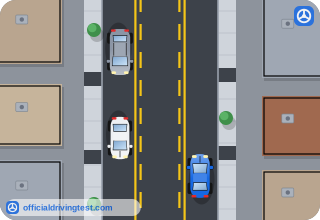
Who may use a shared center lane for left turns?
- Only vehicles traveling in one direction
- Vehicles moving in both directions
- Only emergency vehicles
- Only vehicles passing slower traffic
Show answer
Correct answer: Vehicles moving in both directions
Vehicles moving in both directions may use shared center lanes for left turns (or U-turns when permitted).
Source: Missouri Driver Guide (Revised August 2026), page 43 · Open this page in the manual (Manual page 43)
-
How are shared center lanes marked on each side?
- Two solid white lines
- A broken white line and a solid white line
- Two solid yellow lines only
- A solid yellow line and a dashed yellow line
Show answer
Correct answer: A solid yellow line and a dashed yellow line
Shared center lanes are marked on each side by a solid yellow and dashed yellow lines.
Source: Missouri Driver Guide (Revised August 2026), page 43 · Open this page in the manual (Manual page 43)
-
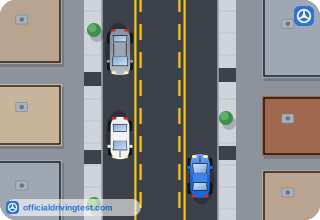
When should you turn out of a shared center lane?
- Only after stopping at the end of the lane
- Only after waiting for a green signal
- As soon as your path is clear
- After driving in it for at least a block
Show answer
Correct answer: As soon as your path is clear
You should turn from a shared center lane as soon as your path is clear.
Source: Missouri Driver Guide (Revised August 2026), page 43 · Open this page in the manual (Manual page 43)