Minnesota: Emergencies and winter driving — Part 3 Practice Test
Crashes, winter driving and survival, skids, hydroplaning, fog, deer, blowouts, brake or steering failure, deep water, fire, overheating and carbon monoxide. — Part 3
Independent educational site · not affiliated with any government agency or DMV
Ready? Test yourself
- Instant feedback with an explanation
- Every answer cites its source in the manual
- Your best score is saved on this device
Questions are original and based on the official manual "Minnesota Driver’s Manual" (June 2026), Minnesota Driver and Vehicle Services.
All 17 questions in this practice test
Take the test above first, then use this list to study. Tap “Show answer” to see the correct answer and explanation.
Show the questions and answersHide the questions
-
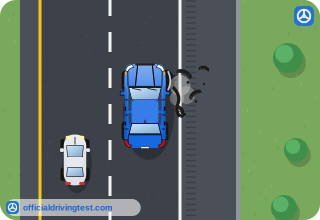
After a blowout, when should you brake?
- Immediately, as hard as you can
- As soon as you hear the tire burst
- Only after you have pulled onto the shoulder
- Not until the vehicle is back under your control
Show answer
Correct answer: Not until the vehicle is back under your control
The manual says not to brake until the vehicle is back under your control.
Source: Minnesota Driver’s Manual (June 2026), page 83
-
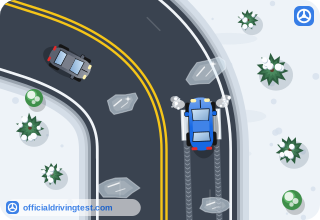
What should you do if the front wheels of your vehicle do not respond when you turn the steering wheel?
- Brake hard to stop the vehicle before it leaves the road
- Ease up on the accelerator and brake only to avoid a crash
- Shift into a lower gear and press the accelerator
- Turn the wheel sharply back and forth to regain control
Show answer
Correct answer: Ease up on the accelerator and brake only to avoid a crash
With steering failure, ease up on the accelerator and do not brake unless it is necessary to avoid a crash.
Source: Minnesota Driver’s Manual (June 2026), page 84
-
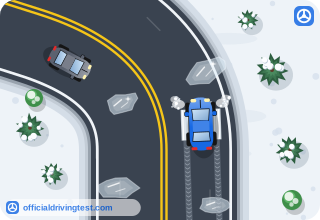
If you must brake after your steering fails, how should you apply the brake?
- Suddenly
- Repeatedly in short bursts
- As hard as possible
- Gently
Show answer
Correct answer: Gently
If you must apply the brake, do so gently, because braking suddenly or shifting gears may throw the vehicle off balance and out of control.
Source: Minnesota Driver’s Manual (June 2026), page 84
-
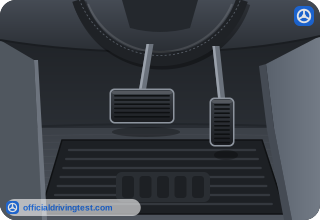
What is a sign that your vehicle’s brakes may be failing?
- A brake pedal that sinks slowly when pressure is applied
- A brake pedal that feels very hard when pressed
- A steering wheel that pulls to one side when you drive
- A thumping sound that gets faster as you speed up
Show answer
Correct answer: A brake pedal that sinks slowly when pressure is applied
A brake pedal that sinks slowly when pressure is applied is a sign the brakes may be failing.
Source: Minnesota Driver’s Manual (June 2026), page 84
-
If your brake pedal suddenly sinks all the way to the floor, what should you try first?
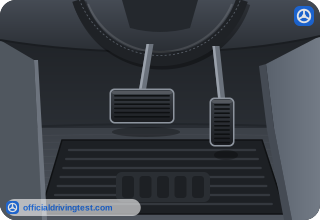
- Slowly applying the emergency/parking brake
- Shifting into neutral right away
- Pumping the pedal to build pressure
- Turning off the ignition
Show answer
Correct answer: Pumping the pedal to build pressure
If the brake pedal sinks to the floor, try pumping the pedal to build pressure; if that does not work, slowly apply the emergency/parking brake.
Source: Minnesota Driver’s Manual (June 2026), page 84
-
Why should you apply the emergency/parking brake slowly if your brakes fail?
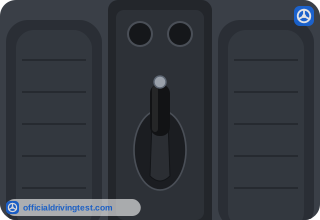
- Applying it quickly could make the brake lights go out
- Applying it too hard could lock the front wheels at once
- Applying it too fast could cause the engine to stall
- Applying it too abruptly could throw the vehicle into a skid
Show answer
Correct answer: Applying it too abruptly could throw the vehicle into a skid
Applying the brake too abruptly could throw the vehicle into a skid, and the emergency/parking brake engages only the rear brakes.
Source: Minnesota Driver’s Manual (June 2026), page 84
-
Which brakes does the emergency/parking brake engage?
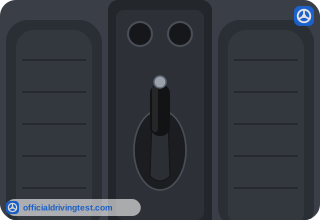
- Only the rear brakes
- Only the front brakes
- All four brakes
- The brakes on the left side
Show answer
Correct answer: Only the rear brakes
The emergency/parking brake engages only the rear brakes.
Source: Minnesota Driver’s Manual (June 2026), page 84
-
If your brakes fail and road conditions allow you to coast to a stop, what should you do?
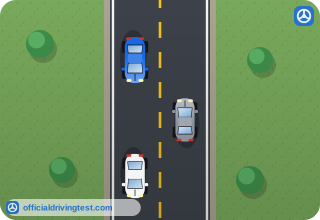
- Shift into neutral and let the vehicle coast to a stop on its own
- Turn off the ignition and steer to the shoulder
- Shift into a lower gear and continue to downshift as you slow down
- Shift into reverse once your speed has dropped
Show answer
Correct answer: Shift into a lower gear and continue to downshift as you slow down
Shift your car into a lower gear and continue to downshift as you decelerate until you can safely pull over and stop.
Source: Minnesota Driver’s Manual (June 2026), page 84
-
If your wheels drift onto the shoulder of the road, what should you do?
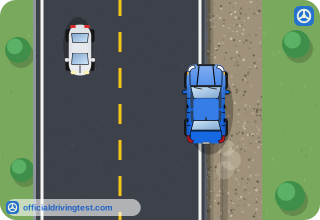
- Swerve back onto the pavement right away
- Stay on the shoulder and slowly release the gas pedal
- Brake hard to stop on the shoulder
- Steer sharply back onto the pavement and speed up
Show answer
Correct answer: Stay on the shoulder and slowly release the gas pedal
Do not try to swerve back onto the pavement; stay on the shoulder, slowly release the gas pedal, and turn back after you have reduced your speed.
Source: Minnesota Driver’s Manual (June 2026), page 84
-
During which hours are deer most active?
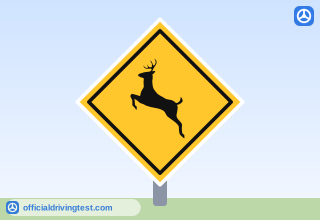
- From dusk to dawn
- From noon to sunset
- From midnight to early morning only
- From sunrise to midday
Show answer
Correct answer: From dusk to dawn
Deer are most active from dusk to dawn, so you should be especially alert during those times.
Source: Minnesota Driver’s Manual (June 2026), page 84
-
What should you do if you see the reflection of your headlights in the eyes of deer at the side of the road?
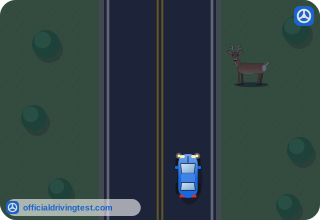
- Turn off your headlights so the deer stay calm
- Speed up to pass the deer before they move
- Slow down, blow the horn and be ready to stop
- Flash your high beams and keep your speed
Show answer
Correct answer: Slow down, blow the horn and be ready to stop
If you see such a reflection, slow down, blow the horn and be ready to stop.
Source: Minnesota Driver’s Manual (June 2026), page 84
-
What should you remember when you see one deer near the road?
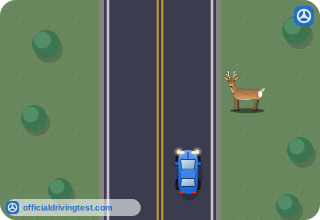
- A single deer will not cross in front of you
- Always watch for more than one deer
- Deer cross only in rural settings
- Deer cross only at marked crossings
Show answer
Correct answer: Always watch for more than one deer
The manual says to always watch for more than one deer, and that deer may cross anywhere, anytime.
Source: Minnesota Driver’s Manual (June 2026), page 84
-
What should you do if a vehicle is traveling toward you in your lane?
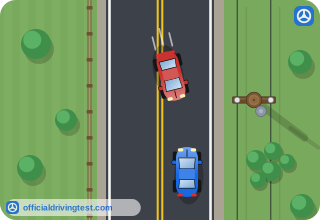
- Move to the left lane and go around the vehicle
- Stop in the middle of your lane
- Speed up to pass it quickly
- Move to the right and do not use the left lane
Show answer
Correct answer: Move to the right and do not use the left lane
If a vehicle is traveling toward you in your lane, move to the right; the driver may return to the correct lane and be in your path if you use the left lane.
Source: Minnesota Driver’s Manual (June 2026), page 84
-
What may help a sleepy or distracted driver who is coming toward you in your lane become alert?
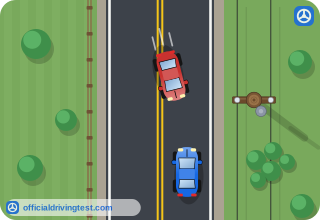
- Turning on your hazard warning lights and slowing
- Sounding your horn and flashing your headlights
- Slowing to a stop in the lane
- Moving into the left lane
Show answer
Correct answer: Sounding your horn and flashing your headlights
Sounding your horn and flashing your headlights may help a sleepy or distracted driver become alert.
Source: Minnesota Driver’s Manual (June 2026), page 84
-
Another driver tries to pass you on a two-lane road and is nearly in position to move back into the right lane. What should you do?
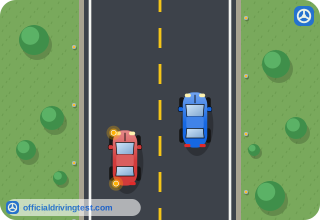
- Speed up and stay beside the passing vehicle so it cannot cut in
- Move to the left to block the passing vehicle
- Brake hard and stop in your lane
- Slow down and let the driver complete the pass as quickly as possible
Show answer
Correct answer: Slow down and let the driver complete the pass as quickly as possible
If the passing vehicle is nearly in position to move back into the right lane, slow down and allow the driver to complete the pass as quickly as possible.
Source: Minnesota Driver’s Manual (June 2026), page 84
-
A passing vehicle must drop back behind you on a two-lane road. What should you do?
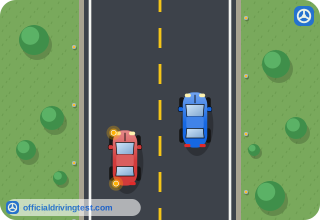
- Speed up so there is adequate room for it to move into the lane behind you
- Slow down so the vehicle can move back into the lane ahead of you
- Stay at your speed and sound your horn
- Move to the left lane and let it pass
Show answer
Correct answer: Speed up so there is adequate room for it to move into the lane behind you
If the passing vehicle must drop back, speed up to make sure there is adequate room for it to move into the lane behind you.
Source: Minnesota Driver’s Manual (June 2026), page 84
-
A crash seems likely because a passing vehicle cannot complete its pass. What should you do if the right shoulder is wide enough for your vehicle?
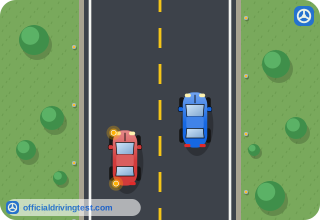
- Stay in your lane, brake hard and flash your headlights at the passing driver
- Move left to give the passing vehicle more room
- Move quickly to the right and let the passing vehicle into your lane
- Speed up and stay on the pavement
Show answer
Correct answer: Move quickly to the right and let the passing vehicle into your lane
If a crash seems likely and the right shoulder is wide enough for your vehicle, quickly move to the right and allow the passing vehicle to move into your lane.
Source: Minnesota Driver’s Manual (June 2026), page 84