Massachusetts: Speed and following distance
Speed limits and school zones, the dangers of speeding, following and stopping distances, and driving at night, in rain, fog and winter weather. Split into 3 shorter tests so you're not stuck in one long quiz.
Independent educational site · not affiliated with any government agency or DMV
Choose a part
Speed and following distance — Part 1
Questions in this part include: “What should you watch for on vehicles ahead of you?”
StartSpeed and following distance — Part 2
Questions in this part include: “What is it called when you let your foot rest on the brake pedal while driving?”
StartSpeed and following distance — Part 3
Questions in this part include: “Which of these must your speed be based on, according to the manual?”
StartAll 60 Speed and following distance questions with answers
Choose a part above to take a practice test, or study every question and answer here.
Show the questions and answersHide the questions
-
Why should you maintain space around your vehicle?
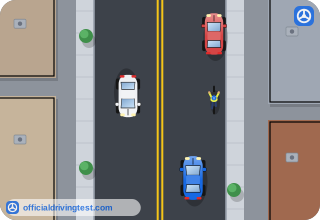
- So other drivers can merge easily in front of you
- So passing vehicles can fit between you and the lane line
- In case you need to suddenly change lanes to avoid a crash
- So you can ignore your mirrors
Show answer
Correct answer: In case you need to suddenly change lanes to avoid a crash
The manual says to maintain space around your vehicle in case you need to suddenly change lanes to avoid a crash.
Source: Massachusetts Driver's Manual (Revised April 2026), page 41 · Open this page in the manual (Manual page 41)
-
What should you watch for on vehicles ahead of you?
- Back-up lights
- Roof racks
- Tinted windows
- Out-of-state license plates
Show answer
Correct answer: Back-up lights
The manual advises watching for back-up lights of vehicles ahead of you.
Source: Massachusetts Driver's Manual (Revised April 2026), page 41 · Open this page in the manual (Manual page 41)
-
Under the three-second rule, what does it mean if you reach the object before you count three?
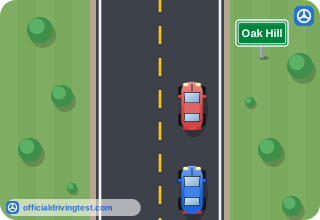
- You have a safe distance
- You are too far behind
- You are too close
- You should speed up
Show answer
Correct answer: You are too close
If you reach the object before you count three, you are too close and should slow down.
Source: Massachusetts Driver's Manual (Revised April 2026), page 43 · Open this page in the manual (Manual page 43)
-
The three-second rule is a minimum safe distance for which conditions?
- Poor weather and very heavy traffic
- Good road conditions and moderate traffic
- Night driving on the highway
- Driving behind a motorcycle
Show answer
Correct answer: Good road conditions and moderate traffic
The three-second rule is a minimum safe distance for good road conditions and moderate traffic; count more for added safety.
Source: Massachusetts Driver's Manual (Revised April 2026), page 43 · Open this page in the manual (Manual page 43)
-
How much space should you keep behind a motorcycle compared with another vehicle?
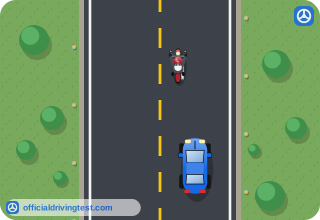
- At least two seconds
- At least three seconds
- At least six seconds
- At least four seconds
Show answer
Correct answer: At least four seconds
The manual says to keep more space, at least four seconds, behind a motorcycle than for another vehicle.
Source: Massachusetts Driver's Manual (Revised April 2026), page 43 · Open this page in the manual (Manual page 43)
-
What is the minimum space, in seconds, that the manual says to keep between your vehicle and heavy equipment such as dump trucks and tractors?
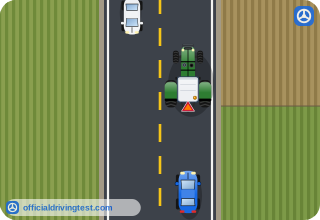
- Three seconds
- Four seconds
- Ten seconds
- Six seconds
Show answer
Correct answer: Ten seconds
The manual says to keep at least ten seconds of space between your vehicle and heavy equipment.
Source: Massachusetts Driver's Manual (Revised April 2026), page 43 · Open this page in the manual (Manual page 43)
-
Why should you never cut in front of heavy equipment or tractor-trailers?
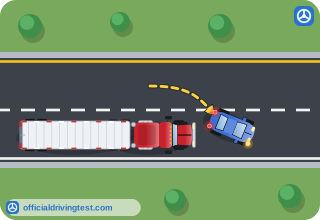
- They need much more space to stop safely
- Their drivers cannot hear your horn at all
- They always have the right-of-way over cars
- They are not able to change lanes quickly
Show answer
Correct answer: They need much more space to stop safely
These vehicles carry more weight and need much more space to stop safely.
Source: Massachusetts Driver's Manual (Revised April 2026), page 43 · Open this page in the manual (Manual page 43)
-
According to the manual, what is the main cause of rear-end crashes?
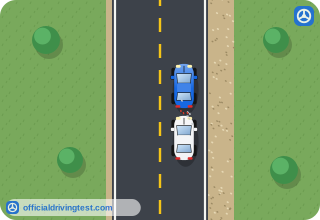
- Driving too slowly
- Worn tires
- Sudden lane changes
- Tailgating
Show answer
Correct answer: Tailgating
The manual says tailgating is illegal and the main cause of rear-end crashes.
Source: Massachusetts Driver's Manual (Revised April 2026), page 43 · Open this page in the manual (Manual page 43)
-
What does the manual say is the highest fine for tailgating?
- $25
- $100
- $50
- $250
Show answer
Correct answer: $100
The fine for tailgating can be as high as $100.
Source: Massachusetts Driver's Manual (Revised April 2026), page 43 · Open this page in the manual (Manual page 43)
-
What should you do if a tailgater is behind you?
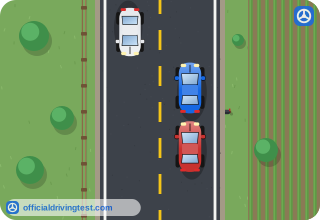
- Tap your brakes to make the tailgater back off
- Move to another lane or pull over to let it pass
- Speed up to pull away from the tailgater
- Stay in your lane and slow down gradually
Show answer
Correct answer: Move to another lane or pull over to let it pass
The manual says to move to another lane or pull to the side of the road to let the tailgater pass.
Source: Massachusetts Driver's Manual (Revised April 2026), page 43 · Open this page in the manual (Manual page 43)
-
What is the time it takes you to react, think, and hit the brakes called?
- Reaction time
- Braking time
- Hazard delay
- Perception distance
Show answer
Correct answer: Reaction time
The manual calls the time it takes to react, think, and hit the brakes "reaction time".
Source: Massachusetts Driver's Manual (Revised April 2026), page 44 · Open this page in the manual (Manual page 44)
-
About how long does it take to react to a situation and step on the brake pedal?
- About one-quarter of a second
- About one and a half to two seconds
- About three-quarters of a second
- About two seconds
Show answer
Correct answer: About three-quarters of a second
The manual says it takes about three-quarters of a second to react and step on the brake pedal.
Source: Massachusetts Driver's Manual (Revised April 2026), page 44 · Open this page in the manual (Manual page 44)
-
At 50 mph, how far does your vehicle go in the time it takes you to react?
- 25 feet
- 55 feet
- 90 feet
- 130 feet
Show answer
Correct answer: 55 feet
At 50 mph the vehicle travels another 55 feet during the three-quarters of a second it takes to react.
Source: Massachusetts Driver's Manual (Revised April 2026), page 44 · Open this page in the manual (Manual page 44)
-
On dry, level, clear pavement, how far may a vehicle at 50 mph go after you hit the brakes before it stops?
- 60 feet or more
- 100 feet or more
- 330 feet or more
- 160 feet or more
Show answer
Correct answer: 160 feet or more
At 50 mph, after you hit the brakes you may go another 160 feet or more before you stop, on dry, level, clear pavement.
Source: Massachusetts Driver's Manual (Revised April 2026), page 44 · Open this page in the manual (Manual page 44)
-
What is your total stopping distance at 50 mph (reaction plus braking distance) on dry, level, clear pavement?
- About 135 feet
- About 185 feet
- About 260 feet
- About 215 feet
Show answer
Correct answer: About 215 feet
The manual gives the total as about 215 feet, which is 55 feet of reaction distance plus 160 feet of braking distance.
Source: Massachusetts Driver's Manual (Revised April 2026), page 44 · Open this page in the manual (Manual page 44)
-
If your brakes and tires are working and the road is dry and level, about how far does it take to react, brake, and safely stop at 60 mph?
- About 190 feet
- About 292 feet
- About 400 feet
- About 520 feet
Show answer
Correct answer: About 292 feet
At 60 mph it takes about 292 feet, almost a whole football field, to react, brake, and safely stop on a dry, level road.
Source: Massachusetts Driver's Manual (Revised April 2026), page 44 · Open this page in the manual (Manual page 44)
-
If your brakes and tires are working and the road is dry and level, what is your total stopping distance at just 30 mph?
- About 70 feet
- About 130 feet
- About 104 feet
- About 190 feet
Show answer
Correct answer: About 104 feet
At just 30 mph the total stopping distance is about 104 feet.
Source: Massachusetts Driver's Manual (Revised April 2026), page 44 · Open this page in the manual (Manual page 44)
-
On which kind of pavement do you need more time to stop?
- Wet, slippery, or uneven pavement
- Dry, level, and clear pavement
- Smooth, dry, well-lit pavement
- Dry, level, freshly swept pavement
Show answer
Correct answer: Wet, slippery, or uneven pavement
You need more time to stop on wet, slippery, or uneven pavement, as well as when going downhill or driving a bigger, heavier vehicle.
Source: Massachusetts Driver's Manual (Revised April 2026), page 44 · Open this page in the manual (Manual page 44)
-
How much stopping distance may large trucks require compared with passenger vehicles?
- The same amount
- Two times as much
- One and a half times as much
- Half as much
Show answer
Correct answer: Two times as much
Large trucks may require two times the stopping distance of passenger vehicles.
Source: Massachusetts Driver's Manual (Revised April 2026), page 45 · Open this page in the manual (Manual page 45)
-
How should you brake when preparing to stop or turn?
- Late and firmly
- Suddenly and hard
- Only at the last moment
- Early and gently
Show answer
Correct answer: Early and gently
The manual advises you to brake early and gently when preparing to stop or turn.
Source: Massachusetts Driver's Manual (Revised April 2026), page 45 · Open this page in the manual (Manual page 45)
-
What is it called when you let your foot rest on the brake pedal while driving?
- Riding your brakes
- Pumping your brakes
- Feathering your brakes
- Covering your brakes
Show answer
Correct answer: Riding your brakes
The manual says not to rest your foot on the brake pedal while driving, which is called riding your brakes.
Source: Massachusetts Driver's Manual (Revised April 2026), page 45 · Open this page in the manual (Manual page 45)
-
What does the manual say to do about the brake pedal if your vehicle has antilock brakes?
- Pump the brakes quickly in a panic stop
- Pump the brakes only on wet roads
- Never pump the brakes
- Pump the brakes when approaching a curve
Show answer
Correct answer: Never pump the brakes
If your vehicle has antilock brakes, you should never pump the brakes.
Source: Massachusetts Driver's Manual (Revised April 2026), page 45 · Open this page in the manual (Manual page 45)
-
Your vehicle is more likely to leave the road at a curve. What should you do near a curve or an area where you cannot see clearly ahead?
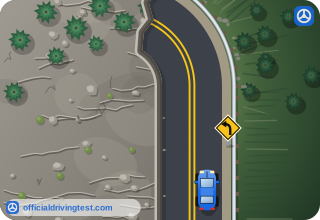
- Keep your speed steady
- Speed up to clear it quickly
- Always slow down
- Move toward the edge of the road
Show answer
Correct answer: Always slow down
You should always slow down near a curve or an area where you cannot see clearly ahead.
Source: Massachusetts Driver's Manual (Revised April 2026), page 45 · Open this page in the manual (Manual page 45)
-
What speed should you keep when driving at night?
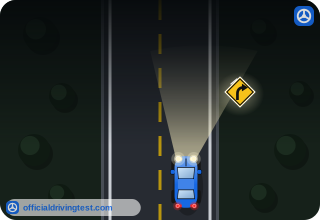
- One that lets you react and stop safely within the distance you can see ahead
- The posted speed limit, no matter how dark the road is or how unfamiliar the area
- A speed that matches the flow of the vehicles ahead of you on the road
- A speed slightly above the posted limit so you leave the dark sooner
Show answer
Correct answer: One that lets you react and stop safely within the distance you can see ahead
At night, keep a speed that will let you react and stop safely within the distance you can see ahead.
Source: Massachusetts Driver's Manual (Revised April 2026), page 46 · Open this page in the manual (Manual page 46)
-
At night, what should you allow near trucks and heavy equipment?
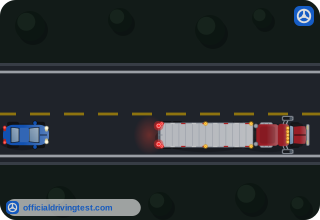
- Less space
- The same space as in daytime
- Additional space
- No extra space if you use high beams
Show answer
Correct answer: Additional space
At night, you should allow additional space when driving near trucks and heavy equipment.
Source: Massachusetts Driver's Manual (Revised April 2026), page 46 · Open this page in the manual (Manual page 46)
-
At night, where should you look instead of straight at oncoming headlights?
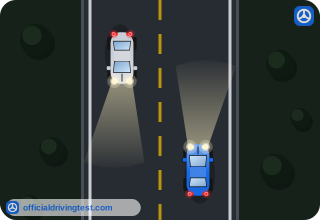
- To the upper left side of the oncoming lane
- At the center line
- At the oncoming driver
- To the lower right side of your lane
Show answer
Correct answer: To the lower right side of your lane
Do not look straight at headlights; look to the lower right side of your lane.
Source: Massachusetts Driver's Manual (Revised April 2026), page 46 · Open this page in the manual (Manual page 46)
-
When should you slow down in the rain?
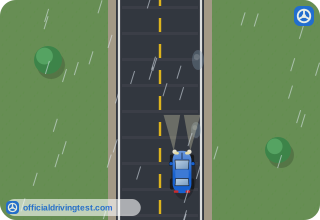
- After the road is completely wet
- As soon as the rain starts
- Only when you cannot see well
- After the first mile
Show answer
Correct answer: As soon as the rain starts
The manual says to slow down as soon as the rain starts.
Source: Massachusetts Driver's Manual (Revised April 2026), page 47 · Open this page in the manual (Manual page 47)
-
When are many roads most slippery in the rain?
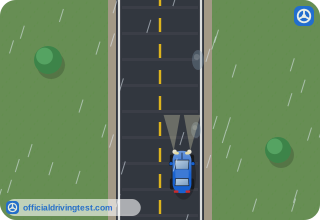
- When rain first mixes with road dirt and oil and forms a greasy film
- After several hours of steady rain have washed all the road dirt and oil away
- When the pavement has completely dried
- Only when the road is covered with leaves
Show answer
Correct answer: When rain first mixes with road dirt and oil and forms a greasy film
Many roads are most slippery when rain first mixes with road dirt and oil and forms a greasy film.
Source: Massachusetts Driver's Manual (Revised April 2026), page 47 · Open this page in the manual (Manual page 47)
-
What does the manual say wet leaves on the road can be as slippery as?
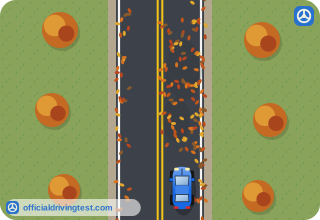
- Dry gravel
- Ice
- Fresh snow
- Wet pavement
Show answer
Correct answer: Ice
Wet leaves on the road can be as slippery as ice.
Source: Massachusetts Driver's Manual (Revised April 2026), page 47 · Open this page in the manual (Manual page 47)
-
In rain or fog, what should you do if you cannot see the pavement or sign posts?
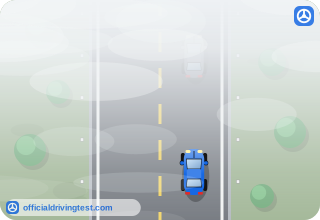
- Speed up to leave the poor-visibility area as quickly as you can
- Slow down and look for road edge markings to guide you
- Follow the center line closely
- Stop in the traffic lane
Show answer
Correct answer: Slow down and look for road edge markings to guide you
If you cannot see the pavement or sign posts, slow down and look for road edge markings to guide you.
Source: Massachusetts Driver's Manual (Revised April 2026), page 47 · Open this page in the manual (Manual page 47)
-
Why should you not drive through puddles?
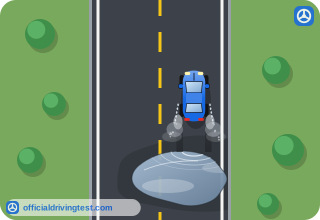
- Puddles damage the horn
- Puddles cover road signs
- Puddles can freeze your gas line
- Wet brakes do not work right
Show answer
Correct answer: Wet brakes do not work right
The manual says not to drive through puddles because wet brakes do not work right.
Source: Massachusetts Driver's Manual (Revised April 2026), page 48 · Open this page in the manual (Manual page 48)
-
After you drive through a large puddle, what should you do to dry your brakes?
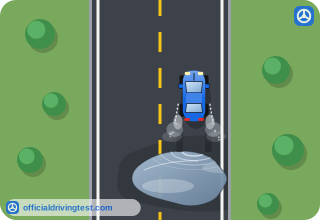
- Apply your brakes lightly until you feel them working normally again
- Press the brakes hard for several seconds and then release
- Wait without touching the brakes
- Pump the brakes quickly several times in a row until they feel dry again
Show answer
Correct answer: Apply your brakes lightly until you feel them working normally again
After a large puddle, apply your brakes lightly as soon as you can to dry them until they work normally again.
Source: Massachusetts Driver's Manual (Revised April 2026), page 48 · Open this page in the manual (Manual page 48)
-
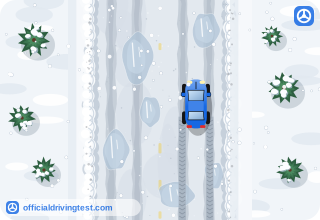
What should you never do on icy roads?
- Drive carefully
- Accelerate slowly
- Lock your brakes
- Lower your speed
Show answer
Correct answer: Lock your brakes
Never lock your brakes on icy roads, because you will lose steering control.
Source: Massachusetts Driver's Manual (Revised April 2026), page 48 · Open this page in the manual (Manual page 48)
-
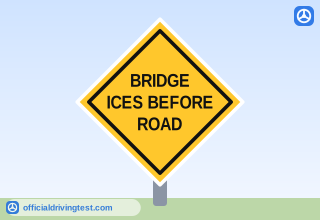
Why do bridges and highway overpasses freeze before the rest of the road?
- They are made of darker material
- The ground does not insulate them
- They are closer to the wind
- They have less traffic to melt ice
Show answer
Correct answer: The ground does not insulate them
Bridges and overpasses freeze before the rest of the road because the ground does not insulate them.
Source: Massachusetts Driver's Manual (Revised April 2026), page 48 · Open this page in the manual (Manual page 48)
-
If it is snowing, how can you test how much traction your tires have?
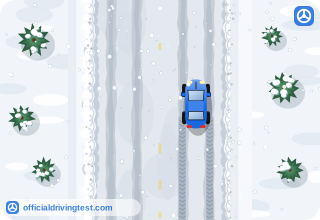
- Tap your brakes gently
- Pull up the hand brake hard
- Turn the wheel sharply
- Accelerate quickly
Show answer
Correct answer: Tap your brakes gently
When it is snowing, start slowly and test your brakes by tapping them gently to see how much traction your tires have.
Source: Massachusetts Driver's Manual (Revised April 2026), page 48 · Open this page in the manual (Manual page 48)
-
As your speed increases, what happens to the time and ground needed to stop your vehicle?
- You cover less ground and it takes less time to stop
- Stopping time stays the same on dry roads
- Stopping time changes only on rainy days
- You cover more ground and it takes longer to stop
Show answer
Correct answer: You cover more ground and it takes longer to stop
The higher the speed, the more ground your vehicle covers before braking begins, and the longer it takes to stop.
Source: Massachusetts Driver's Manual (Revised April 2026), page 78 · Open this page in the manual (Manual page 78)
-
What happens to your vehicle's safety equipment at high speeds?
- It is less effective
- It works the same at any speed
- It works better than at low speeds
- It turns off automatically
Show answer
Correct answer: It is less effective
At high speeds a vehicle's safety equipment is less effective.
Source: Massachusetts Driver's Manual (Revised April 2026), page 78 · Open this page in the manual (Manual page 78)
-
Which of these is a danger of driving fast, according to the manual?
- Your vehicle stops more quickly than usual
- You see the road around you more clearly
- You have a greater chance of losing control
- Your reaction time becomes much shorter
Show answer
Correct answer: You have a greater chance of losing control
Drivers travelling fast do not see well, cannot stop quickly, and have a greater chance of losing control of the vehicle.
Source: Massachusetts Driver's Manual (Revised April 2026), page 78 · Open this page in the manual (Manual page 78)
-
What does the manual say about fuel use when you drive at higher speeds?
- You use more fuel
- You use less fuel
- Fuel use stays the same
- Fuel use changes only on highways
Show answer
Correct answer: You use more fuel
Speeding costs money because more fuel is used at higher speeds.
Source: Massachusetts Driver's Manual (Revised April 2026), page 78 · Open this page in the manual (Manual page 78)
-
What is the fundamental speed law in Massachusetts?
- Always drive exactly at the posted speed limit
- Never travel so fast that it is not safe
- Always keep up with the flow of traffic
- Never drive more than 5 mph over the limit
Show answer
Correct answer: Never travel so fast that it is not safe
The fundamental speed law is that you must never travel so fast that it is not safe.
Source: Massachusetts Driver's Manual (Revised April 2026), page 79 · Open this page in the manual (Manual page 79)
-
Which of these must your speed be based on, according to the manual?
- The number of passengers in your vehicle
- The age of the vehicle you are driving
- Weather conditions and visibility
- How long your trip will take
Show answer
Correct answer: Weather conditions and visibility
Your speed must be based on traffic conditions, road conditions, weather conditions and visibility, and pedestrians or bicyclists.
Source: Massachusetts Driver's Manual (Revised April 2026), page 79 · Open this page in the manual (Manual page 79)
-
If there are poor driving conditions or hazards, what must you do about your speed?
- Keep it at the posted speed limit
- Match the speed of the vehicle ahead
- Raise it to get through the hazard sooner
- Lower it, even if the posted limit is higher
Show answer
Correct answer: Lower it, even if the posted limit is higher
You must lower your speed in poor conditions or hazards; it does not matter if the posted limit is higher.
Source: Massachusetts Driver's Manual (Revised April 2026), page 79 · Open this page in the manual (Manual page 79)
-
Posted speed limits are based on what kind of driving conditions?
- Average driving conditions
- Ideal driving conditions
- Typical rush-hour conditions
- Wet road conditions
Show answer
Correct answer: Ideal driving conditions
All speed limits are based on ideal driving conditions, so you must drive slower if conditions are hazardous.
Source: Massachusetts Driver's Manual (Revised April 2026), page 79 · Open this page in the manual (Manual page 79)
-
What is the minimum speed on the Massachusetts Turnpike?
- 30 mph
- 45 mph
- 55 mph
- 40 mph
Show answer
Correct answer: 40 mph
The manual states a minimum speed of 40 mph on the Massachusetts Turnpike.
Source: Massachusetts Driver's Manual (Revised April 2026), page 79 · Open this page in the manual (Manual page 79)
-
What is the minimum speed in the Boston Harbor tunnels (Callahan, Sumner, and Ted Williams)?
- 10 mph
- 20 mph
- 25 mph
- 35 mph
Show answer
Correct answer: 20 mph
There is a minimum speed of 20 mph in the Boston Harbor tunnels.
Source: Massachusetts Driver's Manual (Revised April 2026), page 79 · Open this page in the manual (Manual page 79)
-
Even where there is no minimum speed, what may a police officer do if a driver is slowing traffic on a state highway?
- Order the driver to follow a police escort
- Ticket every driver in the same lane
- Order the driver to the side of the highway
- Close the highway until traffic clears
Show answer
Correct answer: Order the driver to the side of the highway
A police officer may order a driver to the side of a state highway if the driver is slowing traffic.
Source: Massachusetts Driver's Manual (Revised April 2026), page 79 · Open this page in the manual (Manual page 79)
-
Unless posted otherwise, your speed would not be reasonable and proper in a thickly settled or business district if you drive over what speed?
- 30 mph
- 35 mph
- 45 mph
- 55 mph
Show answer
Correct answer: 30 mph
Unless posted otherwise, driving over 30 mph in a thickly settled or business district is not reasonable and proper.
Source: Massachusetts Driver's Manual (Revised April 2026), page 79 · Open this page in the manual (Manual page 79)
-
Unless posted otherwise, your speed would not be reasonable and proper outside a thickly settled or business district if you drive over what speed?
- 35 mph
- 45 mph
- 55 mph
- 40 mph
Show answer
Correct answer: 40 mph
Unless posted otherwise, driving over 40 mph outside a thickly settled or business district is not reasonable and proper.
Source: Massachusetts Driver's Manual (Revised April 2026), page 79 · Open this page in the manual (Manual page 79)
-
Unless posted otherwise, your speed would not be reasonable and proper on a highway outside a thickly settled or business district if you drive over what speed?
- 45 mph
- 50 mph
- 60 mph
- 65 mph
Show answer
Correct answer: 50 mph
Unless posted otherwise, driving over 50 mph on a highway outside a thickly settled or business district is not reasonable and proper.
Source: Massachusetts Driver's Manual (Revised April 2026), page 79 · Open this page in the manual (Manual page 79)
-
You drive 40 mph in a heavy rainstorm on a highway with a 50 mph speed limit. What can happen?
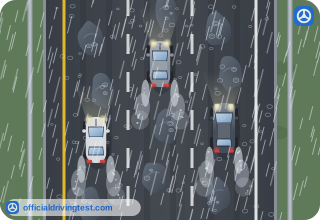
- Nothing, because you are under the posted limit
- You can be ticketed only if a crash occurs
- You can get a ticket for driving too fast
- You can be ticketed only if you drive below 30 mph
Show answer
Correct answer: You can get a ticket for driving too fast
Driving 40 mph in a heavy rainstorm on a 50 mph highway can earn a ticket for driving too fast.
Source: Massachusetts Driver's Manual (Revised April 2026), page 80 · Open this page in the manual (Manual page 80)
-
How does the manual define a thickly settled district?
- An area where buildings are fewer than 200 feet apart for 1/4 mile or more
- An area where buildings are fewer than 500 feet apart for 1/2 mile or more
- An area where buildings are fewer than 100 feet apart for 1 mile or more
- An area where buildings are more than 200 feet apart for 1/4 mile or more
Show answer
Correct answer: An area where buildings are fewer than 200 feet apart for 1/4 mile or more
A thickly settled district is an area where buildings are fewer than 200 feet apart for a distance of 1/4 mile or more.
Source: Massachusetts Driver's Manual (Revised April 2026), page 80 · Open this page in the manual (Manual page 80)
-
Some communities have a thickly settled speed limit of what, unless posted otherwise (per M.G.L. c90, Section 17c)?
- 15 mph
- 35 mph
- 45 mph
- 25 mph
Show answer
Correct answer: 25 mph
Some communities have a thickly settled speed limit of 25 mph unless posted otherwise.
Source: Massachusetts Driver's Manual (Revised April 2026), page 80 · Open this page in the manual (Manual page 80)
-
Where are signs posted in communities that have a 25 mph thickly settled speed limit?
- Only at school zones within these towns
- Only on the limited-access highways nearby
- At all entrances to these cities and towns
- Only at the busiest intersections in town
Show answer
Correct answer: At all entrances to these cities and towns
Signs are posted at all entrances to cities and towns that have a thickly settled speed limit of 25 mph.
Source: Massachusetts Driver's Manual (Revised April 2026), page 80 · Open this page in the manual (Manual page 80)
-
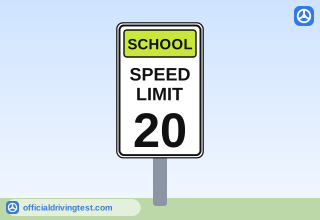
What is the speed limit on roads near schools?
- 15 mph
- 20 mph
- 25 mph
- 35 mph
Show answer
Correct answer: 20 mph
The speed limit on roads near schools is 20 mph.
Source: Massachusetts Driver's Manual (Revised April 2026), page 80 · Open this page in the manual (Manual page 80)
-
How may school zone speed limit signs be posted?
- With flashing red lights during the whole day
- Only on days when it snows or rains
- Only during the first week of the school year
- With flashing yellow lights or for certain hours
Show answer
Correct answer: With flashing yellow lights or for certain hours
School zone speed limit signs may have flashing yellow lights or be posted for certain hours of the day.
Source: Massachusetts Driver's Manual (Revised April 2026), page 80 · Open this page in the manual (Manual page 80)
-
What should you be aware of when you drive carefully into a school zone?
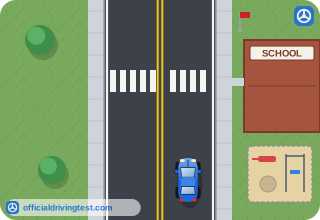
- Children crossing the street or riding bicycles
- Trucks making deliveries to the school itself
- Vehicles changing lanes on a nearby highway
- Large trucks backing out of the school lot
Show answer
Correct answer: Children crossing the street or riding bicycles
When entering a school zone, be aware of children crossing the street or riding bicycles.
Source: Massachusetts Driver's Manual (Revised April 2026), page 80 · Open this page in the manual (Manual page 80)
-
Who should you look out for when entering a school zone?
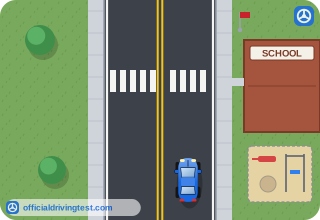
- Only police officers on motorcycles
- School safety patrols or crossing guards
- Only parents waiting at the curb
- Only bus drivers loading passengers
Show answer
Correct answer: School safety patrols or crossing guards
The manual says to look out for school safety patrols or crossing guards in a school zone.
Source: Massachusetts Driver's Manual (Revised April 2026), page 80 · Open this page in the manual (Manual page 80)
-
What does the manual say about the speed limit when you are passing?
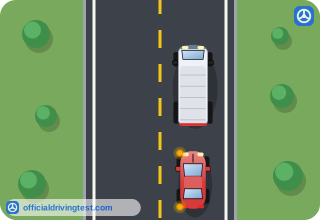
- You may exceed it by 5 miles per hour
- You may exceed it briefly if the passing lane is clear
- You may exceed it on multiple-lane highways
- You may not exceed it
Show answer
Correct answer: You may not exceed it
The manual says you may not exceed the speed limit when passing.
Source: Massachusetts Driver's Manual (Revised April 2026), page 102 · Open this page in the manual (Manual page 102)
-
Which of these acts is against the law in Massachusetts?
- Returning used motor oil to the store that sold it to you
- Waiting for vehicles in the travel lane to pass before you pull away from the curb
- Driving on a bet or wager
- Using a crosswalk when one is available to cross the road
Show answer
Correct answer: Driving on a bet or wager
The manual lists driving on a bet or wager among the things it is illegal to do.
Source: Massachusetts Driver's Manual (Revised April 2026), page 111 · Open this page in the manual (Manual page 111)
-
Which of these is illegal for a driver?
- Drag racing
- Parking between the white lines of a marked parking space
- Staying at least four feet away from a bicycle while passing it
- Using a crosswalk when one is available to cross the road
Show answer
Correct answer: Drag racing
The manual lists drag racing among the things it is illegal to do.
Source: Massachusetts Driver's Manual (Revised April 2026), page 111 · Open this page in the manual (Manual page 111)