Massachusetts: Speed and following distance — Part 1 Practice Test
Questions in this part include: “What should you watch for on vehicles ahead of you?” · “On dry, level, clear pavement, how far may a vehicle at 50 mph go after you hit the brakes before it stops?”
Independent educational site · not affiliated with any government agency or DMV
Ready? Test yourself
- Instant feedback with an explanation
- Every answer cites its source in the manual
- Your best score is saved on this device
Questions are original and based on the official manual "Massachusetts Driver's Manual" (Revised April 2026), Massachusetts Registry of Motor Vehicles.
All 20 questions in this practice test
Take the test above first, then use this list to study. Tap “Show answer” to see the correct answer and explanation.
Show the questions and answersHide the questions
-
Why should you maintain space around your vehicle?
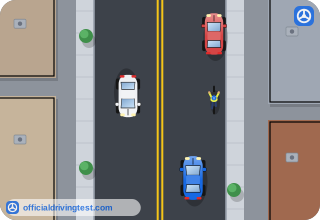
- So other drivers can merge easily in front of you
- So passing vehicles can fit between you and the lane line
- In case you need to suddenly change lanes to avoid a crash
- So you can ignore your mirrors
Show answer
Correct answer: In case you need to suddenly change lanes to avoid a crash
The manual says to maintain space around your vehicle in case you need to suddenly change lanes to avoid a crash.
Source: Massachusetts Driver's Manual (Revised April 2026), page 41 · Open this page in the manual (Manual page 41)
-
What should you watch for on vehicles ahead of you?
- Back-up lights
- Roof racks
- Tinted windows
- Out-of-state license plates
Show answer
Correct answer: Back-up lights
The manual advises watching for back-up lights of vehicles ahead of you.
Source: Massachusetts Driver's Manual (Revised April 2026), page 41 · Open this page in the manual (Manual page 41)
-
Under the three-second rule, what does it mean if you reach the object before you count three?
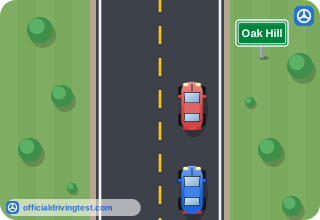
- You have a safe distance
- You are too far behind
- You are too close
- You should speed up
Show answer
Correct answer: You are too close
If you reach the object before you count three, you are too close and should slow down.
Source: Massachusetts Driver's Manual (Revised April 2026), page 43 · Open this page in the manual (Manual page 43)
-
The three-second rule is a minimum safe distance for which conditions?
- Poor weather and very heavy traffic
- Good road conditions and moderate traffic
- Night driving on the highway
- Driving behind a motorcycle
Show answer
Correct answer: Good road conditions and moderate traffic
The three-second rule is a minimum safe distance for good road conditions and moderate traffic; count more for added safety.
Source: Massachusetts Driver's Manual (Revised April 2026), page 43 · Open this page in the manual (Manual page 43)
-
How much space should you keep behind a motorcycle compared with another vehicle?
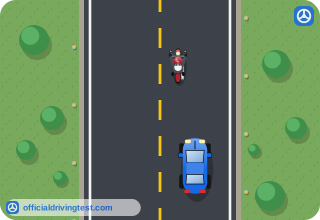
- At least two seconds
- At least three seconds
- At least six seconds
- At least four seconds
Show answer
Correct answer: At least four seconds
The manual says to keep more space, at least four seconds, behind a motorcycle than for another vehicle.
Source: Massachusetts Driver's Manual (Revised April 2026), page 43 · Open this page in the manual (Manual page 43)
-
What is the minimum space, in seconds, that the manual says to keep between your vehicle and heavy equipment such as dump trucks and tractors?
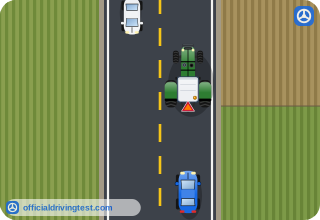
- Three seconds
- Four seconds
- Ten seconds
- Six seconds
Show answer
Correct answer: Ten seconds
The manual says to keep at least ten seconds of space between your vehicle and heavy equipment.
Source: Massachusetts Driver's Manual (Revised April 2026), page 43 · Open this page in the manual (Manual page 43)
-
Why should you never cut in front of heavy equipment or tractor-trailers?
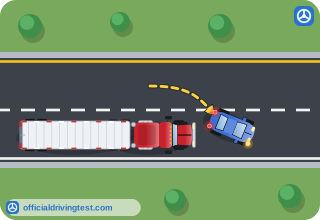
- They need much more space to stop safely
- Their drivers cannot hear your horn at all
- They always have the right-of-way over cars
- They are not able to change lanes quickly
Show answer
Correct answer: They need much more space to stop safely
These vehicles carry more weight and need much more space to stop safely.
Source: Massachusetts Driver's Manual (Revised April 2026), page 43 · Open this page in the manual (Manual page 43)
-
According to the manual, what is the main cause of rear-end crashes?
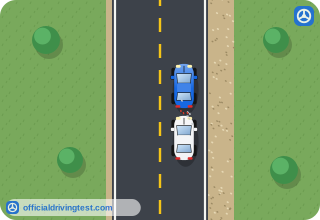
- Driving too slowly
- Worn tires
- Sudden lane changes
- Tailgating
Show answer
Correct answer: Tailgating
The manual says tailgating is illegal and the main cause of rear-end crashes.
Source: Massachusetts Driver's Manual (Revised April 2026), page 43 · Open this page in the manual (Manual page 43)
-
What does the manual say is the highest fine for tailgating?
- $25
- $100
- $50
- $250
Show answer
Correct answer: $100
The fine for tailgating can be as high as $100.
Source: Massachusetts Driver's Manual (Revised April 2026), page 43 · Open this page in the manual (Manual page 43)
-
What should you do if a tailgater is behind you?
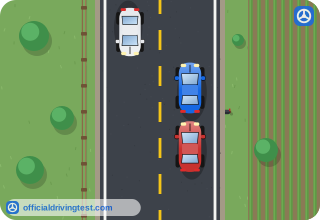
- Tap your brakes to make the tailgater back off
- Move to another lane or pull over to let it pass
- Speed up to pull away from the tailgater
- Stay in your lane and slow down gradually
Show answer
Correct answer: Move to another lane or pull over to let it pass
The manual says to move to another lane or pull to the side of the road to let the tailgater pass.
Source: Massachusetts Driver's Manual (Revised April 2026), page 43 · Open this page in the manual (Manual page 43)
-
What is the time it takes you to react, think, and hit the brakes called?
- Reaction time
- Braking time
- Hazard delay
- Perception distance
Show answer
Correct answer: Reaction time
The manual calls the time it takes to react, think, and hit the brakes "reaction time".
Source: Massachusetts Driver's Manual (Revised April 2026), page 44 · Open this page in the manual (Manual page 44)
-
About how long does it take to react to a situation and step on the brake pedal?
- About one-quarter of a second
- About one and a half to two seconds
- About three-quarters of a second
- About two seconds
Show answer
Correct answer: About three-quarters of a second
The manual says it takes about three-quarters of a second to react and step on the brake pedal.
Source: Massachusetts Driver's Manual (Revised April 2026), page 44 · Open this page in the manual (Manual page 44)
-
At 50 mph, how far does your vehicle go in the time it takes you to react?
- 25 feet
- 55 feet
- 90 feet
- 130 feet
Show answer
Correct answer: 55 feet
At 50 mph the vehicle travels another 55 feet during the three-quarters of a second it takes to react.
Source: Massachusetts Driver's Manual (Revised April 2026), page 44 · Open this page in the manual (Manual page 44)
-
On dry, level, clear pavement, how far may a vehicle at 50 mph go after you hit the brakes before it stops?
- 60 feet or more
- 100 feet or more
- 330 feet or more
- 160 feet or more
Show answer
Correct answer: 160 feet or more
At 50 mph, after you hit the brakes you may go another 160 feet or more before you stop, on dry, level, clear pavement.
Source: Massachusetts Driver's Manual (Revised April 2026), page 44 · Open this page in the manual (Manual page 44)
-
What is your total stopping distance at 50 mph (reaction plus braking distance) on dry, level, clear pavement?
- About 135 feet
- About 185 feet
- About 260 feet
- About 215 feet
Show answer
Correct answer: About 215 feet
The manual gives the total as about 215 feet, which is 55 feet of reaction distance plus 160 feet of braking distance.
Source: Massachusetts Driver's Manual (Revised April 2026), page 44 · Open this page in the manual (Manual page 44)
-
If your brakes and tires are working and the road is dry and level, about how far does it take to react, brake, and safely stop at 60 mph?
- About 190 feet
- About 292 feet
- About 400 feet
- About 520 feet
Show answer
Correct answer: About 292 feet
At 60 mph it takes about 292 feet, almost a whole football field, to react, brake, and safely stop on a dry, level road.
Source: Massachusetts Driver's Manual (Revised April 2026), page 44 · Open this page in the manual (Manual page 44)
-
If your brakes and tires are working and the road is dry and level, what is your total stopping distance at just 30 mph?
- About 70 feet
- About 130 feet
- About 104 feet
- About 190 feet
Show answer
Correct answer: About 104 feet
At just 30 mph the total stopping distance is about 104 feet.
Source: Massachusetts Driver's Manual (Revised April 2026), page 44 · Open this page in the manual (Manual page 44)
-
On which kind of pavement do you need more time to stop?
- Wet, slippery, or uneven pavement
- Dry, level, and clear pavement
- Smooth, dry, well-lit pavement
- Dry, level, freshly swept pavement
Show answer
Correct answer: Wet, slippery, or uneven pavement
You need more time to stop on wet, slippery, or uneven pavement, as well as when going downhill or driving a bigger, heavier vehicle.
Source: Massachusetts Driver's Manual (Revised April 2026), page 44 · Open this page in the manual (Manual page 44)
-
How much stopping distance may large trucks require compared with passenger vehicles?
- The same amount
- Two times as much
- One and a half times as much
- Half as much
Show answer
Correct answer: Two times as much
Large trucks may require two times the stopping distance of passenger vehicles.
Source: Massachusetts Driver's Manual (Revised April 2026), page 45 · Open this page in the manual (Manual page 45)
-
How should you brake when preparing to stop or turn?
- Late and firmly
- Suddenly and hard
- Only at the last moment
- Early and gently
Show answer
Correct answer: Early and gently
The manual advises you to brake early and gently when preparing to stop or turn.
Source: Massachusetts Driver's Manual (Revised April 2026), page 45 · Open this page in the manual (Manual page 45)