Massachusetts: Speed and following distance — Part 2 Practice Test
Questions in this part include: “What is it called when you let your foot rest on the brake pedal while driving?” · “What happens to your vehicle's safety equipment at high speeds?”
Independent educational site · not affiliated with any government agency or DMV
Ready? Test yourself
- Instant feedback with an explanation
- Every answer cites its source in the manual
- Your best score is saved on this device
Questions are original and based on the official manual "Massachusetts Driver's Manual" (Revised April 2026), Massachusetts Registry of Motor Vehicles.
All 20 questions in this practice test
Take the test above first, then use this list to study. Tap “Show answer” to see the correct answer and explanation.
Show the questions and answersHide the questions
-
What is it called when you let your foot rest on the brake pedal while driving?
- Riding your brakes
- Pumping your brakes
- Feathering your brakes
- Covering your brakes
Show answer
Correct answer: Riding your brakes
The manual says not to rest your foot on the brake pedal while driving, which is called riding your brakes.
Source: Massachusetts Driver's Manual (Revised April 2026), page 45 · Open this page in the manual (Manual page 45)
-
What does the manual say to do about the brake pedal if your vehicle has antilock brakes?
- Pump the brakes quickly in a panic stop
- Pump the brakes only on wet roads
- Never pump the brakes
- Pump the brakes when approaching a curve
Show answer
Correct answer: Never pump the brakes
If your vehicle has antilock brakes, you should never pump the brakes.
Source: Massachusetts Driver's Manual (Revised April 2026), page 45 · Open this page in the manual (Manual page 45)
-
Your vehicle is more likely to leave the road at a curve. What should you do near a curve or an area where you cannot see clearly ahead?
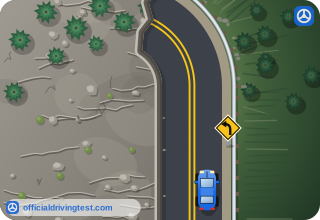
- Keep your speed steady
- Speed up to clear it quickly
- Always slow down
- Move toward the edge of the road
Show answer
Correct answer: Always slow down
You should always slow down near a curve or an area where you cannot see clearly ahead.
Source: Massachusetts Driver's Manual (Revised April 2026), page 45 · Open this page in the manual (Manual page 45)
-
What speed should you keep when driving at night?
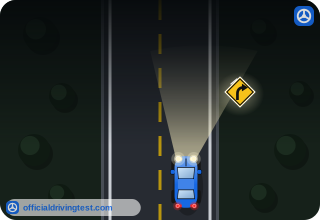
- One that lets you react and stop safely within the distance you can see ahead
- The posted speed limit, no matter how dark the road is or how unfamiliar the area
- A speed that matches the flow of the vehicles ahead of you on the road
- A speed slightly above the posted limit so you leave the dark sooner
Show answer
Correct answer: One that lets you react and stop safely within the distance you can see ahead
At night, keep a speed that will let you react and stop safely within the distance you can see ahead.
Source: Massachusetts Driver's Manual (Revised April 2026), page 46 · Open this page in the manual (Manual page 46)
-
At night, what should you allow near trucks and heavy equipment?
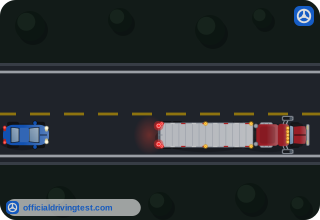
- Less space
- The same space as in daytime
- Additional space
- No extra space if you use high beams
Show answer
Correct answer: Additional space
At night, you should allow additional space when driving near trucks and heavy equipment.
Source: Massachusetts Driver's Manual (Revised April 2026), page 46 · Open this page in the manual (Manual page 46)
-
At night, where should you look instead of straight at oncoming headlights?
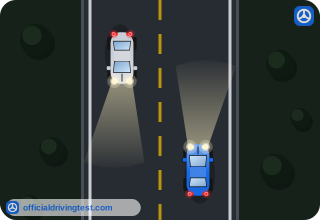
- To the upper left side of the oncoming lane
- At the center line
- At the oncoming driver
- To the lower right side of your lane
Show answer
Correct answer: To the lower right side of your lane
Do not look straight at headlights; look to the lower right side of your lane.
Source: Massachusetts Driver's Manual (Revised April 2026), page 46 · Open this page in the manual (Manual page 46)
-
When should you slow down in the rain?
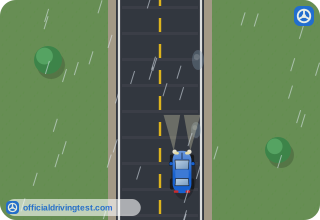
- After the road is completely wet
- As soon as the rain starts
- Only when you cannot see well
- After the first mile
Show answer
Correct answer: As soon as the rain starts
The manual says to slow down as soon as the rain starts.
Source: Massachusetts Driver's Manual (Revised April 2026), page 47 · Open this page in the manual (Manual page 47)
-
When are many roads most slippery in the rain?
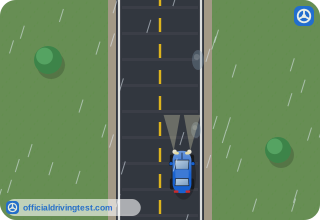
- When rain first mixes with road dirt and oil and forms a greasy film
- After several hours of steady rain have washed all the road dirt and oil away
- When the pavement has completely dried
- Only when the road is covered with leaves
Show answer
Correct answer: When rain first mixes with road dirt and oil and forms a greasy film
Many roads are most slippery when rain first mixes with road dirt and oil and forms a greasy film.
Source: Massachusetts Driver's Manual (Revised April 2026), page 47 · Open this page in the manual (Manual page 47)
-
What does the manual say wet leaves on the road can be as slippery as?
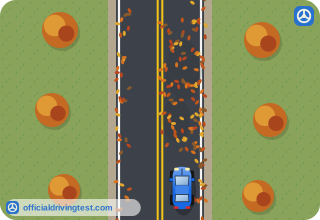
- Dry gravel
- Ice
- Fresh snow
- Wet pavement
Show answer
Correct answer: Ice
Wet leaves on the road can be as slippery as ice.
Source: Massachusetts Driver's Manual (Revised April 2026), page 47 · Open this page in the manual (Manual page 47)
-
In rain or fog, what should you do if you cannot see the pavement or sign posts?
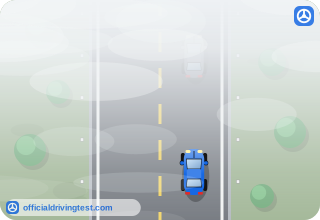
- Speed up to leave the poor-visibility area as quickly as you can
- Slow down and look for road edge markings to guide you
- Follow the center line closely
- Stop in the traffic lane
Show answer
Correct answer: Slow down and look for road edge markings to guide you
If you cannot see the pavement or sign posts, slow down and look for road edge markings to guide you.
Source: Massachusetts Driver's Manual (Revised April 2026), page 47 · Open this page in the manual (Manual page 47)
-
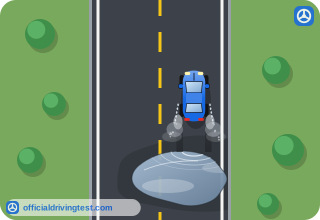
Why should you not drive through puddles?
- Puddles damage the horn
- Puddles cover road signs
- Puddles can freeze your gas line
- Wet brakes do not work right
Show answer
Correct answer: Wet brakes do not work right
The manual says not to drive through puddles because wet brakes do not work right.
Source: Massachusetts Driver's Manual (Revised April 2026), page 48 · Open this page in the manual (Manual page 48)
-
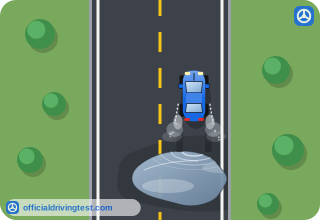
After you drive through a large puddle, what should you do to dry your brakes?
- Apply your brakes lightly until you feel them working normally again
- Press the brakes hard for several seconds and then release
- Wait without touching the brakes
- Pump the brakes quickly several times in a row until they feel dry again
Show answer
Correct answer: Apply your brakes lightly until you feel them working normally again
After a large puddle, apply your brakes lightly as soon as you can to dry them until they work normally again.
Source: Massachusetts Driver's Manual (Revised April 2026), page 48 · Open this page in the manual (Manual page 48)
-
What should you never do on icy roads?

- Drive carefully
- Accelerate slowly
- Lock your brakes
- Lower your speed
Show answer
Correct answer: Lock your brakes
Never lock your brakes on icy roads, because you will lose steering control.
Source: Massachusetts Driver's Manual (Revised April 2026), page 48 · Open this page in the manual (Manual page 48)
-
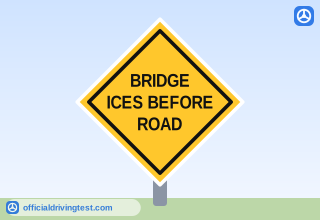
Why do bridges and highway overpasses freeze before the rest of the road?
- They are made of darker material
- The ground does not insulate them
- They are closer to the wind
- They have less traffic to melt ice
Show answer
Correct answer: The ground does not insulate them
Bridges and overpasses freeze before the rest of the road because the ground does not insulate them.
Source: Massachusetts Driver's Manual (Revised April 2026), page 48 · Open this page in the manual (Manual page 48)
-
If it is snowing, how can you test how much traction your tires have?

- Tap your brakes gently
- Pull up the hand brake hard
- Turn the wheel sharply
- Accelerate quickly
Show answer
Correct answer: Tap your brakes gently
When it is snowing, start slowly and test your brakes by tapping them gently to see how much traction your tires have.
Source: Massachusetts Driver's Manual (Revised April 2026), page 48 · Open this page in the manual (Manual page 48)
-
As your speed increases, what happens to the time and ground needed to stop your vehicle?
- You cover less ground and it takes less time to stop
- Stopping time stays the same on dry roads
- Stopping time changes only on rainy days
- You cover more ground and it takes longer to stop
Show answer
Correct answer: You cover more ground and it takes longer to stop
The higher the speed, the more ground your vehicle covers before braking begins, and the longer it takes to stop.
Source: Massachusetts Driver's Manual (Revised April 2026), page 78 · Open this page in the manual (Manual page 78)
-
What happens to your vehicle's safety equipment at high speeds?
- It is less effective
- It works the same at any speed
- It works better than at low speeds
- It turns off automatically
Show answer
Correct answer: It is less effective
At high speeds a vehicle's safety equipment is less effective.
Source: Massachusetts Driver's Manual (Revised April 2026), page 78 · Open this page in the manual (Manual page 78)
-
Which of these is a danger of driving fast, according to the manual?
- Your vehicle stops more quickly than usual
- You see the road around you more clearly
- You have a greater chance of losing control
- Your reaction time becomes much shorter
Show answer
Correct answer: You have a greater chance of losing control
Drivers travelling fast do not see well, cannot stop quickly, and have a greater chance of losing control of the vehicle.
Source: Massachusetts Driver's Manual (Revised April 2026), page 78 · Open this page in the manual (Manual page 78)
-
What does the manual say about fuel use when you drive at higher speeds?
- You use more fuel
- You use less fuel
- Fuel use stays the same
- Fuel use changes only on highways
Show answer
Correct answer: You use more fuel
Speeding costs money because more fuel is used at higher speeds.
Source: Massachusetts Driver's Manual (Revised April 2026), page 78 · Open this page in the manual (Manual page 78)
-
What is the fundamental speed law in Massachusetts?
- Always drive exactly at the posted speed limit
- Never travel so fast that it is not safe
- Always keep up with the flow of traffic
- Never drive more than 5 mph over the limit
Show answer
Correct answer: Never travel so fast that it is not safe
The fundamental speed law is that you must never travel so fast that it is not safe.
Source: Massachusetts Driver's Manual (Revised April 2026), page 79 · Open this page in the manual (Manual page 79)