Maryland: Sharing the road — Part 4 Practice Test
Large trucks and their No-Zones, school buses, motorcycles, bicycles and the passing distance, mopeds, scooters and low-speed vehicles, and aggressive driving. — Part 4
Independent educational site · not affiliated with any government agency or DMV
Ready? Test yourself
- Instant feedback with an explanation
- Every answer cites its source in the manual
- Your best score is saved on this device
Questions are original and based on the official manual "Maryland Driver’s Manual" (October 2025 Edition (DL-002 10-25)), Maryland Motor Vehicle Administration.
All 33 questions in this practice test
Take the test above first, then use this list to study. Tap “Show answer” to see the correct answer and explanation.
Show the questions and answersHide the questions
-
On which side of the road should a bicyclist always ride?
- The left side, facing traffic
- The side with less traffic
- Whichever side has a wider shoulder
- The right side
Show answer
Correct answer: The right side
The manual says to ride with traffic and always ride on the right side.
Source: Maryland Driver’s Manual (October 2025 Edition (DL-002 10-25)), page 53
-
When a bicyclist comes to an intersection, which lane should the bicyclist use?
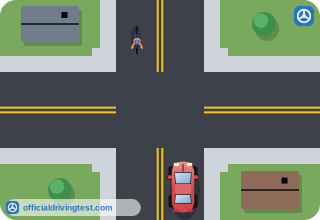
- The appropriate lane for the direction they are going
- Always the far right lane of the road
- Always the lane next to the center line
- Whatever lane happens to be empty at the time
Show answer
Correct answer: The appropriate lane for the direction they are going
At an intersection, use the appropriate lane for the direction you are going (left, straight, right).
Source: Maryland Driver’s Manual (October 2025 Edition (DL-002 10-25)), page 53
-
What should a bicyclist do before changing lanes or turning?
- Ring a bell twice
- Stop and walk the bicycle
- Look back
- Speed up to clear the lane
Show answer
Correct answer: Look back
The manual says to look back before you change lanes or turn and to use your turn signals.
Source: Maryland Driver’s Manual (October 2025 Edition (DL-002 10-25)), page 53
-
Which is a safe way for a bicyclist to make a left turn?
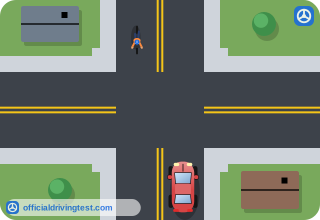
- Ride across the intersection on the sidewalk without stopping
- Stop, get off the bicycle, and walk across in a crosswalk
- Turn from the far right side of the lane without signaling
- Ride against traffic along the right edge of the road
Show answer
Correct answer: Stop, get off the bicycle, and walk across in a crosswalk
A bicyclist may cross like a pedestrian by stopping, getting off the bicycle, and walking across in a crosswalk.
Source: Maryland Driver’s Manual (October 2025 Edition (DL-002 10-25)), page 53
-
Besides crossing like a pedestrian, how may a bicyclist turn left?
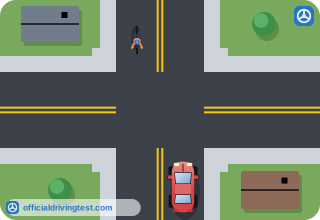
- Stay on the far right edge and make a very wide turn
- Ride on the sidewalk to the next corner and cross
- Follow closely behind a car through the whole turn
- Move to the left side of the travel lane or left turn lane
Show answer
Correct answer: Move to the left side of the travel lane or left turn lane
A bicyclist may turn left like motor vehicles do by moving to the left side of the travel lane (or left turn lane).
Source: Maryland Driver’s Manual (October 2025 Edition (DL-002 10-25)), page 53
-
A bicyclist holds the left arm straight out to the side. According to the manual’s bicycle hand signals, what does this signal?
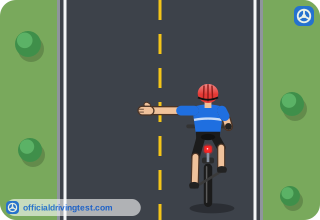
- A left turn
- A right turn
- Stopping
- An alternate right turn
Show answer
Correct answer: A left turn
The bicycle hand signal for a left turn is the left arm held straight out to the side.
Source: Maryland Driver’s Manual (October 2025 Edition (DL-002 10-25)), page 53
-
A bicyclist holds the left arm out with the forearm bent down at the elbow, hand pointing down. According to the manual’s bicycle hand signals, what does this signal?
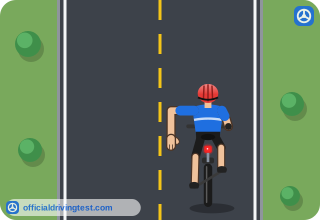
- A left turn
- A right turn
- Stopping
- An alternate right turn
Show answer
Correct answer: Stopping
The bicycle hand signal for stopping is the left arm pointing down.
Source: Maryland Driver’s Manual (October 2025 Edition (DL-002 10-25)), page 53
-
A bicyclist holds the left arm bent upward at the elbow with the hand up. According to the manual’s bicycle hand signals, what does this signal?
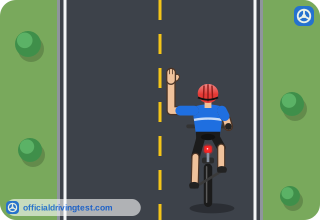
- A left turn
- A right turn
- Stopping
- An alternate right turn
Show answer
Correct answer: A right turn
The bicycle hand signal for a right turn is the left arm bent upward at the elbow.
Source: Maryland Driver’s Manual (October 2025 Edition (DL-002 10-25)), page 53
-
A bicyclist holds the right arm straight out to the side. According to the manual’s bicycle hand signals, what does this signal?
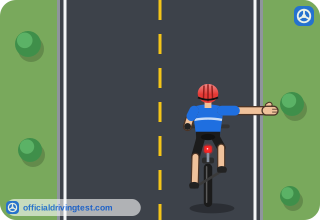
- A left turn
- Stopping
- A right turn made with the left arm
- An alternate right turn
Show answer
Correct answer: An alternate right turn
The alternate right turn signal is the right arm held straight out to the side.
Source: Maryland Driver’s Manual (October 2025 Edition (DL-002 10-25)), page 53
-
When braking in rain or snow, what should a bicyclist do?
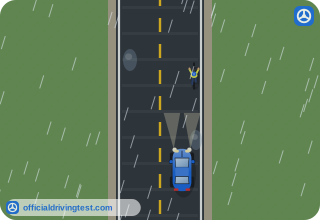
- Allow extra distance to stop
- Brake only with the front brake
- Brake as late as possible
- Ride on the painted pavement markings
Show answer
Correct answer: Allow extra distance to stop
When braking in the rain or snow, a bicyclist should allow extra distance to stop.
Source: Maryland Driver’s Manual (October 2025 Edition (DL-002 10-25)), page 54
-
Which road surfaces may be slippery for a bicyclist in wet weather?
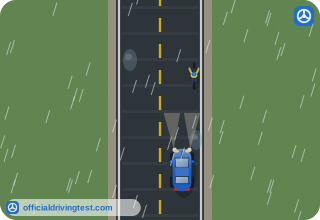
- Fresh asphalt and new smooth concrete
- Gravel shoulders and dirt side roads
- Pavement markings and utility covers
- Bike lane signs and street poles
Show answer
Correct answer: Pavement markings and utility covers
A bicyclist should look for pavement markings and utility covers, which may be slippery.
Source: Maryland Driver’s Manual (October 2025 Edition (DL-002 10-25)), page 54
-
What does Maryland State Law require on a bicycle ridden at night?
- A red headlight on the front and a white reflector on the back
- A white headlight on the front and a red reflector on the back
- A yellow headlight on the front and a blue reflector on the back
- A white reflector on the front and a white headlight on the back
Show answer
Correct answer: A white headlight on the front and a red reflector on the back
When riding at night, Maryland State Law requires a white headlight on the front of your bicycle and a red reflector on the back.
Source: Maryland Driver’s Manual (October 2025 Edition (DL-002 10-25)), page 54
-
A bicycle’s red rear reflector must be visible from at least how far away?
- 100 feet
- 200 feet
- 300 feet
- 600 feet
Show answer
Correct answer: 600 feet
The manual says the red reflector must be visible from at least 600 feet away.
Source: Maryland Driver’s Manual (October 2025 Edition (DL-002 10-25)), page 54
-
What does the manual recommend a bicyclist wear in the daytime?
- Bright clothing
- Dark clothing
- Loose, baggy clothing
- A hooded jacket
Show answer
Correct answer: Bright clothing
It is recommended that you wear bright clothing in the daytime and reflective clothing for night riding.
Source: Maryland Driver’s Manual (October 2025 Edition (DL-002 10-25)), page 54
-
What does the manual recommend a bicyclist wear for night riding?
- Dark clothing
- Loose, baggy clothing
- Reflective clothing
- A dark helmet
Show answer
Correct answer: Reflective clothing
It is recommended that you wear reflective clothing for night riding.
Source: Maryland Driver’s Manual (October 2025 Edition (DL-002 10-25)), page 54
-
Helmets are required for anyone riding on a bike who is under what age?
- Age 12
- Age 16
- Age 14
- Age 18
Show answer
Correct answer: Age 16
Helmets are required for anyone under age 16 riding on a bike.
Source: Maryland Driver’s Manual (October 2025 Edition (DL-002 10-25)), page 54
-
Does the helmet requirement for riders under age 16 apply to a passenger who is not steering the bike?
- No, only the person who steers needs one
- No, passengers are exempt on bike paths
- Only if the bicycle has three wheels or more
- Yes, it includes passengers who are not steering
Show answer
Correct answer: Yes, it includes passengers who are not steering
The helmet requirement includes passengers that are not steering the bike.
Source: Maryland Driver’s Manual (October 2025 Edition (DL-002 10-25)), page 54
-
For whom does the manual say helmets are strongly recommended?
- People of all ages
- Only children
- Only riders on busy roads
- Only riders at night
Show answer
Correct answer: People of all ages
Helmets are also strongly recommended for people of all ages.
Source: Maryland Driver’s Manual (October 2025 Edition (DL-002 10-25)), page 54
-
By law, bicycle brakes must be able to stop the bicycle within how many feet when going 10 miles per hour on dry, level, clean pavement?
- 5 feet
- 25 feet
- 15 feet
- 40 feet
Show answer
Correct answer: 15 feet
By law, all bicycles must have brakes that can stop the bicycle within 15 feet at 10 miles per hour on dry, level, clean pavement.
Source: Maryland Driver’s Manual (October 2025 Edition (DL-002 10-25)), page 54
-
What must a bicycle have if you are traveling with a small child?
- A second set of pedals for the small child to use
- A safety seat or trailer, firmly attached to the bicycle
- A bright flag on a tall pole behind the seat
- A rear-view mirror mounted on each handlebar
Show answer
Correct answer: A safety seat or trailer, firmly attached to the bicycle
By law, a bicycle must have a safety seat or trailer firmly attached if traveling with a small child.
Source: Maryland Driver’s Manual (October 2025 Edition (DL-002 10-25)), page 54
-
What must a bicycle have when carrying small things?
- A strap for holding the items in one hand while you ride
- A small sidecar attached to the rear wheel of the bicycle
- A wider set of handlebar grips made for carrying heavy loads
- A basket, rack, or bag so both hands can be kept on the handlebars
Show answer
Correct answer: A basket, rack, or bag so both hands can be kept on the handlebars
A bicycle must have a basket, rack, or bag when carrying small things so both hands can be kept on the handlebars.
Source: Maryland Driver’s Manual (October 2025 Edition (DL-002 10-25)), page 54
-
How many wheels does an electric bicycle have?
- Two or three
- Only two
- Three or four
- Four
Show answer
Correct answer: Two or three
An electric bicycle has two or three wheels.
Source: Maryland Driver’s Manual (October 2025 Edition (DL-002 10-25)), page 54
-
What must an electric bicycle have besides an electric motor?
- A handlebar-mounted platform
- A rear seat for a passenger
- Fully operable pedals
- A top speed of at least 28 mph
Show answer
Correct answer: Fully operable pedals
Electric bicycles have fully operable pedals and are operated by human power with the assistance of an electric motor.
Source: Maryland Driver’s Manual (October 2025 Edition (DL-002 10-25)), page 54
-
An electric bicycle’s electric motor must have a rating of what?
- 250 watts or less
- 750 watts or less
- 1,500 watts or less
- 3,000 watts or less
Show answer
Correct answer: 750 watts or less
An electric bicycle has an electric motor with a rating of 750 watts or less.
Source: Maryland Driver’s Manual (October 2025 Edition (DL-002 10-25)), page 54
-
Which class of electric bicycle has a motor that provides assistance whether or not the rider is pedaling?
- Class 1
- Class 3
- None of these
- Class 2
Show answer
Correct answer: Class 2
A Class 2 electric bicycle provides assistance whether or not the rider is pedaling and stops at 20 miles per hour.
Source: Maryland Driver’s Manual (October 2025 Edition (DL-002 10-25)), page 54
-
At what speed does the motor of a Class 1 electric bicycle stop providing assistance?
- 20 miles per hour
- 15 miles per hour
- 25 miles per hour
- 28 miles per hour
Show answer
Correct answer: 20 miles per hour
A Class 1 motor provides assistance only when the rider is pedaling and stops at 20 miles per hour.
Source: Maryland Driver’s Manual (October 2025 Edition (DL-002 10-25)), page 54
-
At what speed does the motor of a Class 3 electric bicycle stop providing assistance?
- 15 miles per hour
- 20 miles per hour
- 28 miles per hour
- 35 miles per hour
Show answer
Correct answer: 28 miles per hour
A Class 3 motor provides assistance only when the rider is pedaling and stops at 28 miles per hour.
Source: Maryland Driver’s Manual (October 2025 Edition (DL-002 10-25)), page 54
-
How many people is an electric low-speed vehicle designed to transport?
- The operator and one passenger
- Only the operator
- Up to three people
- Up to five people
Show answer
Correct answer: Only the operator
Electric low-speed vehicles are designed to transport only the operator.
Source: Maryland Driver’s Manual (October 2025 Edition (DL-002 10-25)), page 54
-
An electric low-speed vehicle weighs less than how much?
- 25 pounds
- 250 pounds
- 500 pounds
- 100 pounds
Show answer
Correct answer: 100 pounds
Electric low-speed vehicles weigh less than 100 pounds.
Source: Maryland Driver’s Manual (October 2025 Edition (DL-002 10-25)), page 54
-
What does an electric low-speed vehicle have for the rider?
- Handlebars and a platform the rider stands on
- A bench seat, a steering wheel and a roof
- Two seats with a roof and a windshield
- A small cargo bed behind the driver’s seat
Show answer
Correct answer: Handlebars and a platform the rider stands on
Electric low-speed vehicles have handlebars and a platform the rider stands on.
Source: Maryland Driver’s Manual (October 2025 Edition (DL-002 10-25)), page 54
-
How are electric low-speed vehicles powered?
- By a gasoline engine and a fuel tank
- By a diesel engine and an exhaust pipe
- By an electric motor and human power
- By an electric motor with no human power
Show answer
Correct answer: By an electric motor and human power
Electric low-speed vehicles are powered by an electric motor and human power.
Source: Maryland Driver’s Manual (October 2025 Edition (DL-002 10-25)), page 54
-
An electric low-speed vehicle can operate at a speed of up to how many miles per hour?
- 10 miles per hour
- 20 miles per hour
- 28 miles per hour
- 35 miles per hour
Show answer
Correct answer: 20 miles per hour
Electric low-speed vehicles can operate at a speed of up to 20 miles per hour.
Source: Maryland Driver’s Manual (October 2025 Edition (DL-002 10-25)), page 54
-
If you use a low-speed electric vehicle, what should you check?
- Whether it has a Maryland license plate
- Whether your insurer allows it
- Whether it has an air bag
- Whether there are other local restrictions
Show answer
Correct answer: Whether there are other local restrictions
If you use a low-speed electric vehicle, check to see if there are other local restrictions.
Source: Maryland Driver’s Manual (October 2025 Edition (DL-002 10-25)), page 54