Maryland: Sharing the road — Part 2 Practice Test
Large trucks and their No-Zones, school buses, motorcycles, bicycles and the passing distance, mopeds, scooters and low-speed vehicles, and aggressive driving. — Part 2
Independent educational site · not affiliated with any government agency or DMV
Ready? Test yourself
- Instant feedback with an explanation
- Every answer cites its source in the manual
- Your best score is saved on this device
Questions are original and based on the official manual "Maryland Driver’s Manual" (October 2025 Edition (DL-002 10-25)), Maryland Motor Vehicle Administration.
All 34 questions in this practice test
Take the test above first, then use this list to study. Tap “Show answer” to see the correct answer and explanation.
Show the questions and answersHide the questions
-
How should you pass a truck that is going in the same direction?
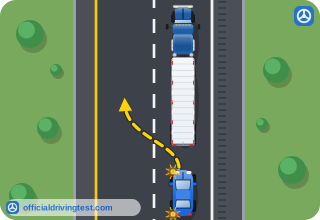
- Slowly, staying beside it so its driver can see you
- Alongside it for as long as possible
- Quickly, so you can still see what is around you
- Only when the truck has slowed to a stop
Show answer
Correct answer: Quickly, so you can still see what is around you
When passing a truck going in the same direction, pass quickly so you can continue to see what is happening around you.
Source: Maryland Driver’s Manual (October 2025 Edition (DL-002 10-25)), page 38
-
After passing a truck, when may you move back into the lane in front of it?
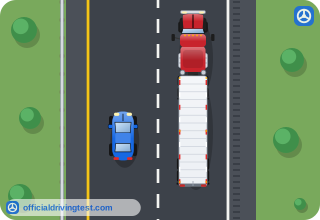
- As soon as your rear bumper clears its front
- When both of its headlights show in your rear-view mirror
- When you see the truck driver's face in your mirror
- As soon as you can see one of its headlights
Show answer
Correct answer: When both of its headlights show in your rear-view mirror
Move back into the lane with the truck only when you can see both of its headlights in your rear-view mirror.
Source: Maryland Driver’s Manual (October 2025 Edition (DL-002 10-25)), page 38
-
Why could stopping past the stop line at an intersection be a problem for trucks?
- Trucks must stop behind you at the stop line
- Your vehicle could be ticketed for blocking a lane
- Trucks are unable to see the stop line clearly
- You could block trucks turning from a cross street
Show answer
Correct answer: You could block trucks turning from a cross street
If you stop past the stop line, your vehicle could be in the way of trucks turning from a cross street.
Source: Maryland Driver’s Manual (October 2025 Edition (DL-002 10-25)), page 38
-
According to the manual, fully loaded trucks can weigh more than how many pounds?
- 80,000 pounds
- 8,000 pounds
- 18,000 pounds
- 800 pounds
Show answer
Correct answer: 80,000 pounds
The manual says fully loaded trucks can weigh more than 80,000 pounds.
Source: Maryland Driver’s Manual (October 2025 Edition (DL-002 10-25)), page 38
-
About how much distance can a fully loaded truck need to stop?
- The length of a city block
- The length of a school bus
- The length of a football field
- The length of two cars
Show answer
Correct answer: The length of a football field
Fully loaded trucks take the length of a football field to stop, which is why you should never cut in front of one.
Source: Maryland Driver’s Manual (October 2025 Edition (DL-002 10-25)), page 38
-
How many large blind spots called “no zones” are there around trucks?
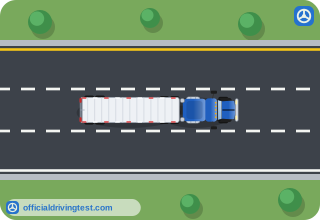
- Two
- Three
- Six
- Four
Show answer
Correct answer: Four
The manual says there are four large blind spots around trucks, called no zones.
Source: Maryland Driver’s Manual (October 2025 Edition (DL-002 10-25)), page 38
-
What is the sign that a truck driver cannot see you in the truck's side-view mirror?
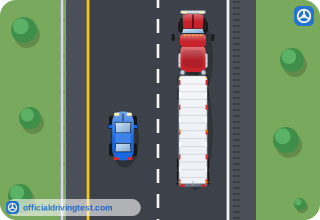
- You cannot see the driver's face in the mirror
- The truck's turn signal is flashing
- The truck is driving slower than you
- You can see the whole trailer in the mirror
Show answer
Correct answer: You cannot see the driver's face in the mirror
If you cannot see the driver's face in their side-view mirror, they cannot see you.
Source: Maryland Driver’s Manual (October 2025 Edition (DL-002 10-25)), page 38
-
How far does the right-side blind spot of a truck extend out from the truck?
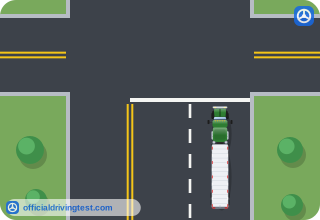
- One lane
- Two lanes
- Three lanes
- Four lanes
Show answer
Correct answer: Three lanes
The right-side blind spot runs the length of the truck's trailer and extends out three lanes.
Source: Maryland Driver’s Manual (October 2025 Edition (DL-002 10-25)), page 38
-
Why is it dangerous to tailgate a truck or bus?
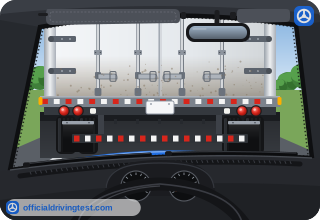
- The driver is likely to sound the horn to warn you
- The driver cannot see you behind and you have no place to go
- The truck's exhaust fumes may damage your car's paint
- The truck's brake lights are hidden from your view
Show answer
Correct answer: The driver cannot see you behind and you have no place to go
Trucks and buses have huge no zones directly behind them, and their drivers cannot see your car there. If the vehicle suddenly slows or stops, you have no place to go.
Source: Maryland Driver’s Manual (October 2025 Edition (DL-002 10-25)), page 38
-
Compared with cars, how much time and room do truck and bus drivers need to stop?
- About the same
- Almost half as much
- Almost three times as much
- Almost twice as much
Show answer
Correct answer: Almost twice as much
Truck and bus drivers need almost twice as much time and room to stop as cars do.
Source: Maryland Driver’s Manual (October 2025 Edition (DL-002 10-25)), page 38
-
After you pull in front of a truck or bus that you have passed, what should you not do?
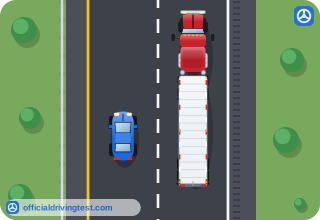
- Slow down
- Use your turn signal
- Look in your rear-view mirror
- Keep a steady speed
Show answer
Correct answer: Slow down
The manual says to look for both headlights in the rear-view mirror before pulling in front of a truck or bus, and then not to slow down.
Source: Maryland Driver’s Manual (October 2025 Edition (DL-002 10-25)), page 38
-
What should you never do with a truck that is backing up?
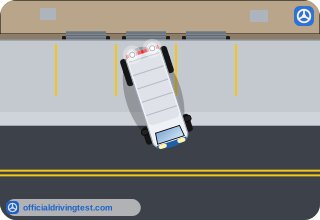
- Pass it on the left
- Wait for it at a distance
- Cross behind it
- Sound your horn
Show answer
Correct answer: Cross behind it
The manual says never to cross behind a truck that is backing up, because its driver may not see you.
Source: Maryland Driver’s Manual (October 2025 Edition (DL-002 10-25)), page 38
-
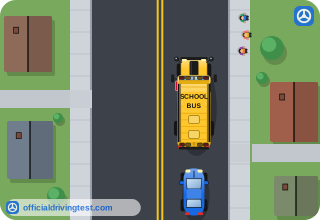
When must you stop for a school bus?
- Only when children are crossing the road in front of it
- When it has stopped on the road with its flashing red lights on
- Only when it has stopped at the side of the road
- Whenever it is within 100 feet of you
Show answer
Correct answer: When it has stopped on the road with its flashing red lights on
If a school bus has stopped on the road with its flashing red lights on, you must stop as you approach it.
Source: Maryland Driver’s Manual (October 2025 Edition (DL-002 10-25)), page 38
-
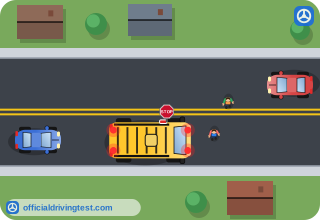
A school bus has stopped on the road with its flashing red lights on and you are behind it. How far from the back of the bus must you stop?
- At least 10 feet
- At least 30 feet
- At least 50 feet
- At least 20 feet
Show answer
Correct answer: At least 20 feet
You must stop at least 20 feet from the back of the school bus if you are behind it.
Source: Maryland Driver’s Manual (October 2025 Edition (DL-002 10-25)), page 38
-
A school bus has stopped on the road with its flashing red lights on and you are in front of it. How far from the front of the bus must you stop?
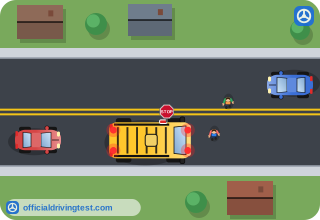
- At least 20 feet
- At least 5 feet
- At least 15 feet
- At least 40 feet
Show answer
Correct answer: At least 20 feet
You must stop at least 20 feet from the front of the school bus if you are in front of it.
Source: Maryland Driver’s Manual (October 2025 Edition (DL-002 10-25)), page 38
-
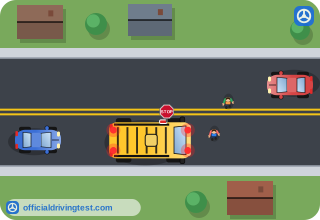
After stopping for a school bus with its flashing red lights on, when may you start moving again?
- As soon as the children have crossed in front of you
- As soon as the bus driver waves you on past it
- When the bus moves or turns off its flashing red lights
- After waiting about 10 seconds with your car in gear
Show answer
Correct answer: When the bus moves or turns off its flashing red lights
You may not start moving again until the school bus starts moving or turns off its flashing red lights.
Source: Maryland Driver’s Manual (October 2025 Edition (DL-002 10-25)), page 39
-
You are on a multiple lane road divided by a physical barrier, and a school bus on the other side of the barrier has its red lights flashing. What should you do?
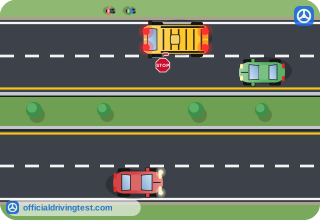
- Stop at least 20 feet from the bus
- Not stop
- Stop only if the bus is in the lane next to the barrier
- Slow down and then stop
Show answer
Correct answer: Not stop
On a multiple lane road divided by a physical barrier, you do not stop if the bus is on the other side of the barrier.
Source: Maryland Driver’s Manual (October 2025 Edition (DL-002 10-25)), page 39
-
What rights and privileges do motorcyclists have on the road?
- Fewer than car drivers
- More than car drivers
- The right to pass in the same lane
- The same as any other driver
Show answer
Correct answer: The same as any other driver
Motorcyclists have the same rights and privileges as any other driver on the road.
Source: Maryland Driver’s Manual (October 2025 Edition (DL-002 10-25)), page 39
-
What must you do when turning left and a motorcycle is oncoming?
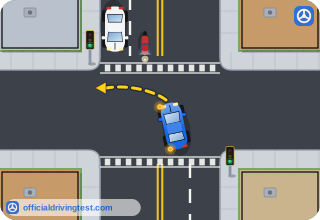
- Yield the right-of-way to the motorcycle
- Turn first, because the motorcycle can stop faster
- Flash your headlights to tell the rider to go on
- Turn quickly before the motorcycle reaches you
Show answer
Correct answer: Yield the right-of-way to the motorcycle
You must yield the right-of-way to an oncoming motorcycle when turning left, or you could get a citation with significant penalties.
Source: Maryland Driver’s Manual (October 2025 Edition (DL-002 10-25)), page 39
-
Why should you look twice before changing lanes or merging into traffic?
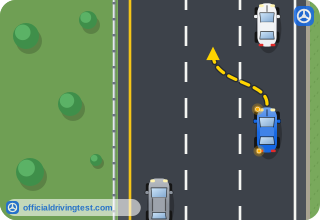
- Motorcycles always travel faster than cars
- Most lanes are too narrow for motorcycles
- Motorcycles can be hidden in your blind spot
- Motorcycle riders rarely use their turn signals
Show answer
Correct answer: Motorcycles can be hidden in your blind spot
Motorcycles can be hidden in your blind spot or missed in a quick look because they are smaller.
Source: Maryland Driver’s Manual (October 2025 Edition (DL-002 10-25)), page 39
-
How much of a traffic lane are motorcyclists allowed to use?
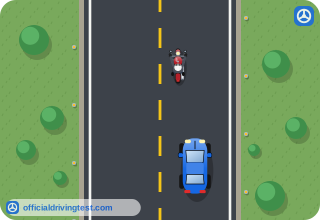
- Only the center of the lane
- The whole lane
- Only the left half of the lane
- Only the right half of the lane
Show answer
Correct answer: The whole lane
Motorcyclists are allowed to use the whole lane, so you should not share a lane with a motorcycle.
Source: Maryland Driver’s Manual (October 2025 Edition (DL-002 10-25)), page 39
-
Why do motorcyclists often move around within a traffic lane?
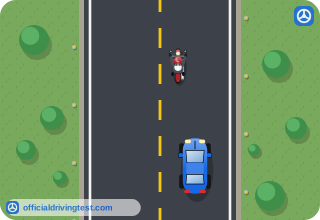
- To get around slower vehicles in front of them
- To stop other drivers from tailgating them
- To save fuel and keep the engine from overheating
- To avoid road hazards like potholes or oil spills
Show answer
Correct answer: To avoid road hazards like potholes or oil spills
Motorcyclists often move around in a lane to avoid road hazards like potholes or oil spills, because of wind, and to be seen by others.
Source: Maryland Driver’s Manual (October 2025 Edition (DL-002 10-25)), page 39
-
What following distance should you leave between your vehicle and a motorcycle in front of you?
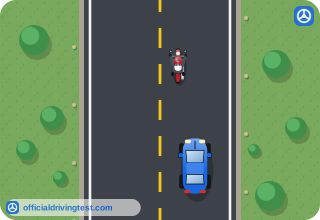
- At least 3 to 4 seconds
- At least 1 to 2 seconds
- At least 2 to 3 seconds
- At least 5 to 6 seconds
Show answer
Correct answer: At least 3 to 4 seconds
The manual says to leave at least a 3 to 4-second following distance behind a motorcycle.
Source: Maryland Driver’s Manual (October 2025 Edition (DL-002 10-25)), page 39
-
What do motorcyclists often do that can surprise a driver following them?
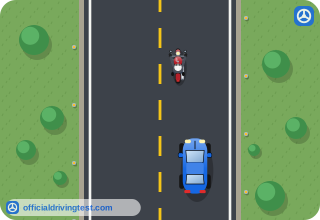
- Stop suddenly without using their brakes at all
- Change lanes without ever checking their mirrors
- Reduce speed without turning on their brake lights
- Speed up without any warning to other drivers
Show answer
Correct answer: Reduce speed without turning on their brake lights
Motorcyclists often reduce speed in ways that do not cause their brake lights to come on, so you should be alert and leave plenty of space.
Source: Maryland Driver’s Manual (October 2025 Edition (DL-002 10-25)), page 39
-
What can affect a motorcycle when a vehicle passes it?
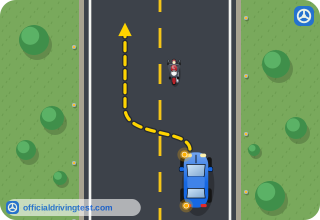
- Heat from the engine
- Wind gusts and drafts
- Glare from headlights
- The noise of the horn
Show answer
Correct answer: Wind gusts and drafts
Wind gusts and drafts from a passing vehicle can affect a motorcycle, so you should leave plenty of space when passing.
Source: Maryland Driver’s Manual (October 2025 Edition (DL-002 10-25)), page 39
-
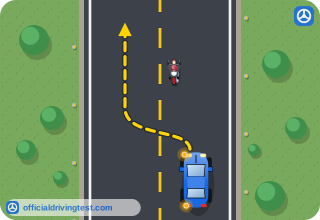
After passing a motorcycle, what should you be able to see in your rear-view mirror before moving back into the lane?
- The motorcycle's brake light
- The rider's face
- The motorcycle's turn signal
- The motorcycle's headlight
Show answer
Correct answer: The motorcycle's headlight
After passing a rider, make sure you can see the motorcycle's headlight in your rear-view mirror before moving back into the lane.
Source: Maryland Driver’s Manual (October 2025 Edition (DL-002 10-25)), page 39
-
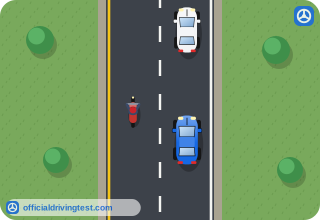
A motorcyclist is passing you. What should you do?
- Maintain your speed and let them complete the pass
- Speed up so that they can pass you more quickly
- Move to the edge of your lane to make room
- Slow down and tap your brakes to give them room
Show answer
Correct answer: Maintain your speed and let them complete the pass
If a motorcyclist is passing you, simply maintain your speed and allow them to complete their passing.
Source: Maryland Driver’s Manual (October 2025 Edition (DL-002 10-25)), page 39
-
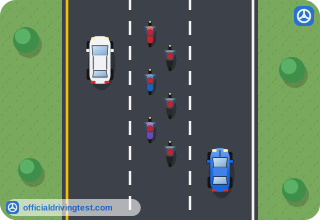
You need to change lanes or reach an exit near a group of motorcyclists. What should you do?
- Merge quickly between two riders in the group
- Sound your horn to get the group to move over
- Signal early and wait for the riders to make room
- Flash your headlights and then merge in quickly
Show answer
Correct answer: Signal early and wait for the riders to make room
If you need to change lanes or reach an exit, use your turn signal early and wait for the riders in the group to make room for you.
Source: Maryland Driver’s Manual (October 2025 Edition (DL-002 10-25)), page 39
-
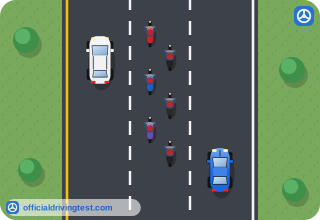
When should you merge in between groups or riders in a motorcycle ride?
- Whenever your turn signal has been turned on
- Only when there is enough space to do so safely
- Whenever the riders are not in a single line
- Only on a multiple lane road with no traffic
Show answer
Correct answer: Only when there is enough space to do so safely
Only merge in between groups or riders when there is enough space to do so safely.
Source: Maryland Driver’s Manual (October 2025 Edition (DL-002 10-25)), page 39
-
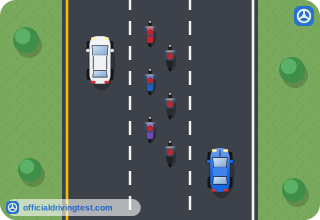
Near a small group of motorcyclists, what may be easier than changing lanes through them?
- Speeding up to pass the group
- Following the last rider closely
- Moving between the first two riders
- Slowing down and letting the group pass
Show answer
Correct answer: Slowing down and letting the group pass
For a small group, it may be easier to slow down and let the group pass before changing lanes.
Source: Maryland Driver’s Manual (October 2025 Edition (DL-002 10-25)), page 39
-
Under Maryland law, what are bicycles?
- Vehicles
- Pedestrians on wheels
- Exempt from traffic signals
- Allowed on the road only in bike lanes
Show answer
Correct answer: Vehicles
The manual says bicycles are vehicles according to Maryland law, and bicyclists must obey all traffic signals.
Source: Maryland Driver’s Manual (October 2025 Edition (DL-002 10-25)), page 39
-
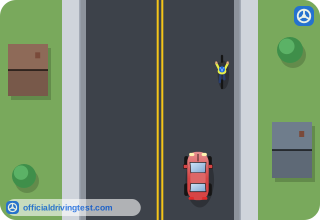
Why must you drive carefully near bicyclists?
- They always ride in the center of the traffic lane
- They are not permitted to ride on the road at all
- They lack a protective barrier like a motor vehicle
- They may ignore traffic signals at most intersections
Show answer
Correct answer: They lack a protective barrier like a motor vehicle
Bicyclists are harder to see, quieter, and have no protective barrier around them like a motor vehicle, so even a little mistake can result in serious injury or death.
Source: Maryland Driver’s Manual (October 2025 Edition (DL-002 10-25)), page 39
-
According to the manual, why may a bicyclist ride out in the travel lane where motor vehicles are?
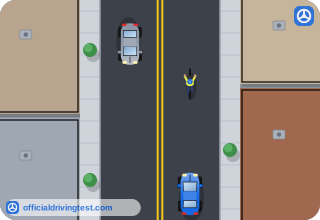
- The road is narrow, or the bicyclist is avoiding obstacles or pavement hazards
- The bicyclist is required to stay out of the bike lane at all times
- Bicycles are not allowed on roads that have shoulders
- Motor vehicles are not allowed to use the lane the bicyclist is in
Show answer
Correct answer: The road is narrow, or the bicyclist is avoiding obstacles or pavement hazards
Bicyclists may ride in the travel lane for their own safety, because the road is narrow or to avoid obstacles or pavement hazards.
Source: Maryland Driver’s Manual (October 2025 Edition (DL-002 10-25)), page 40
-
You should expect to find bicyclists on all types of roads except which?
- Roads without shoulders
- Roads in residential areas
- Interstate highways
- Roads that have no bike lane
Show answer
Correct answer: Interstate highways
The manual says to expect bicyclists on all types of roads except interstate highways, and bridges and tunnels with tolls.
Source: Maryland Driver’s Manual (October 2025 Edition (DL-002 10-25)), page 40