Maryland: Interstate driving Practice Test
Entering and leaving an interstate or limited-access highway, acceleration and deceleration lanes, lane choice and stopping on the shoulder.
Independent educational site · not affiliated with any government agency or DMV
Ready? Test yourself
- Instant feedback with an explanation
- Every answer cites its source in the manual
- Your best score is saved on this device
Questions are original and based on the official manual "Maryland Driver’s Manual" (October 2025 Edition (DL-002 10-25)), Maryland Motor Vehicle Administration.
All 16 questions in this practice test
Take the test above first, then use this list to study. Tap “Show answer” to see the correct answer and explanation.
Show the questions and answersHide the questions
-
Which describes a limited access highway?
- A large road with no intersections or traffic lights
- A road with traffic lights only at its ramps and exits
- A two-lane road with very few driveways or side roads
- A road that only trucks and buses are allowed to use
Show answer
Correct answer: A large road with no intersections or traffic lights
The manual describes limited access highways as large roads with no intersections or traffic lights and a limited number of places to enter and exit.
Source: Maryland Driver’s Manual (October 2025 Edition (DL-002 10-25)), page 31
-
What is an interstate?
- A limited access highway that crosses from one state to another
- Any highway that has a route number and several lanes
- A road that connects two cities inside one state
- A highway with traffic lights at the entrance to towns
Show answer
Correct answer: A limited access highway that crosses from one state to another
The manual says an interstate is a type of limited access highway that crosses from one state to another.
Source: Maryland Driver’s Manual (October 2025 Edition (DL-002 10-25)), page 31
-
How are interstate and other limited access highways usually reached?
- By a deceleration lane and an exit ramp
- By a signalized intersection with a turn lane
- By an entrance ramp and an acceleration lane
- By a service road crossing at each mile
Show answer
Correct answer: By an entrance ramp and an acceleration lane
The manual says interstate and other limited access highways are usually reached by an entrance ramp and an acceleration lane.
Source: Maryland Driver’s Manual (October 2025 Edition (DL-002 10-25)), page 32
-
What is the acceleration lane used for?
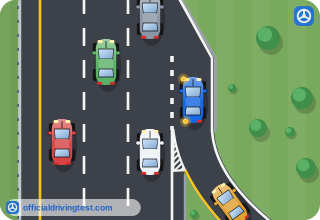
- To stop and wait for a gap
- To adjust your speed to the flow of traffic
- To pass slower vehicles on the highway
- To slow down before an exit
Show answer
Correct answer: To adjust your speed to the flow of traffic
The manual says you use the acceleration lane to adjust your speed to the flow of traffic already on the interstate.
Source: Maryland Driver’s Manual (October 2025 Edition (DL-002 10-25)), page 32
-
When entering an interstate, which lines should you not cross?
- The broken lines between the lanes of the highway
- The yellow lines along the edge of the shoulder
- The painted lines at the end of the entrance ramp
- The solid lines that divide the entrance and the highway
Show answer
Correct answer: The solid lines that divide the entrance and the highway
The manual says that when entering an interstate you should not cross the solid lines that divide the entrance and the highway.
Source: Maryland Driver’s Manual (October 2025 Edition (DL-002 10-25)), page 32
-
If you are driving slower than the speed of traffic on an interstate, which lane must you use whenever possible?
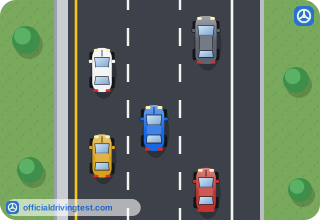
- The left lane
- The center lane
- The acceleration lane
- The right lane
Show answer
Correct answer: The right lane
The manual says that if you are driving slower than the speed of traffic on the highway, you must drive in the right lane whenever possible.
Source: Maryland Driver’s Manual (October 2025 Edition (DL-002 10-25)), page 32
-
When should you move to the right lane to exit an interstate?
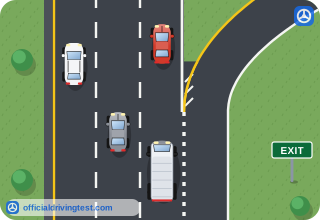
- Just as you pass the exit sign
- Well before you reach the exit
- Only after you enter the deceleration lane
- At the last moment before the exit
Show answer
Correct answer: Well before you reach the exit
The manual says to move to the right lane well before you reach the exit you plan to take.
Source: Maryland Driver’s Manual (October 2025 Edition (DL-002 10-25)), page 32
-
When should you start slowing down to leave an interstate?
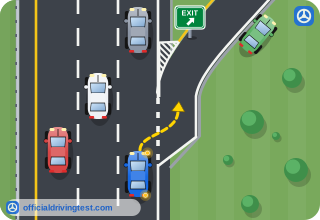
- Only after you are on the exit ramp
- When you reach the end of the exit ramp
- As soon as you enter the deceleration lane
- While still in the right lane of the highway
Show answer
Correct answer: As soon as you enter the deceleration lane
The manual says to start slowing down as soon as you enter the deceleration lane.
Source: Maryland Driver’s Manual (October 2025 Edition (DL-002 10-25)), page 32
-
Where does the deceleration lane lead you?
- To the exit ramp
- To the entrance ramp
- To the shoulder
- To the acceleration lane
Show answer
Correct answer: To the exit ramp
The manual says the deceleration lane leads you to the exit ramp and gives you time to start slowing down to a safe speed.
Source: Maryland Driver’s Manual (October 2025 Edition (DL-002 10-25)), page 32
-
What should you do if you exit an interstate at the wrong place?
- Stop on the exit ramp and back up to the highway lanes
- Cross the solid lines to rejoin the highway quickly
- Continue until you are off the exit ramp and re-enter
- Pull to the side of the ramp and wait for a gap
Show answer
Correct answer: Continue until you are off the exit ramp and re-enter
The manual says to continue until you are off the exit ramp and then look for a way to re-enter the road.
Source: Maryland Driver’s Manual (October 2025 Edition (DL-002 10-25)), page 32
-
Which is true of stopping and backing up on an interstate or other highway?
- Do it only on the shoulder
- Never do it on any part of the highway
- Do it only if no traffic is in sight
- Do it only on an exit ramp
Show answer
Correct answer: Never do it on any part of the highway
The manual says never to stop and back up on any part of the highway.
Source: Maryland Driver’s Manual (October 2025 Edition (DL-002 10-25)), page 32
-
What is the rule about stopping in the lanes where traffic is moving on an interstate?
- You may stop there if you turn on your flashers
- You may stop there if you are in the right lane
- You may stop there for up to one minute
- You are not allowed to stop there
Show answer
Correct answer: You are not allowed to stop there
The manual says you are not allowed to stop in the lanes where traffic is moving on an interstate or other highway.
Source: Maryland Driver’s Manual (October 2025 Edition (DL-002 10-25)), page 32
-
When may you stop on the shoulder of an interstate?
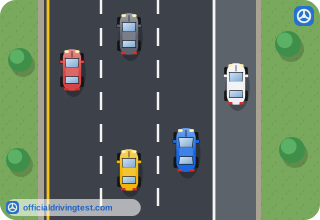
- Whenever you need to stop to check a map or your phone
- Whenever you want to let faster traffic pass
- Whenever the traffic in the moving lanes is slow
- Only when your vehicle is disabled or in another emergency
Show answer
Correct answer: Only when your vehicle is disabled or in another emergency
The manual says you may stop on the shoulder only when your vehicle is disabled or you have another emergency.
Source: Maryland Driver’s Manual (October 2025 Edition (DL-002 10-25)), page 32
-
If you must stop on the shoulder of an interstate, what should you turn on?
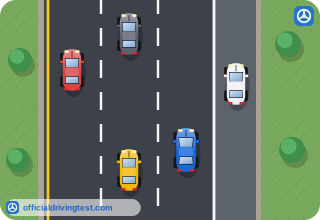
- Your high-beam headlights
- Your emergency flashers
- Your parking lights
- Your left turn signal
Show answer
Correct answer: Your emergency flashers
The manual says to turn on your emergency flashers to warn other drivers if you must stop on the shoulder.
Source: Maryland Driver’s Manual (October 2025 Edition (DL-002 10-25)), page 32
-
If you must stop on the shoulder of an interstate, where should you stay if you can?
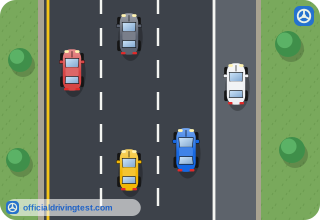
- Standing behind your vehicle
- Beside your vehicle, on the grass
- Inside your vehicle
- Walking along the shoulder
Show answer
Correct answer: Inside your vehicle
The manual says to stay inside your vehicle if you can when you must stop on the shoulder.
Source: Maryland Driver’s Manual (October 2025 Edition (DL-002 10-25)), page 32
-
Why is it very dangerous to stand or walk along an interstate?
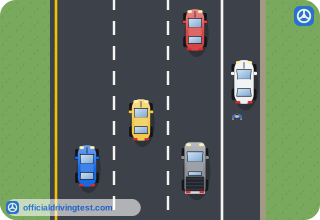
- Traffic is traveling at very high speeds
- The shoulder is always too narrow
- Drivers cannot see people at night
- Vehicles are not allowed to slow down
Show answer
Correct answer: Traffic is traveling at very high speeds
The manual says it is very dangerous to stand or walk along an interstate or other highway because traffic is traveling at very high speeds.
Source: Maryland Driver’s Manual (October 2025 Edition (DL-002 10-25)), page 32