Maryland: Emergency vehicles and work zones
Yielding to emergency vehicles, Maryland’s Move Over Law, police traffic stops and driving through work zones. Split into 2 shorter tests so you're not stuck in one long quiz.
Independent educational site · not affiliated with any government agency or DMV
Choose a part
Emergency vehicles and work zones — Part 1
Questions in this part include: “How is a work zone typically marked?”
StartEmergency vehicles and work zones — Part 2
Questions in this part include: “What do law enforcement officers issue to people charged with violating the Maryland Motor Vehicle Law?”
StartAll 36 Emergency vehicles and work zones questions with answers
Choose a part above to take a practice test, or study every question and answer here.
Show the questions and answersHide the questions
-
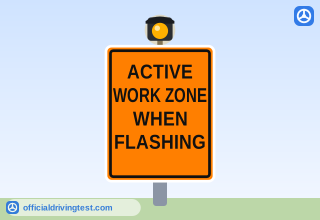
A work zone sign reads ACTIVE WORK ZONE WHEN FLASHING and has a light on top. What applies when the light is flashing?
- Reduced fines
- Increased fines
- No fines
- Fines only at night
Show answer
Correct answer: Increased fines
The manual labels this work zone sign "Work Zone Active when Flashing" with the note that increased fines apply.
Source: Maryland Driver’s Manual (October 2025 Edition (DL-002 10-25)), page 22
-
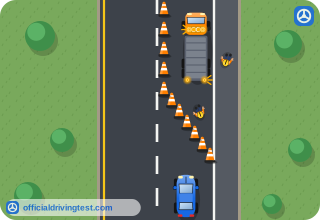
What is a work zone?
- A stretch of road where the posted speed limit has been temporarily reduced
- Any lane of a road that is closed because of a crash or a stalled vehicle
- A roadside area set aside for police and emergency vehicles to park
- A specific area where construction, maintenance, or utility work is happening
Show answer
Correct answer: A specific area where construction, maintenance, or utility work is happening
The manual defines a work zone as a specific area on a road or highway where construction, maintenance, or utility work is happening.
Source: Maryland Driver’s Manual (October 2025 Edition (DL-002 10-25)), page 30
-
How is a work zone typically marked?
- By painted lines on the shoulder
- By signs and traffic control devices
- By police vehicles at each end
- By flashing signals above every lane
Show answer
Correct answer: By signs and traffic control devices
The manual says a work zone is typically marked by signs and traffic control devices.
Source: Maryland Driver’s Manual (October 2025 Edition (DL-002 10-25)), page 30
-
Which is an example of a work zone that moves down the road slowly?
- A bridge being widened
- A new overpass being built
- A pavement striping project
- A building beside the road being repaired
Show answer
Correct answer: A pavement striping project
The manual says some work zones move down the road slowly, like a pavement striping project.
Source: Maryland Driver’s Manual (October 2025 Edition (DL-002 10-25)), page 30
-
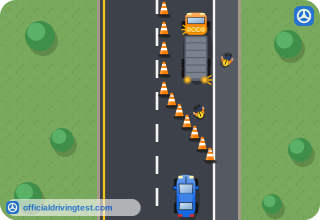
Which unexpected condition can you meet in a work zone?
- Pavement drop-offs and uneven surfaces
- Wider lanes than normal
- Longer sight distance than normal
- Extra shoulder space
Show answer
Correct answer: Pavement drop-offs and uneven surfaces
The manual lists pavement drop-offs and uneven surfaces among the unexpected conditions in a work zone.
Source: Maryland Driver’s Manual (October 2025 Edition (DL-002 10-25)), page 30
-
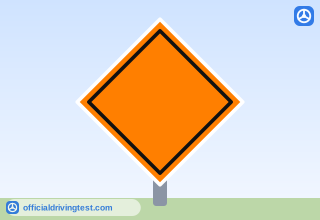
If you see orange signs while driving, what should you do?
- Speed up to get through the area as quickly as possible
- Expect the road to be completely closed just ahead
- Pay close attention and be prepared for unexpected conditions
- Move into the left lane as early as you can
Show answer
Correct answer: Pay close attention and be prepared for unexpected conditions
The manual says that when you see orange signs you should pay close attention and be prepared for unexpected driving conditions.
Source: Maryland Driver’s Manual (October 2025 Edition (DL-002 10-25)), page 31
-
What helps to safely guide you through a work zone?
- Permanent roadside billboards
- Temporary traffic control devices
- Your vehicle navigation system
- The brake lights of other drivers
Show answer
Correct answer: Temporary traffic control devices
The manual says temporary traffic control devices such as signs, cones, barrels, signals or pavement markings help guide you through a work zone.
Source: Maryland Driver’s Manual (October 2025 Edition (DL-002 10-25)), page 31
-
What should be your first priority when driving in a work zone?
- Passing slower traffic
- Keeping up with other drivers
- Arriving on time
- Safety
Show answer
Correct answer: Safety
The manual says to stay alert and make safety your first priority in a work zone.
Source: Maryland Driver’s Manual (October 2025 Edition (DL-002 10-25)), page 31
-
What do flashing lights in a work zone mean?
- The work zone has ended
- A lane has just opened
- Traffic ahead is stopped
- There are workers present
Show answer
Correct answer: There are workers present
The manual says flashing lights in a work zone mean there are workers present.
Source: Maryland Driver’s Manual (October 2025 Edition (DL-002 10-25)), page 31
-
How may speeding fines in a work zone compare with fines elsewhere?
- They are the same as they would be on any other road
- They may be much higher, and even higher if workers are present
- They are lower than elsewhere because speeds are reduced
- They are higher only when the work zone is active at night
Show answer
Correct answer: They may be much higher, and even higher if workers are present
The manual says speeding fines may be much higher in work zones and even higher if workers are present.
Source: Maryland Driver’s Manual (October 2025 Edition (DL-002 10-25)), page 31
-
In a work zone, what do flashing blue lights mean?
- A police officer is directing traffic
- The work zone has ended
- Speed cameras are active
- A lane is closed ahead
Show answer
Correct answer: Speed cameras are active
The manual says flashing blue lights mean the speed cameras are active.
Source: Maryland Driver’s Manual (October 2025 Edition (DL-002 10-25)), page 31
-
Flashing green lights in and before work zones may be found on what?
- Highway maintenance vehicles
- Police patrol vehicles
- Active speed cameras
- Signs for lane closures ahead
Show answer
Correct answer: Highway maintenance vehicles
The manual says flashing green lights may be found on highway maintenance vehicles or service equipment in and before work zones.
Source: Maryland Driver’s Manual (October 2025 Edition (DL-002 10-25)), page 31
-
Because work zone conditions change constantly, what should you be ready to do?
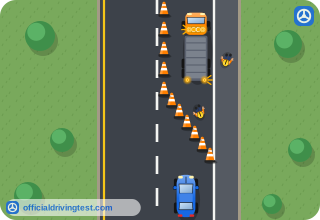
- React, even by stopping if traffic ahead stops
- Change lanes quickly to keep traffic moving
- Drive faster to leave the zone sooner than others
- Follow the vehicle ahead closely to save time
Show answer
Correct answer: React, even by stopping if traffic ahead stops
The manual says to expect the unexpected and be ready to react, including coming to a complete stop if traffic in front of you stops.
Source: Maryland Driver’s Manual (October 2025 Edition (DL-002 10-25)), page 31
-
When driving through a work zone, when should you change lanes?
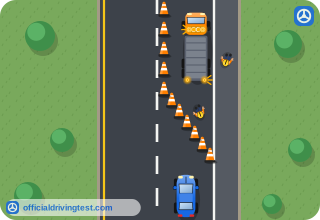
- Whenever traffic is slow
- Only when you have to
- Whenever you see an open lane
- Only when a flagger waves you over
Show answer
Correct answer: Only when you have to
The manual says not to tailgate and not to change lanes in a work zone unless you have to.
Source: Maryland Driver’s Manual (October 2025 Edition (DL-002 10-25)), page 31
-
What should you do about a flagger’s directions in a work zone?
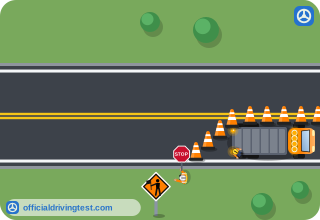
- Follow them only if the signs agree
- Ignore them when the road looks clear
- Obey them only at night
- Obey them
Show answer
Correct answer: Obey them
The manual lists obeying the flagger’s directions as a work zone safety rule.
Source: Maryland Driver’s Manual (October 2025 Edition (DL-002 10-25)), page 31
-
When do emergency vehicles such as police cars, ambulances and fire engines have the right-of-way?
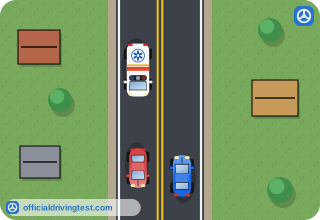
- Whenever they are on the road
- Only when they are on a divided highway
- Only when two or more of them are together
- When using their sirens and flashing lights
Show answer
Correct answer: When using their sirens and flashing lights
Emergency vehicles have the right-of-way when they are using their sirens and flashing lights.
Source: Maryland Driver’s Manual (October 2025 Edition (DL-002 10-25)), page 37
-
An emergency vehicle is approaching with its signals on. As soon as you see or hear it, where must you move?
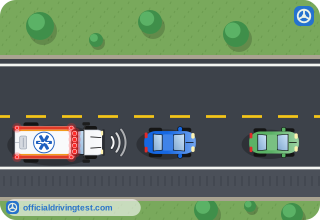
- As close as possible to the edge of the road
- To the center of the road
- Into the nearest intersection to clear the lane
- To the far left lane
Show answer
Correct answer: As close as possible to the edge of the road
You must move as close as possible to the edge of the road after you see or hear an approaching emergency vehicle that is using its signals.
Source: Maryland Driver’s Manual (October 2025 Edition (DL-002 10-25)), page 37
-
An emergency vehicle is approaching with its signals on. What must you stay out of?
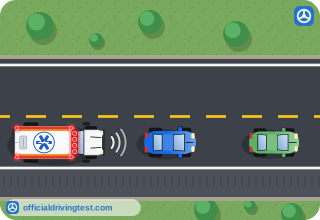
- Bike lanes
- Driveways
- Intersections
- Left turn lanes
Show answer
Correct answer: Intersections
You must stay out of intersections after you see or hear an approaching emergency vehicle that is using its signals.
Source: Maryland Driver’s Manual (October 2025 Edition (DL-002 10-25)), page 37
-
How long must you stay stopped after pulling over for an emergency vehicle that is using its signals?
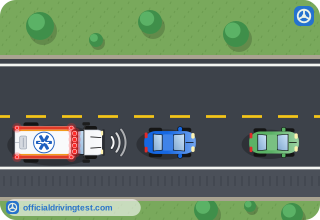
- Until its siren can no longer be heard
- Until the emergency vehicle has passed
- For at least 30 seconds
- Until the traffic ahead of you starts moving
Show answer
Correct answer: Until the emergency vehicle has passed
You must remain stopped until the emergency vehicle has passed.
Source: Maryland Driver’s Manual (October 2025 Edition (DL-002 10-25)), page 37
-
You are going in the same direction as an emergency vehicle that is using its signals. When may you pass it?
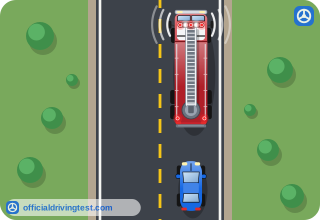
- Whenever the lane beside it is clear of traffic
- Whenever you stay under the posted speed limit
- Whenever it is slowing down for traffic ahead
- Only if it stops or a police officer tells you to pass
Show answer
Correct answer: Only if it stops or a police officer tells you to pass
You may not pass an emergency vehicle using its signals unless it stops or a police officer tells you to pass it.
Source: Maryland Driver’s Manual (October 2025 Edition (DL-002 10-25)), page 37
-
You are approaching an emergency vehicle, tow truck or other service vehicle that is stopped on the road. What must you do if you can?
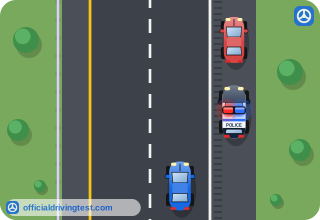
- Move to a lane not right next to the stopped vehicle
- Stop behind it and wait until it has driven away
- Keep to the lane beside it and pass it slowly
- Move to the shoulder and stop until it leaves
Show answer
Correct answer: Move to a lane not right next to the stopped vehicle
You must move to a lane that is not immediately adjacent to the stopped vehicle.
Source: Maryland Driver’s Manual (October 2025 Edition (DL-002 10-25)), page 37
-
You are approaching a stopped emergency vehicle and cannot move over. What must you do?
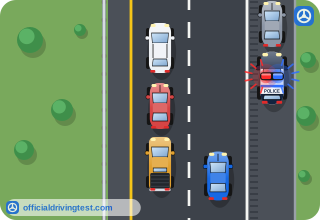
- Keep your speed and sound your horn
- Stop completely until it has driven away
- Slow to a safe speed and prepare to stop
- Speed up and pass it as quickly as you can
Show answer
Correct answer: Slow to a safe speed and prepare to stop
If it is not possible to move over, you must slow down to a safe speed and prepare to stop if necessary.
Source: Maryland Driver’s Manual (October 2025 Edition (DL-002 10-25)), page 37
-
What do law enforcement officers issue to people charged with violating the Maryland Motor Vehicle Law?
- Verbal warnings on the driving record
- Written traffic citations (tickets)
- Vehicle inspection orders
- Registration cancellation notices
Show answer
Correct answer: Written traffic citations (tickets)
Law enforcement officers issue written traffic citations (tickets) to people who are charged with violating the Maryland Motor Vehicle Law.
Source: Maryland Driver’s Manual (October 2025 Edition (DL-002 10-25)), page 44
-
What may happen if you do not follow an officer's directions when you are stopped?
- Your registration is cancelled
- You must retake the knowledge test
- Your insurance is cancelled
- You may be arrested
Show answer
Correct answer: You may be arrested
You must follow the officer's directions if you are stopped, or you may be arrested.
Source: Maryland Driver’s Manual (October 2025 Edition (DL-002 10-25)), page 44
-
If a law enforcement officer stops you, how should you pull over?
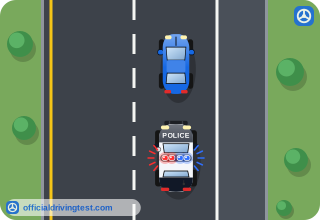
- Into the next lane, with your high beams on
- Straight ahead to the next exit before stopping
- Onto the left side of the road, with your window up
- To the side, far from traffic, with flashers on
Show answer
Correct answer: To the side, far from traffic, with flashers on
You should pull off to the side of the road as far away from traffic as possible and turn on your flashers.
Source: Maryland Driver’s Manual (October 2025 Edition (DL-002 10-25)), page 45
-
What should you turn off when a law enforcement officer stops you?
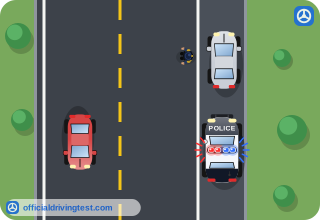
- Your headlights and radio
- Your engine and radio
- Your flashers and engine
- Only your radio
Show answer
Correct answer: Your engine and radio
The manual says to turn off your engine and radio when an officer stops you.
Source: Maryland Driver’s Manual (October 2025 Edition (DL-002 10-25)), page 45
-
What should you do with your window when a law enforcement officer stops you?
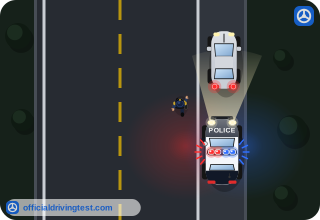
- Keep it closed and show your license against the glass
- Open the door slightly to speak
- Roll it down so you can communicate with the officer
- Step out and speak through the officer's window
Show answer
Correct answer: Roll it down so you can communicate with the officer
You should roll down your window so you can communicate with the officer.
Source: Maryland Driver’s Manual (October 2025 Edition (DL-002 10-25)), page 45
-
If a law enforcement officer stops you, where should you stay?
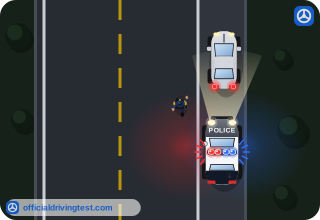
- In your vehicle, with your seat belt fastened
- Standing beside your vehicle with your hands visible
- In the officer's vehicle
- Outside, behind your vehicle
Show answer
Correct answer: In your vehicle, with your seat belt fastened
You should stay in your vehicle and keep your seat belt fastened.
Source: Maryland Driver’s Manual (October 2025 Edition (DL-002 10-25)), page 45
-
Where should you keep your hands when a law enforcement officer stops you?
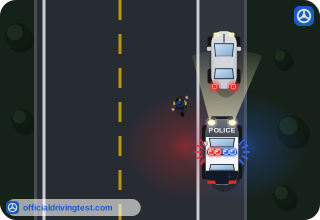
- Out of sight, in your lap or pockets
- In plain view, with the steering wheel being best
- Reaching for your license as the officer walks up
- Beside you on the seat, under your papers
Show answer
Correct answer: In plain view, with the steering wheel being best
Keep your hands in plain view, on the steering wheel is best, and do not make any movement that will make the officer think you are hiding or reaching for something.
Source: Maryland Driver’s Manual (October 2025 Edition (DL-002 10-25)), page 45
-
If an officer issues you a citation, what should you do?
- Explain why it is wrong so the officer cancels it
- Refuse to take it until you speak with the MVA
- Drive away and send an explanation by mail
- Not argue, because you can make your case in court
Show answer
Correct answer: Not argue, because you can make your case in court
You should not argue with the officer about the citation, because you will have your chance to make your case if you go to court.
Source: Maryland Driver’s Manual (October 2025 Edition (DL-002 10-25)), page 45
-
Under the Move Over Law, what must you do when approaching a vehicle that is stopped, standing, or parked on a road with its lights flashing?
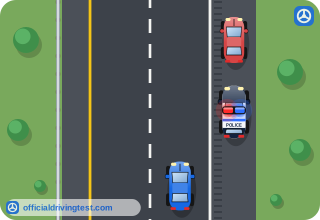
- Move over
- Stop until the lights stop flashing
- Sound your horn
- Speed up to pass it quickly
Show answer
Correct answer: Move over
In Maryland, you must move over when approaching any vehicles stopped, standing, or parked on a road with their lights flashing.
Source: Maryland Driver’s Manual (October 2025 Edition (DL-002 10-25)), page 45
-
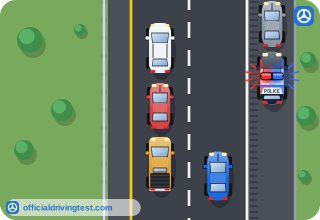
What must you do if it is not safe or possible to move over for a vehicle stopped with its lights flashing?
- Stop completely behind the vehicle
- Change lanes without signaling
- Slow down to a safe speed
- Keep your speed and flash your headlights
Show answer
Correct answer: Slow down to a safe speed
If it is not safe or possible to move over, you must slow down to a safe speed.
Source: Maryland Driver’s Manual (October 2025 Edition (DL-002 10-25)), page 45
-
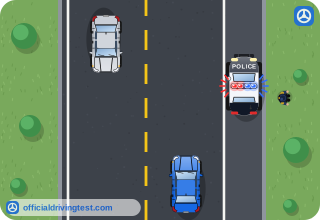
Which of these should you consider when deciding a safe speed under the Move Over Law?
- Weather, road conditions, traffic, and pedestrians
- Only the posted speed limit
- The color of the stopped vehicle's flashing lights
- The age of the stopped vehicle
Show answer
Correct answer: Weather, road conditions, traffic, and pedestrians
You should consider the weather, road conditions, traffic, and pedestrians when deciding a safe speed.
Source: Maryland Driver’s Manual (October 2025 Edition (DL-002 10-25)), page 45
-
How does Maryland classify a violation of the Move Over Law?
- As a felony
- As a civil infraction
- As a misdemeanor
- As a parking violation
Show answer
Correct answer: As a misdemeanor
Violating the Move Over Law is a misdemeanor.
Source: Maryland Driver’s Manual (October 2025 Edition (DL-002 10-25)), page 45
-
What is the fine for a Move Over Law violation that causes a crash?
- $100
- $250
- $500
- $150
Show answer
Correct answer: $150
A violation that causes a crash carries a $150 fine and three points.
Source: Maryland Driver’s Manual (October 2025 Edition (DL-002 10-25)), page 45
-
What is the fine for a Move Over Law violation when there is a death or serious injury?
- $350
- $750
- $500
- $1,000
Show answer
Correct answer: $750
A Move Over Law violation with a death or serious injury carries a $750 fine and three points.
Source: Maryland Driver’s Manual (October 2025 Edition (DL-002 10-25)), page 45