Maryland: Emergency vehicles and work zones — Part 1 Practice Test
Questions in this part include: “How is a work zone typically marked?” · “What do flashing lights in a work zone mean?”
Independent educational site · not affiliated with any government agency or DMV
Ready? Test yourself
- Instant feedback with an explanation
- Every answer cites its source in the manual
- Your best score is saved on this device
Questions are original and based on the official manual "Maryland Driver’s Manual" (October 2025 Edition (DL-002 10-25)), Maryland Motor Vehicle Administration.
All 18 questions in this practice test
Take the test above first, then use this list to study. Tap “Show answer” to see the correct answer and explanation.
Show the questions and answersHide the questions
-
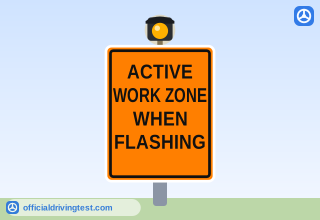
A work zone sign reads ACTIVE WORK ZONE WHEN FLASHING and has a light on top. What applies when the light is flashing?
- Reduced fines
- Increased fines
- No fines
- Fines only at night
Show answer
Correct answer: Increased fines
The manual labels this work zone sign "Work Zone Active when Flashing" with the note that increased fines apply.
Source: Maryland Driver’s Manual (October 2025 Edition (DL-002 10-25)), page 22
-
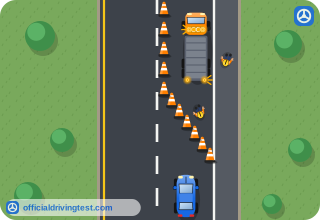
What is a work zone?
- A stretch of road where the posted speed limit has been temporarily reduced
- Any lane of a road that is closed because of a crash or a stalled vehicle
- A roadside area set aside for police and emergency vehicles to park
- A specific area where construction, maintenance, or utility work is happening
Show answer
Correct answer: A specific area where construction, maintenance, or utility work is happening
The manual defines a work zone as a specific area on a road or highway where construction, maintenance, or utility work is happening.
Source: Maryland Driver’s Manual (October 2025 Edition (DL-002 10-25)), page 30
-
How is a work zone typically marked?
- By painted lines on the shoulder
- By signs and traffic control devices
- By police vehicles at each end
- By flashing signals above every lane
Show answer
Correct answer: By signs and traffic control devices
The manual says a work zone is typically marked by signs and traffic control devices.
Source: Maryland Driver’s Manual (October 2025 Edition (DL-002 10-25)), page 30
-
Which is an example of a work zone that moves down the road slowly?
- A bridge being widened
- A new overpass being built
- A pavement striping project
- A building beside the road being repaired
Show answer
Correct answer: A pavement striping project
The manual says some work zones move down the road slowly, like a pavement striping project.
Source: Maryland Driver’s Manual (October 2025 Edition (DL-002 10-25)), page 30
-
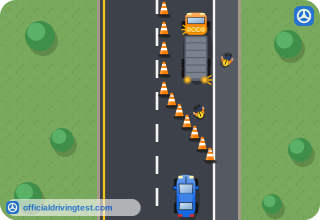
Which unexpected condition can you meet in a work zone?
- Pavement drop-offs and uneven surfaces
- Wider lanes than normal
- Longer sight distance than normal
- Extra shoulder space
Show answer
Correct answer: Pavement drop-offs and uneven surfaces
The manual lists pavement drop-offs and uneven surfaces among the unexpected conditions in a work zone.
Source: Maryland Driver’s Manual (October 2025 Edition (DL-002 10-25)), page 30
-
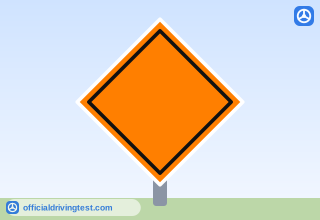
If you see orange signs while driving, what should you do?
- Speed up to get through the area as quickly as possible
- Expect the road to be completely closed just ahead
- Pay close attention and be prepared for unexpected conditions
- Move into the left lane as early as you can
Show answer
Correct answer: Pay close attention and be prepared for unexpected conditions
The manual says that when you see orange signs you should pay close attention and be prepared for unexpected driving conditions.
Source: Maryland Driver’s Manual (October 2025 Edition (DL-002 10-25)), page 31
-
What helps to safely guide you through a work zone?
- Permanent roadside billboards
- Temporary traffic control devices
- Your vehicle navigation system
- The brake lights of other drivers
Show answer
Correct answer: Temporary traffic control devices
The manual says temporary traffic control devices such as signs, cones, barrels, signals or pavement markings help guide you through a work zone.
Source: Maryland Driver’s Manual (October 2025 Edition (DL-002 10-25)), page 31
-
What should be your first priority when driving in a work zone?
- Passing slower traffic
- Keeping up with other drivers
- Arriving on time
- Safety
Show answer
Correct answer: Safety
The manual says to stay alert and make safety your first priority in a work zone.
Source: Maryland Driver’s Manual (October 2025 Edition (DL-002 10-25)), page 31
-
What do flashing lights in a work zone mean?
- The work zone has ended
- A lane has just opened
- Traffic ahead is stopped
- There are workers present
Show answer
Correct answer: There are workers present
The manual says flashing lights in a work zone mean there are workers present.
Source: Maryland Driver’s Manual (October 2025 Edition (DL-002 10-25)), page 31
-
How may speeding fines in a work zone compare with fines elsewhere?
- They are the same as they would be on any other road
- They may be much higher, and even higher if workers are present
- They are lower than elsewhere because speeds are reduced
- They are higher only when the work zone is active at night
Show answer
Correct answer: They may be much higher, and even higher if workers are present
The manual says speeding fines may be much higher in work zones and even higher if workers are present.
Source: Maryland Driver’s Manual (October 2025 Edition (DL-002 10-25)), page 31
-
In a work zone, what do flashing blue lights mean?
- A police officer is directing traffic
- The work zone has ended
- Speed cameras are active
- A lane is closed ahead
Show answer
Correct answer: Speed cameras are active
The manual says flashing blue lights mean the speed cameras are active.
Source: Maryland Driver’s Manual (October 2025 Edition (DL-002 10-25)), page 31
-
Flashing green lights in and before work zones may be found on what?
- Highway maintenance vehicles
- Police patrol vehicles
- Active speed cameras
- Signs for lane closures ahead
Show answer
Correct answer: Highway maintenance vehicles
The manual says flashing green lights may be found on highway maintenance vehicles or service equipment in and before work zones.
Source: Maryland Driver’s Manual (October 2025 Edition (DL-002 10-25)), page 31
-
Because work zone conditions change constantly, what should you be ready to do?
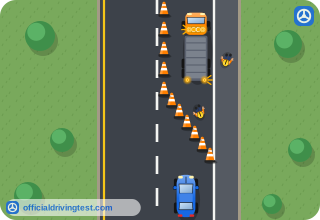
- React, even by stopping if traffic ahead stops
- Change lanes quickly to keep traffic moving
- Drive faster to leave the zone sooner than others
- Follow the vehicle ahead closely to save time
Show answer
Correct answer: React, even by stopping if traffic ahead stops
The manual says to expect the unexpected and be ready to react, including coming to a complete stop if traffic in front of you stops.
Source: Maryland Driver’s Manual (October 2025 Edition (DL-002 10-25)), page 31
-
When driving through a work zone, when should you change lanes?
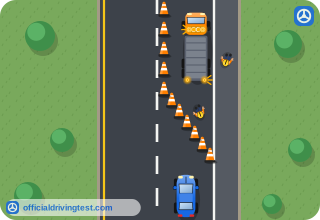
- Whenever traffic is slow
- Only when you have to
- Whenever you see an open lane
- Only when a flagger waves you over
Show answer
Correct answer: Only when you have to
The manual says not to tailgate and not to change lanes in a work zone unless you have to.
Source: Maryland Driver’s Manual (October 2025 Edition (DL-002 10-25)), page 31
-
What should you do about a flagger’s directions in a work zone?
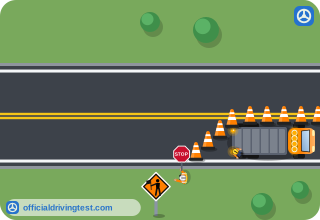
- Follow them only if the signs agree
- Ignore them when the road looks clear
- Obey them only at night
- Obey them
Show answer
Correct answer: Obey them
The manual lists obeying the flagger’s directions as a work zone safety rule.
Source: Maryland Driver’s Manual (October 2025 Edition (DL-002 10-25)), page 31
-
When do emergency vehicles such as police cars, ambulances and fire engines have the right-of-way?
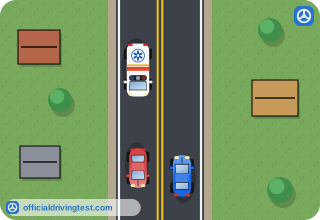
- Whenever they are on the road
- Only when they are on a divided highway
- Only when two or more of them are together
- When using their sirens and flashing lights
Show answer
Correct answer: When using their sirens and flashing lights
Emergency vehicles have the right-of-way when they are using their sirens and flashing lights.
Source: Maryland Driver’s Manual (October 2025 Edition (DL-002 10-25)), page 37
-
An emergency vehicle is approaching with its signals on. As soon as you see or hear it, where must you move?
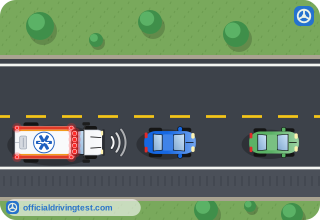
- As close as possible to the edge of the road
- To the center of the road
- Into the nearest intersection to clear the lane
- To the far left lane
Show answer
Correct answer: As close as possible to the edge of the road
You must move as close as possible to the edge of the road after you see or hear an approaching emergency vehicle that is using its signals.
Source: Maryland Driver’s Manual (October 2025 Edition (DL-002 10-25)), page 37
-
An emergency vehicle is approaching with its signals on. What must you stay out of?
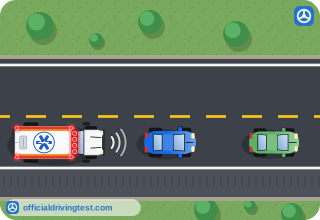
- Bike lanes
- Driveways
- Intersections
- Left turn lanes
Show answer
Correct answer: Intersections
You must stay out of intersections after you see or hear an approaching emergency vehicle that is using its signals.
Source: Maryland Driver’s Manual (October 2025 Edition (DL-002 10-25)), page 37