Maine: Speed and following distance — Part 3 Practice Test
Managing speed, Maine speed limits, stopping distances, space cushions, night driving and road conditions. — Part 3
Independent educational site · not affiliated with any government agency or DMV
Ready? Test yourself
- Instant feedback with an explanation
- Every answer cites its source in the manual
- Your best score is saved on this device
Questions are original and based on the official manual "Maine Driver’s License Manual" (Rev 4/24), Maine Bureau of Motor Vehicles.
All 32 questions in this practice test
Take the test above first, then use this list to study. Tap “Show answer” to see the correct answer and explanation.
Show the questions and answersHide the questions
-
In the manual's chart of stopping distance at different speeds, what vehicle length is used to count total stopping distance in vehicle lengths?
- 12 feet
- 16 feet
- 20 feet
- 24 feet
Show answer
Correct answer: 16 feet
The chart of stopping distance at different speeds counts vehicle lengths with a vehicle length of 16 feet.
Source: Maine Driver’s License Manual (Rev 4/24), page 8-8 · Open this page in the manual (Manual page 8-8)
-
According to the manual's chart, what is the total stopping distance at 30 mph on dry level pavement?
- 65 feet
- 92 feet
- 78 feet
- 110 feet
Show answer
Correct answer: 78 feet
The chart of stopping distance at different speeds on dry level pavement shows a total stopping distance of 78 feet at 30 mph.
Source: Maine Driver’s License Manual (Rev 4/24), page 8-8 · Open this page in the manual (Manual page 8-8)
-
According to the manual's chart, what is the total stopping distance at 60 mph on dry level pavement?
- 240 feet
- 272 feet
- 310 feet
- 350 feet
Show answer
Correct answer: 272 feet
The chart of stopping distance at different speeds on dry level pavement shows a total stopping distance of 272 feet at 60 mph.
Source: Maine Driver’s License Manual (Rev 4/24), page 8-8 · Open this page in the manual (Manual page 8-8)
-
According to the manual's chart, how far do you travel during reaction time at 20 mph?
- 15 feet
- 18 feet
- 28 feet
- 22 feet
Show answer
Correct answer: 22 feet
The chart of stopping distance at different speeds shows a reaction time distance of 22 feet at 20 mph.
Source: Maine Driver’s License Manual (Rev 4/24), page 8-8 · Open this page in the manual (Manual page 8-8)
-
According to the manual's chart, what is the braking distance at 40 mph on dry level pavement?
- 81 feet
- 65 feet
- 100 feet
- 115 feet
Show answer
Correct answer: 81 feet
The chart of stopping distance at different speeds shows a braking distance of 81 feet at 40 mph.
Source: Maine Driver’s License Manual (Rev 4/24), page 8-8 · Open this page in the manual (Manual page 8-8)
-
According to the manual's chart, about how many vehicle lengths is the total stopping distance at 70 mph?
- 25
- 20
- 30
- 35
Show answer
Correct answer: 25
The chart of stopping distance at different speeds shows a total stopping distance of about 25 vehicle lengths at 70 mph.
Source: Maine Driver’s License Manual (Rev 4/24), page 8-8 · Open this page in the manual (Manual page 8-8)
-
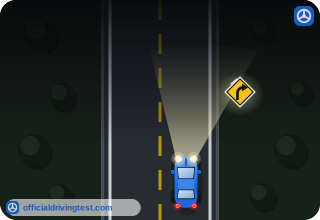
At night, compared with the daytime, how close must you be to an object to see it?
- You can be farther away
- You can be at the same distance
- You must be closer
- It depends only on the color of the object
Show answer
Correct answer: You must be closer
You must be closer to an object to see it at night than during the day.
Source: Maine Driver’s License Manual (Rev 4/24), page 8-8 · Open this page in the manual (Manual page 8-8)
-
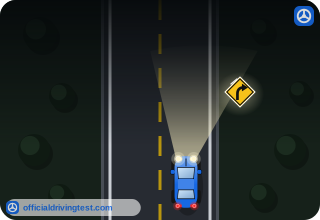
What is the rule about your speed at night and the distance you can see with your lights?
- Drive at the posted limit as long as your headlights are on
- Never drive so fast that you cannot stop within the distance you can see ahead
- Drive fast enough to keep up with the lights of the traffic ahead
- Drive at the speed of the car whose taillights you can see
Show answer
Correct answer: Never drive so fast that you cannot stop within the distance you can see ahead
Never drive so fast that you cannot stop within the distance you can see ahead with your lights.
Source: Maine Driver’s License Manual (Rev 4/24), page 8-8 · Open this page in the manual (Manual page 8-8)
-
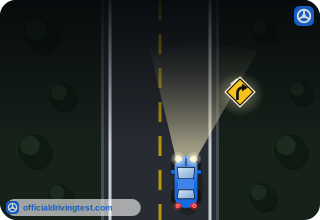
About how far ahead do headlights let you see clearly?
- About 150 feet
- About 400 feet
- About 600 feet
- About 250 feet
Show answer
Correct answer: About 250 feet
Headlights will let you see clearly only about 250 feet ahead.
Source: Maine Driver’s License Manual (Rev 4/24), page 8-8 · Open this page in the manual (Manual page 8-8)
-
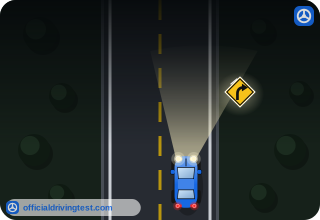
Faster than about what speed on a dark road are you really "driving blind"?
- About 30 mph
- About 50 mph
- About 40 mph
- About 65 mph
Show answer
Correct answer: About 50 mph
Because headlights show only about 250 feet ahead, driving faster than about 50 mph on a dark road is "driving blind."
Source: Maine Driver’s License Manual (Rev 4/24), page 8-8 · Open this page in the manual (Manual page 8-8)
-
What should you do if you cannot properly see, even when driving slowly, in a very heavy rain, a snowstorm or thick fog?
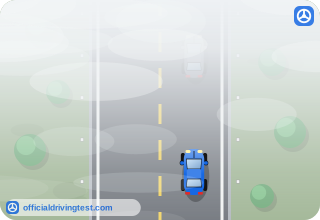
- Turn on your high beams and keep going at a slow speed
- Follow the taillights of the vehicle ahead closely
- Speed up to leave the area of bad weather quickly
- Pull off the road and wait until conditions improve
Show answer
Correct answer: Pull off the road and wait until conditions improve
In very heavy rain, a snowstorm or thick fog you may not see properly, so pull off the road and wait until conditions improve.
Source: Maine Driver’s License Manual (Rev 4/24), page 8-8 · Open this page in the manual (Manual page 8-8)
-
How should you approach a "blind" intersection where trees, bushes or buildings block your view of cars from the side?
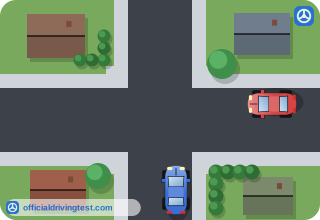
- Slowly enough to stop if a car pulls out suddenly
- At the posted speed limit if no cars are in sight
- Quickly, to clear the intersection before a car appears
- At a steady speed while sounding your horn
Show answer
Correct answer: Slowly enough to stop if a car pulls out suddenly
You need to approach a blind intersection slowly enough to be able to stop if a car pulls out suddenly.
Source: Maine Driver’s License Manual (Rev 4/24), page 8-9 · Open this page in the manual (Manual page 8-9)
-
Why should you slow down when you come to a steep hill or a sharp curve?
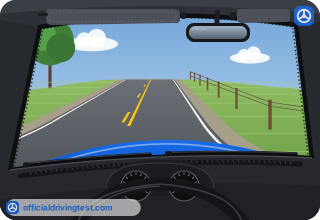
- Other drivers expect you to be slower there
- The road is always slippery there
- A stalled car may be on the other side
- The speed limit is always lower there
Show answer
Correct answer: A stalled car may be on the other side
You never know what is on the other side of a steep hill or sharp curve. If a stalled car is there, you must be going slowly enough to stop.
Source: Maine Driver’s License Manual (Rev 4/24), page 8-9 · Open this page in the manual (Manual page 8-9)
-
What should you do when cars are parked along the side of the road?
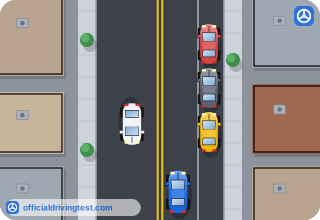
- Stay close to them so oncoming cars have room
- Honk once to warn people who may be getting out
- Speed up to pass them before anyone steps out
- Give them plenty of room and be prepared to stop
Show answer
Correct answer: Give them plenty of room and be prepared to stop
Parked cars block your view and people may get out or walk out from between them, so give parked cars plenty of room and be prepared to stop.
Source: Maine Driver’s License Manual (Rev 4/24), page 8-9 · Open this page in the manual (Manual page 8-9)
-
Why do you need to reduce your speed in heavy traffic?
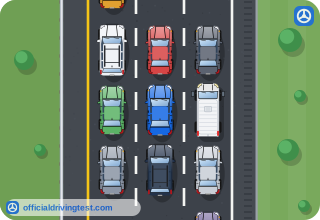
- There is less driving space, so you have less time and space to react
- Heavy traffic lowers the posted speed limit for all drivers
- Your tires grip the road less when many cars are nearby
- Other drivers cannot see you unless you drive slowly
Show answer
Correct answer: There is less driving space, so you have less time and space to react
In heavy traffic there is less driving space, so you need to reduce your speed to have time to react within the shorter space and timeframe.
Source: Maine Driver’s License Manual (Rev 4/24), page 8-9 · Open this page in the manual (Manual page 8-9)
-
Which of these is a place where you need to reduce speed because cars and people move in different directions at the same time?
- Long stretches of open expressway
- Rural roads with no buildings nearby
- Shopping centers and downtown areas
- Straight roads with no intersections
Show answer
Correct answer: Shopping centers and downtown areas
Shopping centers, parking lots and downtown areas are packed with cars and people moving in different directions at the same time.
Source: Maine Driver’s License Manual (Rev 4/24), page 8-9 · Open this page in the manual (Manual page 8-9)
-
Why should you reduce speed at toll plazas?
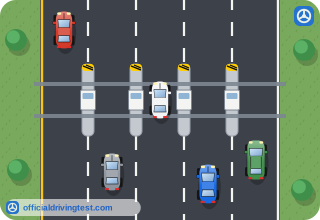
- Cars must stop for a full minute before paying
- Cars change lanes as they approach and leave
- The plaza lanes are always icy
- Toll plazas have a posted limit of 15 mph
Show answer
Correct answer: Cars change lanes as they approach and leave
Cars change lanes as they approach and leave toll plazas, so you need to reduce speed there.
Source: Maine Driver’s License Manual (Rev 4/24), page 8-9 · Open this page in the manual (Manual page 8-9)
-
Why do you need to reduce speed on narrow bridges and in tunnels?
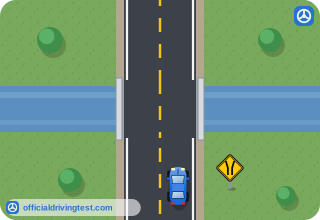
- Cars ahead are required to stop at the entrance
- Headlights cannot be used inside them
- Cars approaching each other are forced closer together
- The road surface is always wet there
Show answer
Correct answer: Cars approaching each other are forced closer together
On narrow bridges and in tunnels, cars approaching each other are forced closer together.
Source: Maine Driver’s License Manual (Rev 4/24), page 8-9 · Open this page in the manual (Manual page 8-9)
-
When do accidents tend to happen, according to the manual?
- When all the cars in a lane are moving at the same speed
- When one driver is going faster or slower than other cars on the road
- When drivers leave a large space cushion around their vehicle
- When roads are dry and traffic is light
Show answer
Correct answer: When one driver is going faster or slower than other cars on the road
Cars moving in the same lane at the same speed cannot hit one another; accidents tend to happen when one driver is going faster or slower than the others.
Source: Maine Driver’s License Manual (Rev 4/24), page 8-9 · Open this page in the manual (Manual page 8-9)
-
What happens to your chance of a collision each time you pass another car?
- The chance of a collision stays the same
- The chance of a collision drops because you are ahead
- The chance of a collision drops once you reach the speed limit
- There is more chance of a collision
Show answer
Correct answer: There is more chance of a collision
Each time you pass another car there is more of a chance for a collision.
Source: Maine Driver’s License Manual (Rev 4/24), page 8-9 · Open this page in the manual (Manual page 8-9)
-
How much of an hour's drive time does speeding save?
- Only a few minutes
- About 15 minutes
- About half an hour
- About 20 minutes
Show answer
Correct answer: Only a few minutes
Speeding does not save more than a few minutes out of an hour's drive time.
Source: Maine Driver’s License Manual (Rev 4/24), page 8-9 · Open this page in the manual (Manual page 8-9)
-
Why can going slower than other cars or stopping suddenly be just as bad as speeding?
- Cars bunch up and could cause a rear-end crash
- Cars ahead of you are forced into your lane
- Oncoming drivers cannot tell how fast you move
- Your tires lose grip below the speed limit
Show answer
Correct answer: Cars bunch up and could cause a rear-end crash
Going slower than other cars or stopping suddenly makes cars bunch up behind you, which could cause a rear-end crash.
Source: Maine Driver’s License Manual (Rev 4/24), page 8-9 · Open this page in the manual (Manual page 8-9)
-
If many cars are pulling out to pass you even though you drive at the posted speed, what could you do?
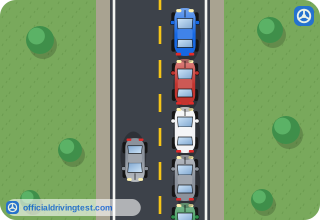
- Speed up to the speed of the cars passing you
- Move to the center of the road and hold your speed
- Slow up a bit or pull over to the right to be passed
- Brake several times to warn the cars behind you
Show answer
Correct answer: Slow up a bit or pull over to the right to be passed
You could slow up a bit or pull over to the right side so you can be passed safely.
Source: Maine Driver’s License Manual (Rev 4/24), page 8-9 · Open this page in the manual (Manual page 8-9)
-
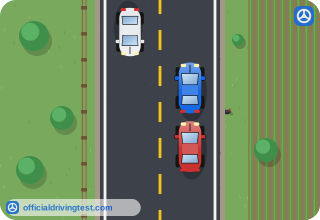
What increases your chances of being hit from behind when you turn off a road at an intersection or driveway?
- Signaling your turn too early
- Slowing way down or stopping
- Checking your mirrors before the turn
- Turning at the posted speed
Show answer
Correct answer: Slowing way down or stopping
Slowing way down or stopping will increase your chances of being hit from behind.
Source: Maine Driver’s License Manual (Rev 4/24), page 8-10 · Open this page in the manual (Manual page 8-10)
-
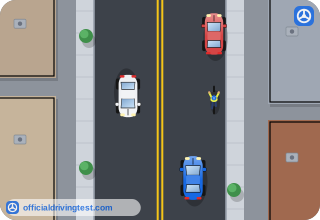
What is a space cushion?
- The distance between your car and the edge of the pavement
- The room needed to pull off the road in an emergency
- The space you allow between your vehicle and other roadway users
- The gap between two parked cars
Show answer
Correct answer: The space you allow between your vehicle and other roadway users
The more space you allow between your vehicle and other roadway users, the more time you give yourself to react. This is called a space cushion.
Source: Maine Driver’s License Manual (Rev 4/24), page 8-11 · Open this page in the manual (Manual page 8-11)
-
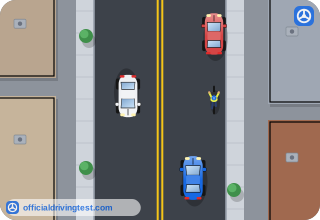
What is the only way to be sure you will have enough time to react when another driver makes a mistake?
- Drive faster than the cars around you
- Leave plenty of space between your car and others
- Stay in the left lane
- Use your horn to warn the cars around you
Show answer
Correct answer: Leave plenty of space between your car and others
The only way to be sure you have enough time to react is to leave plenty of space between your car and the cars around you.
Source: Maine Driver’s License Manual (Rev 4/24), page 8-11 · Open this page in the manual (Manual page 8-11)
-
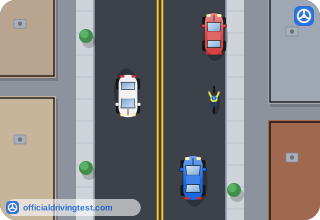
On how many sides of your vehicle should you try to keep a cushion of space?
- The front only
- The front and rear only
- The left and right only
- All sides
Show answer
Correct answer: All sides
You should try to keep a cushion of space on all sides of your motor vehicle, considering the existing speed and road conditions.
Source: Maine Driver’s License Manual (Rev 4/24), page 8-11 · Open this page in the manual (Manual page 8-11)
-
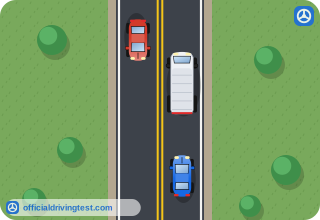
What does following too closely limit?
- Your braking power
- Your view of the road
- Your use of turn signals
- The brightness of your headlights
Show answer
Correct answer: Your view of the road
Following too closely limits your view of the road and does not allow enough reaction time to avoid a collision.
Source: Maine Driver’s License Manual (Rev 4/24), page 8-11 · Open this page in the manual (Manual page 8-11)
-
To determine your following distance, what do you do after the rear of the vehicle ahead passes a sign, pole or other fixed point?
- Count the car lengths between you and that vehicle
- Count the vehicles between you and that point
- Check how many seconds it takes the other car to stop
- Count the seconds it takes you to reach the same point
Show answer
Correct answer: Count the seconds it takes you to reach the same point
You watch when the rear of the vehicle ahead passes a fixed point and then count the seconds it takes you to reach the same point.
Source: Maine Driver’s License Manual (Rev 4/24), page 8-11 · Open this page in the manual (Manual page 8-11)
-
What should you do if you find you are following too closely?
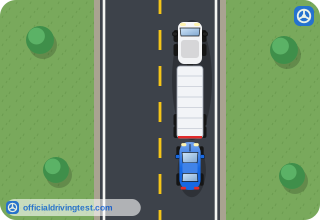
- Slow down and check your new following distance
- Speed up and pass the vehicle ahead
- Flash your headlights at the vehicle ahead
- Move to the shoulder and stop
Show answer
Correct answer: Slow down and check your new following distance
Slow down and check your new following distance, and repeat until you are following no closer than the safe distance.
Source: Maine Driver’s License Manual (Rev 4/24), page 8-11 · Open this page in the manual (Manual page 8-11)
-
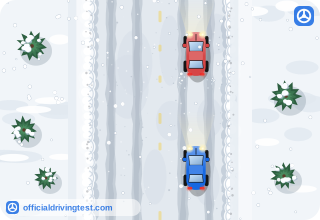
Why should you increase your following distance on slick roads?
- Slick roads make the cars ahead drive faster
- Your headlights are less effective on slick roads
- The car ahead may slow or stop and you need more room
- Cars behind you cannot see your brake lights
Show answer
Correct answer: The car ahead may slow or stop and you need more room
On slippery roads, if the car ahead should slow or stop, you will need more distance to stop your car.
Source: Maine Driver’s License Manual (Rev 4/24), page 8-11 · Open this page in the manual (Manual page 8-11)
-
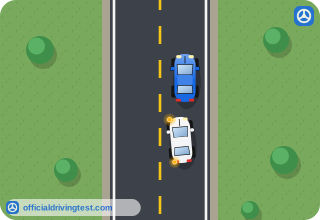
What should you do when the driver behind you wants to pass?
- Speed up so they cannot pass
- Move onto the shoulder and stop
- Slow a bit while they pass to assist them
- Move toward the center line to give them room
Show answer
Correct answer: Slow a bit while they pass to assist them
When the driver behind you wants to pass, slow a bit while they pass to assist the passing driver.
Source: Maine Driver’s License Manual (Rev 4/24), page 8-12 · Open this page in the manual (Manual page 8-12)