Maine: Speed and following distance — Part 1 Practice Test
Managing speed, Maine speed limits, stopping distances, space cushions, night driving and road conditions. — Part 1
Independent educational site · not affiliated with any government agency or DMV
Ready? Test yourself
- Instant feedback with an explanation
- Every answer cites its source in the manual
- Your best score is saved on this device
Questions are original and based on the official manual "Maine Driver’s License Manual" (Rev 4/24), Maine Bureau of Motor Vehicles.
All 32 questions in this practice test
Take the test above first, then use this list to study. Tap “Show answer” to see the correct answer and explanation.
Show the questions and answersHide the questions
-
Which of these does the manual list as aggressive driving?
- Driving below the speed limit
- Signaling before every turn
- Not signaling when you turn
- Yielding to pedestrians
Show answer
Correct answer: Not signaling when you turn
The manual says aggressive driving includes speeding, following too close, unsafe lane changes, not signaling when you turn, and not obeying traffic controls.
Source: Maine Driver’s License Manual (Rev 4/24), page 3-5 · Open this page in the manual (Manual page 3-5)
-
Which of these does the manual list as aggressive driving?
- Leaving a large space ahead of you
- Following too close
- Moving over for a faster driver
- Waiting for a green light
Show answer
Correct answer: Following too close
The manual says aggressive driving includes speeding, following too close, unsafe lane changes, not signaling when you turn, and not obeying traffic controls.
Source: Maine Driver’s License Manual (Rev 4/24), page 3-5 · Open this page in the manual (Manual page 3-5)
-
What does smooth driving in the lane with the least stopping and starting allow you to do?
- Pass other vehicles on the right more easily
- Drive faster than the posted speed limit allows
- Keep more distance between yourself and other drivers
- Skip checking your mirrors before changing lanes
Show answer
Correct answer: Keep more distance between yourself and other drivers
Smooth driving allows you to keep more distance between yourself and other drivers, and it also helps save gas.
Source: Maine Driver’s License Manual (Rev 4/24), page 6-8 · Open this page in the manual (Manual page 6-8)
-
What should you have for use every time you are driving?
- A search pattern
- A written route plan
- A passenger who watches for hazards
- A fixed speed for the whole trip
Show answer
Correct answer: A search pattern
The manual says to have a search pattern for use every time you drive, so you keep checking ahead, to the sides and behind you.
Source: Maine Driver’s License Manual (Rev 4/24), page 8-1 · Open this page in the manual (Manual page 8-1)
-
You must always be aware of what is ahead of you and to the sides. Where else must you be aware?
- Under your vehicle
- Beyond the next intersection
- Behind you
- Inside the vehicles around you
Show answer
Correct answer: Behind you
A driver must be aware of what is ahead, to the sides and behind.
Source: Maine Driver’s License Manual (Rev 4/24), page 8-1 · Open this page in the manual (Manual page 8-1)
-
What does continual searching give you time to do?
- Read signs without watching traffic
- Change speed or direction to avoid hazards
- Drive closer to the vehicle ahead
- Stop checking the sides of the road
Show answer
Correct answer: Change speed or direction to avoid hazards
Continual searching helps you see hazards early, which gives you time to change speed or direction to avoid them.
Source: Maine Driver’s License Manual (Rev 4/24), page 8-1 · Open this page in the manual (Manual page 8-1)
-
While you search for possible problems, how should you use your eyes?
- Fix them on the vehicle directly ahead
- Stare at the center of the road
- Keep them on the lane lines
- Keep them moving and avoid staring
Show answer
Correct answer: Keep them moving and avoid staring
The manual says to stay alert, not stare, and keep your eyes moving as you search for possible problems.
Source: Maine Driver’s License Manual (Rev 4/24), page 8-1 · Open this page in the manual (Manual page 8-1)
-
According to the manual, most of what you do while driving is what?
- Planned before you start the trip
- Controlled by your vehicle’s systems
- Based on what other drivers tell you
- A reaction to what you see
Show answer
Correct answer: A reaction to what you see
Most driving actions are reactions to what you see, which is why continual searching matters.
Source: Maine Driver’s License Manual (Rev 4/24), page 8-1 · Open this page in the manual (Manual page 8-1)
-
What does looking far ahead give you?
- Time to plan your path
- A shorter stopping distance
- A better view of vehicles behind you
- The right to follow larger vehicles closely
Show answer
Correct answer: Time to plan your path
Looking far ahead gives you time to plan your path.
Source: Maine Driver’s License Manual (Rev 4/24), page 8-2 · Open this page in the manual (Manual page 8-2)
-
What happens the sooner you see a problem ahead?
- You need less room to stop
- You no longer need to check your mirrors
- You may follow other vehicles more closely
- You have more reaction time
Show answer
Correct answer: You have more reaction time
The sooner you see a problem, the more reaction time you have.
Source: Maine Driver’s License Manual (Rev 4/24), page 8-2 · Open this page in the manual (Manual page 8-2)
-
How far you look down the road depends on what?
- The speed of the vehicle behind you
- Where you are driving
- The type of license you hold
- The color of your vehicle
Show answer
Correct answer: Where you are driving
The manual says how far you look depends on where you are driving; in cities you may not see as far ahead as on a highway.
Source: Maine Driver’s License Manual (Rev 4/24), page 8-2 · Open this page in the manual (Manual page 8-2)
-
Why should you not follow closely behind larger vehicles?
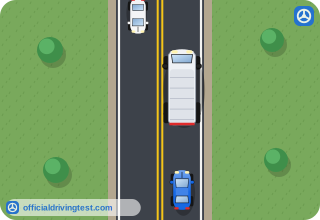
- They block your vision
- They make it hard to hear your horn
- Their headlights shine into your mirrors
- They always drive slower than other vehicles
Show answer
Correct answer: They block your vision
The manual says larger vehicles block your vision, so give yourself space so you can see.
Source: Maine Driver’s License Manual (Rev 4/24), page 8-2 · Open this page in the manual (Manual page 8-2)
-
What is one of the most common mistakes drivers make when looking ahead?
- Looking at the mirrors instead of out the windshield
- Looking too far up the road instead of at the car ahead
- Looking in front of the car instead of up the road
- Looking at the sides of the road instead of the center line
Show answer
Correct answer: Looking in front of the car instead of up the road
The manual says one of the most common mistakes is looking in front of the car instead of up the road.
Source: Maine Driver’s License Manual (Rev 4/24), page 8-2 · Open this page in the manual (Manual page 8-2)
-
What does focusing your attention far ahead make easier?
- Braking later at intersections
- Keeping your car on a steady path
- Passing other vehicles
- Staying farther from the center line
Show answer
Correct answer: Keeping your car on a steady path
When you focus attention ahead, it is easier to keep your car on a steady path.
Source: Maine Driver’s License Manual (Rev 4/24), page 8-2 · Open this page in the manual (Manual page 8-2)
-
Looking far ahead means taking in the entire scene. What does that scene include besides the road ahead?
- Only the center of the road
- Only the vehicle directly ahead
- The dashboard instruments
- The sides of the road
Show answer
Correct answer: The sides of the road
Taking in the entire scene includes the sides of the road as well.
Source: Maine Driver’s License Manual (Rev 4/24), page 8-2 · Open this page in the manual (Manual page 8-2)
-
A 5-sided sign means you are in a school zone. To what speed must you slow during recess?
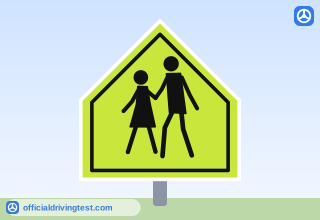
- 10 mph
- 20 mph
- 25 mph
- 15 mph
Show answer
Correct answer: 15 mph
The manual says a 5-sided school sign means you are in a school zone and must slow to 15 mph during recess.
Source: Maine Driver’s License Manual (Rev 4/24), page 8-3 · Open this page in the manual (Manual page 8-3)
-
How often should you check your mirror for traffic behind you?
- Every 2 to 3 seconds
- Every 6 to 8 seconds
- Every 10 to 15 seconds
- Every minute
Show answer
Correct answer: Every 6 to 8 seconds
The manual says to check your mirror often for traffic behind you, every 6 to 8 seconds.
Source: Maine Driver’s License Manual (Rev 4/24), page 8-3 · Open this page in the manual (Manual page 8-3)
-
What does checking your mirror often help you find out?
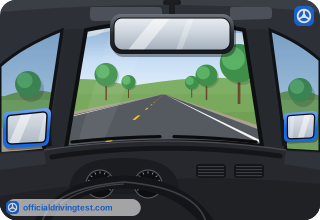
- Whether the vehicle ahead is planning to turn off the road
- Whether your tires are losing traction on the road surface
- Whether the signal ahead is about to change to red
- If someone is following too closely or coming up too fast
Show answer
Correct answer: If someone is following too closely or coming up too fast
Frequent mirror checks show if someone is following too closely or coming up too fast, giving you time to alter your speed or path.
Source: Maine Driver’s License Manual (Rev 4/24), page 8-3 · Open this page in the manual (Manual page 8-3)
-
Checking your mirror often lets you know what about the space behind you at all times?
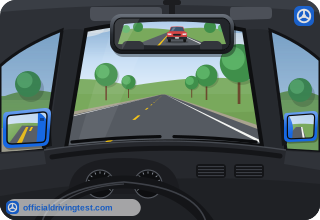
- The exact distance to the next intersection
- How many vehicles are in the next lane
- The speed limit on the road behind you
- The cushion of space you have to the rear
Show answer
Correct answer: The cushion of space you have to the rear
The manual says you will know the cushion of space you have to the rear at all times.
Source: Maine Driver’s License Manual (Rev 4/24), page 8-3 · Open this page in the manual (Manual page 8-3)
-
Besides changing lanes, slowing down and stopping, when must you check behind you?
- Only when another driver honks
- Before you enter an intersection
- Only after you have left an intersection
- Only when you drive on an expressway
Show answer
Correct answer: Before you enter an intersection
The manual says to check behind when changing lanes, slowing down or stopping, and before you enter an intersection.
Source: Maine Driver’s License Manual (Rev 4/24), page 8-3 · Open this page in the manual (Manual page 8-3)
-
What should you do before you slow down or stop, especially if you slow down suddenly?
- Sound your horn twice
- Turn on your high beams
- Look in the mirrors quickly
- Shift into neutral
Show answer
Correct answer: Look in the mirrors quickly
The manual says to look in the mirrors quickly before you slow down or stop.
Source: Maine Driver’s License Manual (Rev 4/24), page 8-4 · Open this page in the manual (Manual page 8-4)
-
Which of these does the manual give as an example of slowing for something the driver behind you cannot see?
- A stalled car in the road just around a corner
- A posted speed limit sign far ahead of you
- A green light at the next corner ahead
- A car passing you on the left side
Show answer
Correct answer: A stalled car in the road just around a corner
You should check behind when you slow for something ahead that the driver behind you cannot see, such as a stalled car around a corner.
Source: Maine Driver’s License Manual (Rev 4/24), page 8-4 · Open this page in the manual (Manual page 8-4)
-
Why should you check behind before turning into a side road or driveway just before a large intersection?
- You cannot slow down once you are in the intersection
- The driver behind will not expect you to slow down there
- Drivers behind always slow down at large intersections
- Side roads near intersections are often wet
Show answer
Correct answer: The driver behind will not expect you to slow down there
A driver behind will not expect you to slow down where you do and may be too close behind.
Source: Maine Driver’s License Manual (Rev 4/24), page 8-4 · Open this page in the manual (Manual page 8-4)
-
Driving safely requires adjusting your speed for what?
- The posted speed limit alone
- The speed of the vehicle behind you
- The type of vehicle you drive
- Road and traffic conditions
Show answer
Correct answer: Road and traffic conditions
Safe driving requires adjusting speed for road and traffic conditions, keeping a safe following distance and obeying the speed limit.
Source: Maine Driver’s License Manual (Rev 4/24), page 8-5 · Open this page in the manual (Manual page 8-5)
-
What should you always do before entering a curve?
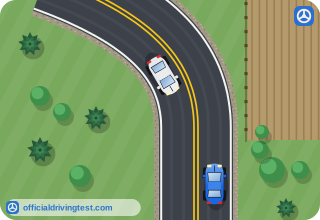
- Speed up slightly
- Slow down
- Keep your speed constant
- Shift to neutral
Show answer
Correct answer: Slow down
The manual says to always slow before entering a curve.
Source: Maine Driver’s License Manual (Rev 4/24), page 8-6 · Open this page in the manual (Manual page 8-6)
-
A safe speed in a curve allows you to do what?
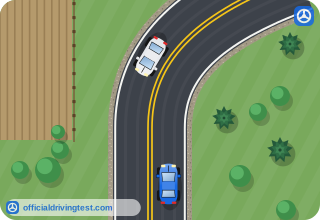
- Brake firmly in the middle of the curve
- Coast through the curve in neutral
- Slightly accelerate through the curve
- Hold the brake lightly through the curve
Show answer
Correct answer: Slightly accelerate through the curve
The manual says a safe speed allows you to slightly accelerate through the curve.
Source: Maine Driver’s License Manual (Rev 4/24), page 8-6 · Open this page in the manual (Manual page 8-6)
-
Which situation means you should slow even more for a curve?
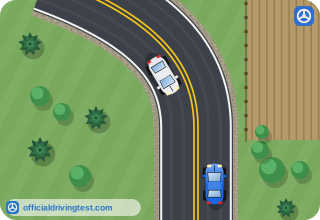
- You cannot see the end of the curve
- The road is dry and has good traction
- No other vehicles are nearby
- You are driving in daylight
Show answer
Correct answer: You cannot see the end of the curve
The manual says to slow more if traction is poor, when following other vehicles or if you cannot see the end of the curve.
Source: Maine Driver’s License Manual (Rev 4/24), page 8-6 · Open this page in the manual (Manual page 8-6)
-
Hard braking in a curve can cause a skid because about how much vehicle is moving in a straight line?
- About one ton
- About two tons
- About half a ton
- About four tons
Show answer
Correct answer: About two tons
The manual says about two tons of vehicle is moving in a straight line with only the front tires to control the turn.
Source: Maine Driver’s License Manual (Rev 4/24), page 8-6 · Open this page in the manual (Manual page 8-6)
-
In a curve, which tires does the manual say control the turn?
- Only the rear tires
- All four tires equally
- Only the tires on the inside of the curve
- Only the front tires
Show answer
Correct answer: Only the front tires
About two tons of vehicle is moving in a straight line with only the front tires to control the turn.
Source: Maine Driver’s License Manual (Rev 4/24), page 8-6 · Open this page in the manual (Manual page 8-6)
-
When should you reduce speed on a road that may become slippery?
- Only after the car starts to skid
- Only when the road is completely covered with ice
- At the first sign of rain, snow, sleet, or ice
- Only when other vehicles begin to slow down
Show answer
Correct answer: At the first sign of rain, snow, sleet, or ice
The manual says to reduce speed at the first sign of rain, snow, sleet or ice.
Source: Maine Driver’s License Manual (Rev 4/24), page 8-6 · Open this page in the manual (Manual page 8-6)
-
How are stopping and turning affected when the roadway is slippery?
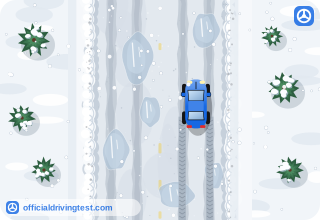
- It takes longer to stop and is harder to turn without skidding
- It takes a shorter distance to stop but turning is harder
- You can stop sooner but it is harder to turn
- Both stopping and turning are easier because speed is lower
Show answer
Correct answer: It takes longer to stop and is harder to turn without skidding
When the roadway is slippery, it takes longer to stop and it is harder to turn without skidding.
Source: Maine Driver’s License Manual (Rev 4/24), page 8-6 · Open this page in the manual (Manual page 8-6)
-
On a wet road, by how much does the manual say to slow down?
- 15 to 20 mph
- 1 to 3 mph
- 20 to 25 mph
- 5 to 10 mph
Show answer
Correct answer: 5 to 10 mph
The manual's guideline for a wet road is to slow down 5 to 10 mph.
Source: Maine Driver’s License Manual (Rev 4/24), page 8-6 · Open this page in the manual (Manual page 8-6)