Maine: Right-of-way and turning — Part 3 Practice Test
Who yields at intersections and four-way stops, turning lanes, traffic circles and roundabouts, passing and turning around. — Part 3
Independent educational site · not affiliated with any government agency or DMV
Ready? Test yourself
- Instant feedback with an explanation
- Every answer cites its source in the manual
- Your best score is saved on this device
Questions are original and based on the official manual "Maine Driver’s License Manual" (Rev 4/24), Maine Bureau of Motor Vehicles.
All 34 questions in this practice test
Take the test above first, then use this list to study. Tap “Show answer” to see the correct answer and explanation.
Show the questions and answersHide the questions
-
Unless otherwise directed by a police officer or traffic control devices, what must vehicles approaching a traffic circle or roundabout do?
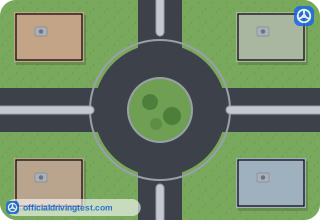
- Claim the right-of-way over vehicles already in the circle
- Yield the right-of-way to vehicles already in the circle
- Stop completely and wait until the circle is empty
- Yield only to vehicles that are about to exit
Show answer
Correct answer: Yield the right-of-way to vehicles already in the circle
The manual says all vehicles approaching a traffic circle or roundabout must yield the right-of-way to vehicles already in it.
Source: Maine Driver’s License Manual (Rev 4/24), page 7-2 · Open this page in the manual (Manual page 7-2)
-
Which way do you go around the raised center island when entering a roundabout?
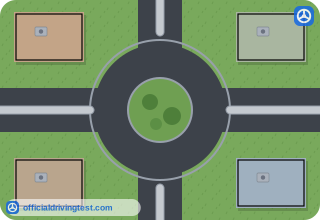
- To the left (clockwise)
- To the right (clockwise)
- Whichever way is shorter to your exit
- To the right (counterclockwise)
Show answer
Correct answer: To the right (counterclockwise)
The manual says to enter a roundabout by proceeding to the right around the raised center island (counterclockwise).
Source: Maine Driver’s License Manual (Rev 4/24), page 7-2 · Open this page in the manual (Manual page 7-2)
-
What is the raised pavement on the inside of a traffic circle for?
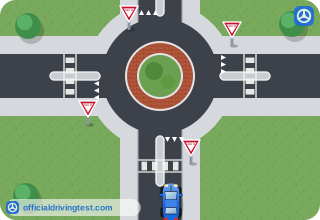
- It enables trucks to negotiate around the small island
- It marks where drivers must stop to enter
- It keeps pedestrians from crossing the circle
- It separates the lanes of oncoming traffic
Show answer
Correct answer: It enables trucks to negotiate around the small island
The manual says raised pavement on the inside of the circle enables trucks to negotiate around the small island while other vehicles stay in the outer travel lane.
Source: Maine Driver’s License Manual (Rev 4/24), page 7-2 · Open this page in the manual (Manual page 7-2)
-
What are large traffic circles called?
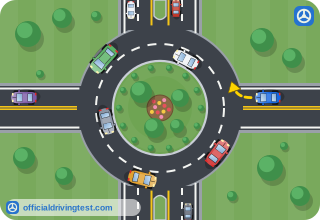
- Cloverleafs
- Interchanges
- Rotaries
- Overpasses
Show answer
Correct answer: Rotaries
The manual says large traffic circles are called rotaries.
Source: Maine Driver’s License Manual (Rev 4/24), page 7-2 · Open this page in the manual (Manual page 7-2)
-
At a rotary, to which vehicle must drivers yield the right-of-way?
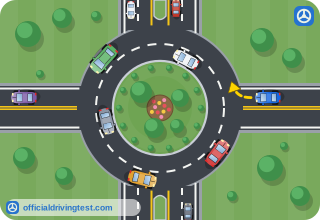
- A vehicle on the operator’s left
- A vehicle on the operator’s right
- The vehicle that arrived first
- The largest vehicle
Show answer
Correct answer: A vehicle on the operator’s left
The manual says drivers must yield the right-of-way to a vehicle on the operator’s left in a rotary.
Source: Maine Driver’s License Manual (Rev 4/24), page 7-3 · Open this page in the manual (Manual page 7-3)
-
How do you leave a traffic circle or roundabout?
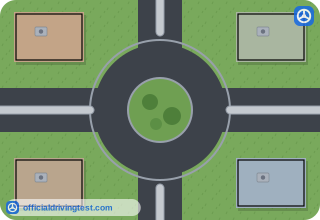
- By making a left turn
- By going straight over the center island
- By making a right turn
- By stopping before the exit
Show answer
Correct answer: By making a right turn
The manual says the exit from the circle or roundabout is made by making a right turn.
Source: Maine Driver’s License Manual (Rev 4/24), page 7-3 · Open this page in the manual (Manual page 7-3)
-
What does the manual say you should pay strict attention to when entering and leaving traffic circles or roundabouts?
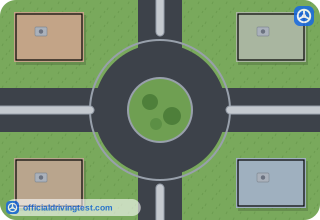
- Billboards and advertising near the circle
- Highway signs and pavement markings
- Horns sounded by other drivers
- Hand signals from other drivers
Show answer
Correct answer: Highway signs and pavement markings
The manual says strict attention to highway signs and pavement markings is necessary in traffic circles and roundabouts.
Source: Maine Driver’s License Manual (Rev 4/24), page 7-3 · Open this page in the manual (Manual page 7-3)
-
If you are going to turn from a rotary within two exits, which lane does the manual suggest you be in?
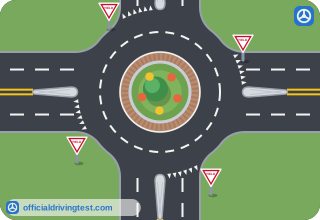
- The leftmost lane
- The center lane
- Any lane with room
- The rightmost lane
Show answer
Correct answer: The rightmost lane
The manual suggests being in the right most lane when turning from a rotary within two exits, unless signs or markings say otherwise.
Source: Maine Driver’s License Manual (Rev 4/24), page 7-3 · Open this page in the manual (Manual page 7-3)
-
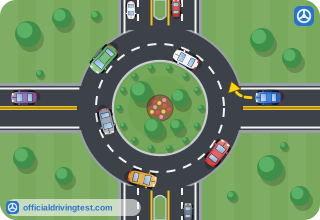
What should you do as you come to a traffic circle to enter it?
- Speed up to match the vehicles in it
- Move into the leftmost lane
- Slow down to enter the circle
- Switch on your hazard lights
Show answer
Correct answer: Slow down to enter the circle
Among the rules for traffic circles, the manual says to slow down to enter the circle.
Source: Maine Driver’s License Manual (Rev 4/24), page 7-3 · Open this page in the manual (Manual page 7-3)
-
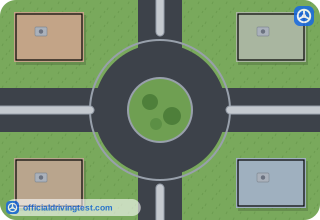
Once you enter a traffic circle to the right, what should you follow?
- The lane lines
- The tail lights of the car ahead
- The edge of the center island
- The curb on your left
Show answer
Correct answer: The lane lines
The manual says to enter a traffic circle to the right and follow the lane lines.
Source: Maine Driver’s License Manual (Rev 4/24), page 7-3 · Open this page in the manual (Manual page 7-3)
-
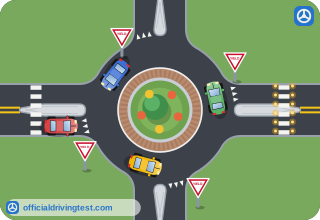
What should you do when you are about to leave a traffic circle?
- Sound your horn at the exit
- Stop before leaving the circle
- Turn on your hazard lights
- Signal your exit
Show answer
Correct answer: Signal your exit
The manual says to signal your exit when using traffic circles.
Source: Maine Driver’s License Manual (Rev 4/24), page 7-3 · Open this page in the manual (Manual page 7-3)
-
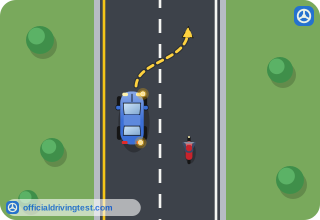
How should you check your blind spot when you plan to change lanes?
- Glance at the rearview mirror twice before you start to move over
- Turn your head and look over your shoulder in the direction you plan to move
- Lean toward the other window and check the side mirror
- Look through the rear window while you start to move
Show answer
Correct answer: Turn your head and look over your shoulder in the direction you plan to move
The manual says to check your blind spot by turning your head and looking over your shoulder in the direction you plan to move.
Source: Maine Driver’s License Manual (Rev 4/24), page 7-3 · Open this page in the manual (Manual page 7-3)
-
What causes some of the blind spots around your vehicle?
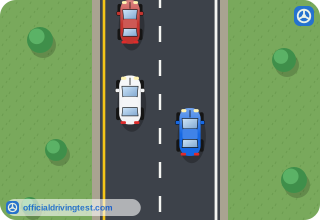
- Dirty windows and worn-out windshield wiper blades
- Tinted glass on the side windows
- Sunlight reflecting off the hood
- Headrests and door pillars that block your vision
Show answer
Correct answer: Headrests and door pillars that block your vision
The manual says blind spots are areas around your vehicle caused by headrests and door pillars that block your vision.
Source: Maine Driver’s License Manual (Rev 4/24), page 7-3 · Open this page in the manual (Manual page 7-3)
-
What should you never rely on solely when making a lane change?
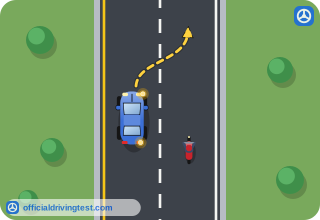
- Your rearview mirrors
- Your turn signal lights
- Your headlights
- The lane lines
Show answer
Correct answer: Your rearview mirrors
The manual says never to rely solely on your rearview mirrors when making a lane change.
Source: Maine Driver’s License Manual (Rev 4/24), page 7-3 · Open this page in the manual (Manual page 7-3)
-
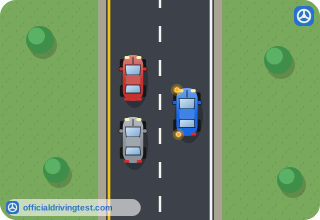
After you find a gap in traffic and signal, what should you do before changing lanes?
- Sound your horn
- Brake gently
- Look again
- Turn on your hazard lights
Show answer
Correct answer: Look again
The manual says to find a gap, signal, and then look again before changing lanes.
Source: Maine Driver’s License Manual (Rev 4/24), page 7-3 · Open this page in the manual (Manual page 7-3)
-
Which of these counts as changing lanes?
- Driving around a gentle curve
- Slowing down in your own lane
- Entering a freeway from an entrance lane
- Driving straight through an intersection
Show answer
Correct answer: Entering a freeway from an entrance lane
The manual lists entering a freeway or highway from an entrance lane as changing lanes.
Source: Maine Driver’s License Manual (Rev 4/24), page 7-4 · Open this page in the manual (Manual page 7-4)
-
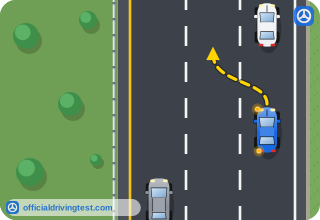
When you glance in your rearview and side mirrors before changing lanes, what should you make sure of?
- That your mirrors are clean
- That nobody is preparing to pass you
- That no one is behind you at all
- That your brake lights are working
Show answer
Correct answer: That nobody is preparing to pass you
The manual says to glance in the mirrors and make sure nobody is preparing to pass you.
Source: Maine Driver’s License Manual (Rev 4/24), page 7-4 · Open this page in the manual (Manual page 7-4)
-
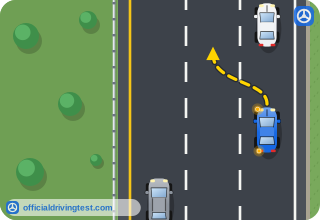
What should you be alert for when you check for traffic behind you?
- Only vehicles larger than yours
- Parked vehicles on the shoulder
- Only vehicles in your own lane
- Motorcycles or bicycles
Show answer
Correct answer: Motorcycles or bicycles
The manual says to be alert for motorcycles or bicycles when checking for traffic behind you.
Source: Maine Driver’s License Manual (Rev 4/24), page 7-4 · Open this page in the manual (Manual page 7-4)
-
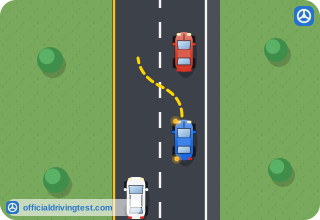
Why should you not take your eyes off the road ahead for more than an instant when you check behind?
- Your side mirrors could lose their adjustment
- A traffic signal ahead could change without warning
- The vehicle ahead could stop suddenly while you are checking
- The driver behind you could pass at once
Show answer
Correct answer: The vehicle ahead could stop suddenly while you are checking
The manual says the vehicle ahead of you could stop suddenly while you are checking behind.
Source: Maine Driver’s License Manual (Rev 4/24), page 7-4 · Open this page in the manual (Manual page 7-4)
-
Why should you check all lanes before changing lanes?
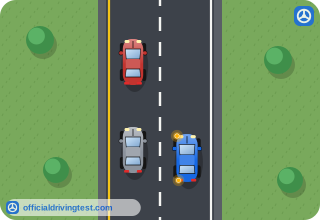
- Someone in another lane may plan to move into the same spot
- Vehicles in the far lanes have the right-of-way over you
- Other lanes always move faster than your own
- Each lane has its own posted speed limit
Show answer
Correct answer: Someone in another lane may plan to move into the same spot
The manual says someone in another lane may plan to move into the same spot you do.
Source: Maine Driver’s License Manual (Rev 4/24), page 7-4 · Open this page in the manual (Manual page 7-4)
-
What must you do whenever you pass another car on a two-lane road?
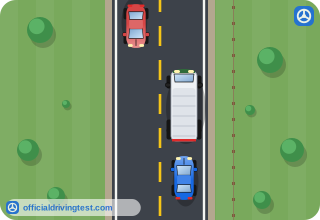
- Enter a lane that belongs to oncoming cars
- Use the right shoulder to go around
- Stay in your lane and speed up
- Slow below the speed of the car ahead first
Show answer
Correct answer: Enter a lane that belongs to oncoming cars
The manual says passing on a two-lane road means entering a lane that belongs to oncoming cars.
Source: Maine Driver’s License Manual (Rev 4/24), page 7-6 · Open this page in the manual (Manual page 7-6)
-
At highway speeds of 50 to 55 mph, how much time do you need to complete a pass safely?
- 2 to 3 seconds
- 5 to 6 seconds
- 10 to 12 seconds
- 15 to 18 seconds
Show answer
Correct answer: 10 to 12 seconds
The manual says you need from 10 to 12 seconds to complete a pass safely at 50 to 55 mph.
Source: Maine Driver’s License Manual (Rev 4/24), page 7-6 · Open this page in the manual (Manual page 7-6)
-
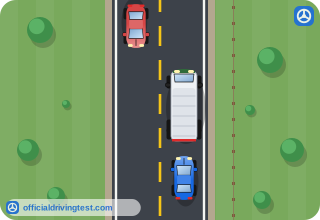
You must judge whether you have enough room to pass whenever you approach which of these?
- A sign beside the road
- A hill or a curve
- A solid white edge line
- A long, straight, empty road
Show answer
Correct answer: A hill or a curve
The manual says to judge room to pass when approaching an oncoming car, a hill or a curve, an intersection, or a roadway obstruction.
Source: Maine Driver’s License Manual (Rev 4/24), page 7-6 · Open this page in the manual (Manual page 7-6)
-
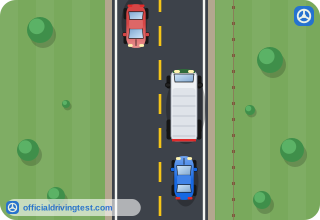
Into which lane do you steer when you pass another car on a two-lane road?
- The right lane
- The shoulder
- The center turn lane
- The passing (left) lane
Show answer
Correct answer: The passing (left) lane
The manual says to steer into the passing (left) lane.
Source: Maine Driver’s License Manual (Rev 4/24), page 7-6 · Open this page in the manual (Manual page 7-6)
-
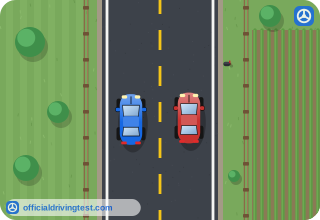
What should you do before returning to the right lane after passing?
- Flash your high beams and move over
- Brake sharply and move over
- Signal and check over your shoulder
- Speed up and move over at once
Show answer
Correct answer: Signal and check over your shoulder
The manual says to signal and check over your shoulder before returning to the right lane.
Source: Maine Driver’s License Manual (Rev 4/24), page 7-6 · Open this page in the manual (Manual page 7-6)
-
What should you do when another vehicle is passing you?
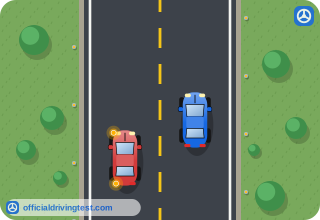
- Hold a steady speed and stay in your lane
- Drift toward the center line to block it
- Flash your headlights to warn the driver
- Speed up to keep pace with it
Show answer
Correct answer: Hold a steady speed and stay in your lane
The manual says to stay in your lane and hold a steady speed to allow the pass to occur.
Source: Maine Driver’s License Manual (Rev 4/24), page 7-7 · Open this page in the manual (Manual page 7-7)
-
If the vehicle passing you decides to drop back behind you, what may you need to do?
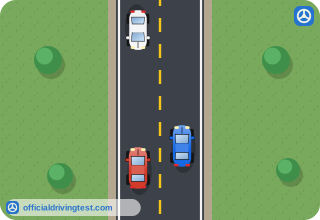
- Brake hard to let it back in
- Move onto the shoulder
- Stop and wait for the oncoming vehicle
- Speed up before an oncoming vehicle arrives
Show answer
Correct answer: Speed up before an oncoming vehicle arrives
The manual says you may need to speed up before an oncoming vehicle arrives if the passing vehicle drops back behind you.
Source: Maine Driver’s License Manual (Rev 4/24), page 7-7 · Open this page in the manual (Manual page 7-7)
-
At highway speeds, how far will you travel in 10 to 12 seconds?
- About 400 feet
- Over 800 feet
- About 1,200 feet
- About 200 feet
Show answer
Correct answer: Over 800 feet
The manual says that at highway speeds you will travel over 800 feet in 10 to 12 seconds.
Source: Maine Driver’s License Manual (Rev 4/24), page 7-7 · Open this page in the manual (Manual page 7-7)
-
At highway speeds, about how much distance do you need to pass safely when there is an oncoming vehicle?
- About 400 feet, or one-twelfth of a mile
- Over 1,600 feet, or about one-third of a mile
- About 1,000 feet, or one-fifth of a mile
- About 2,500 feet, or half a mile
Show answer
Correct answer: Over 1,600 feet, or about one-third of a mile
The manual says you need over 1,600 feet, or about one-third of a mile, to pass safely because the oncoming car also travels over 800 feet.
Source: Maine Driver’s License Manual (Rev 4/24), page 7-7 · Open this page in the manual (Manual page 7-7)
-
What can you use to get to know what a distance of one-third of a mile looks like?
- Your speedometer
- Your rearview mirror
- A stopwatch
- Your odometer
Show answer
Correct answer: Your odometer
The manual says to use your odometer to get to know what the distance looks like.
Source: Maine Driver’s License Manual (Rev 4/24), page 7-7 · Open this page in the manual (Manual page 7-7)
-
Why is it risky to judge an oncoming car or motorcycle one-third of a mile away?
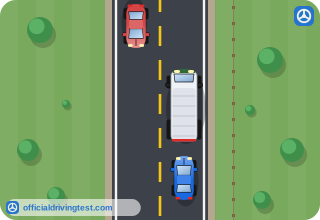
- It does not seem to be coming as fast as it really is
- It seems to be coming faster than it really is
- It cannot be seen at all in daylight
- It is always hidden in your blind spot
Show answer
Correct answer: It does not seem to be coming as fast as it really is
The manual says oncoming vehicles far away do not seem to be coming as fast as they really are, and a car far enough away seems to be standing still.
Source: Maine Driver’s License Manual (Rev 4/24), page 7-7 · Open this page in the manual (Manual page 7-7)
-
If your view is blocked by a curve or a hill, what should you assume?
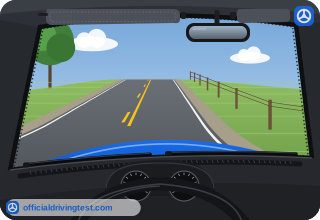
- The road ahead is clear
- Oncoming cars will slow down for you
- There is an oncoming car just out of sight
- A passing zone begins at the top
Show answer
Correct answer: There is an oncoming car just out of sight
The manual says to assume there is an oncoming car just out of sight and to treat a curve or a hill as you would an oncoming car.
Source: Maine Driver’s License Manual (Rev 4/24), page 7-7 · Open this page in the manual (Manual page 7-7)
-
Within what distance of a hill or curve should you not start to pass?
- One-third of a mile
- One-tenth of a mile
- One-half of a mile
- One mile
Show answer
Correct answer: One-third of a mile
The manual says not to start to pass if you are within one-third of a mile of a hill or curve.
Source: Maine Driver’s License Manual (Rev 4/24), page 7-7 · Open this page in the manual (Manual page 7-7)
-
Why is passing dangerous at intersections, crossroads and shopping center entrances?
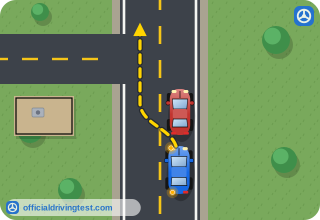
- The lanes at these places are always much narrower
- Traffic signals at these places change too quickly
- The car you pass blocks your view of people and cars
- Other drivers cannot see your turn signal at all
Show answer
Correct answer: The car you pass blocks your view of people and cars
The manual says that while passing, your view of people and cars is blocked by the car you are passing.
Source: Maine Driver’s License Manual (Rev 4/24), page 7-7 · Open this page in the manual (Manual page 7-7)