Maine: Pedestrians
Yielding to pedestrians at crosswalks and turns, and visually impaired pedestrians with a white cane or guide dog. Split into 2 shorter tests so you're not stuck in one long quiz.
Independent educational site · not affiliated with any government agency or DMV
Choose a part
Pedestrians — Part 1
Questions in this part include: “The manual's list of when to yield to waiting pedestrians includes which situation?”
StartPedestrians — Part 2
Questions in this part include: “What is the fine range for an operator who fails to yield the right-of-way to a visually impaired pedestrian?”
StartAll 36 Pedestrians questions with answers
Choose a part above to take a practice test, or study every question and answer here.
Show the questions and answersHide the questions
-
What must you do about a vehicle that has stopped for pedestrians in a crosswalk?
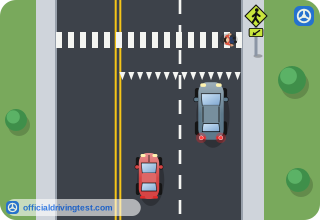
- Pass it on the right side only
- Pass it slowly while sounding your horn
- Pass it if no oncoming traffic is in sight
- Do not pass the stopped vehicle
Show answer
Correct answer: Do not pass the stopped vehicle
Do not pass any vehicle that has stopped for pedestrians in a crosswalk.
Source: Maine Driver’s License Manual (Rev 4/24), page 6-2 · Open this page in the manual (Manual page 6-2)
-
The manual's list of when to yield to waiting pedestrians includes which situation?
- Only when a police officer is directing traffic
- Only when the pedestrians are children
- Only when it is dark
- At an intersection with no traffic lights or police
Show answer
Correct answer: At an intersection with no traffic lights or police
You yield to pedestrians in a marked crosswalk when there are no traffic lights or police at the intersection.
Source: Maine Driver’s License Manual (Rev 4/24), page 6-2 · Open this page in the manual (Manual page 6-2)
-
When a car is turning a corner and the pedestrians are crossing with the light, what must the driver do?
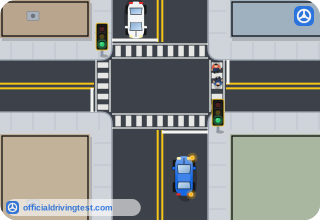
- Yield the right-of-way to the pedestrians
- Go first, because the car is already moving
- Go first if the turn signal is on
- Honk and continue slowly
Show answer
Correct answer: Yield the right-of-way to the pedestrians
A driver turning a corner must yield the right-of-way to waiting pedestrians who are crossing with the light.
Source: Maine Driver’s License Manual (Rev 4/24), page 6-2 · Open this page in the manual (Manual page 6-2)
-
Cars coming out of a driveway or alley must wait for whom?
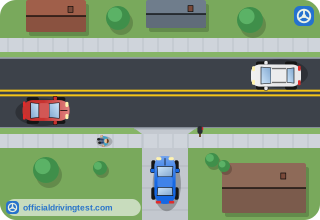
- Only vehicles on the public way
- Only pedestrians on the sidewalk
- Pedestrians and traffic
- Only vehicles coming from the left
Show answer
Correct answer: Pedestrians and traffic
Cars coming out of a driveway or alley must wait for pedestrians and traffic.
Source: Maine Driver’s License Manual (Rev 4/24), page 6-2 · Open this page in the manual (Manual page 6-2)
-
When must you yield the right-of-way to school children crossing a street?
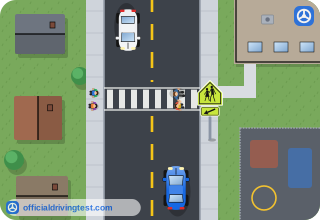
- Only in a school zone
- Always
- Only when a crossing guard is present
- Only during school hours
Show answer
Correct answer: Always
The manual says to always yield the right-of-way to school children crossing a street.
Source: Maine Driver’s License Manual (Rev 4/24), page 6-2 · Open this page in the manual (Manual page 6-2)
-
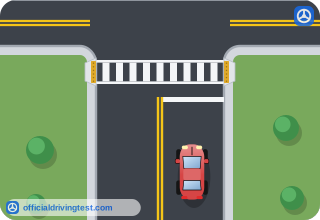
What do crosswalks show?
- Where vehicles may park along the road
- Where drivers should pass
- Where school zones begin
- Where pedestrians may cross the road
Show answer
Correct answer: Where pedestrians may cross the road
Crosswalks show where pedestrians may cross the road.
Source: Maine Driver’s License Manual (Rev 4/24), page 6-11 · Open this page in the manual (Manual page 6-11)
-
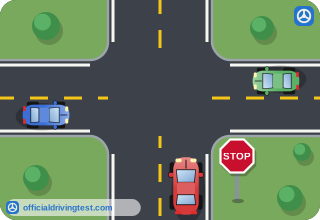
Where must you stop when crosswalks are not marked at an intersection?
- At least 30 feet back from the edge of the intersection
- Before the intersection, close enough to see approaching traffic
- In the middle of the intersection
- At the corner of the nearest building
Show answer
Correct answer: Before the intersection, close enough to see approaching traffic
If crosswalks are not marked, you must stop before the intersection close enough to see approaching traffic.
Source: Maine Driver’s License Manual (Rev 4/24), page 6-11 · Open this page in the manual (Manual page 6-11)
-
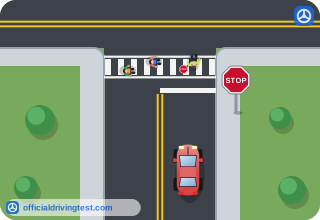
At an intersection there is a stop line before the crosswalk. Where must you stop?
- In the crosswalk
- Past the crosswalk
- At the stop line
- At the far edge of the intersection
Show answer
Correct answer: At the stop line
If there is a stop line before the crosswalk, you must stop at the stop line.
Source: Maine Driver’s License Manual (Rev 4/24), page 6-11 · Open this page in the manual (Manual page 6-11)
-
How are crosswalks often marked?
- With red or green lines
- With blue or orange lines
- With black lines only
- With yellow or white lines
Show answer
Correct answer: With yellow or white lines
Crosswalks are often marked with yellow or white lines, and there may be warning signs.
Source: Maine Driver’s License Manual (Rev 4/24), page 6-11 · Open this page in the manual (Manual page 6-11)
-
Where are most crosswalks located?
- At intersections
- Only near traffic signals
- Only near schools
- Only on divided highways
Show answer
Correct answer: At intersections
Most crosswalks are at intersections, but sometimes they are in the middle of a block.
Source: Maine Driver’s License Manual (Rev 4/24), page 6-11 · Open this page in the manual (Manual page 6-11)
-
Where may school zones be found?
- Only in town, near large buildings
- In the country as well as in town
- Only on divided highways
- Only on one-way streets
Show answer
Correct answer: In the country as well as in town
You should be alert for school zones in the country as well as in town.
Source: Maine Driver’s License Manual (Rev 4/24), page 6-11 · Open this page in the manual (Manual page 6-11)
-
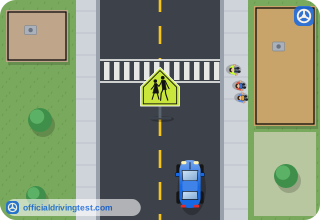
What must you do when a school crossing guard directs you?
- Slow down and keep going
- Sound your horn
- Stop
- Go around the guard
Show answer
Correct answer: Stop
You must stop when the school crossing guard directs you.
Source: Maine Driver’s License Manual (Rev 4/24), page 6-11 · Open this page in the manual (Manual page 6-11)
-
What should you always do for schoolchildren crossing the street?
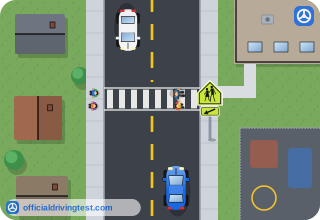
- Sound your horn to warn them
- Pass them before they step into the road
- Flash your headlights
- Yield the right-of-way
Show answer
Correct answer: Yield the right-of-way
You should always yield the right-of-way to any schoolchildren crossing the street.
Source: Maine Driver’s License Manual (Rev 4/24), page 6-11 · Open this page in the manual (Manual page 6-11)
-
Why are stop lines usually painted on the roadway a distance from an intersection?
- To give pedestrians a walkway in front of stopped cars
- To mark where cars may wait in line to park at the curb
- To mark where passing begins
- To show the edge of the lane
Show answer
Correct answer: To give pedestrians a walkway in front of stopped cars
Stop lines are painted at a distance from the intersection to give pedestrians a walkway in front of stopped cars.
Source: Maine Driver’s License Manual (Rev 4/24), page 6-12 · Open this page in the manual (Manual page 6-12)
-
When you are turning a corner on a green light, what should you remember about pedestrians?
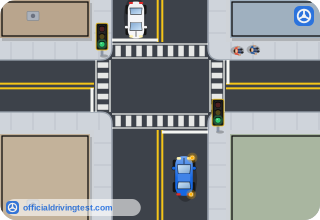
- The light is always red for them
- The light may also be green for them
- They must wait for you to pass
- They may not cross until you signal
Show answer
Correct answer: The light may also be green for them
If you have a green light, the light may also be green for pedestrians, so you must watch for people about to cross.
Source: Maine Driver’s License Manual (Rev 4/24), page 6-12 · Open this page in the manual (Manual page 6-12)
-
To whom must you yield when turning a corner?
- Only pedestrians who are crossing in a marked crosswalk
- Only pedestrians who have a signal
- Pedestrians in a crosswalk, marked or unmarked
- Only children
Show answer
Correct answer: Pedestrians in a crosswalk, marked or unmarked
You must yield to pedestrians in a crosswalk, marked or unmarked.
Source: Maine Driver’s License Manual (Rev 4/24), page 6-12 · Open this page in the manual (Manual page 6-12)
-
What does a person who is blind or visually impaired and uses a white cane or a guide dog always have?
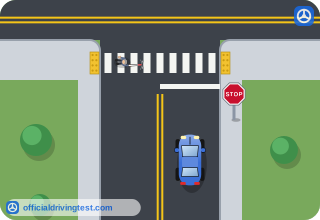
- A separate signal to wait for
- A requirement to yield to vehicles
- The right of way only at crosswalks
- The right of way
Show answer
Correct answer: The right of way
A visually impaired person with a white cane or guide dog always has the right of way.
Source: Maine Driver’s License Manual (Rev 4/24), page 6-12 · Open this page in the manual (Manual page 6-12)
-
If you see anyone in the roadway with a white cane or guide dog, how far away must you stop at least?
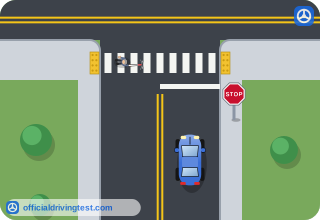
- 3 feet
- 10 feet
- 20 feet
- 50 feet
Show answer
Correct answer: 10 feet
You must stop at least 10 feet away and wait until the person is out of danger.
Source: Maine Driver’s License Manual (Rev 4/24), page 6-12 · Open this page in the manual (Manual page 6-12)
-
After stopping for a person with a white cane or guide dog, how long must you wait?
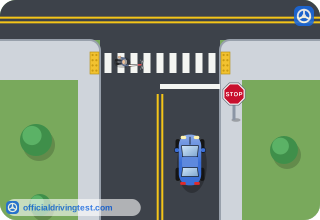
- Until the person reaches the curb you are on
- Until the person waves you on
- Until the person is out of danger
- For 30 seconds
Show answer
Correct answer: Until the person is out of danger
You should stop at least 10 feet away and wait until the person is out of danger.
Source: Maine Driver’s License Manual (Rev 4/24), page 6-12 · Open this page in the manual (Manual page 6-12)
-
What is the fine range for an operator who fails to yield the right-of-way to a visually impaired pedestrian?
- A minimum of $50 and a maximum of $1,000
- A minimum of $25 and a maximum of $100
- A minimum of $100 and a maximum of $5,000
- A flat fine of $250
Show answer
Correct answer: A minimum of $50 and a maximum of $1,000
Failing to yield to a visually impaired pedestrian is a traffic infraction with a minimum $50 and maximum $1,000 fine.
Source: Maine Driver’s License Manual (Rev 4/24), page 6-12 · Open this page in the manual (Manual page 6-12)
-
What should you check before slowing or stopping for pedestrians?
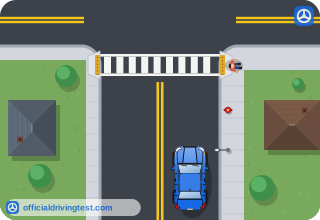
- The traffic behind you
- The signal on the next corner
- Your tire pressure
- The speedometer only
Show answer
Correct answer: The traffic behind you
Slowing or stopping for pedestrians is one of the situations when you need to check behind before slowing.
Source: Maine Driver’s License Manual (Rev 4/24), page 8-4 · Open this page in the manual (Manual page 8-4)
-
A person is crossing the street in a marked crosswalk. What must you do?
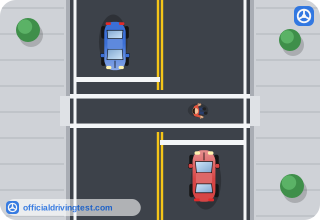
- Yield the right-of-way to the person
- Sound your horn and keep moving slowly
- Pass the person before they reach your lane
- Slow down but proceed if the person is far away
Show answer
Correct answer: Yield the right-of-way to the person
Maine drivers must yield the right-of-way to any person crossing the street in a marked crosswalk.
Source: Maine Driver’s License Manual (Rev 4/24), page 10-1 · Open this page in the manual (Manual page 10-1)
-
What does the manual say about pedestrians who are not in a crosswalk?
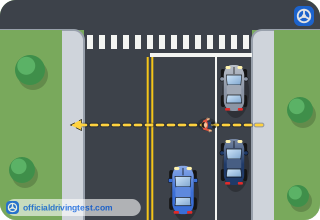
- They must yield to all vehicles
- They have no right-of-way outside a crosswalk
- Always yield to them
- Yield to them only if they are children
Show answer
Correct answer: Always yield to them
The manual says to always yield to pedestrians even if they are not in a crosswalk.
Source: Maine Driver’s License Manual (Rev 4/24), page 10-1 · Open this page in the manual (Manual page 10-1)
-
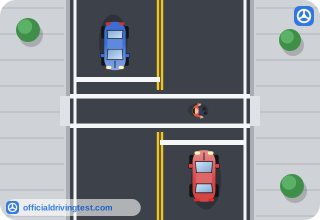
When traffic-control devices are not in operation, who must yield to a pedestrian crossing within a marked crosswalk?
- The pedestrian
- The vehicle operator
- Whoever reaches the crosswalk first
- The operator with the most passengers
Show answer
Correct answer: The vehicle operator
When traffic-control devices are not in operation, an operator must yield the right-of-way to a pedestrian crossing within a marked crosswalk.
Source: Maine Driver’s License Manual (Rev 4/24), page 10-1 · Open this page in the manual (Manual page 10-1)
-
What does the manual say about mid-block crosswalks?
- They are always marked with flashing lights
- They are found only next to schools
- Pedestrians crossing at them must yield to traffic
- They may not be marked by warning signs and road markings
Show answer
Correct answer: They may not be marked by warning signs and road markings
Pedestrians cross at mid-block crosswalks that may not be marked by warning signs and road markings, so a driver must stay aware of them.
Source: Maine Driver’s License Manual (Rev 4/24), page 10-1 · Open this page in the manual (Manual page 10-1)
-
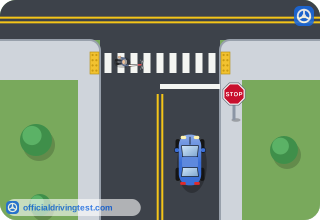
A pedestrian is crossing the street with a guide dog or carrying a white cane. What must you do?
- Come to a complete stop
- Slow down and pass behind the pedestrian
- Sound your horn to warn the pedestrian
- Stop only if the pedestrian is in a crosswalk
Show answer
Correct answer: Come to a complete stop
When a pedestrian is crossing a street with a guide dog or carrying a white cane, you must come to a complete stop.
Source: Maine Driver’s License Manual (Rev 4/24), page 10-1 · Open this page in the manual (Manual page 10-1)
-
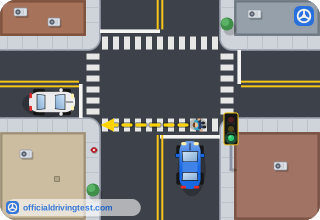
Which statement about pedestrians and a green traffic light is correct?
- A green light gives drivers the right-of-way over pedestrians
- Drivers must yield only when the light is red or yellow
- Drivers must yield to pedestrians even if the light is green
- Drivers must yield only to pedestrians in marked crosswalks
Show answer
Correct answer: Drivers must yield to pedestrians even if the light is green
The manual says to yield to all pedestrians even if the traffic light is green.
Source: Maine Driver’s License Manual (Rev 4/24), page 10-1 · Open this page in the manual (Manual page 10-1)
-
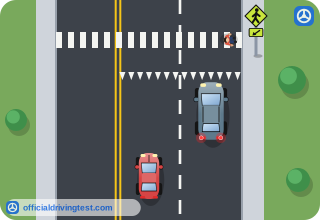
A vehicle ahead in the next lane has stopped to let a pedestrian cross in a crosswalk. What must you not do?
- Stop behind that vehicle
- Overtake or pass that vehicle
- Check for pedestrians ahead
- Stay in your own lane
Show answer
Correct answer: Overtake or pass that vehicle
You must not overtake or pass other vehicles stopped or slowing to yield to pedestrians in a crosswalk.
Source: Maine Driver’s License Manual (Rev 4/24), page 10-1 · Open this page in the manual (Manual page 10-1)
-
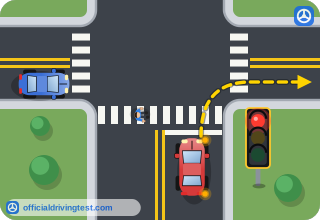
When you make a right or left turn on red, what must you do about pedestrians?
- Sound your horn so they wait
- Go first because you have already stopped
- Yield only to pedestrians who are in a crosswalk
- Yield to pedestrians
Show answer
Correct answer: Yield to pedestrians
When making a right or left turn on red, you must yield to pedestrians.
Source: Maine Driver’s License Manual (Rev 4/24), page 10-1 · Open this page in the manual (Manual page 10-1)
-
Where is it especially important to check for pedestrians before you back up?
- In parking lots
- On freeway entrance ramps
- On open rural highways
- Near railroad crossings
Show answer
Correct answer: In parking lots
The manual tells drivers to check for pedestrians before backing, especially in parking lots.
Source: Maine Driver’s License Manual (Rev 4/24), page 10-1 · Open this page in the manual (Manual page 10-1)
-
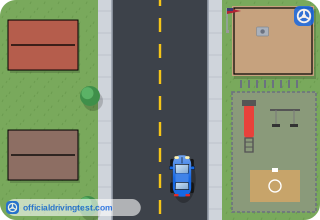
Why should you slow down near playgrounds and in residential areas?
- Police patrol these areas more often
- Traffic lights there change more quickly
- Children can run out from between parked vehicles
- Bicyclists are not allowed on those streets
Show answer
Correct answer: Children can run out from between parked vehicles
Children can run out from between parked vehicles, so a driver must be ready to stop quickly.
Source: Maine Driver’s License Manual (Rev 4/24), page 10-1 · Open this page in the manual (Manual page 10-1)
-
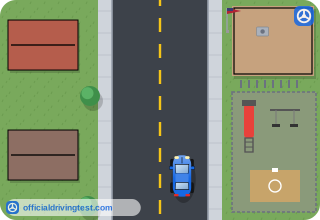
When must you obey the slower speed limit in a school zone?
- Only when a crossing guard is on duty during the school day
- When lights are flashing or children are present outside
- Only when a school bus is loading or unloading students
- Only when the road has a marked crosswalk at the school
Show answer
Correct answer: When lights are flashing or children are present outside
In a school zone you must obey a slower speed limit when lights are flashing or children are present outside.
Source: Maine Driver’s License Manual (Rev 4/24), page 10-1 · Open this page in the manual (Manual page 10-1)
-
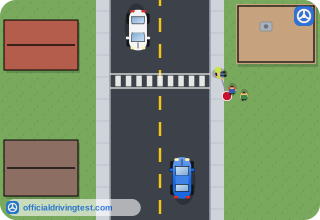
What must you do at a school crossing that has a crossing guard?
- Slow down and pass if no child is in your lane
- Continue at normal speed unless a child steps out
- Stop only when the guard faces your lane
- Stop and yield as signaled
Show answer
Correct answer: Stop and yield as signaled
At school crossings where there is a crossing guard you must stop and yield as signaled.
Source: Maine Driver’s License Manual (Rev 4/24), page 10-1 · Open this page in the manual (Manual page 10-1)
-
When your vehicle is crossing a sidewalk, whom must you yield to?
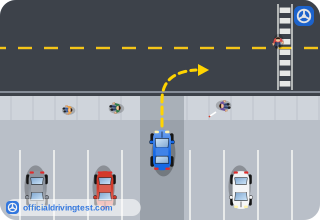
- All pedestrians and bicyclists on the sidewalk
- Only pedestrians walking toward your vehicle
- Only pedestrians, because bicyclists must yield to you
- Only children and people with disabilities
Show answer
Correct answer: All pedestrians and bicyclists on the sidewalk
When crossing a sidewalk, you must yield to all pedestrians or bicyclists on the sidewalk.
Source: Maine Driver’s License Manual (Rev 4/24), page 10-1 · Open this page in the manual (Manual page 10-1)
-
Which statement about pedestrians and bicyclists is correct even when you are obeying every other traffic law?
- Obeying the laws means you are never responsible for a collision
- Pedestrians and bicyclists must avoid you at all times
- You must still use care to avoid colliding with them
- You need to watch for them only at intersections
Show answer
Correct answer: You must still use care to avoid colliding with them
Despite all laws, you must exercise care to avoid colliding with pedestrians or bicyclists.
Source: Maine Driver’s License Manual (Rev 4/24), page 10-1 · Open this page in the manual (Manual page 10-1)
-
If a pedestrian is crossing in the middle of the street, not at a crosswalk (jaywalking), even though it is illegal, what must you do?
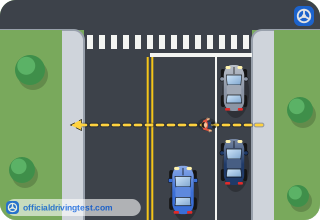
- Stop for the pedestrian
- Keep driving, because the pedestrian is breaking the law
- Honk your horn at the pedestrian
- Speed up to pass before the pedestrian reaches your lane
Show answer
Correct answer: Stop for the pedestrian
The manual answers that even when a pedestrian is jaywalking and it is illegal, you must stop for them.
Source: Maine Driver’s License Manual (Rev 4/24), page 12-2 · Open this page in the manual (Manual page 12-2)