Maine: Pedestrians — Part 2 Practice Test
Questions in this part include: “What is the fine range for an operator who fails to yield the right-of-way to a visually impaired pedestrian?” · “Where is it especially important to check for pedestrians before you back up?”
Independent educational site · not affiliated with any government agency or DMV
Ready? Test yourself
- Instant feedback with an explanation
- Every answer cites its source in the manual
- Your best score is saved on this device
Questions are original and based on the official manual "Maine Driver’s License Manual" (Rev 4/24), Maine Bureau of Motor Vehicles.
All 18 questions in this practice test
Take the test above first, then use this list to study. Tap “Show answer” to see the correct answer and explanation.
Show the questions and answersHide the questions
-
After stopping for a person with a white cane or guide dog, how long must you wait?
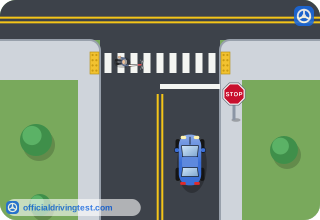
- Until the person reaches the curb you are on
- Until the person waves you on
- Until the person is out of danger
- For 30 seconds
Show answer
Correct answer: Until the person is out of danger
You should stop at least 10 feet away and wait until the person is out of danger.
Source: Maine Driver’s License Manual (Rev 4/24), page 6-12 · Open this page in the manual (Manual page 6-12)
-
What is the fine range for an operator who fails to yield the right-of-way to a visually impaired pedestrian?
- A minimum of $50 and a maximum of $1,000
- A minimum of $25 and a maximum of $100
- A minimum of $100 and a maximum of $5,000
- A flat fine of $250
Show answer
Correct answer: A minimum of $50 and a maximum of $1,000
Failing to yield to a visually impaired pedestrian is a traffic infraction with a minimum $50 and maximum $1,000 fine.
Source: Maine Driver’s License Manual (Rev 4/24), page 6-12 · Open this page in the manual (Manual page 6-12)
-
What should you check before slowing or stopping for pedestrians?
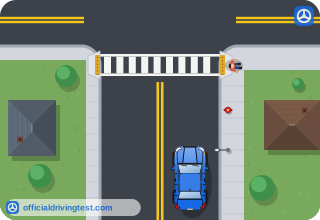
- The traffic behind you
- The signal on the next corner
- Your tire pressure
- The speedometer only
Show answer
Correct answer: The traffic behind you
Slowing or stopping for pedestrians is one of the situations when you need to check behind before slowing.
Source: Maine Driver’s License Manual (Rev 4/24), page 8-4 · Open this page in the manual (Manual page 8-4)
-
A person is crossing the street in a marked crosswalk. What must you do?
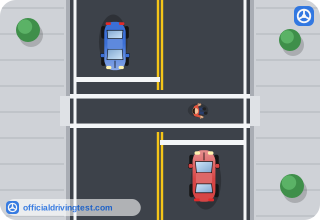
- Yield the right-of-way to the person
- Sound your horn and keep moving slowly
- Pass the person before they reach your lane
- Slow down but proceed if the person is far away
Show answer
Correct answer: Yield the right-of-way to the person
Maine drivers must yield the right-of-way to any person crossing the street in a marked crosswalk.
Source: Maine Driver’s License Manual (Rev 4/24), page 10-1 · Open this page in the manual (Manual page 10-1)
-
What does the manual say about pedestrians who are not in a crosswalk?
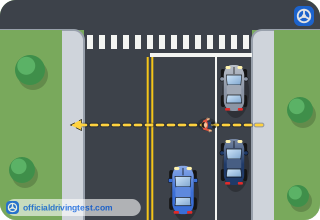
- They must yield to all vehicles
- They have no right-of-way outside a crosswalk
- Always yield to them
- Yield to them only if they are children
Show answer
Correct answer: Always yield to them
The manual says to always yield to pedestrians even if they are not in a crosswalk.
Source: Maine Driver’s License Manual (Rev 4/24), page 10-1 · Open this page in the manual (Manual page 10-1)
-
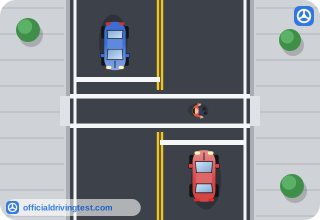
When traffic-control devices are not in operation, who must yield to a pedestrian crossing within a marked crosswalk?
- The pedestrian
- The vehicle operator
- Whoever reaches the crosswalk first
- The operator with the most passengers
Show answer
Correct answer: The vehicle operator
When traffic-control devices are not in operation, an operator must yield the right-of-way to a pedestrian crossing within a marked crosswalk.
Source: Maine Driver’s License Manual (Rev 4/24), page 10-1 · Open this page in the manual (Manual page 10-1)
-
What does the manual say about mid-block crosswalks?
- They are always marked with flashing lights
- They are found only next to schools
- Pedestrians crossing at them must yield to traffic
- They may not be marked by warning signs and road markings
Show answer
Correct answer: They may not be marked by warning signs and road markings
Pedestrians cross at mid-block crosswalks that may not be marked by warning signs and road markings, so a driver must stay aware of them.
Source: Maine Driver’s License Manual (Rev 4/24), page 10-1 · Open this page in the manual (Manual page 10-1)
-
A pedestrian is crossing the street with a guide dog or carrying a white cane. What must you do?
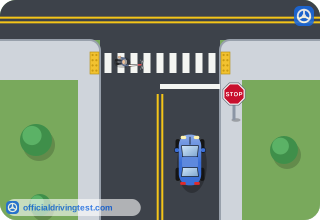
- Come to a complete stop
- Slow down and pass behind the pedestrian
- Sound your horn to warn the pedestrian
- Stop only if the pedestrian is in a crosswalk
Show answer
Correct answer: Come to a complete stop
When a pedestrian is crossing a street with a guide dog or carrying a white cane, you must come to a complete stop.
Source: Maine Driver’s License Manual (Rev 4/24), page 10-1 · Open this page in the manual (Manual page 10-1)
-
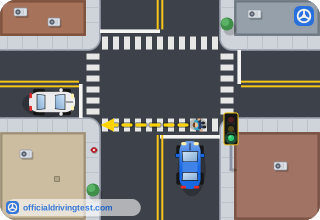
Which statement about pedestrians and a green traffic light is correct?
- A green light gives drivers the right-of-way over pedestrians
- Drivers must yield only when the light is red or yellow
- Drivers must yield to pedestrians even if the light is green
- Drivers must yield only to pedestrians in marked crosswalks
Show answer
Correct answer: Drivers must yield to pedestrians even if the light is green
The manual says to yield to all pedestrians even if the traffic light is green.
Source: Maine Driver’s License Manual (Rev 4/24), page 10-1 · Open this page in the manual (Manual page 10-1)
-
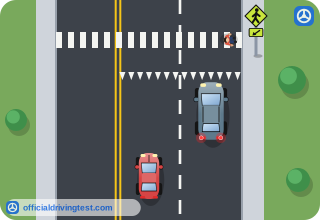
A vehicle ahead in the next lane has stopped to let a pedestrian cross in a crosswalk. What must you not do?
- Stop behind that vehicle
- Overtake or pass that vehicle
- Check for pedestrians ahead
- Stay in your own lane
Show answer
Correct answer: Overtake or pass that vehicle
You must not overtake or pass other vehicles stopped or slowing to yield to pedestrians in a crosswalk.
Source: Maine Driver’s License Manual (Rev 4/24), page 10-1 · Open this page in the manual (Manual page 10-1)
-
When you make a right or left turn on red, what must you do about pedestrians?
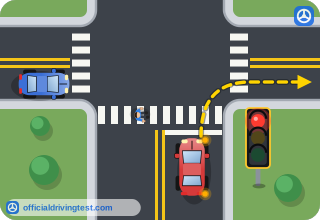
- Sound your horn so they wait
- Go first because you have already stopped
- Yield only to pedestrians who are in a crosswalk
- Yield to pedestrians
Show answer
Correct answer: Yield to pedestrians
When making a right or left turn on red, you must yield to pedestrians.
Source: Maine Driver’s License Manual (Rev 4/24), page 10-1 · Open this page in the manual (Manual page 10-1)
-
Where is it especially important to check for pedestrians before you back up?
- In parking lots
- On freeway entrance ramps
- On open rural highways
- Near railroad crossings
Show answer
Correct answer: In parking lots
The manual tells drivers to check for pedestrians before backing, especially in parking lots.
Source: Maine Driver’s License Manual (Rev 4/24), page 10-1 · Open this page in the manual (Manual page 10-1)
-
Why should you slow down near playgrounds and in residential areas?
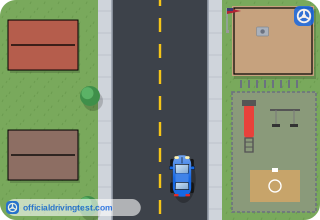
- Police patrol these areas more often
- Traffic lights there change more quickly
- Children can run out from between parked vehicles
- Bicyclists are not allowed on those streets
Show answer
Correct answer: Children can run out from between parked vehicles
Children can run out from between parked vehicles, so a driver must be ready to stop quickly.
Source: Maine Driver’s License Manual (Rev 4/24), page 10-1 · Open this page in the manual (Manual page 10-1)
-
When must you obey the slower speed limit in a school zone?
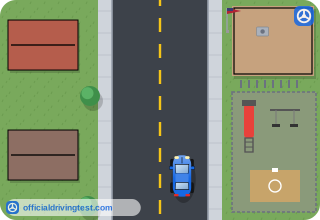
- Only when a crossing guard is on duty during the school day
- When lights are flashing or children are present outside
- Only when a school bus is loading or unloading students
- Only when the road has a marked crosswalk at the school
Show answer
Correct answer: When lights are flashing or children are present outside
In a school zone you must obey a slower speed limit when lights are flashing or children are present outside.
Source: Maine Driver’s License Manual (Rev 4/24), page 10-1 · Open this page in the manual (Manual page 10-1)
-
What must you do at a school crossing that has a crossing guard?
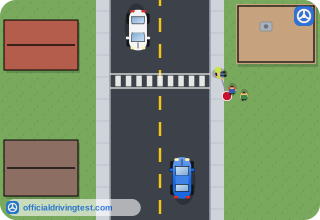
- Slow down and pass if no child is in your lane
- Continue at normal speed unless a child steps out
- Stop only when the guard faces your lane
- Stop and yield as signaled
Show answer
Correct answer: Stop and yield as signaled
At school crossings where there is a crossing guard you must stop and yield as signaled.
Source: Maine Driver’s License Manual (Rev 4/24), page 10-1 · Open this page in the manual (Manual page 10-1)
-
When your vehicle is crossing a sidewalk, whom must you yield to?
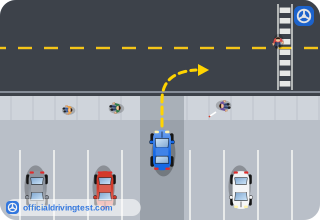
- All pedestrians and bicyclists on the sidewalk
- Only pedestrians walking toward your vehicle
- Only pedestrians, because bicyclists must yield to you
- Only children and people with disabilities
Show answer
Correct answer: All pedestrians and bicyclists on the sidewalk
When crossing a sidewalk, you must yield to all pedestrians or bicyclists on the sidewalk.
Source: Maine Driver’s License Manual (Rev 4/24), page 10-1 · Open this page in the manual (Manual page 10-1)
-
Which statement about pedestrians and bicyclists is correct even when you are obeying every other traffic law?
- Obeying the laws means you are never responsible for a collision
- Pedestrians and bicyclists must avoid you at all times
- You must still use care to avoid colliding with them
- You need to watch for them only at intersections
Show answer
Correct answer: You must still use care to avoid colliding with them
Despite all laws, you must exercise care to avoid colliding with pedestrians or bicyclists.
Source: Maine Driver’s License Manual (Rev 4/24), page 10-1 · Open this page in the manual (Manual page 10-1)
-
If a pedestrian is crossing in the middle of the street, not at a crosswalk (jaywalking), even though it is illegal, what must you do?
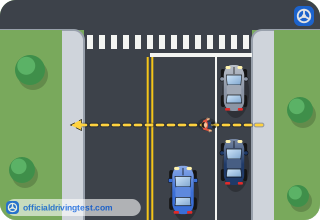
- Stop for the pedestrian
- Keep driving, because the pedestrian is breaking the law
- Honk your horn at the pedestrian
- Speed up to pass before the pedestrian reaches your lane
Show answer
Correct answer: Stop for the pedestrian
The manual answers that even when a pedestrian is jaywalking and it is illegal, you must stop for them.
Source: Maine Driver’s License Manual (Rev 4/24), page 12-2 · Open this page in the manual (Manual page 12-2)